Week-11 Challenge: Braking
Q1. For a defined driving cycle, calculate the energy required for braking.
Ans:
At first the drive cycle is defined in an excel sheet and a plot is made. Using the plot, the values from the braking regions of the vehicle are taken. The plot of the drive cycle is given below.
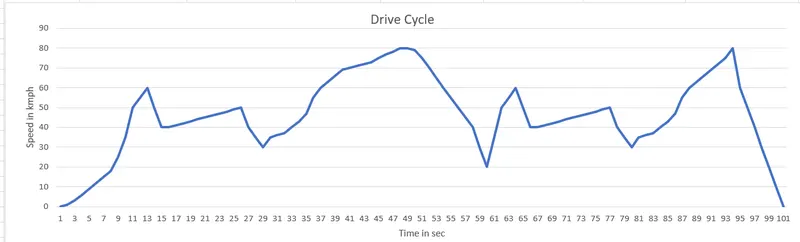
From the plot it is seen that, it consist of 6 braking regions. The initial and final values of the velocities are as given below.
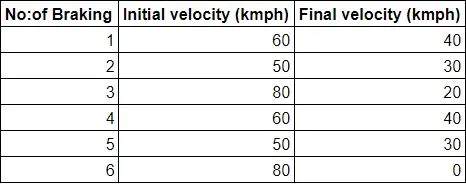
The above values are used to calculate the energy required using the formula
E = 0.5*m*(vi - vf)^2
where, m = Mass of the vehicle in (Kg) = 1000 kgs
vi = Initial velocity of vehicle in (m/s)
vf = Final velocity of the vehicle in (m/s)
With the above values the deceleration values and total braking energy requiment of the vehicle are calculated using the excel calculator. The calculations are as given below given below.

The total braking energy required = 0.068 KWh
Q2. Why electric motor can’t develop braking torque at high speed similar to starting? How electric and mechanical brakes are coordinated?
Ans:
This situation occurs only when the vehicle is at high speeds because the motor will be running at the constant power region. In the constant power region the torque of the motor reduces and so the motor cannot develop the braking torque which is equal to the torque occured during low speed at the constant torque region.
The torque vs speed plot of a vector control induction motor is given below.
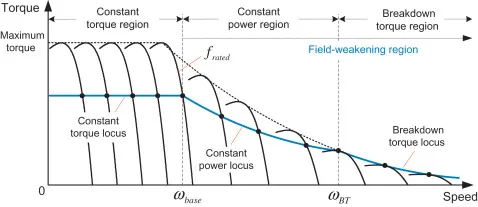
From the above characteristic curves of the motor it is seen that, the torque of the motor remains high at low speeds and reduces as the speed increases.
Therefore electric motor cannot develop braking torque at high speed similar to starting.
Electrical braking
Electrical braking can be done by many methods such as,
- Unblancing the input phases of current to the motor.
- Using transistors in H-bridge configuration to reverse the motor direction in order to reduce speed.
- Implimenting regenerative braking system by using bi-directional power converters. Regenerative braking converts much of the energy to electrical energy, which may be stored for later use.
Mechanical braking
Mechanical brakes commonly use friction between two surfaces pressed together to convert the kinetic energy of the moving object into heat, though other methods of energy conversion may be employed. The friction between the surfaces are produced using pressurized air or pressurized oil which are commonly known as air brake and hydraulic brake respectively.
Coordination of electrical and mechanical braking in EV
Two types of brake control strategies are used to coordinate the electrical brake and mechanical brake they are,
- Series control strategy
- Parallel control strategy
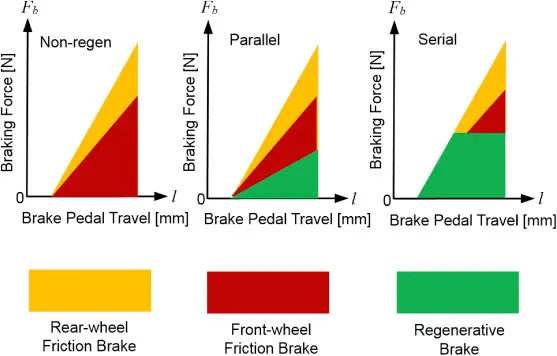
The comparison of the control strategies are shown in the below figure.
In the figure it is seen that, according to the amount of brake pedal travel of the vehicle, the mechanical brakes and regenerative brake are applied.
Parallel control strategy
When the brake is applied according to the brake pedal travel the front wheel friction brake, the rear wheel friction brakes and the regenerative brakes are applied simultameously. The higher the travel of the brake pedal the higher the amount of braking will be done.
The braking energy is distributed in the following manner,
Rear wheel friction brake > Front wheel friction brake > Regenerative brake
Series control strategy
When the brake is applied according to the brake pedal travel the front wheel friction brake, the rear wheel friction brakes and the regenerative brakes are applied one after another. As the braking requirement increases the frictional brakes are used accordingly.
For low speeds of the vehicle, regenerative braking is used but it may be limited according to the SOC (state of charge) of the battery.
As the speed of the vehicle increases the rear wheel frictional brake will be applied, if the braking requirement in not satisfied yet then the front wheel frictional brake is also used.
The coordination of the series control braking can be done with preference to comfort of braking (or) energy storage.
Q3. Make a MATLAB program which plots contour of given motor speed, torque and efficiency values. Attach the code as a .m file attach a screenshot of all the plots.
Ans:
Inputs considered
Motor speed (W) = 1 to 1000 rad/s
Torque (T) = 1 to 250 Nm
Copper loss constant (Kc) = 0.2
Iron loss constant (Ki) = 0.008
Windage loss constant (Kw) = 0.00001
Constant loss = 20
Formule used
- Tl = CL+IL+WL+C
where, Tl = Total loss in motor
CL = Copper loss in motor
IL = Iron loss in motor
WL = Windage loss in motor
C = Constant loss of the motor
- CL = Kc*(T^2)
- IL = Ki*(W)
- WL = Kw*(W^3)
where, W = speed of the motor in rad/s
T = Torque of the motor in N-m
- Output power = W*T
- Input power = output power + Tl
- Efficiency = Output power/Input power
M-Scirpt:
%%MATLAB program which plots contour of given motor speed, torque and efficiency values%%
clear all
close all
clc

% Speed and torque inputs
W = linspace(1,1000); %speed of the motor
T = linspace(1,250);  %torque of the motor
[W,T]=meshgrid(W,T);

% Constants
Kc = 0.2;  %Copper loss constant
Ki = 0.008;  %Iron loss constant
Kw = 0.00001;  %Windage loss constant


% Calculating losses in a motor
CL = Kc*(T.^2); %Copper loss in motor
IL = Ki*(W);    %Iron loss in motor
WL = Kw*(W.^3);  %Wintage loss in motor
C = 20;  %Constant losses in motor

% Total loss in the motor
Tl = CL+IL+WL+C;

% Power calculations
P_out = W.*T;
P_in = P_out+Tl;

% Efficiency
Z = P_out./P_in;
V = [0.70,0.75,0.80,0.85,0.90,0.91,0.92,0.93]; %Efficiency points for contour plot

% Contour plot
contourf(W,T,Z,V)
colorbar
box off
grid off
title ('Contour plot motor speed, torque and efficiency values');
xlabel ('Speed in (rad/s)');
ylabel ('Torque in (N-m)');
Result:
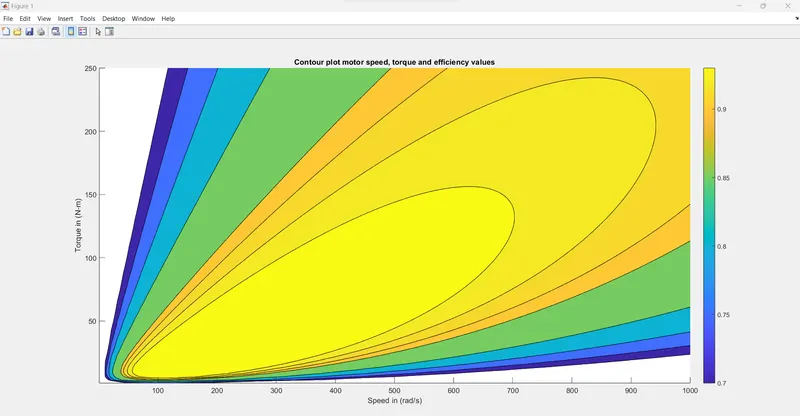
From the plot it is seen that, as the speed and torque of the motor changes the efficiency changes accordingly. With increasing efficiency order as going inward and decreasing efficiency order as going outward.