Week-6 Challenge: EV Drivetrain
Challenge 1-
In electric vehicle, batteries super capacitor and fuel cells are used to store electrical energy and it uses AC or DC motor based on requirements. this motors are powering the vehicle through power train and for supplying electricity from storage element to motor, different power converters are used like
DC-DC converter (chopper)
DC-AC converter (inverter)
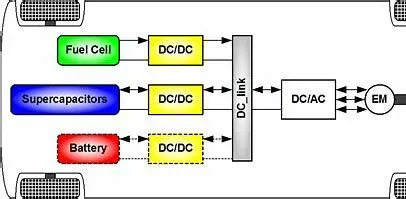
input DC are fixed as battery are only design for giving DC input. and choppers are used for DC-DC conversion and usually Variable frequency drive is used for DC-AC inverter.
In hybrid electric vehicle, the power sharing devices can be IC engine, generator and motor and this generator and motor are connected with battery by a converter that is totally depends on the nature of the machine. battery storage element are usually DC in nature, whereas Generator and motor can be AC or DC in nature according to the design of the vehicle.
So considering all possibilities the converter in hybrid vehicle can be classified in two ways
DC-DC converter (chopper)
DC-AC converter (inverter)
all the converters in both EV and HEV is operational in all four coderant for effective forward motoring, forward braking and regenerative braking and reverse motoring.
Challenge 2-
given that-
battery voltage =72
rated armature voltage=72
Ra=0.5
`kphi=0.7`
and motor torque equation
`T=24.7-0.0051omega^2` ..............(1)
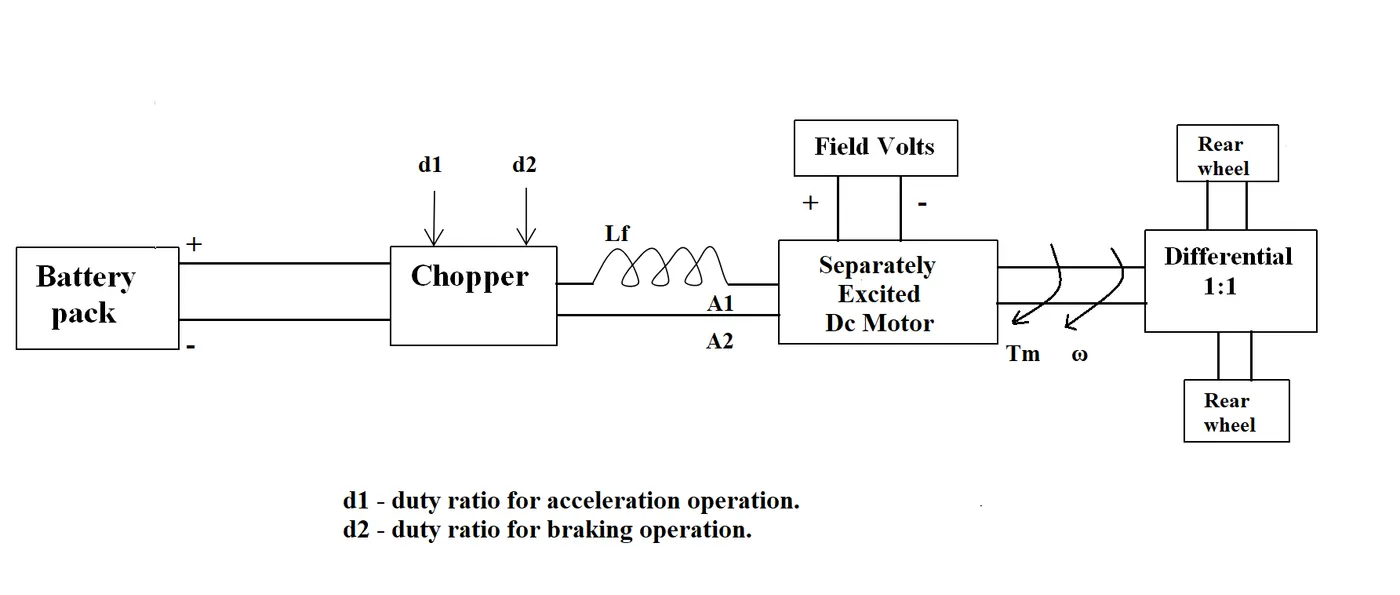
duty cycle for this specific case is 70% so the averqage voltage output of the chopper is gonna be..
`Vo=70/100xx72`
`Vo=50.4`volts
and we know that speed of seperately excited DC motor is given by
`omega =v/(kphi)-Ra/(kphi)^2 *T`
from equation (1)
`omega =V/(kphi)-(Ra)/(kphi)^2*(24.7+(0.0051)*omega^2)`
`omega= 50.4/0.7-0.5/(0.7)^2*(24.7+0.0051omega^2)`
`omega^2+192.3omega-9000=0`
solving the equation
`omega=38.92,-231.25`
negative value of speed is not possible therefore the the steady state speed would be 38.92 radians/sec.
Challenge 3-
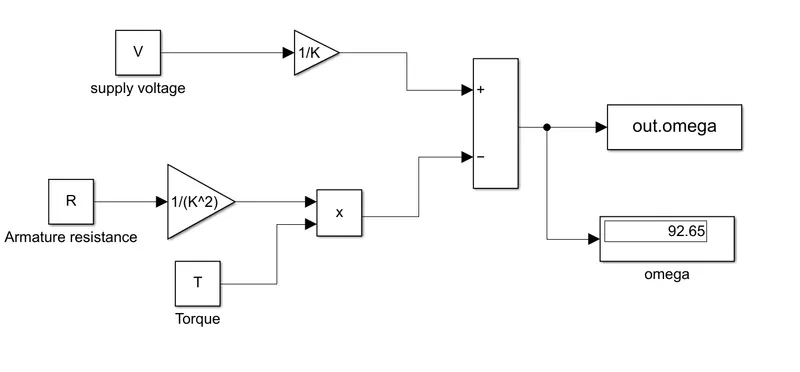
we are implementing the following equation in simulink environment
`omega=V/K-R/K^2*T`
where, `K=kphi`
we use simulation blocks like constant, gain, adder, substractor and product block and use display to show the results with an array output which is going to save in workspace.
The values of parameters are saved in model workspace
Challenge 4-
The auther of the blog is wally rippel, and after reading his blog we can conclude that wally rippel has great knowlege of different motors and inverters used in EV/HEV drives. He compare the two prominent electric motors used in automobile industries that is, brushless DC motor and Induction motor.
His view is basically application oriented, specially when it comes to select the motor for powering the vehicle. He says Brushless DC motors are most likely to use in Low power application whereas Induction motors are used where Power requirement is more and this is due to excellent design of induction motor for high power application, whereas Brushless DC motor maynot be used for high power application as Flux density due to permanentmagnet is limited and Higher core losses when we use Higher flux density machines. in addition to that Induction motor flux density can be controlled by V/f (voltage to frequency) control strategy.
He says, Both the motors have similar hardware and can be worked togather in the future. The stator of Brushless DC motor is similar to the induction motor and both requires inverter in order to drive the vehicle but rotor of the Brushless DC motor having permanent magnets and for induction motor it is solid conducting bars with laminated core. in addition the closed loop control of Induction motor gives great performance and required a speed sensor, whereas Brushless DC motor requires accurate position sensor in along with the speed sensor.