Week -2
Challenge1-
Details- In order to make an electric doorbell in Simulink environment, firstly we require a solenoid with plunger. The plunger used for making an impact on a metal bell to produce sound.
The solenoid is driven by a battery source and is connected through a controlled switch, this switch is driven by a signal builder in order to ON the switch for 2sec of time.
0 for 0-4 sec,
1 for 4-6 sec,
0 for 6-10 sec.
In last step we measure plunger movement by a ideal motion sensor and lets assume the plunger motion is associated with a plunger bell arrangement and the corresponding output drive the bell in order to produce sound, the output recorded in the scope is following-
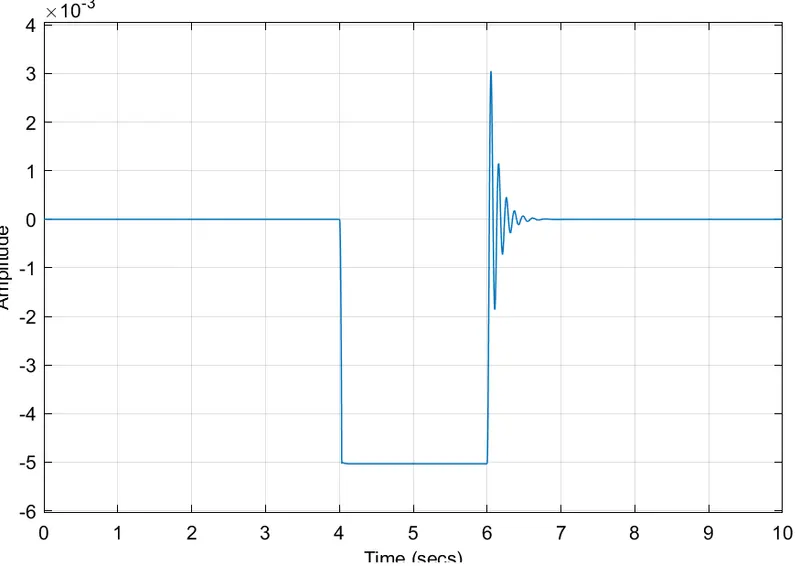
The negative motion is due to the plunger setting which can be altered by changing the supply terminal of the solenoid. Simulink file and ss is attached with this submission.
Challenge2-
Details- As per the challenge given to me, I take the case of a room fan that is a single phase induction motor type ceiling fan and a conventional room heater.
The fan is driven by a 230V AC source and controlled by a TRIAC, the control signal to this arrangement is given by a control unit which involves basic carbon resistors and a 10k thermistor and an OP-AMP comparator, the elements are very cheap and available easily.
We use a voltage divider circuit powered by a 12V battery and thermistor connected in one of the branch of the bridge, this bridge is created in such way that it is balanced when room temperature is 25°C. one side of bridge is connected to battery and the other side is given to a comparator as an input. Whenever room temperature exceeded 25°C the output of comparator is high(5V) and when it is less than 25°C then the output of comparator is low(0V).
As per instruction, the simulation run for 50 second and the input to the thermistor is given by a ideal temperature source. This temperature source is driven by a signal builder block in order to mimic the condition given in the challenge itself and this signal is in Kelvin.
20°C = 293K for 0-10 sec,
27°C = 300K for 10-30 sec
23°C = 296K for 30-50 sec
At last stage we connect a ideal torque sensor to sense the output of the motor and detect the torque supplied by motor with respect to time and the output of the torque sensor is following-
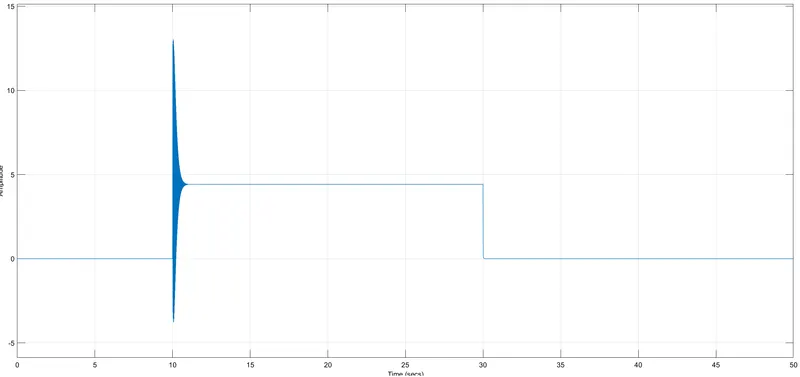
Conclusion- when room temperature exceeds 25C the torque supplied by motor is positive that indicates fan ON condtion, and when room temperature is less than 25C then torque supplied by the motor is zero, this indicates the fan OFF condition.
The model image and Simulink file is attached with the submission.