Week-6 Challenge: EV Drivetrain
1) Which types of power converter circuits are employed in electric and hybrid electric vehicle?
Power converter: It is a electric circuit that converts one form of energy to another desired form as per the load. A converter may do one or more functions and give an output which differs frm input. Increase or decrease in magnitude of voltage, change in frequency of current and many more. It can convert AC current to DC and vice-versa.
There are 3 types of power converters;
- AC to DC (rectifier)
- DC to AC (inverter)
- DC to DC (chopper)
AC to DC (rectifier): A rectifier is an electric device that converts alternating current(AC) into direct currrent(DC), which periodically reverses direction that flows in only one direction. This is known as rectification as it straightens the direction of current. Rectification is again has different types.
Types of rectifiers are:
- Bridge rectifier
- Half wave rectifier
- Full wave rectifier
Rectifiers are implemented using semiconductor devices that conditionally conducts current in only one direction, like diodes.
Example for such devices in electric vehicle is EV charger.
DC to AC(inverter): A inverter is an electric device converts direct current(DC) into alternating current(AC). These are used in electric vehicle motor that can change the speed of the motor by adjusting the frequency of the alternating current. It can aslo increase or decrease the torque power by varying the amplitude of the signal. Regardless of any motor whether the motor is synchronous, asynchronous or a dc motor,a inverter works in a similar way.
DC to DC(chopper): It is an electronics device that converts a source of DC voltage from one level to another. conversion of power ranges from very low level to very high level.
example; from batteries to high voltage power transmission.
Either way is also done, conversion from high voltage to lower DC voltage to power up the headlights, interior lights,wiper etc...in electric and HEV vehicles. These are classifeid into unidirectional and bidirectional converters. Unidirectional DC-DC converters are catagorized to various load like sensors, controls, safety equipments etc..and the Bidirectional converters are applied in places where battery charging, regenerative braking and backup power are required.
2) Given parameters of the electric vehicle,
Motor and Controller Parameters:
Rated Armature voltage= 72 V
Rated armature current= 400 A
Ra= 0.5Ω, KΦ= 0.7 Volt second
Chopper Switching frequency= 400 Hz
The vehicle speed-torque characteristics are given by the below equation: Tv=24.7+(0.0051)w^2 ----------(1)
What is EV steady state speed if duty cycle is 70%?
WKT;
T= (VK-wK²)/R
T=torque
V=armature voltage
w=angular speed
R=armature resistance
we need find V
wkt Vo=Vin*D
given duty cycle is 70%=0.7
so Vo=72*0.7
Vo=50.4V
now T=((50.4*0.7)-w*(0.7)²)/0.5
T=70.56-0.98w -----------(2)
comapring (1)&(2)
24.7+(0.0051)w² = 70.56-0.98w
0.0051w²+0.98w-45.86=0
using quadratic equation

w = (−0.98 ± √(0.982 − 4*0.0051*(-45.86c)))/2*0.0051
w=(−0.98 ±1.377)/0.0102
w=38.92rad/sec , w= -231.0784rad/sec
neglecting the negative value
w=38.92rad/sec =steady state speed at 70% of duty cycle.
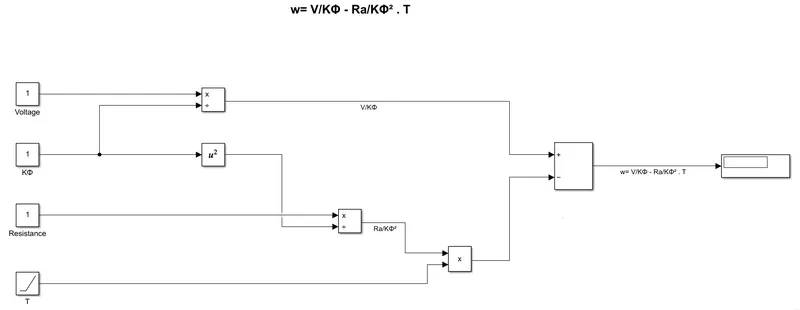
3) Develop a mathematical model of a DC Motor for the below equation using Simulink.
w= V/KΦ - Ra/KΦ² . T
4) Author's perspective on Induction vs DC Brushless motor:
Before we discuss about the blog let us know some points about the author.
Author Wally Rippel is a long time Proponent of Electric Motors. Before joining Tesla motors, he was an engineer at AeroVironment, where he helped in devlope of EV1 for General Motors. Also worked for Jet Propulsion Laboratory on research of electric vehicle battery. He also built an electric car and won the Great Transcontinental Electric Cars against MIT.
Now when we look at the blog author has proposed about the working, difference, similarities, merits and demerits of both Induction and DC motor, and also the basic construction of both induction and DC brushless motor. when we look at the author's perspective it is clear that auhtor has given a fair report on uses of both Induction and DC burshless motor in Electric vehicle for now and also in future point of view.
In DC brushless motor rotor consists of two or more permanent magnets which produces magnetic field. The magnetic field enters the stator core, intracts with current through the windings and troque is produced between stator and rotor. Results in the rotation of rotor.
In case of Induction motor rotor has no permanent magnets instead has core laminations and the stator part is idenctical in both the motors. The current flowing in stator produces rotating magnet field that enters the rotor. As said unlike DC motors, induction motor have no magnets, consists bars around them in which current gets induced and rotor starts rotating. Author mentions that a DC motor is useless without an inverter and also points that an Induction motor when operats with smart inverter has adbantages on DC motor.
The major advantage of DC motor is less generation of rotor heat, so the rotor cooling is easier and the peak point effeciency is generally high for such drive. The DC motor can operate at unity power factor, but the best power drive for induction is about 85%.
In an brushless drive, the strength of the magnetic field produced by the permanent magnet would be adjustable. when max torque is required at low speeds, magnetic field strength should be maximum so that the motor and inverter currnt are maintained at there lowest value.
In case of induction motors there is no magnets presents and B fields are adjustable since it is propotinate to voltage and frequency, which means incase of light loads inverter can reduce the voltage such that magnetic losses are reduced and efficiency is maximized.
With DC brushless, increase in size of machine proportionally increases the magnetic losses and load efficiency drops. where as in Induction grow in size of machine, losses do not necessarily grow.
The construction of DC motor is costly compared to Induction due to the use of permanent magnets.
Auhtor concludes the blog saying that there is no winner here but still DC brushless drive likely continue to dominate in hybrid and coming PHEV market, and induction drive will maintain the dominance.