Week-6 Challenge: EV Drivetrain
1)Aim:
To explain about the power converter employed in Electric vehicles and Hybrid vehicles.
Types of Power Converters:
- DC-DC Converter
- AC-DC Converter
- DC-AC Converter
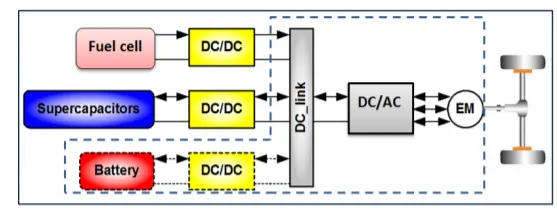
Explanation:
DC-DC Converter:
Due to the high voltage levels being produced in HEVs, it becomes essential to have DC/DC converters to supply all the auxiliary loads of the vehicle. Although the DC/DCconverter technology is well developed for low-power applications at a lower cost, much work needs to be done for high-power applications.
- Providing low voltage (12V or 14V) for low voltage loads.
- Boosting the voltage level of the battery such that it matches the level of the DC bus voltage for driving the AC motor inverter if the traction motor is an AC motor.
- Motor propulsion if the traction motor is a DC motor.
DC-AC Converter:
AC-DC Converter:
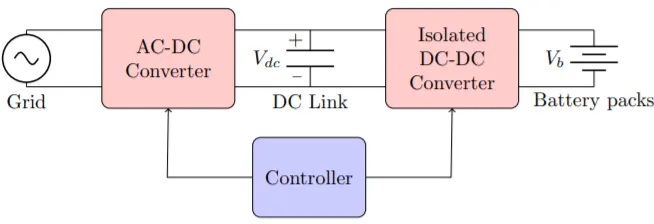
The AC-DC Converter is used to convert the AC supply from the grid or charging Station to DC Supply. The main use of this converter is for charging the battery.
2)Aim:
To calculate the steady-state speed at the given condition.
Condition:
Duty cycle=0.70
Motor and Controller Parameters:
Rated Armature voltage= 72 V
Rated armature current= 400 A
Ra= 0.5Ω, KΦ= 0.7 Volt second
Chopper Switching frequency= 400 Hz
Equation:
`T=24.7+(0.0051)*(omega)^2`-----(1)
Solution:
`omega=V/(k*phi)-R_a/(k*phi)^2*T`-----(2)
From 2 we get,
`T=(V*k*phi)/(R_a)-(w*(k*phi)^2)/R_a`
Duty Cycle=0.70
Voltage=72*0.70=50.4 V
on Substuting the values we get,
T=50.4*0.7-0.7*0.7*ω
T=70.56-0.98*ω----(2)
On solving equation 1 and 2 we get
`omega^2+192.15*omega-8992.15=0`
`omega=-231.58 (rad)/sec`
`omega=38.33 (rad)/sec`
Speed can-not be negative. So Speed is 38.33 rad/sec.
Result:
The EV steady state speed if duty cycle is 70% is 38.33 rad/sec.
3)Aim:
To develop a mathematical model of a DC Motor for the given equation using Simulink
Equation:
`omega=V/(k*phi)-R_a/(k*phi)^2*T`
Model:
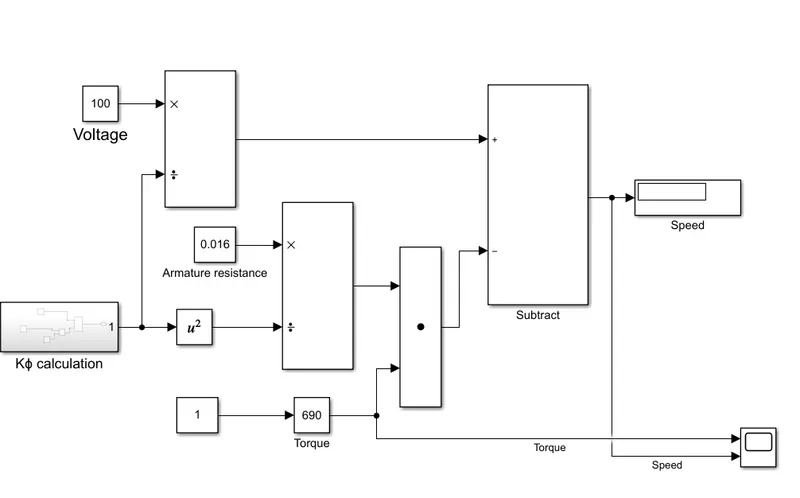
Simulink Model For the DC motor Torque- Speed Equation.
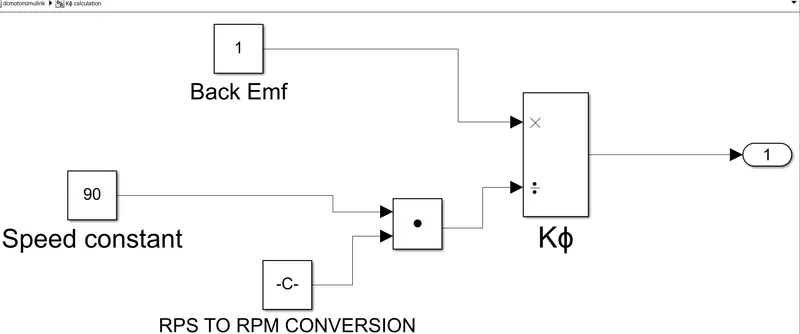
SubModel For the calculation of Kϕ.
Explanation:
In the Case SubModel For the calculation of Kϕ, the back Emf of the motor is considered as 1 and the Speed Constant of the motor is 90 is multiplied by 0.01666666666 to convert speed into RPM.
In the case of the Model of the DC Motor, Voltage and Armature Resistance are fed via constant block, and Torque is fed via slider Gain block which allows to varies the torque during simulation.
Conclusion:
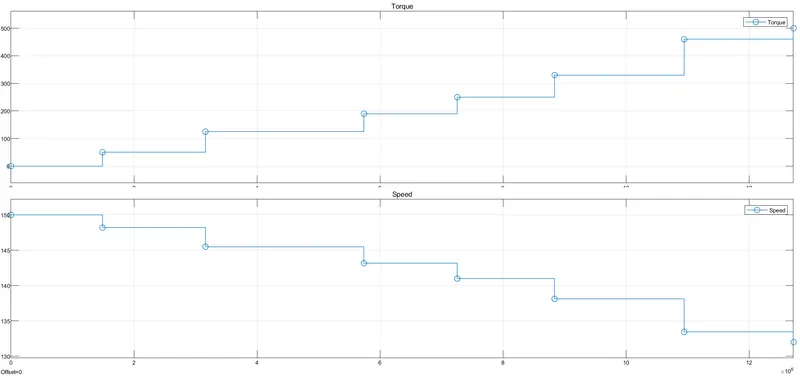
From the above graph, we can see that when torque is zero and speed is 150 and torque increases, speed decreases. From the above graph, we can conclude that speed and Torque are inversely proportional.
4)Aim:
To explain about the Induction Verus Dc brushless Motor by Wally Rippel, Tesla.
Explanation:
DC Brushless Motor:
With brushless machines, the rotor includes two or more permanent magnets that generate a DC magnetic field (as seen from the vantage point of the rotor). In turn, this magnetic field enters the stator core (a core made up of thin, stacked laminations) and interacts with currents flowing within the windings to produce a torque interaction between the rotor and stator. As the rotor rotates, it is necessary that the magnitude and polarity of the stator currents be continuously varied – and in just the right way - such that the torque remains constant and the conversion of electrical to mechanical energy is optimally efficient. The device that provides this current control is called an inverter. Without it, brushless motors are useless motors.
Induction Motor:
The induction rotor has no magnets – just stacked steel laminations with buried peripheral conductors that form a “shorted structure.” Currents flowing in the stator windings produce a rotating magnetic field that enters the rotor. In turn, the frequency of this magnetic field as “seen” by the rotor is equal to the difference between the applied electrical frequency and the rotational “frequency” of the rotor itself. Accordingly, an induced voltage exists across the shorted structure that is proportionate to this speed difference between the rotor and electrical frequency. In response to this voltage, currents are produced within the rotor conductors that are approximately proportionate to the voltage, hence the speed difference. Finally, these currents interact with the original magnetic field to produce forces – a component of which is the desired rotor torque.
Comparison:
- In the case of DC Brushless motor and induction motor, the stator construction is similar varies only with the rotor construction and the inverter controls. And with digital controllers, the only control differences are with control code.
- In the case of DC Brushless motor, the rotor heat generated is less and the rotor is cooling easier when compared with the Induction motor.
- The DC brushless drive can also operate at unity power factor, whereas the best power factor for the induction drive is about 85 percent. This means that the peak point energy efficiency for a DC brushless drive will typically be a few percentage points higher than for an induction drive.
- In the case of Induction machines, are more difficult to control. The control laws are more complex and difficult to understand. Achieving stability over the entire torque-speed range and over temperature is more difficult with induction than with DC brushless.
-
With DC brushless, as machine size grows, the magnetic losses increase proportionately and part load efficiency drops. With induction, as machine size grows, losses do not necessarily grow. Thus, induction drives may be the favored approach where high-performance is desired; peak efficiency will be a little less than with DC brushless, but average efficiency may actually be better.
Conclusion:
The DC Brushless motor is used for Hybrid vehicles and plug-in vehicles and the Induction Motor is used in pure electric vehicles.