Week-6 Challenge: EV Drivetrain
1. Which types of power converter circuits are employed in electric and hybrid electric vehicle?
Power converters generally control the flow of Electrical Energy in a form that is a optimally suited for user loads.
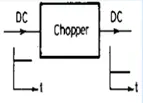
- Chopper circuits are known as DC to DC converters. Similar to the transformers of the AC circuit, choppers are used to step up and step down the DC power.
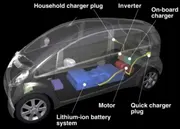
- An inverterconverts the DC electricity from sources such as batteries or fuel cells to AC electricity.
- Rectifier converts Alternating current to Direct Current
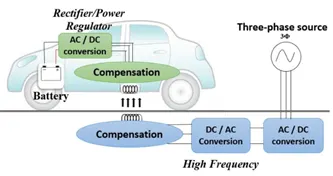
2) An Electric Vehicle's powertrain with 72V battery pack in shown in the diagram below. The duty ratio for acceleration operation is 'd1' and for the braking operation the duty ratio is 'd2'.
Relation between Torque and Speed is given by:
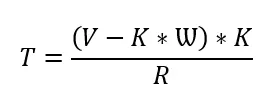
Given:
V = 72V, K = 0.7 Volt Second, R = 0.5Ohm
T = 24.7 + (0.0051*Ѡ2)
Duty Cycle = 70%
Considering the duty cycle, output voltage is given by:
V = 0.7*72 = 50.4V
Substituting the values in the above equation we get:
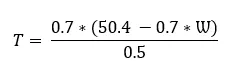
T = 70.56 – 0,98Ѡ
24.7 + (0.0051*Ѡ2) = 70.56 – 0,98Ѡ
(0.0051*Ѡ2) + 0,98Ѡ – 45,86 = 0
Ѡ = 38.91 or -231.07 rad per second
Assuming the vehicle moves in the forward direction, Ѡ cannot have negative value.
Ѡ = 38.91 rad per second
Steady-state speed of vehicle: n = 372 rpm
3) Refer to the blog on below topic:
Induction Versus DC brushless motors by Wally Rippel, Tesla
Explain in brief about author’s perspective.
In this Blog, the author discusses the pros and cons of Induction and Brushless motor:
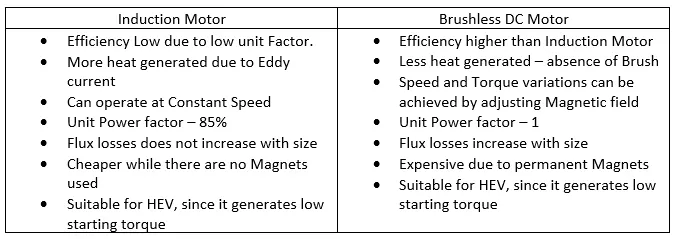
Both Motors appear to be well suited for the Electric Vehicle application. They can have different application domains from passenger to commercial vehicles based on their advantages and disadvantages.