Week-6 Calculate the Stretch Ratio by comparing the ELFORM (-2,-1,1,2) with Ogden_Material Model.
Aim:-To calculate the stretch ratio by using different element formulation of a solid element with Odgen material.
Theory:-
Hyperelastic materials are the special class of materials that respond elastically even when they are subjected to large deformations. They show both a nonlinear material behavior as well as large shape changes. They are characterized by:
- Can undergo large elastic deformations in order of 100 to 700% which are fully recoverable, i.e., the initial shape is recovered when the load is removed.
- Are nearly incompressible, which means that they change can their shape but overall volume remains almost constant.
- Show a highly nonlinear stress-strain relation.
- The material softens and then becomes stiffer again when applied to tension whereas, under compression, they have a quite stiff response.
Many polymers show hyperelastic behavior, such as elastomers, rubbers, and other similar soft flexible materials.
Hyperelastic materials are mostly used in applications where high flexibility, in the long run, is required, under the presence of high loads. Some typical examples of their use are elastomeric pads in bridges, rail pads, car door seals, car tires, and fluid seals.
UNIAXIAL TENSION
For the case of uniaxial tension loading of an incompressible material, the specimen is loaded along one axis. The stretches are given by:
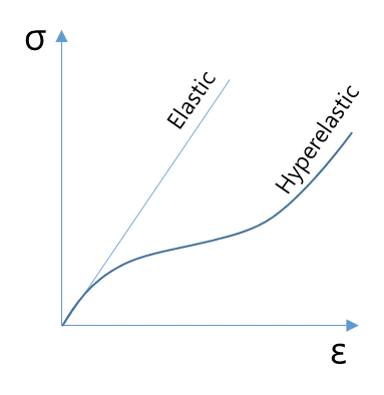
An elastic material is a linear material. This means that stress varies linearly with respect to strain. This material model is accurate for many material models, such as paper, metal, and wood, as long as the deformation is very small.
STRETCH RATIO The stretch ratio or extension ratio is a measure of the extensional or normal strain of a differential line element, which can be defined at either the undeformed configuration or the deformed configuration. It is defined as the ratio between the final length ℓ and the initial length L of the material line
Hyperelastic materials are designed for modeling rubber or rubber-like materials in which the elastic deformation can be extremely large.
Strain energy density functions (W) establish the relationship between the amount of energy employed to deform a volume unit of a solid and imposed strain
https://www.simscale.com/docs/simulation-setup/materials/hyperelastic-materials/
PROCEDURE:-
- First, we need to import the material model into the software.
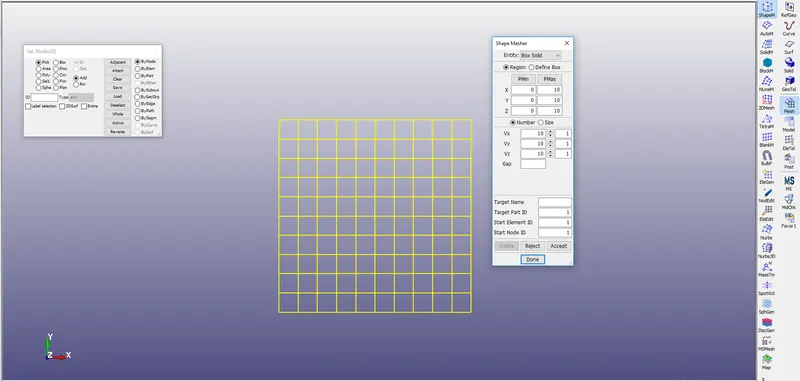
- In this, we need to create the solid box with 10*10*10 and the mesh size must be 10mm.
- To make a solid box we need to go to mesh and select the option shape mesh and select box solid and give dimensions and click on apply.
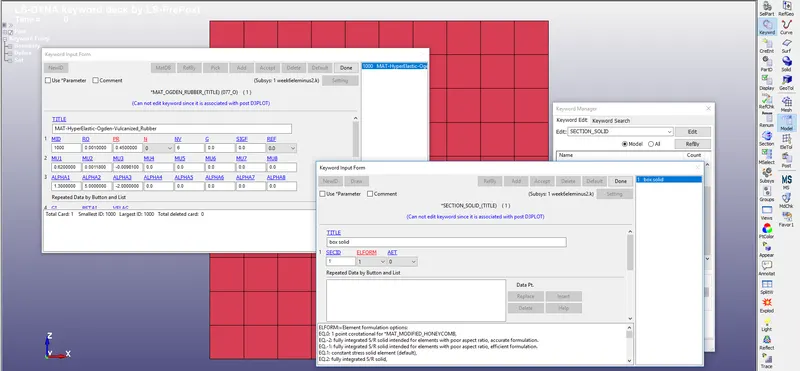
- Then after we need to assign the section id for the solid
- And then give material and section id to the part.
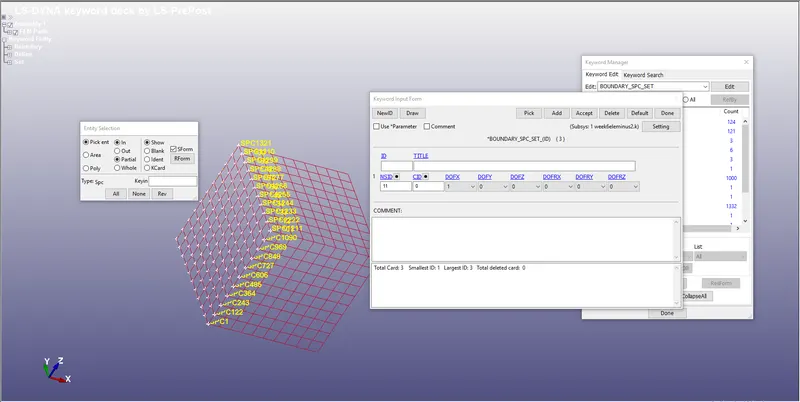
- Here we are going to perform a uniaxial tensile test where one need will be fixed and other ends will under motion.
- To make one end of the cube we need to go to boundary condition and select SPC set and lock them in all DOF.
- For the stability issue, we need to lock in another to set in different axises.
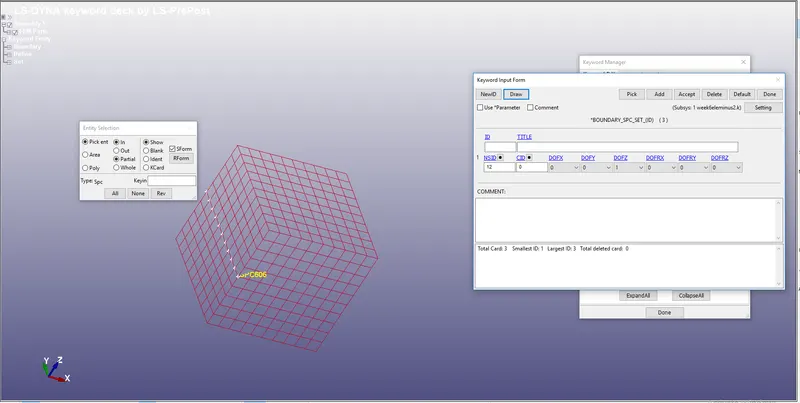
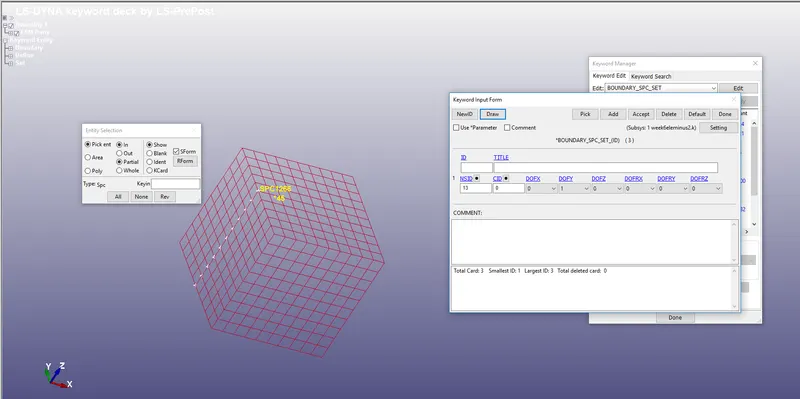
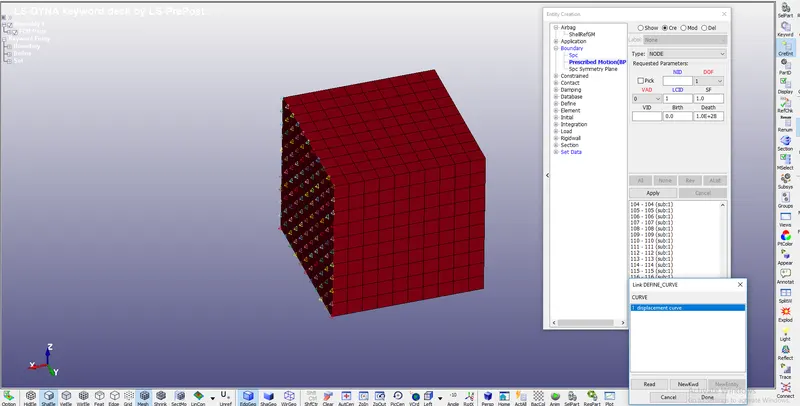
- Then we need to give the motion to another end by creating another boundary condition which is the prescribed motion set.
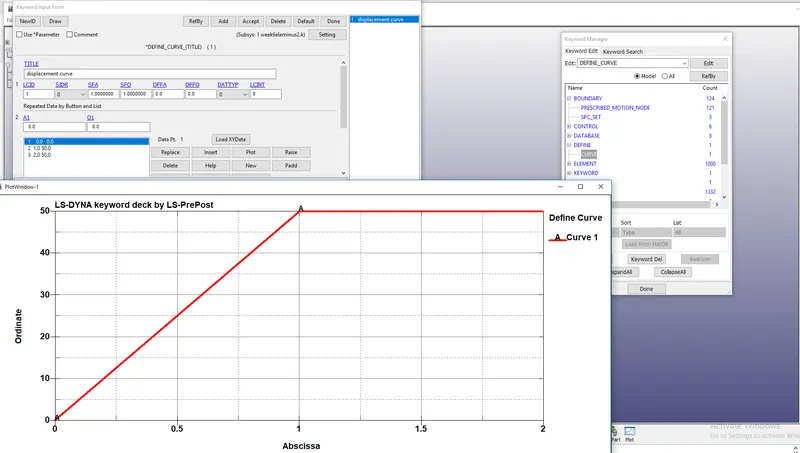
- For that, we are going to give a curve for the displacement
- The minimum load to be applied on the moving surface to attain a stretch ratio of 5, is calculated by using the following relation.
λ=1+ε
λ=5, L=10
ε=∂l/l
∂L=40mm
- To define the curve we need to go to define and select the curve and give the value of displacement with respect to time.
- To load the curve we need to select the boundary condition and select the prescribed motion set and select LCID and load the curve.
- For this simulation, we are going to use only the implicit solver.
- To activate the implicit solver we need to select control implicitly and select IMFLAG as 1.
- The solver will be activated and we can give the initial time step to start.
- Here we had given the initial time step as 0.01ms.
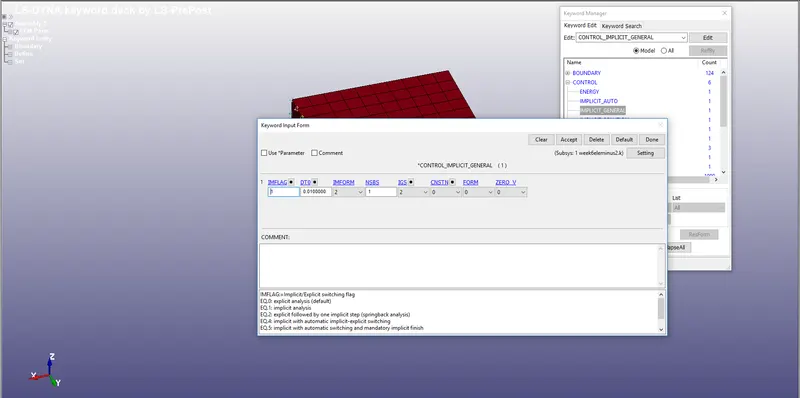
- And we need to activate the auto time step to increase the chance of convergence.
- And also we can constrain the number of iteration to be solved.
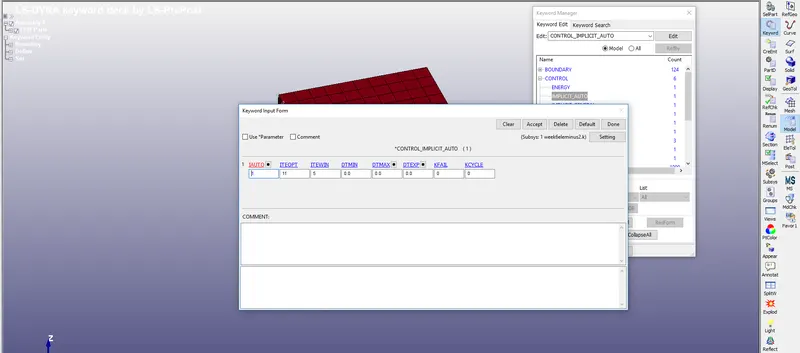
ITEOPT: Optimum equilibrium iteration count per time step.
ITEWIN: Allowable iteration window. If iteration count is within ITEWIN
iterations of ITEOPT, the step size will not be adjusted for the next
step.
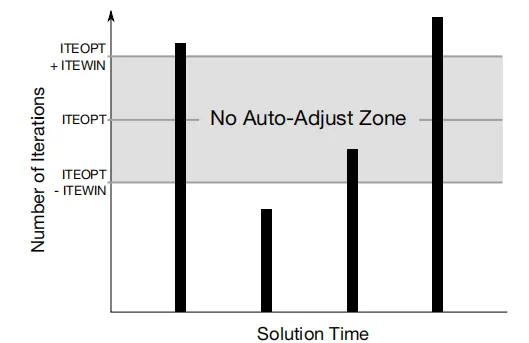
- For a certain time step if the solver is converging in less number of the steps then the time step will automatically increase.
- If it is unable to solve for that time step it will increase the iterations.
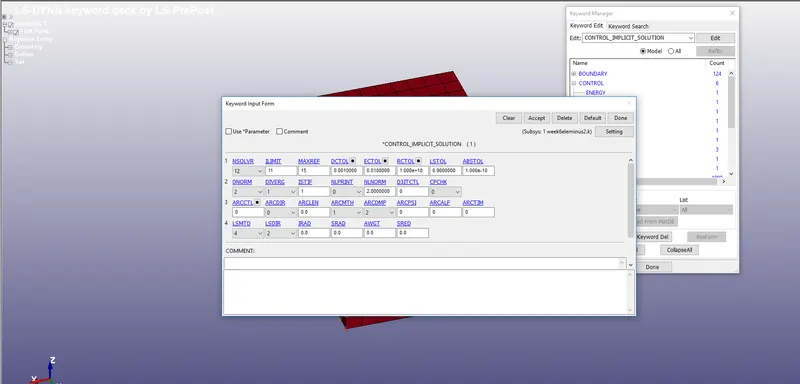
- CONTROL_IMPLICIT_SOLUTION:-These optional cards apply to implicit calculations. Use these cards to specify whether a linear or nonlinear solution is desired.
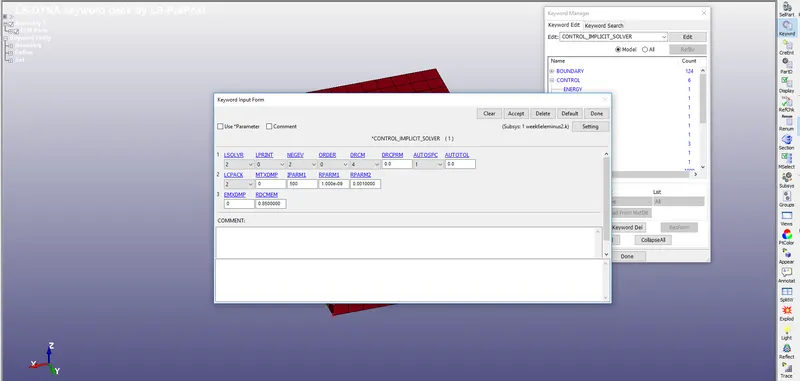
- CONTROL_IMPLICIT_SOLVER:-These optional cards apply to implicit calculations. The linear equation solver performs the CPU-intensive stiffness matrix solution.
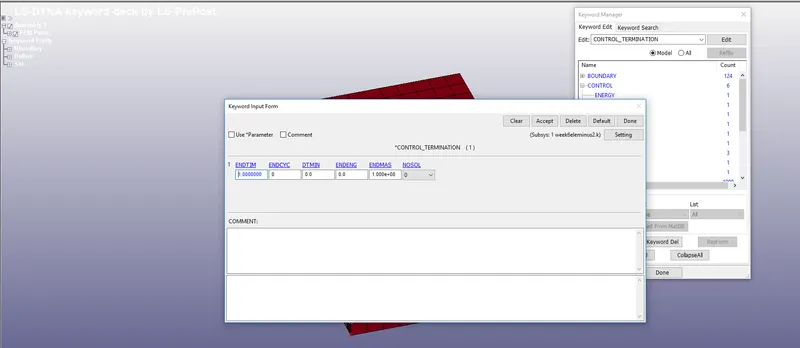
- We need to give the end termination time to solve.
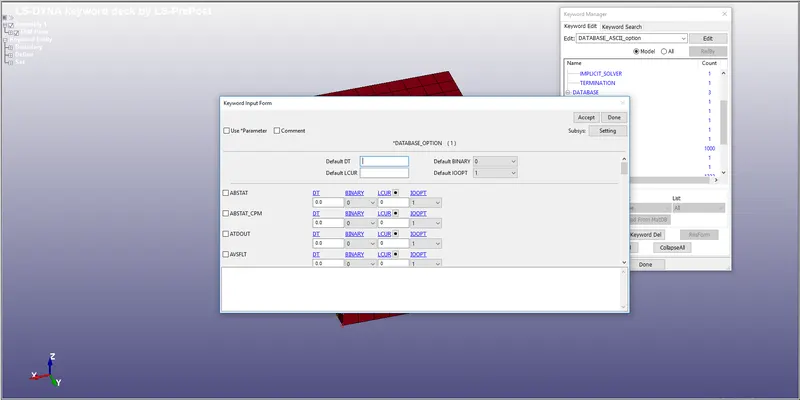
- We need to give output requests to get results from the post-processor.
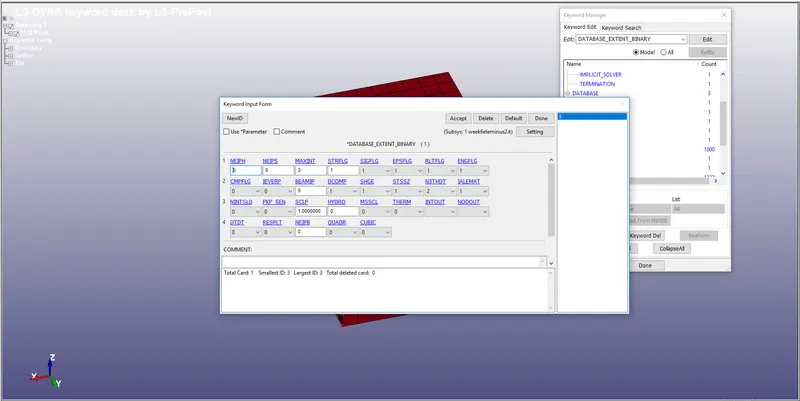
- This is used to get the strain result from the elements STRFLG=1.
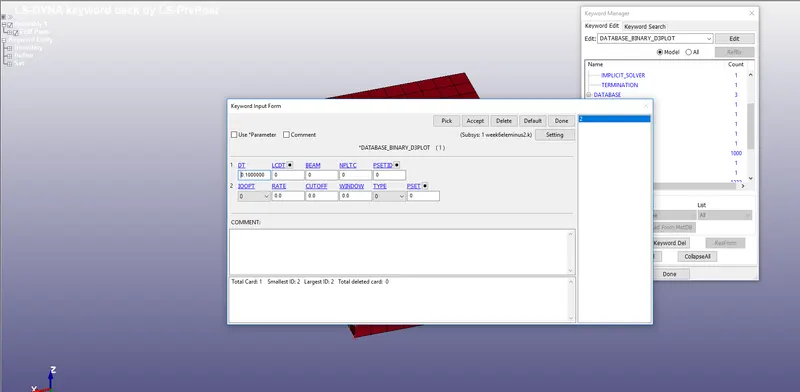
- And we need to give access to binary d3plot and In ASCII glstat.
RESULTS:-
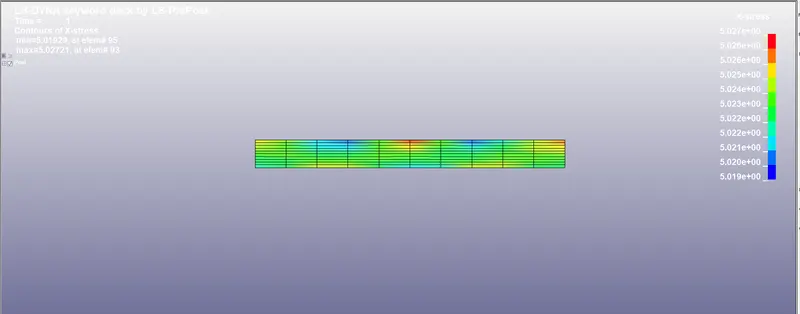
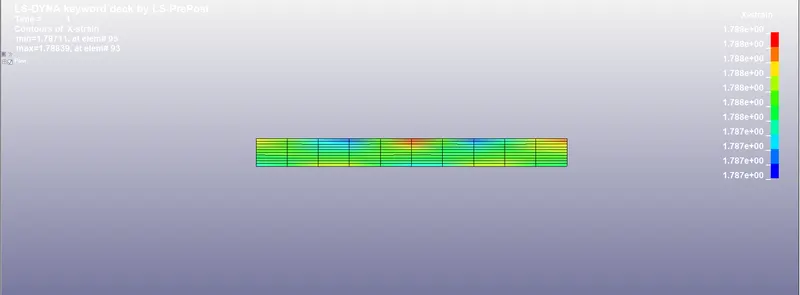
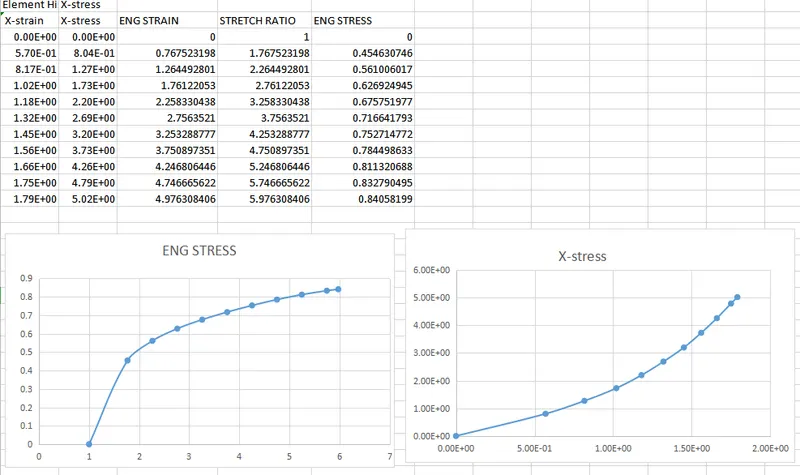
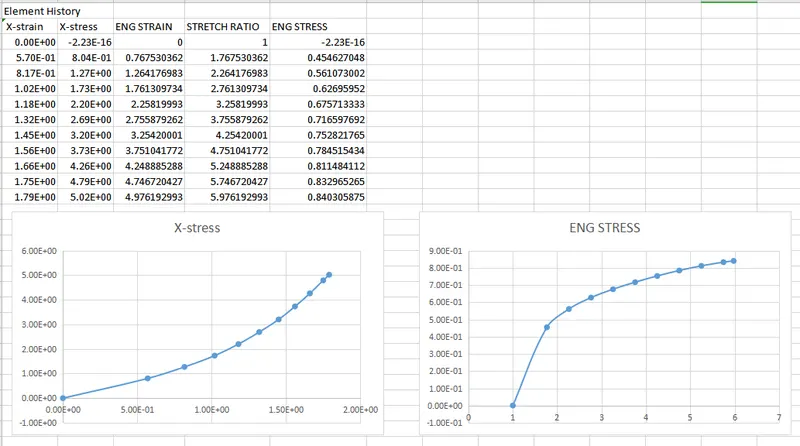
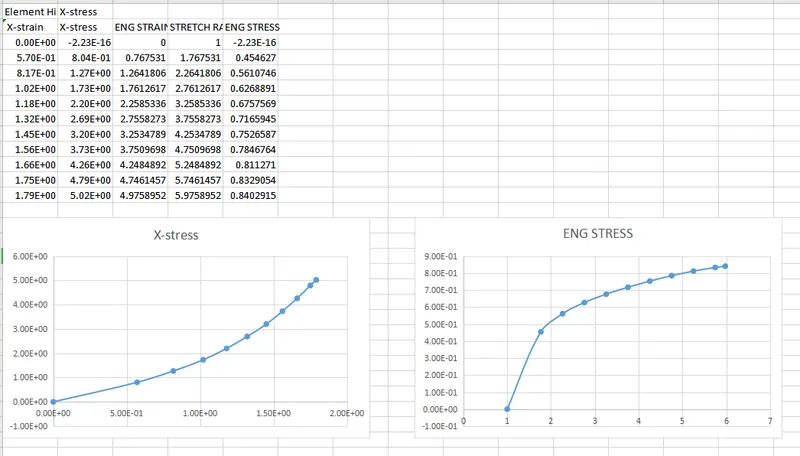
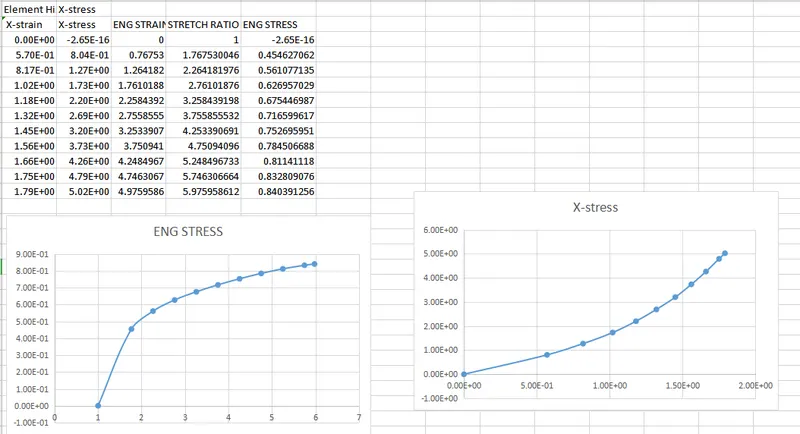
Calculation of Engineering Stress, Strain and Stretch Ratio:-
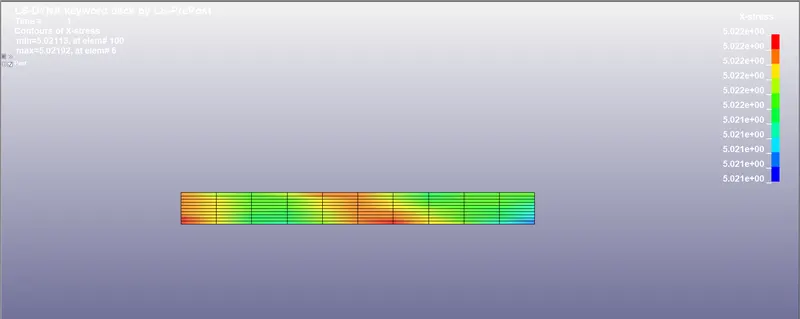
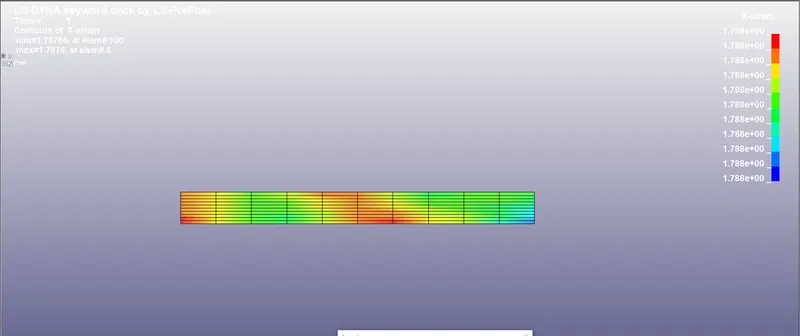
The Output Stress and Strain Obtained From The Post-processing are Noted as True Stress and Strain values,
We know that,
Stretch ratio, λ=1+ε
`σe=sigma_t/(1+epsilon_e)`
`σt=σe(1+epsilon_e)`
'λ=`1+epsilon_e`
`ϵt=ln(1+epsilon_e)`
σe=Engineering stress
σt=True stress
ϵt=True strain
εe=Engineering strain
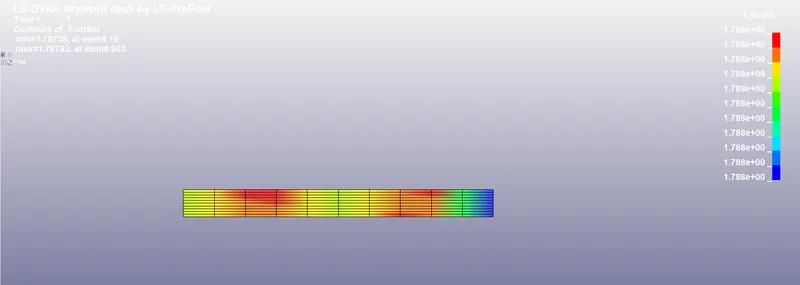
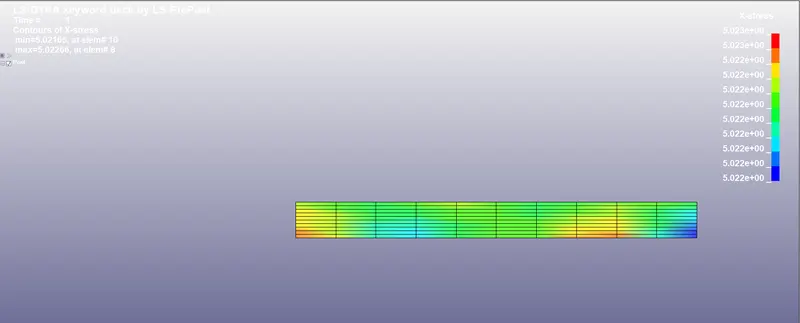
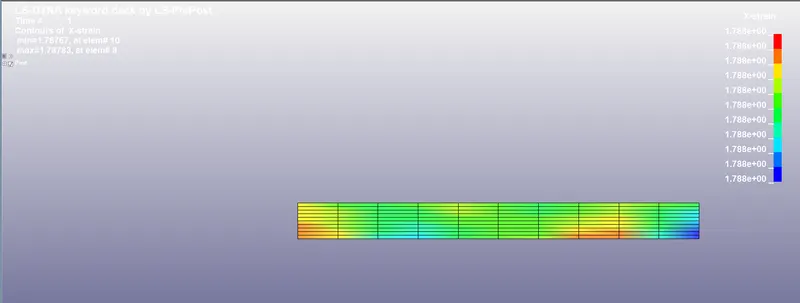

CONCLUSION:-
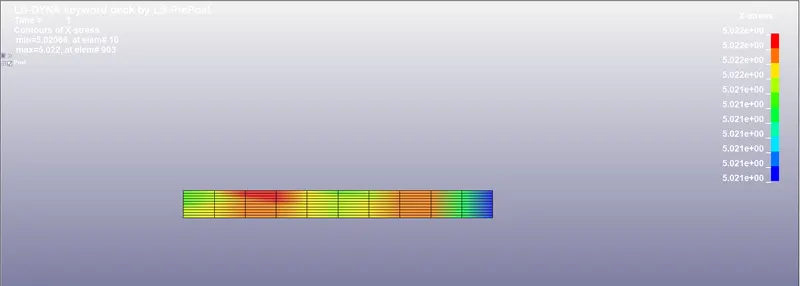
- Here we can see there no change in the output results are have good results.
- We cannot justify the formulation with respect to this stimulation as per the knowledge of the solver we can say that the fully integrated elements are good
- A fully integrated element will reduce the hourglass and also increases the computational time.
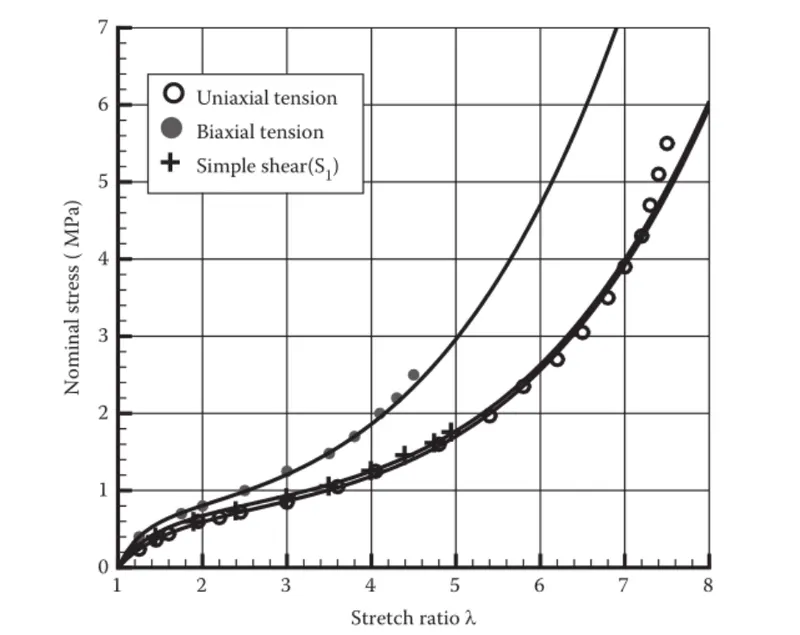
- Here performed the uniaxial tensile test for hyperelastic material to understand the behavior and its properties.
- Here the analysis attained max stretch ratio at 0.8Mpa of 5.2 but actually test value having the value of 1.6 at 5 Mpa
- The change is due to shear locking or boundary conditions.
- I understood how to perform nonlinear analysis by using Odgen material which has hyper-elastic behavior