Week 5 - Rayleigh Taylor Instability
Rayleigh Taylor Instability
Aim:
In this our aim is to simulate a setup involving two phases using Volume of Fluid Method.
To perform the Rayleigh Taylor instability simulation for 2 different mesh sizes with the base mesh being 0.5 mm.
To run one more simulation with water and user-defined material(density = 400 kg/m3, viscosity = 0.001 kg/m-s) for refined mesh.
To define the Atwood Number. Find out the Atwood number for both the cases and explain how the variation in Atwood number in the above two cases affects the behavior of the instability.
Introduction:
The Rayleigh–Taylor instability, or RT instability (after Lord Rayleigh and G.I.Taylor), is an instability of an interface between two fluids of different densities which occurs when the lighter fluid is pushing the heavier fluid.
Water suspended atop air is an everyday example of Rayleigh–Taylor instability, and it may be modeled by two completely plane-parallel layers of immiscible fluid, the more dense on top of the less dense one and both subject to the Earth's gravity. The equilibrium here is unstable to any perturbations or disturbances of the interface: if a parcel of heavier fluid is displaced downward with an equal volume of lighter fluid displaced upwards, the potential energy of the configuration is lower than the initial state. Thus the disturbance will grow and lead to a further release of potential energy, as the more dense material moves down under the (effective) gravitational field, and the less dense material is further displaced upwards. This was the set-up as studied by Lord Rayleigh.The important insight by G. I. Taylor was his realisation that this situation is equivalent to the situation when the fluids are accelerated, with the less dense fluid accelerating into the more dense fluid. This occurs deep underwater on the surface of an expanding bubble and in a nuclear explosion.
Atwood Number:
The Atwood number (A) is a dimensionless number in fluid dynamics used in the study of hydrodynamic instabilities.
It is written as
`A = (rho_1 - rho_2)/(rho_1+rho_2)`
where
`rho_1` is higher density fluid
`rho_2` is lower density fluid.
We will simulate this Rayleigh Taylor Instability, by using the volume of fluid method in Ansys Fluent.
Steps Followed:
a) Geometry preperation
b) Meshing
c) Setup
d) Results
We will be following the above mentioned steps one by one.
a) Geometry preperation:
We will use spaceclaim, to prepare geometry.
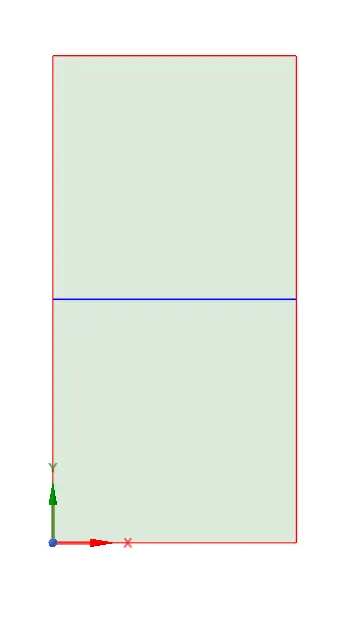
Select sketch plane and draw two rectangles of size 20mm x 20mm and convert them to planes using the pull tool.
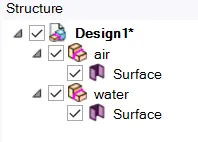
Move the planes to different componets and name them as air and water.
go to workbench > shareprep > share.
Final geometry looks like

Geometry preperation is completed.
b) Meshing:
Case-1
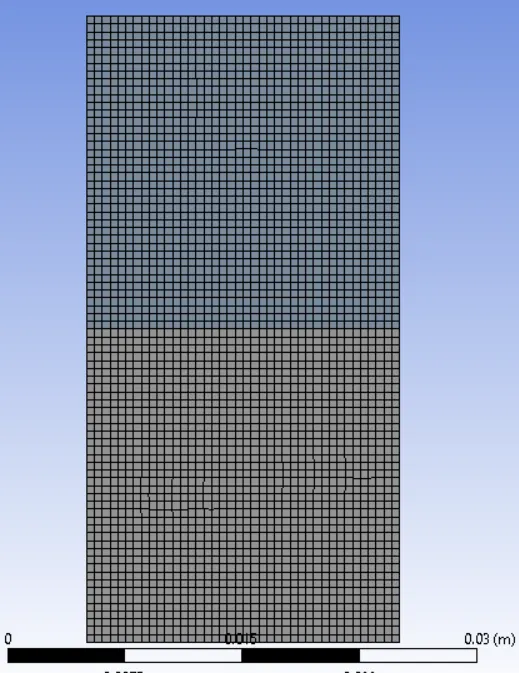
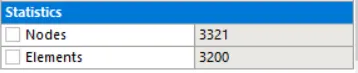
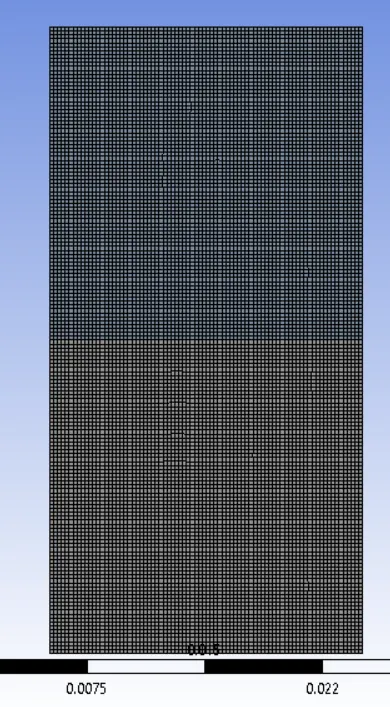
Mesh with 0.5 mm element size looks like,
Case-2
Mesh with 0.25mm

c) Setup:
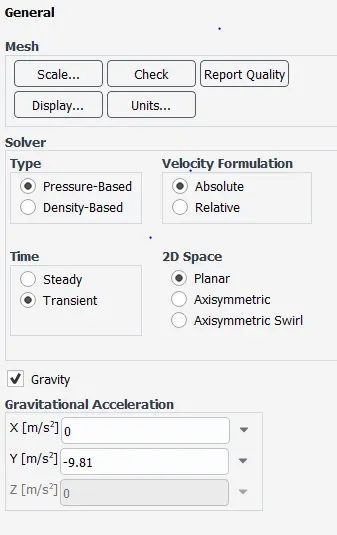
In physics > general > select pressure based solver, transient simulation, gravity (-9.81m/s2) along y-direction.
No need of enabling energy equation.
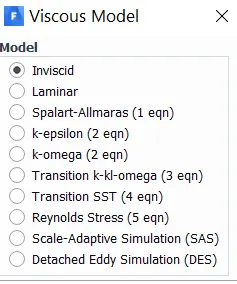
Viscous model > Laminar.
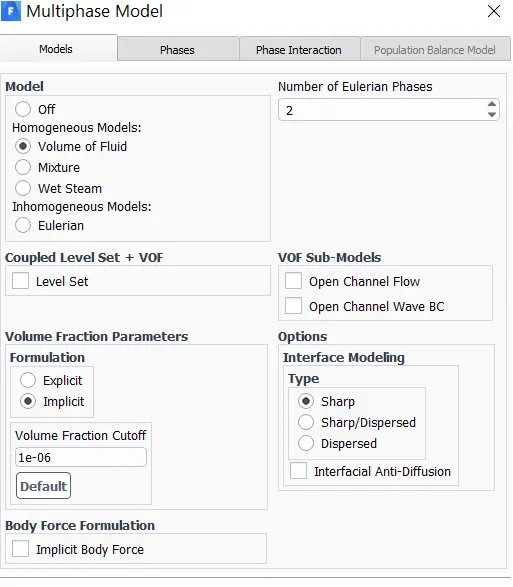
Modes > Multi-phase > Volume of fluid Method.
Select Implicit Method.
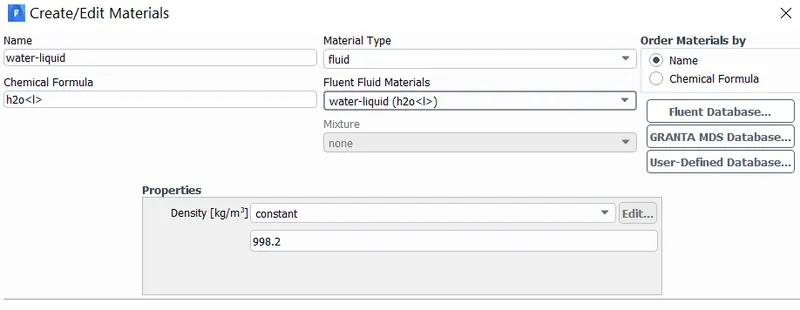
In Materials > select air and water.
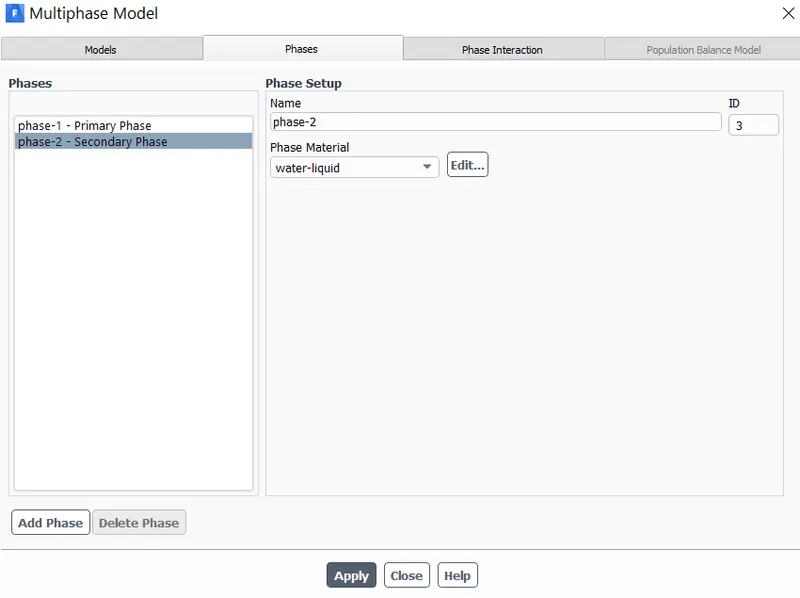
Phases > select phase-I as air and phase-II as water.
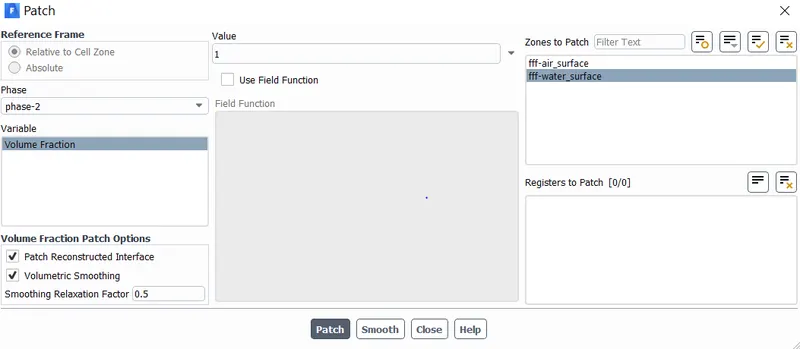
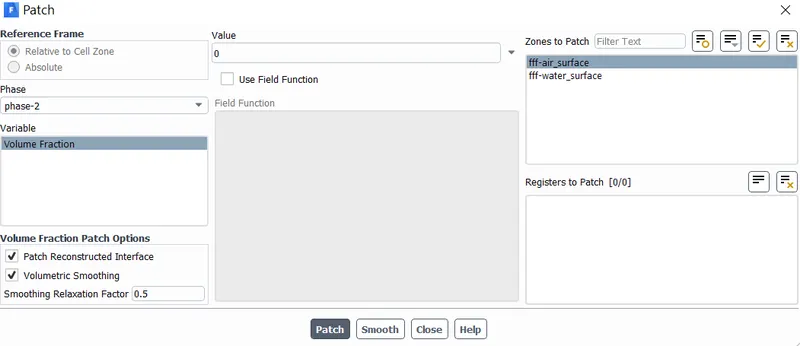
In solution > Initialize and patch appropriately.
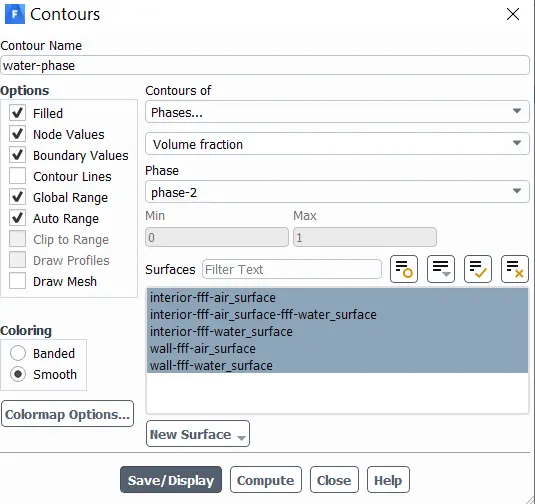
In Post-processing create contour for distinction of phases.
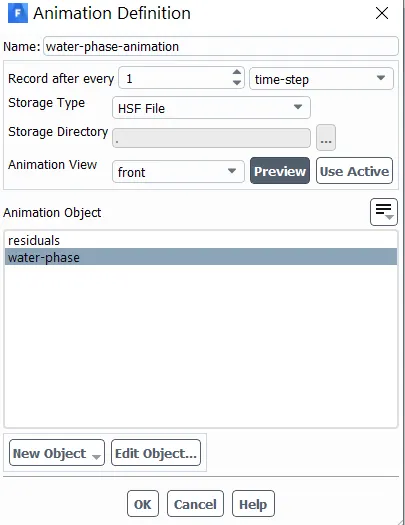
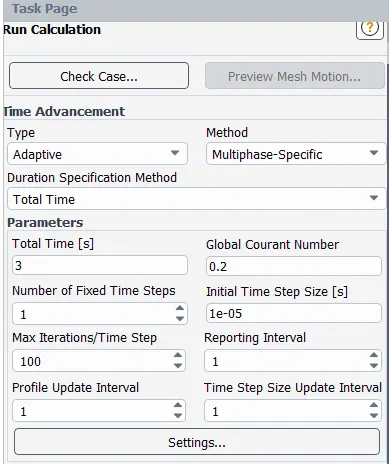
In solution > create solution animation and in run time calculations use time stepping method is adaptive stepping.
Note: Every time you initialize solution, we need to patch the domain.

d) Results:
The following results are obtained:
Case-1
Air and Water
Case-2
Air and Water
Case-3
User-defined Material and Water
user-defined material=(density = 400 kg/m3, viscosity = 0.001 kg/m-s)
Conclusion:
Using the above mentioned formula, we find
Atwood Number with air and water as two phases is 0.9977525.
Atwood Number with user-defined material and water as two phases is 0.4285714.
Effect of Atwood Number on the behaviour of instability:
From case-2 and case-3 videos pasted above
When Atwood number is close to '1', bubble like finger interfaces (mushroom cloud) are formed initially. Whereas in case of Atwood number close to zero to multiple small fingers are formed instead of single large bubble.