Week 5 - Rayleigh Taylor Instability
Aim- To simulate Rayleigh-Taylor instability.
Introduction- Rayleigh-Taylor instability is an instability that occurs when two different fluids of different densities have a common interface and the lighter fluid pushes the heavier fluid. An example from school is the famous water and oil behaviour in a container with the gravity of earth acting vertically downwards. Since water is less dense and lesser in viscosity than oil it pushes oil upward and suspends over it. This phenomena takes place with the formation of mushroom shape bubble like structures called mushrooms.
Theory-
Practical CFD Models based on the mathematical analysis of Rayleigh Taylor waves-
- Kelvin–Helmholtz instability - It occurs when there is a difference in velocity of two fluids across their interfaces, for example, wind blowing over surface of water in a sea gives rise to waves. It can also occur when there is a velociy shear in a single continous fluid. The theory predicts the onset of an instability and the transition to a turbulent flow within fluids of different densities movinf at different velocities. This instability can be characterised as unstable small scale motions occuring vertically and laterally simulataneously.
- Richtmyer–Meshkov instability - It occurs when two fluids of different densities are impulsively accelerated, which means both the fluid are accelerated for a short period of time which produces shockwaves. The instability is achieved by initially passing a low amplitude shockwave which linearly grows with time. A mushroom shape bubble occurs when a light fluid enters a heavy fluid and a spike appears in case of a heavy fluid entering a light fluid.
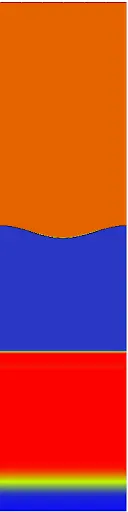 ~ A series of shockwaves passed through two different fluids with a common interface and different properties.
 - Plateau–Rayleigh instability - This instability explains why a stream of fluid falling breaks up into smaller packets of fluid with the same volume but lesser surface area, the best examples are rain, waterfall, tap water with enough height to illustrate this instability. This instability exists because of the sheer virtue of surface tension in fluids which even allows objects of higher density than water's to float over it example a thin blade or an insect.

Modelling approach-
The simulation is merely two-dimensional, so two surfaces has to be created in SpaceClaim with a common boundary. The meshing initially will be coarse and then compared with a more refined set up. The two fluids used will be water and air. in Fluent the water will be patched in the top surface and air in the bottom, with gravity acting vertically downwards. Since, in real time the phenomena takes place in a matter of seconds, the time step size in the transient solver could be 0.005 seconds for a much better animation which gives us a visual aid of the instability.
Case I - Air and water
Geometry-
- SpaceClaim from Workbench is booted.
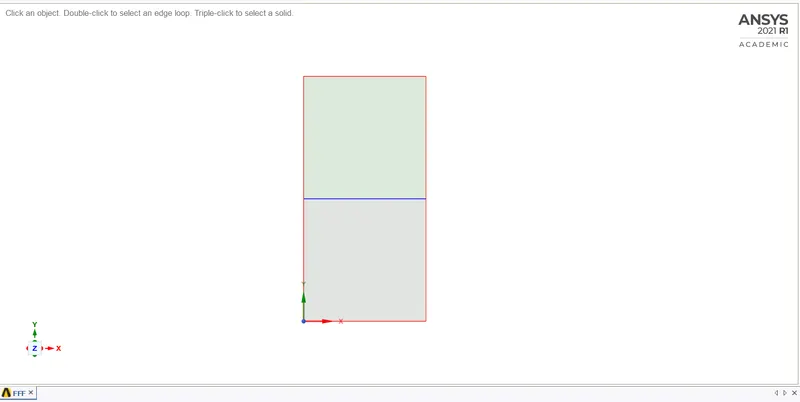
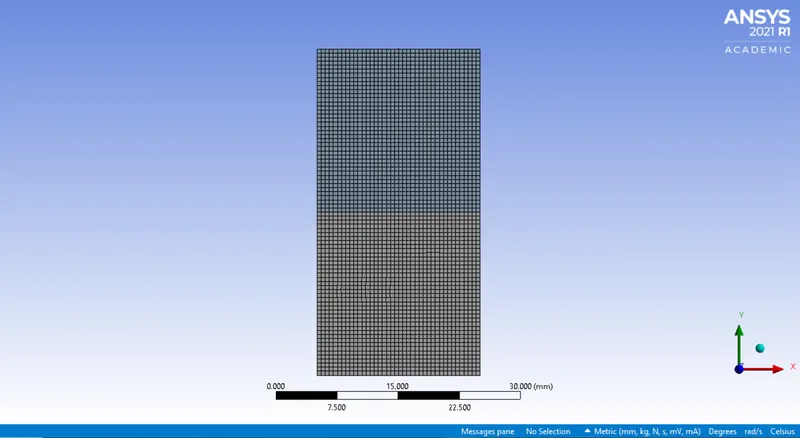
- The XY plane is selected to create a square of dimensions 20mmx20mm and by using the pull tool, it is made as a surface .
- This square is moved in a new component and is named as air and another component is created.
- The second component is named as water and another square is created on top of the previous one and with the pull tool made a surface.
- For both the squares to share topology and produce conformal mesh, share tool is used in the Workbench option from top and the common edge is shared. A pop-up shows the confirmation of the same.
Mesh-
- To start with the base line set-up, i.e. a mesh size of 0.5mm just generate the mesh with 0.5mm size without any additional steps required and exit Ansys Mesh.
Fluent-
- Perform Mesh check.
- Select the transient solver.
- Give a check on gravity and input the value for it as -9.81 m/s^2 in the y-direction.
- Select the laminar viscous model.
- Enable the Multiphase model as Volume of fluid and select the Implicit formulation method.
- Click on the Materials section and select the list for the Fluent database. Search for water in the list and select copy, this should make water included in the drop down list of fluids being used in the same window that shows up after selecting the Materials.
- Define the phases in the Multiphase model section. Define air as the primary fluid and water as the secondary.
- Hit the initialise button using the standard method.
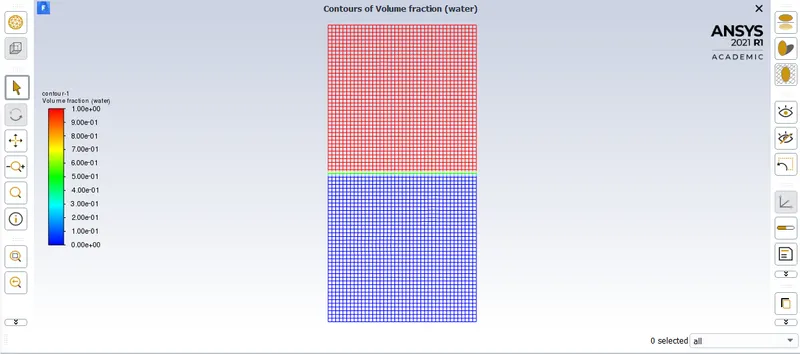
- Select the patch option. Patching the surfaces in the geometry with the proper fluids with water in the top and air in the bottom is important. Select water instead of mixture and select the volume fraction below, give the value for alpha=0 and select air from the left and hit the patch button below. After deselecting air, select water and give the alpha value as 1, hit patch and close the window.
- To have a visual of the patching done correctly create a contour for phases with volume fraction for all the surfaces enlisted and display it. The scale can be used to check the values for the volume fraction being appropriately assigned for air and water.
- Create an animation for the same contour to have an intuitive understanding of how the entire process looks like in time scale.
- Run the calculation with time step size of 0.005 seconds and number of time steps as 800.
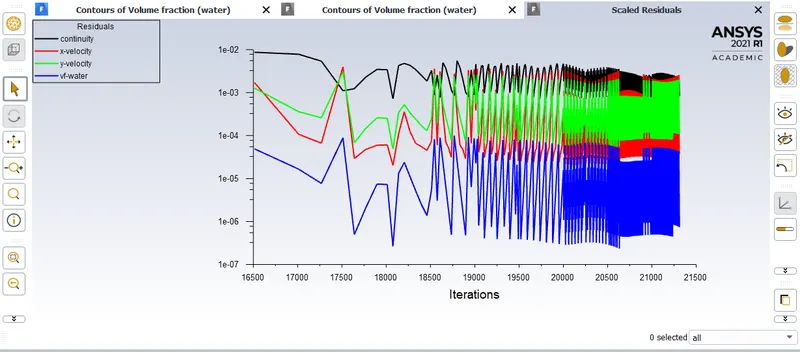
<animation link>CASE-I_0.5mm
Refined set-up-
- The geometry remains unchanged in SpaceClaim.
- For Ansys Mesh the mesh size has to be smaller to at least 0.1mm.
- The Fluent settings remain unchanged, make sure the mesh is updated in it.
- Initialize the solution and hit calculate.
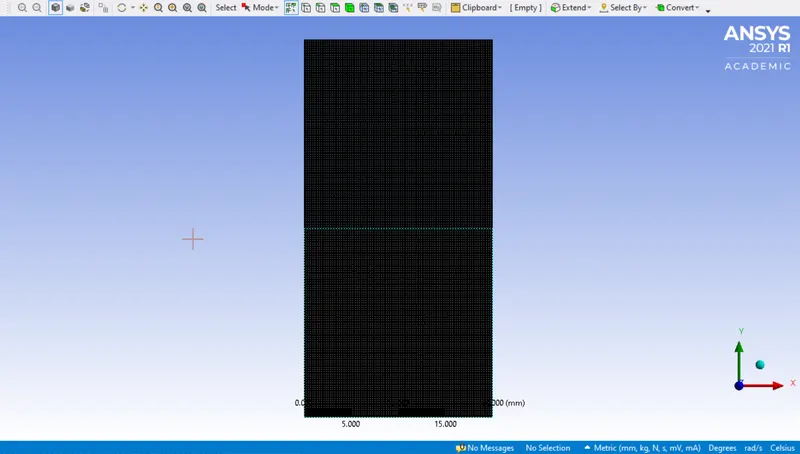
<animation link>CASE-I_0.1mm
Results comparison-
-
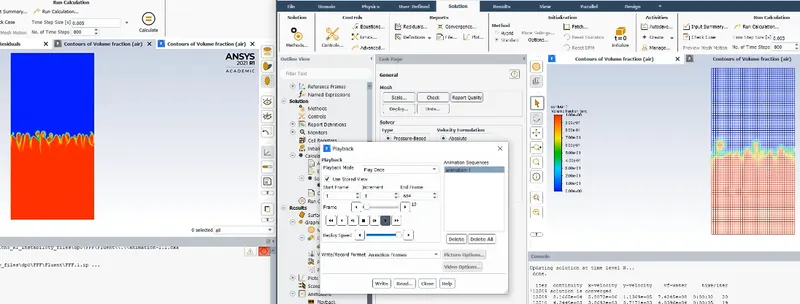 Initially the bubble formation starts and the only difference evident is the refinement, besides that the bubbels are larger in number due to more number of elements in the refined set-up.
 -
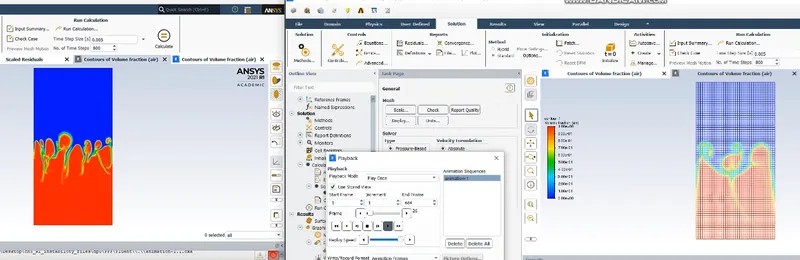 The refined set up has a larger number of mushroom like bubbles comapred to the base line set up where the mushroom like structure seems absent.
 -
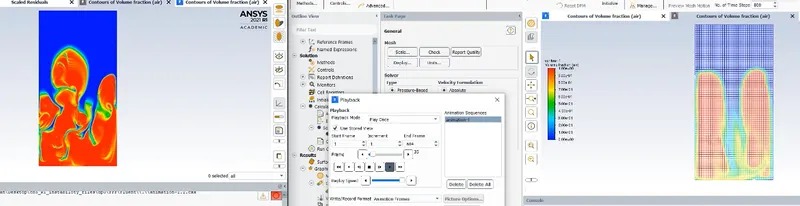 The bubbles in both cases grow larger in size as the lighter fluid is pushing the heavier fluid. The instability is much profound in the refined setup than the base line set up.
 -
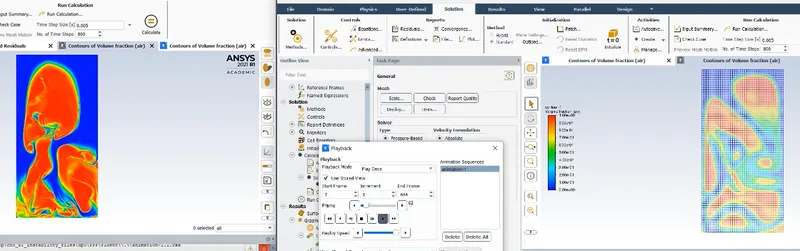 Further, the mixing of the fluid is much faster in the base line set up due to lesser elements which entails lesser equations to solve. While the refined set up is still dealing with the mushroom bubbles.
 -
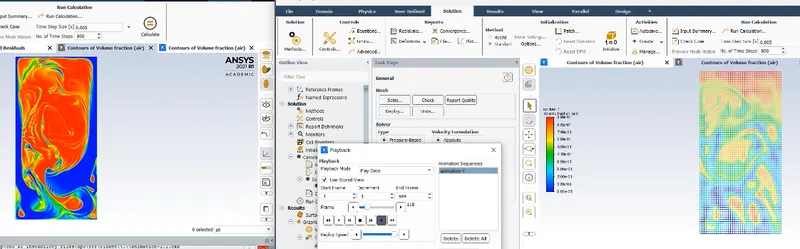 Both the cases after the mushroom bubble phase has been displayed above, it looks like the fluids are still intact individually in the refined set up, whereas in the base line set up the volume fraction from the scale in green can be seen in the set up.
 -
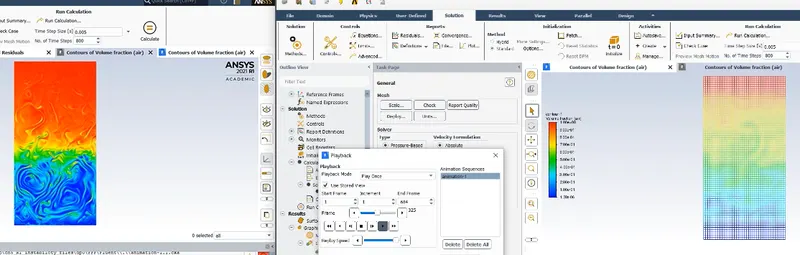 Nearing to the fluids to settle and stratify the flow within, the refined set up has two very distinct colours by scale i.e. the water and air and very little traces of yellow and green indicating a mixture. While in the base line set up there is a lot of mixture and a lesser individual water and air.
 -
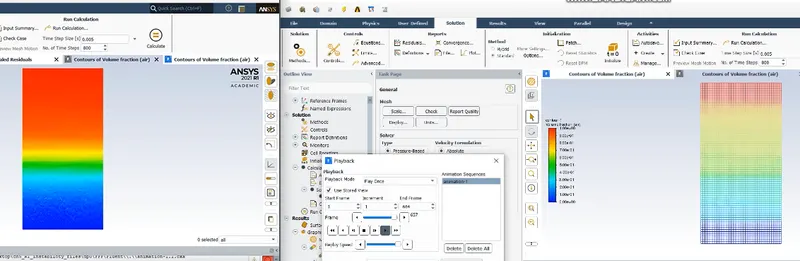 At the end of the timesteps the fluid is stratified and the refined set up has air at the top with water at the bottom and a mixture of both in between them. In the base line set up there is a huge patch of mixture of water and air and small parts of just water and air at the bottom and top respectively.
Why a steady state approach is not useful in such type of cases?
For a steady-state solver it solves the solution and computes it entirely that does not changes with time, i.e. the time is steady for all the quantities solved. In the case of a transient solver every quantity is solved in real time instantaneously for every second or fractions of it. So to have an intuitive and a visual understanding of how the Rayleigh-Taylor instability occurs a transient solver is used with a time step size of 0.005 seconds since the mixing phenomena hardly takes a couple seconds in real time. This approach will help us have a visual over every small movement or rather distortion of the boundary interface shared by the two fluids.
Case II - Water and a user-defined fluid -
- Geometry from the previous case remains the same in SpaceClaim.
- Meshing in AnsysMesh needs to be refined so going with 0.1mm size will be appropriate.
- For Fluent the step where materials are edited we need to select air and change its density to 400kg/m3
and viscosity to 0.001 kg/m-s or create a new material and give the same properties. - Initialize the solution and hit calculation with a time step size of 0.005 seconds with 800 time steps.
<animation link>CASE-II_UD
Atwood number-
Atwood number is an another dimensionless number in fluid dynamics to study the hydrodynamic instabilities in density stratified flows. Density stratification is a change in the density of a fluid with respect to the y co-ordinate system with the denser fluid at the bottom and the lighter on top of it. Therefore, a density stratified flow is a flow which has achieved the density stratification process.
Atwood number, A = ρ1 – ρ2 / ρ1 + ρ2
Where, ρ1 = density of heavier fluid
ρ2 = density of lighter fluid
Density of water = 998.2 kg/m3
Density of air = 1.225 kg/m3
A = ρ1 – ρ2 / ρ1 + ρ2
For Case I – water and air, water is the heavier fluid.
Therefore, Atwood number = 998.2 – 1.225 / 998.2 + 1.225
= 0.9975
For Case II – water and user defined fluid with density 400 kg/m3, water is the heavier fluid.
Therefore, Atwood number = 998.2 – 400 / 998.2 + 400
= 0.4278
Conclusion-
The penetrating distance of heavy fluid bubbles into the lighter fluid is a function of acceleration time scale, Agt2
where g is gravitational acceleration and t is time.
For a higher Atwood number the penetration distance is larger, since the density difference is extreme it is logical to infer that water is much more denser than air and would be heavy enough to penetrate air profoundly.
While in the case of a fluid which is half the density of water has lesser Atwood number with water since the density difference is not that huge, and hence the penetrating distance.