Week 5 - Rayleigh Taylor Instability
Rayleigh-Taylor instability
The aim, Introduction, Theory:
Perform a simulation based on Rayleigh-Taylor instability with two different mesh sizes. I have a base mesh of element size 0.5 mm and the other will be a more refined mesh. I am going to use water and air for the first simulation and water and a user-defined material for the other simulation (density= 400kg/m^3, Viscosity= 0.001kg/m-s).
Rayleigh-Taylor instability is a interesting phenomenon around all of us, like when there is oil over water. The process of disppersion of the material from its original shape to other by the action of gravity is fascinating. To define RT instability, it is a instability of two fluids in contact with each other, having different densities and the material with lower density is resting at the buttom to resist the high density material.
Lord Rayleigh observed that when two immiscible fluids are used to model and the denser fluid is atop the less dense fluid the denser fluid tends to travel to the buttom of the system with the action of gravity. According to him and as observed the equilibrium at the contact is very unstable. If there is a small pertubation or disturbance also the denser fluid will displace the less denser one. If the denser fluid is displaced with the same amount of lesser dense fluid the potential energy can be concluded to be less than the potential energy at initial stages. If the case is so then there will be a increase in pertubations and there will be release of potential energy. G.I Taylor observed the phenomenon as same when a less dense fluid is accelerated into a denser fluid.
Solving & Modelling approach:
I will perform two simulations one with water on top and air and the other with a custom material atop and air at the buttom.I am doing a 2D simulation and to solve the above problem I will take two rectangles as the fluids and change the material properties as and if needed. I have a interface of air and the other material, maybe water, which I need to mesh accordingly. I am going for a conformal mesh as that way we will be able to capture the phenomenon. For the first simulation I am taking a baseline mesh with element size 0.05 mm. In the second case though I am going to use a much more refined mesh, also the upper material will also change with custom material properties.
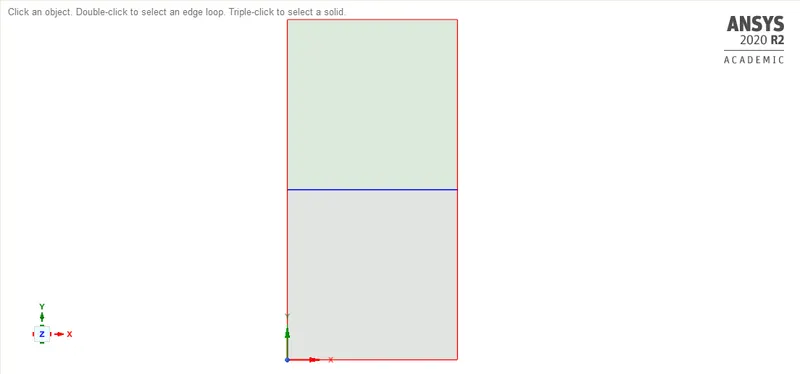
Fig.1- Geometry of Rayleigh-Taylor instability
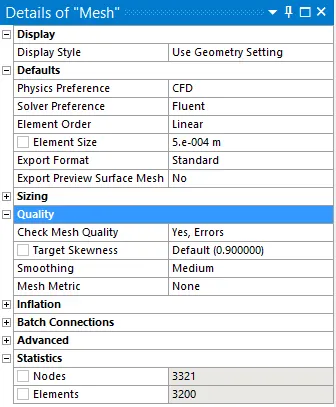
Fig.3- Mesh settings for the first simulations
Pre-processing and solver setting:
I am going for a transient simulation as I am more interested to observe how the interface collapses and how the materials are moving with respect to time. I will take gravitational force also in account. We can suggest that the velocity of the two fluid may be very slow as there is only gravity acting on the phase and there is no external force to move it, in which case we can take a laminar viscous model. It is a multiphase model with Liquid-Gas iterface. I turn on the volume of fluid method in multiphase feature. I have set the materials to water and air and then defined the phases. Initialising the simulation with standard method and then we have to something know as patch.
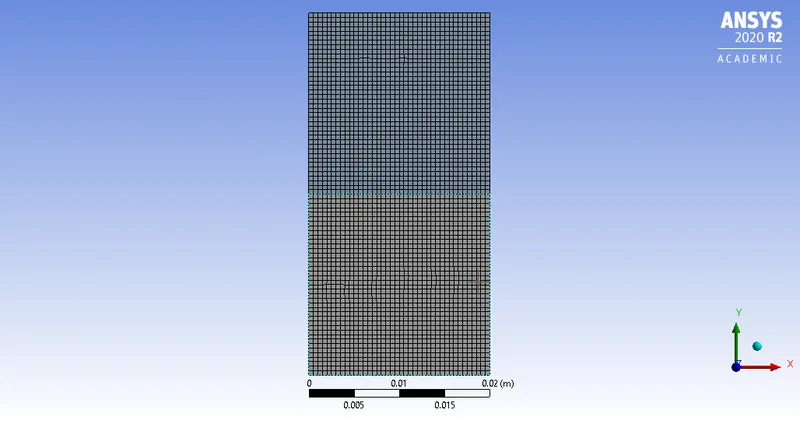
Fig3.- Meshing done for first case
Results:
Animation.1- Rayleigh-Taylor instability with a mesh wit less element numbers
The above animation depicts the interaction pattern of air and water. The element size is 0.5 mm in the above simulation case. There are less number of iterations still we can observe the air from the buttom moving very fast forming a large bubble like shape.
Animation.2- Air and water phase interaction in RT
In the above animation I have further decreased the element size to 0.1 and also increase the time steps to simulate the flow. The Atwood number is similar to the previous one. In the above animation we can see the whole air packet going up in a large bubble form.
Animation.3- User defined material and water
For the above case I have change the mesh element size along with the interface material to certain user define material with a density of 400 kg/`m^3`. The Atwood number of the above system decreases nearly to half of the previous, to 0.4278. I can say that the interaction and movement of the fluid is random and when the fluid flow is spliting also we can observe symmetry.
`A=(rho1-rho2 )/(rho1+rho2)`
`rho1`= Density of denser fluid
`rho2`= Density of lighter fluid
Conclusion:
Rayleigh-Taylor Instability can be defined as the phenomenon happening at the interface of two fluids may be liquid-liquid, liquid-gas etcetra.
Kelvin–Helmholtz instability is a CFD model that can be obtained by the study of RT instability. Kelvin-Helmholts instability model is very similar to RTI as it occurs when there is change in velocity of two fluids in contact.
Rayleigh instability is also related to RT instability in many senses. In rayleigh instability the key player becomes the surface tension of fluid for example rain drops.