Week 5 - Rayleigh Taylor Instability
Introduction:
Rayleigh Taylor instablity is an instablity occurs on the interface of two fluids of different density and occurs when the lighter fluid exerts force on the denser fluid. Both the fluid are under influence of gravity and there exist and equllibrium across the interface of the fluid and any disturbuance to the instablity will cause instablity and the less denser fluid rises up and the denser fluid in the effect of gravity pulled dowanwards this happens till the potential energy of this process is higher than the initial potential energy. Once dispersed the fluid pattern will be close to bubbels and can be approximated with linear equations but since the disturbance grows exponentionally with time therefore the flow patterns becomes unpredicted and could be delt with non-linear equations this wquations depends on the densities of the dispersed fluids. Some exaples of these are water over oil, nuclear explosions etc..
1) Pratical CFD Models bsed on RTI:
- Kelvin-Helmholtz/ Rayleigh taylor Hybrid Model:
The instablities occurs when there is a velocity shear or velocity difference on the interface of the two fluids. In this model the velocity and density profiles are uniform in each fluid layers but are not at the interface of two layers. due to this discountunity the interface becomes unstable,thus creating vortex. Therefore this model is suitable for observing the unstablity at the interface of two different liquids specifically used in Air-Fuel atomizer in IC engines.
- Plateau-Rayleigh Instablity:
This model is also called as Rayeligh instablity model. As mentioned previously due to unstablity at the surface leads to formation of vortex in shape of bubbles. This is due to the pertrubution on the interface. This is used in ink-jet technology where the ink jet is introduce to a steady stream of water where the fluid breakes up into small fragments with similar volume and less surface tension.This model is used for this problem.
- Richtmeyer-Meshkow Instablity:
Ritchmeyer-Meshkow is the fluid flow phenomenon that occurs when a shockwave impinges (perpendicularly) upon an interface separating two gases having different densities. And this causes disturbance or pertrubation on the interface and produces vortices thus causing turbulant mixing which initially increases linearly with time and thereby leading to formation of non-linear bubbles. And this model also comines the transition and growth of turbulance across wide range of Mach Numbers.
- Lattice Boltzmann Model:
The lattice Boltzmann model is a powerful technique for the simulation of single and multi-phase flows in complex geometries. They are suitable for incompressible flows. This is used in place of Navier-strokes Equvation and a fluid density on a lattice is simulated with streaming and collision (relaxation) processes. Since the basic structure of the method is that of a synchronous automaton it is also an ideal platform for realizing combinations with related simulation techniques such as cellular automata or crystal growth in a fluid or gas environment.
2) Results:
Mesh:
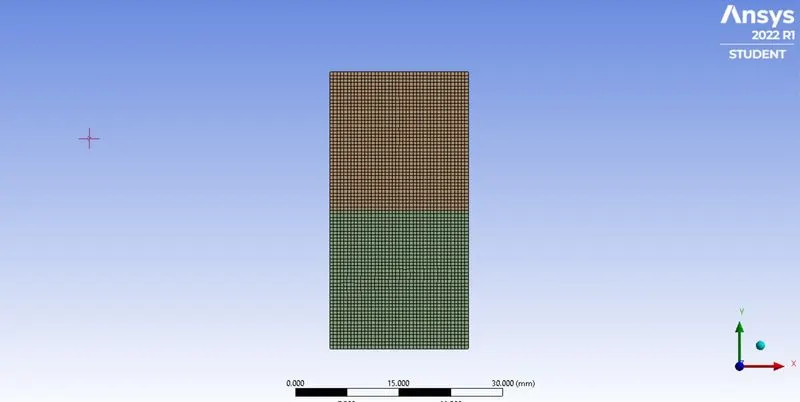
Size = 0.5 mm
No.of Elements = 3200
Size = 0.1 mm
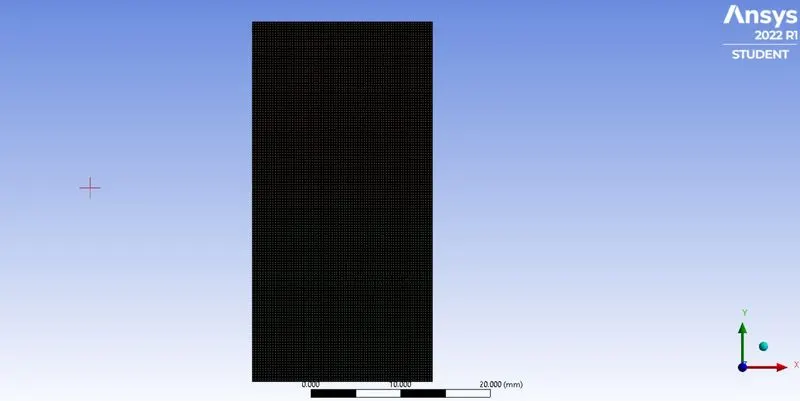
No.of Elements = 80000
Setup :
We choose laminar model. Since the instablity is a very fine and needed to be observed mineautly it requires small time steps to perfectly capture the interaction.We choose transient model as it is suitable for smaller time steps as in this case. Therefore this becomes a time marching solution, thats the reason we do not consider this case as steady state model.
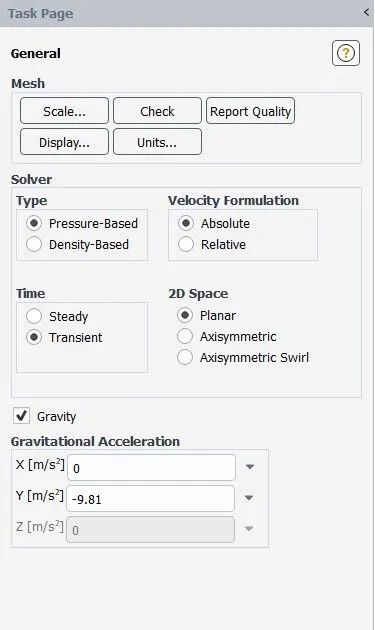
Since the model is orieanted inX-Y plane we give the gravitational force along -Y direction.
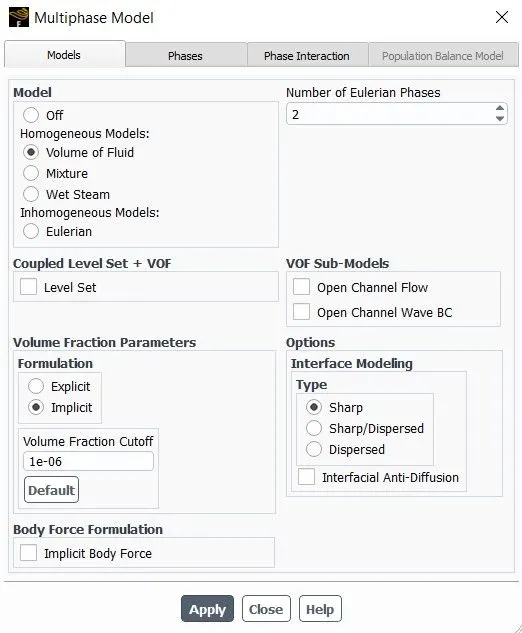
We choose Volume of Fluid method as it computes by considring the formed bubbles and it keeps track of it at every timnesteps.
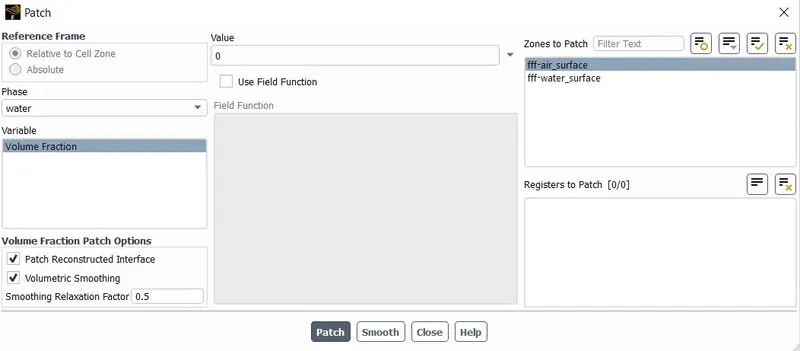
Then we patch the two surfaces in this case we visuvalize for water and we input water as 1 and makes it a heavier fluid on top and 0 for air and makes it below.
We then initialize the solution and run it for the below conditions.
Outputs:
Condition 1 :
Fluid Air & Water
Time step Size = 0.005
No.of Time steps = 1000
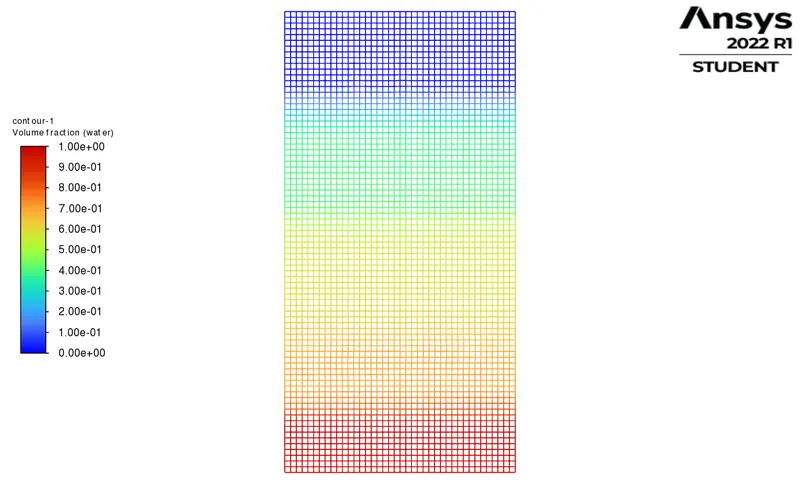
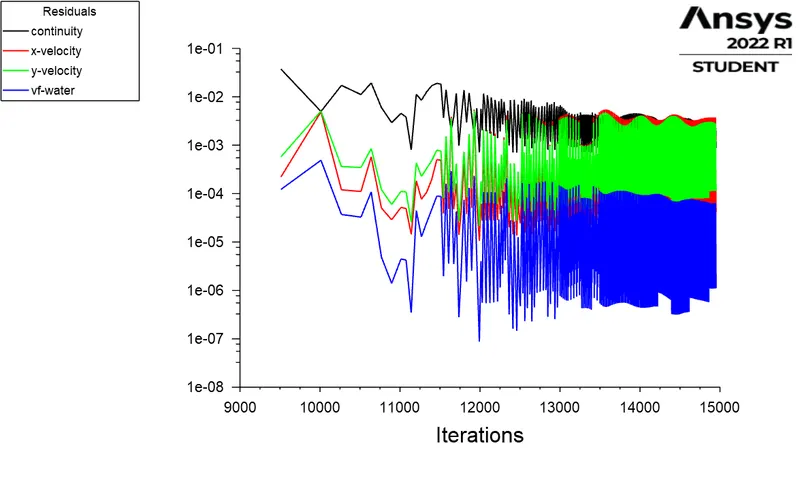
Link :Animated video
Refined Case :
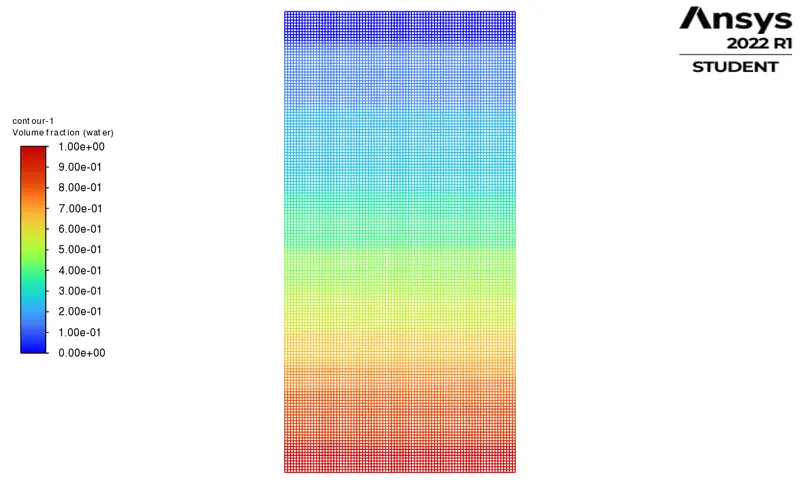
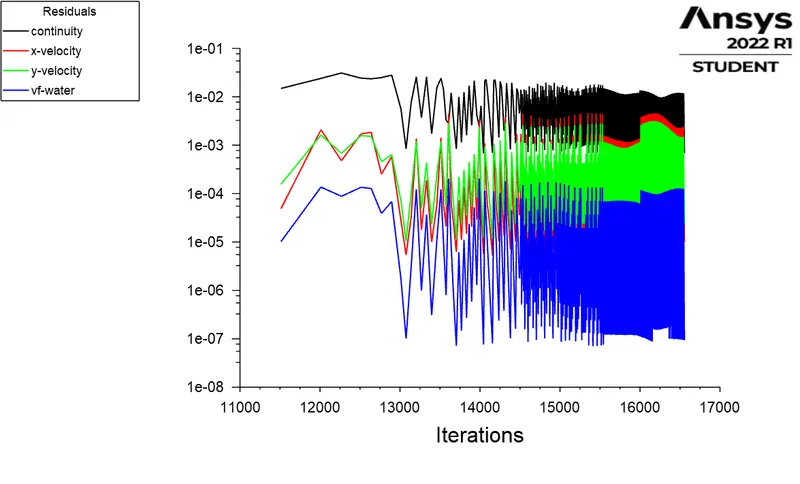
Link: Animated video
3) Condition 2:
Fluid User Defined & Water
Density = 400 kg/m3
Viscosity = 0.001 kg·m−1·s−1
Time step Size = 0.002
No.of Time steps = 1000
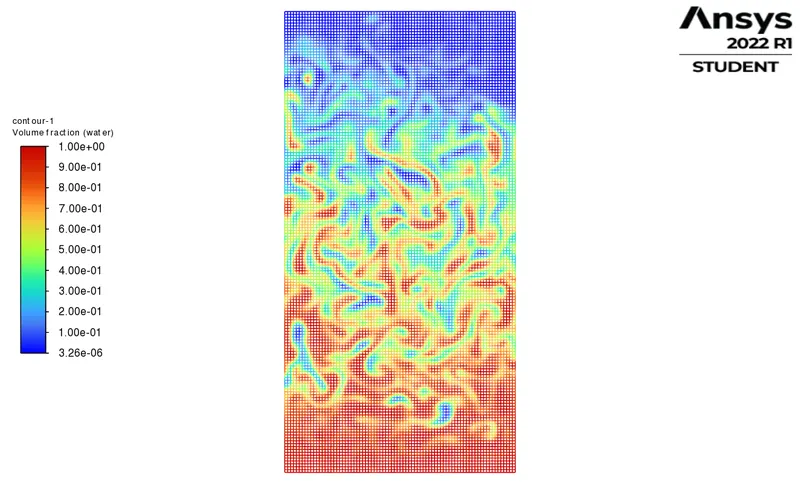
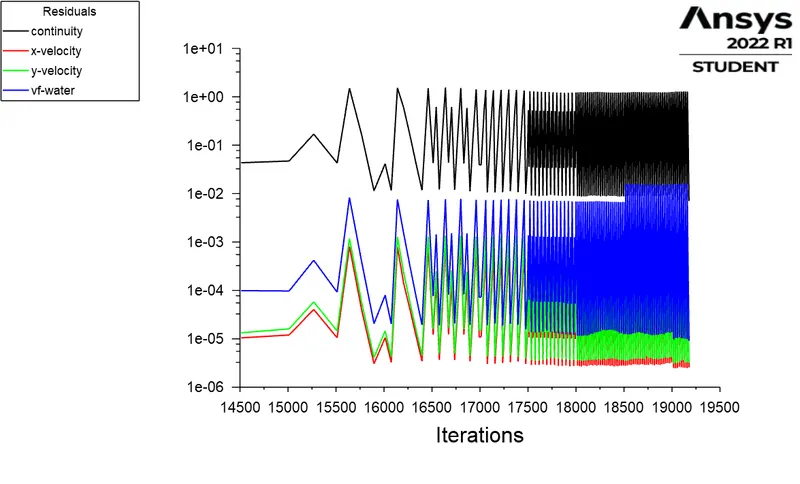
Link : Animated video
Conclusion and challenges:
With the results above the lower density fluid pushes the heavier fluid and leads to a disturbunce at the interface and creates bubbles which grows exponentionally with time. Further the finer condition captures the details better than the first and the bubbles stays a bit longer and takes more time to settle.
4) Antwood Number:
Antwood number is a diementionless number used to study the hydrodynamic instablities in density stratified flows. At the interface it is the density difference between two adjucent fluids. With the result of Antwood Number we can say if the number is close to 0 then Rayleigh Taylor instablity flow takes the form of 'symmetric' fingers of the fluid. and if the number is close to 1 then the lighter fluid flows straigth above and into the heavier fluids in form of bubbles. Further if the number is positive the interface is stable and unstable if it is negative. It is defiend as follows,
Antwood Number (A) =`(rho(1) -rho(2)) / (rho(1) + rho(2))`
`rho(1) =` Density of heavier fluid
`rho(2) =` Density of lighter fluid
Density of Water (`rho(1)`) = 998.2 `(kg)/(m)^3`
Density of Air =1.225 `(kg)/(m)^3`
Density of User defined fluid = 400 `(kg)/(m)^3`
Condition 1:
Air & Water , A =`( 998.2 - 1.225)/(998.2 + 1.225)`
A= 0.997
Condition 2:
User Defined Fluid & Water , A = 0.427
From the above results, for condition 1 since the result is large and close to 1 there willbe formation of bubbles. And for condition 2 since the value is close to 0 there will be formation of spikes or fingers.