Week 5 - Rayleigh Taylor Instability
RAYLEIGH-TAYLOR INSTABITIES
Aim:
To simulate Rayleigh-Taylor Instability (RTI) between water and air and comparing the results of the simulation from the meshes with different grid size.
Additionally, performing another RTI simulation from water and user-defined fluid (density = 400 kg/m^3 and viscosity = 1e-3 kg/m-s) in order to observe the effect on the behavior of RTI with the variation in Atwood number.
Theory:
Rayleigh-Taylor Instabilities:
The Rayleigh-Taylor Instabilities or RTI, is an instability of the interface of the two fluids with different densities when the low-density fluid pushes the high-density fluid. RTI can be observed in a setup, where two immiscible fluids with different densities are placed with more dense fluid on top of less dense fluid within the influence of Gravity. In such cases the interface becomes instable and heavier fluid moves downwards and lighter fluid moves upwards. This unstable arrangement possess high potential energy and it gradually decreases with the fluids moving under the effect of gravity. Such setup was prepared and studied by Lord Rayleigh.
Example for RTI:
Real time examples for RTI are Suspension of water on top of the oil, formation of Mushroom Clouds on volcanic eruption or nuclear explosion, instabilities in the plasma fusion reactors, etc.
An important observation by Taylor was that the same phenomenon is observed when the lower density fluid is accelerated into the higher density fluid. Such occurrence can be observed in the explosion as volcanic eruption and nuclear explosion, even in supernova explosions where the expanding gases from explosion accelerates into the denser surrounding gases.
Following are the few practical CFD models that are based on the mathematical analysis of Rayleigh-Taylor waves:
Kelvin-Helmholtz Instability:
Kelvin-Helmholtz Instability occurs when there is velocity difference across the interface of the two parallel streams of fluids (either homogeneous or heterogeneous). The velocity shear at interface induces vorticity leads to formation of unstable vortex street that roll up into a spiral. Example- Air blown over hot water surface.
Richtmyer-Meshkov Instability:
Richtmyer-Meshkov Instability occurs when shockwave is refracted by interface of the two fluids. Shockwave creates an intensive impulse leads to sudden acceleration of fluid at the interface. Bubbles are formed when lighter fluid enters into the denser fluid and spikes are formed for vice-versa.
Plateau-Rayleigh Instability:
Plateau-Rayleigh Instability occurs when the falling fluid splits and reduces into small droplets. By the virtue of surface tension, liquids have tendency to minimize their surface area to possess minimum potential energy.
Procedure:
Workbench Project:
-Open ANSYS Workbench and drag and drop Fluent
-Click on File and Save the project as ‘ Rayleigh_Taylor_Instability ’
Geometry:
-Creating a 2-D square surface of dimension 20 m x 20 m and name it as AIR. Place another square surface on top of it and name it as WATER.
-Make sure to enable share topology to avoid formation of non-conformal mesh at the interface of the surfaces.
-Click on File and Save the Project.
Meshing
-Open ANSYS Mesh and click on generate mesh to create a baseline mesh.
-We will run the simulation for two cases one with baseline mesh size and another with refined mesh size.
-For baseline mesh set the element size as 5e-3m and for refined mesh set element size as 1e-3m.
-Save the Project.
50mm
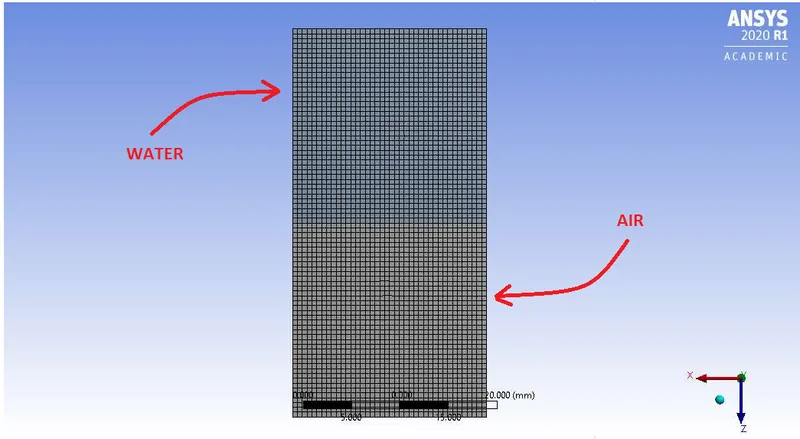
25mm
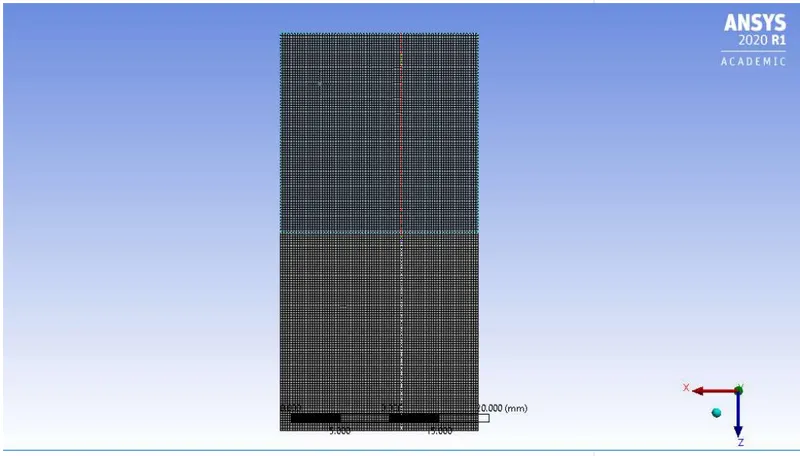
Setup:
-Open ANSYS Fluent and setup the simulation as mentioned below:
- Solver Type: Pressure-Based Transient simulation
- Enable Gravity with -9.81 m/s^2 in Y-direction
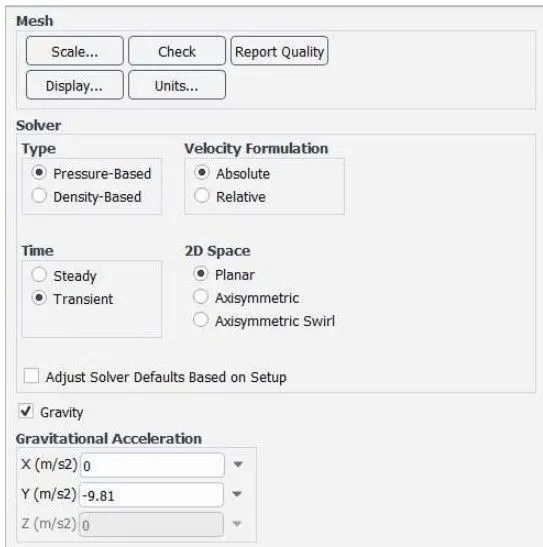
- Material: Import the data of AIR and WATER from the Fluent Database.
- Model: Multiphase model with VOF model. Select AIR as primary phase and WATER as secondary phase.
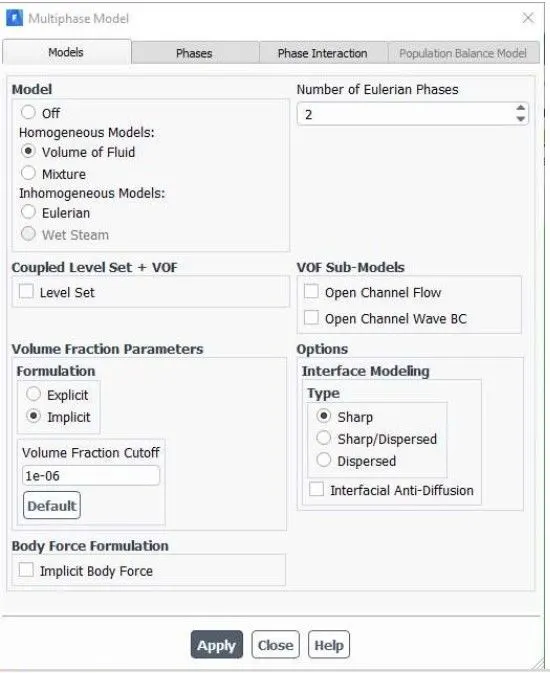
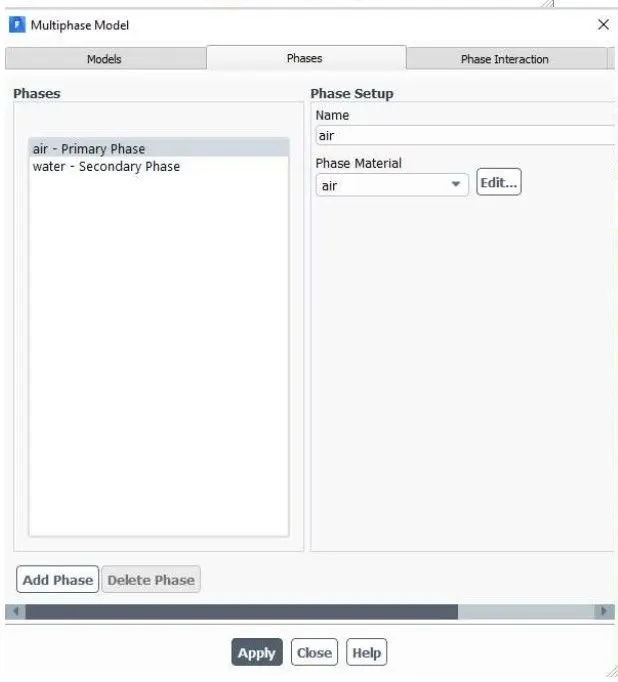
-Initialize the solution using Standard Initialization and patch the air and water in their respective zones.
- Set the timestep of 0.005 sec for 1000 iterations. Click on the calculate to run the simulation.
Results:
Animations:
WATER AND AIR 50MM
WATER AND AIR 25MM:
Similar Results are created for the simulation of RTI for WATER and USER-DEFINED Material.
Discussion and Conclusion:
Atwood Number:
Atwood number is defined as a dimensionless number in fluid dynamics used in the study of hydrodynamic instabilities in density stratified flow. It is defined as
`(rho_a-rho_b)/(rho_a+rho_b)`
where a is denser fluid
b is lighter fluid
Atwood Number for Water and Air :
`(rho_w-rho_a)/(rho_w+rho_a)`
`(998.2-1.225)/(998.2+1.225) = 0.9975`
Atwood Number for Water and User-Defined Material :
`(rho_w-rho_u)/(rho_w+rho_u)`
`(998.2-400)/(998.2+400) = 0.427`
Atwood number is an important parameter in the study of Rayleigh Taylor Instability helps in the prediction of the nature of the instability. Atwood number close to 0, the instability take place in the form of fingers in the fluid; whereas what the Atwood number close to 1, bubble like plumes are formed.
Atwood number for the air and water interface is close to 1 and we found in the simulation that the water being denser fluid moves downward under the influence of gravity and air moves upward leads to formation of bubble-like plums. Whereas for the water and the user defined material, Atwood number is close to 1, water moves downward into the user defined material takes the form of fingers in the fluid.
Why a steady state approach might not be suitable for simulation of Rayleigh-Taylor instability
Transient approach is most suitable for this simulation, than steady state approach, because we need to capture the transition of the system for every iterations and timestep to observe the behavior of interaction of the fluids.