Week 5 - Rayleigh Taylor Instability
Some practical models that is based on the mathematical analysis of Rayleigh Taylor waves:
The Kelvin–Helmholtz instability happens when there is a velocity difference across the interface between two fluids. A common example is observed when wind blows across a water surface. Here the instability can be observed as waves.
The Richtmyer–Meshkov instability happens when two fluids having different densities are impulsively accelerated
Aim:
- Perform the Rayleigh Taylor instability simulation for 2 different mesh sizes.
- Compare the results by showing the animation
Solving approach:
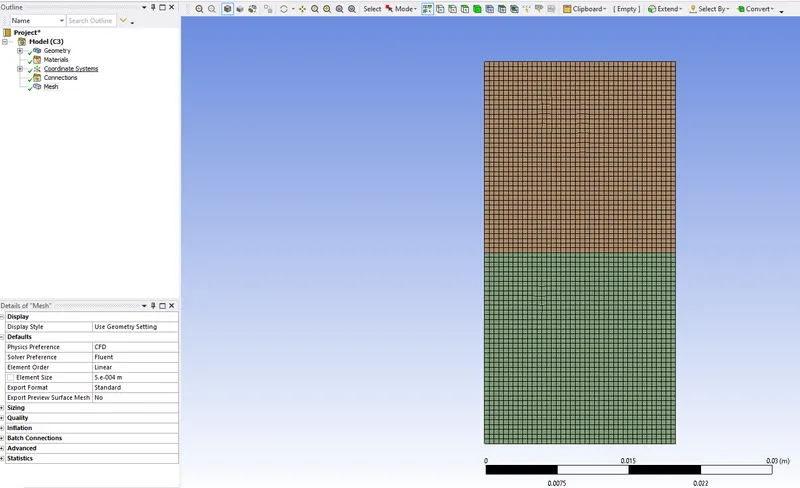
Mesh quality:

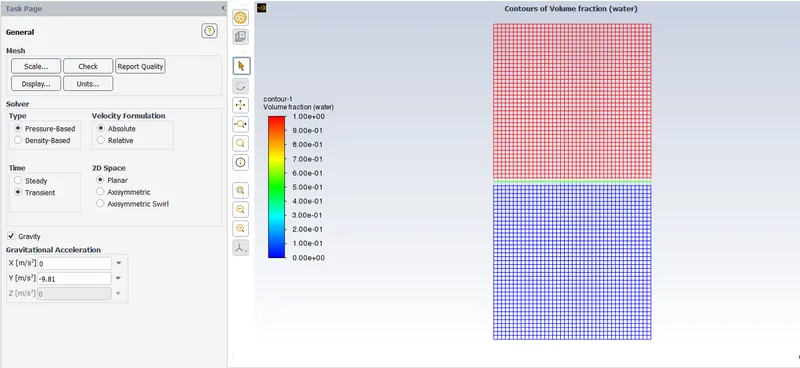
Solver Settings:
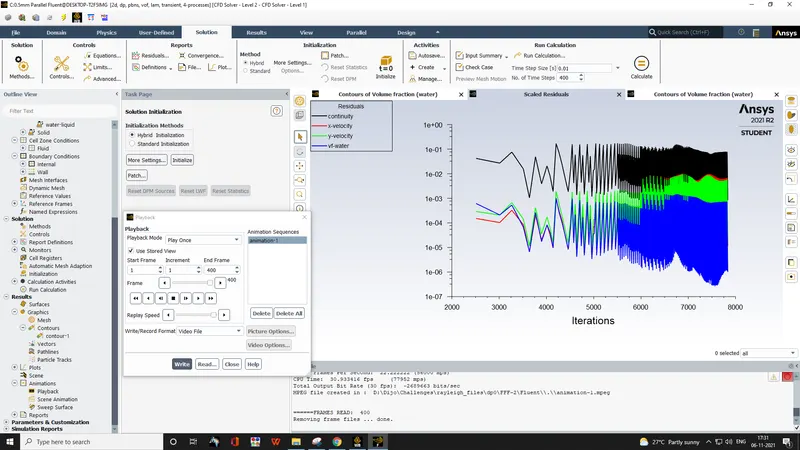
Scaled residuals:
Results:
1. Animation for Rayleigh Taylor instability simulation with mesh size 0.4mm and Time step size 0.05sec:
https://youtu.be/8UZMR7zrKXM
2. Animation for Rayleigh Taylor instability simulation with mesh size 0.5mm and time step size 0.01sec :
https://youtu.be/cJUzhyFWmw0
3. Animation for Rayleigh Taylor instability simulation for user defined material :
https://youtu.be/1JZ4eiNNmYE
Atwood number is a dimensionless quantity used to analyse the hydrodynamic instabilities in density startified flows.
A = (rho1-rho2)/(rho1+rho2)
rho1=density of heavier fluid
rho2=density of lighter fluid
Atwood number is used in the analysis of Rayleigh-Taylor (RT) instability.
Rayleigh-Taylor (RT) instability happens when a less denser fluid supports a high density fluid and then any disturbance of the interface will make the heavier fluid to penetrate into the lighter fluid(due to gravity) and the interface becomes unstable.
The interface will be stable if the less density fluid is above the heavy fluid.
In Rayleigh–Taylor instability, the penetration distance of heavier fluid bubbles into the lighter fluid is a function of acceleration time scale, Agt^2 where g is the gravitational acceleration and t is the time.
For low Atwood number the disturbances can be approximated as linear for a larger time.
For higher Atwood number, amplitude of disturbance is too large and it occurs very rapidly which leads to a non linear growth rate.
Finer mesh helps to capture the instability much better compared to that with the coarse mesh. But computational cost increases.
In this simulation we are capturing instabilities. These instabilities are unpredictable. They are changing in as a function of time therefore transient approach is preferred for this kind of simulations.
For Air and water,
Water, rho1 = 998.2
Air, rho2 = 1.225
Atwood No. = (998.2-1.225)/(998.2+1.225) = 0.998
For water- user defined material,
Water, rho1 = 998.2
user defined material, rho2 = 400
Atwood No. = (998.2-400)/(998.2+400) = 0.428
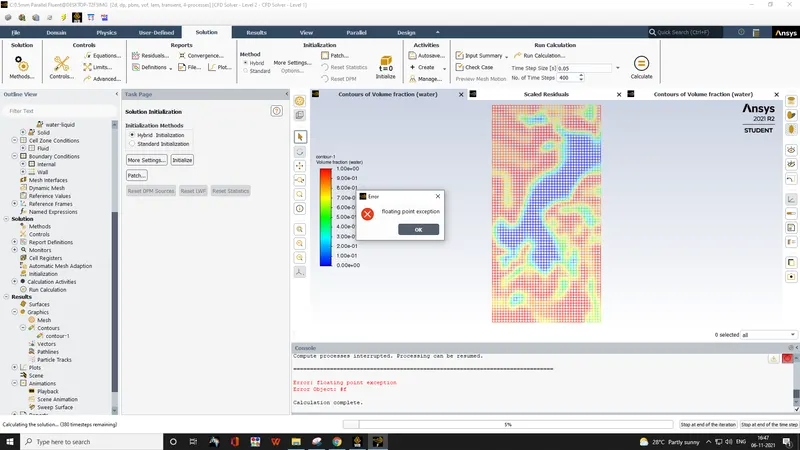
Error occured:
Floating point exemption: Occured when used a larger time step size of 0.05
It was resolved when we used a smaller time step size of 0.01 or 0.001