Week 5: Prandtl Meyer Shock problem
Aim:
- To provide an overview of theoritical and computational details on shock wave in high speed compressible flows.
- Simulate Prandtl Meyer Shock Problem and note the effects of sub grid scaling of the adapative mesh refinement on the flow and simulation parameters
Objectives:
- Provide a high level introduction on shock waves and Prandtl Meyer Problem by carrying out literature review on shock waves
- Using the literature review, set up a case of the Prandtl Meyer Problem using CONVERGE Studio
- Document the effects of sub grid scaling attribute of the Adapative Mesh Refinment feature on the flow and simulation parameters
- Post Process the simulation results using Paraview and CONVERGE Studio
Theory:
Shock is defined as a disturbance which propogates faster than the local speed of the sound in the medium. It is generally characterized by the sharp change in the values of flow parameters such as the pressure, velocity and density. The shock waves are further classified into three major groups: Normal shock, Bow shock and Oblique shock. The naming convention for the shock types are based on its angle and shape with respect to the flow direction
The core concept behind the shock formation is the difference of speed between the object travelling at speeds greater than that of sound and local speed of the sound. The information to "move away" from the disturbance cannot propogate to the nearby fluid before the disturbance arrives.
The concept is visually depicted in the following illustration where a, V and M have their standard meaning form the Fluid Mechanics literature.
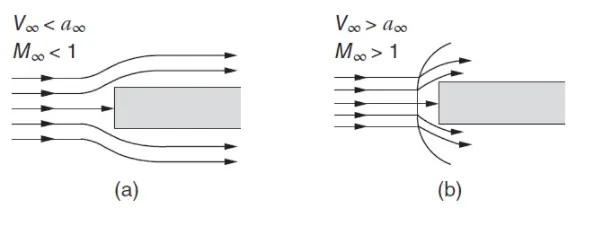
Experimental evidence show that the size of the shock waves are in order of the mean free path and hence with respect to continuum hypothesis for two and three dimensional flow shock waves can be treated as a line or surface of zero thickness respectively.
In the Prandtl Meyer shock problem, due to the sudden expansion of the geometry a similar phenomenon to shock is observed. This is called as the expansion fan. There are few differences between the shock and the expansion fan, they are as follows. Along a shock the total energy is constant but the entopy increases but the flow through the expansion fan is isentropic. The Mach Number deacrease along the shock while the Mach Number increases for the expansion fan. Similarly reverse relationship is observed for flow parameters like the temperature, pressure and fluid property density for shocks and expansion fan.
An illustration of the Prandtl Meyer Problem which highlights the expansion fan is shown as follows
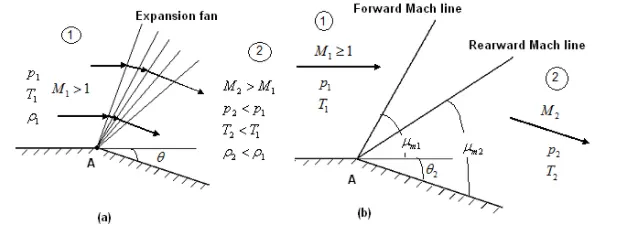
This mild introduction to shocks and expansion fan is just provided to provide a intuitive idea about these complex concepts. For further mathematical details, the reader is encouraged to refer Wiki articles or standard compressible fluid flow textbooks.
Using the analysis of the pseudo linear partial differential equations on compressible Navier-Stokes equation, one can conclude that the governing equations are hyperbolic in temporal and spatial terms. As a result, the compressible Navier-Stokes equation can be solves as an initial value problem. So, instead of specifing the outlet boundary conditons for the flow parameters as Dirichlet condition we supply a zero normal gradient boundary condition (Neumann condition), since the solution can interpolate those values on the outlet from the interior of the domain using the domain of dependence.
Geometry:
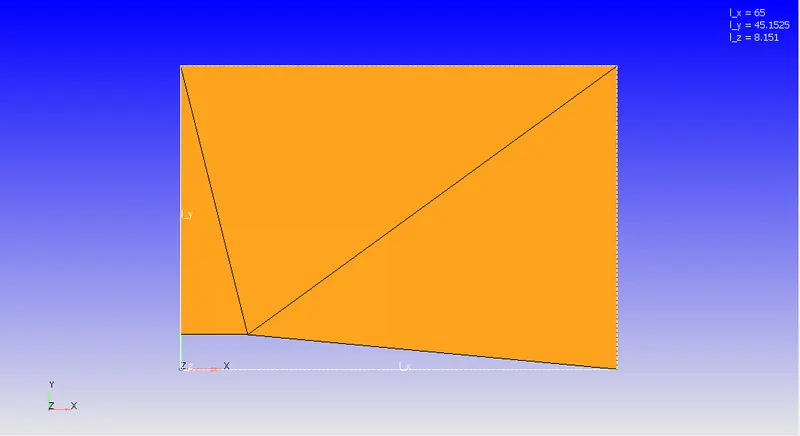
For simulating the Prandtl Meyer shock problem, we add a five sided polygon such that the expansion region is not abrupt. The total length in the x-direction is 65 m, in the direction it is 45.1525 m and ~8 m in the z direction. As we treat the current problem as a slice of an infinite domain in the z-direction, the problem is two-dimensional as the gradients in the z-direction are virtually zero.
Case Setup:
The case setup for the current study is carried out using the CONVERGE Studio Case Setup GUI. The following settings have been chosen for the simulation in the respective subtree
- Application subtree:
- Due to the relatively simple nature of the geometry, the Time based application was chosen
- Materials subtree:
- We choose the pre-defined mixture of Air for the gas simulation with default settings
- The global transport parameters with default settings is chosen
- Air is assumed to be 77% Nitrogen and 23% Oxygen and is a non-reacting mixture
- Simulation Parameters subtree:
- A compressible steady state solver with full hydrodynamic feature is chosen for the study
- A steady state monitor for average velocity, static pressure, average temperature and average density at the outlet is chosen with a sample size of 500 cycles for a relative tolerance `10^{-4}`
- We chose 25000 as the total number of the cycles and maximum convection CFL number as 1 to satisfy the CFL criteria
- The Navier-Stokes Solver is set to the default density-based PISO scheme
- Boundary conditions subtree:
- Inlet: Pressure = Static Pressure of 101000 Pa (1.01 bar), Velocity = Uniform value of 678 m/s in the x-direction, Temperature = Uniform value of 286K, Species = 0.23 Oxygen and 0.77 Nitrogen massfraction
- Outlet: Pressure = zero normal gradient, Velocity = zero normal gradient (Initial Value Problem)
- Wall: Velocity = Stationary, fixed with slip, Temperature = zero normal gradeint
- Front and Back = Two Dimensional boundary condition
- Initial Conditions and Events subtree:
- The entire domain is initialized with velocity of 678 m/s in the x-direction, at 286K and at 101000 Pa with Standard Air
- Physical models subtree:
- The fluid flow is inviscid so we dont use any turbulence modelling
- Grid Control subtree:
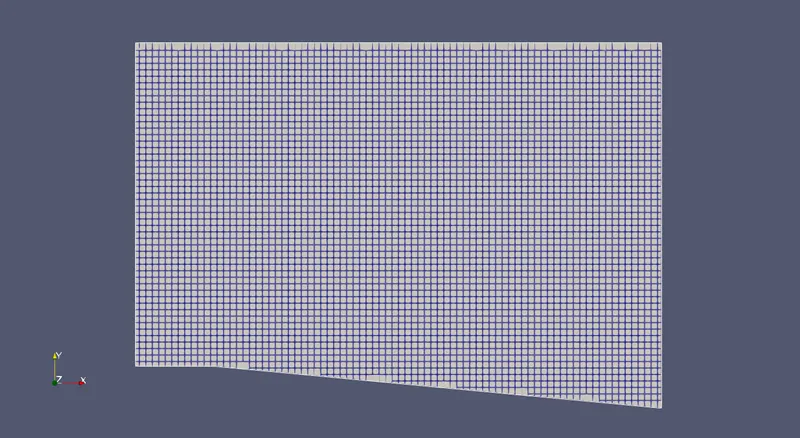
- A base grid of 0.8 m is used in all the directions
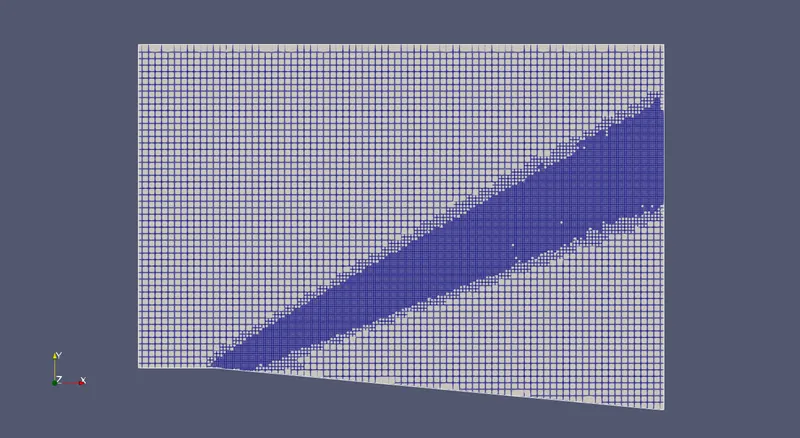
- Adaptive mesh refinement based on the temperature with 2 embedded layers and a sub-grid criterion
The initial base mesh generated from the case setup is as follows:
Simulation Results:
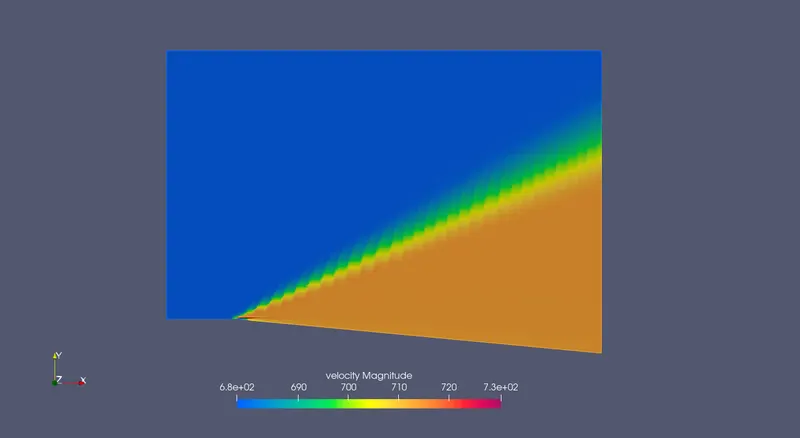
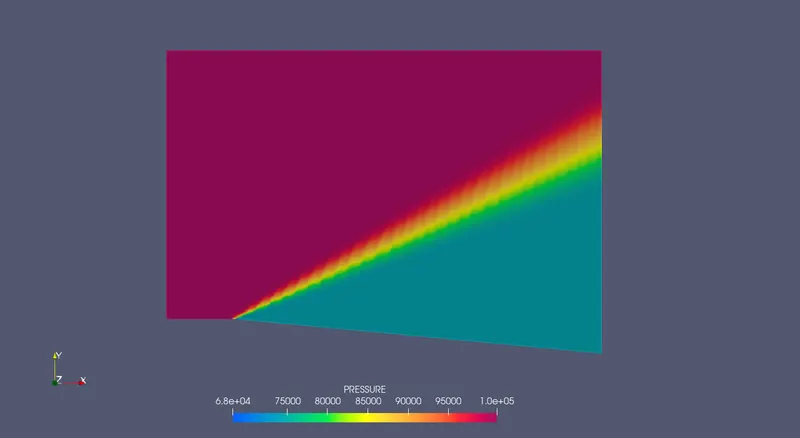
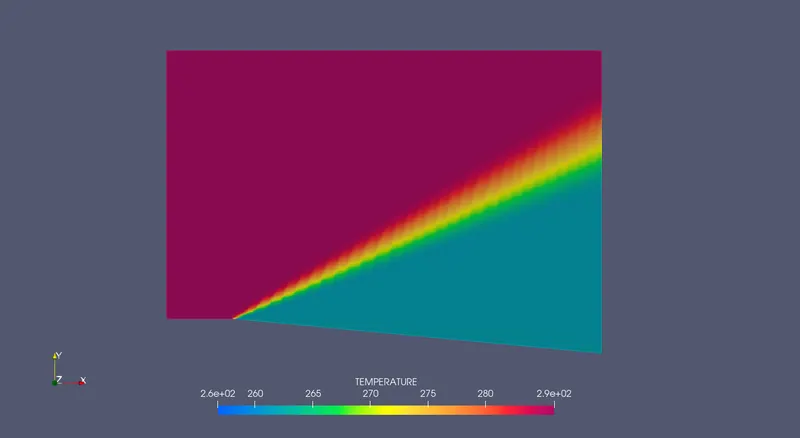
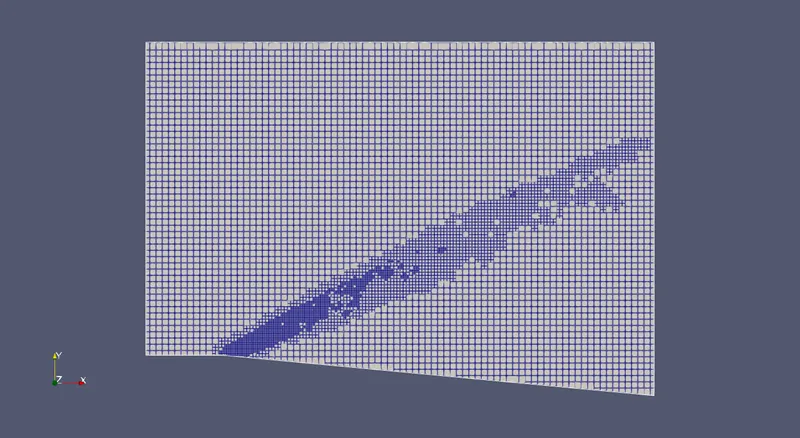
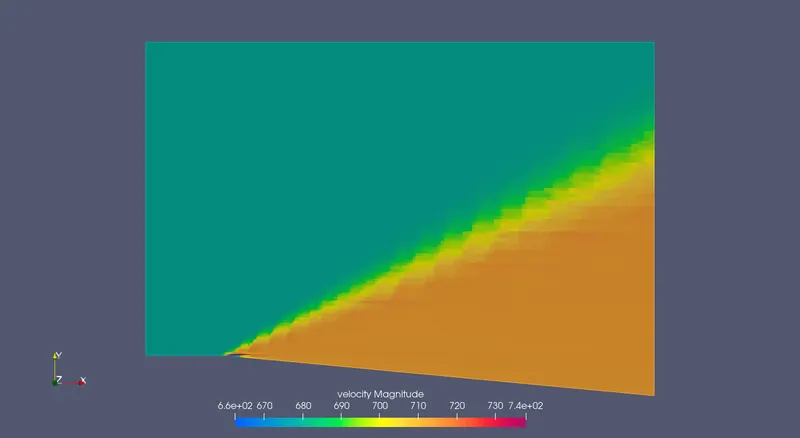
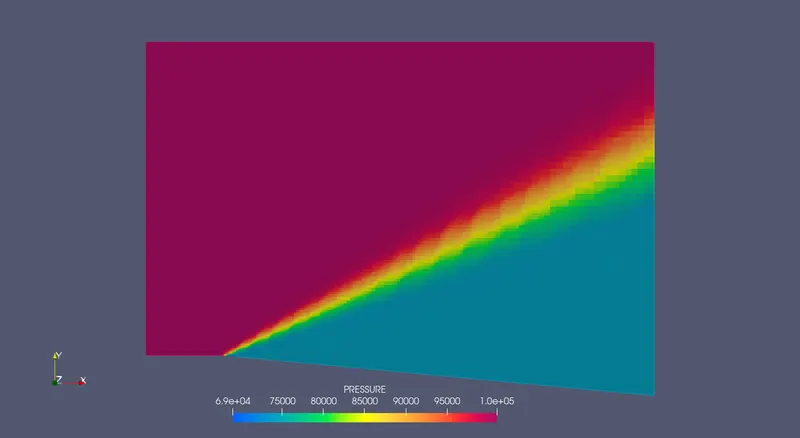
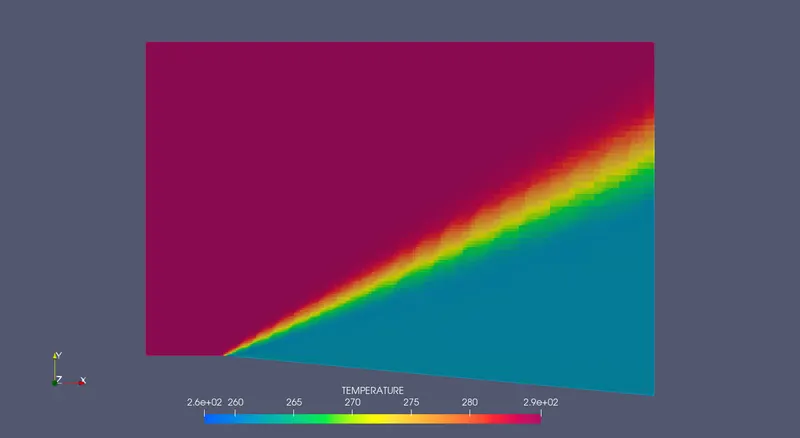
For the current study, we study the effects of the sub-grid criterion. So we have chosen the subgrid scale values of 0.01, 0.05 and 0.1 for the analysis
Mesh 1: (Subgrid scale criterion = 0.01) (Animation Link)
The steady state adaptive refined Mesh 1 is illustrated as below
Velocity Contour:
Pressure Contour:
Temperature Contour:
Mesh 2: (Subgrid scale criterion = 0.05) (Animation Link)
The steady state adaptive refined Mesh 2 is illustrated as below
Velocity Contour:
Pressure Contour:
Temperature Contour:
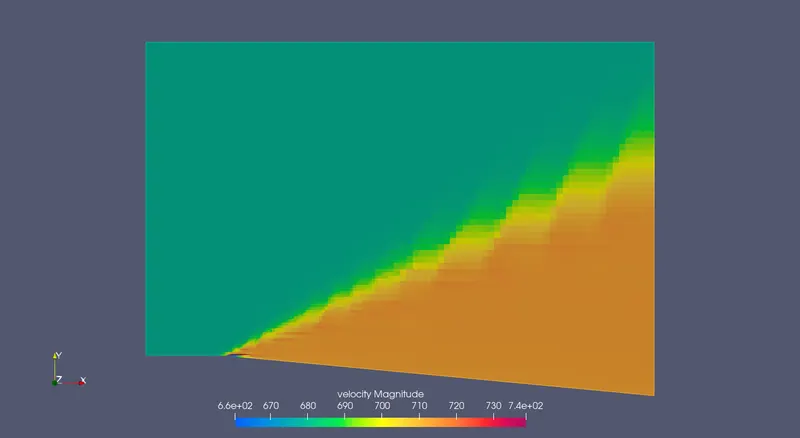
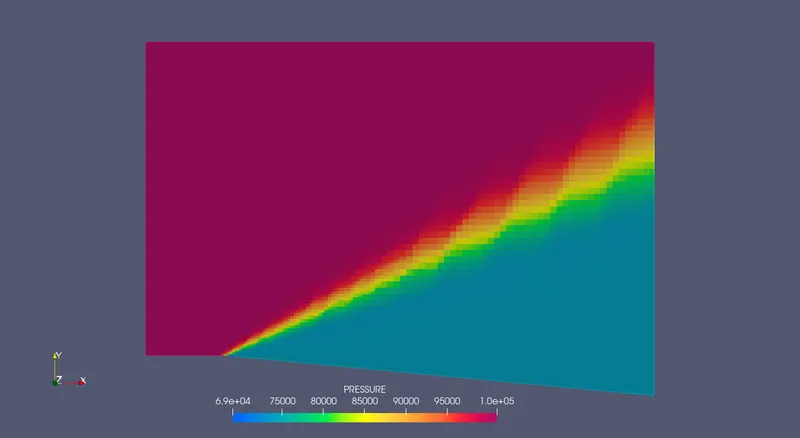
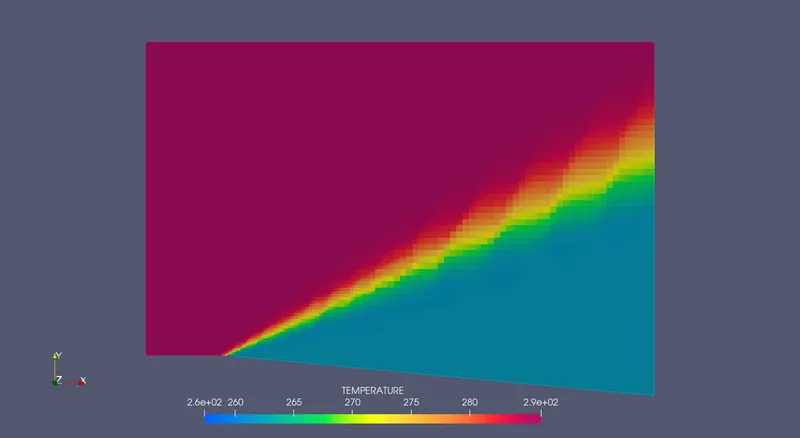
Mesh 3: (Subgrid scale criterion = 0.1) (Animation Link)
The steady state adaptive refined Mesh 2 is illustrated as below
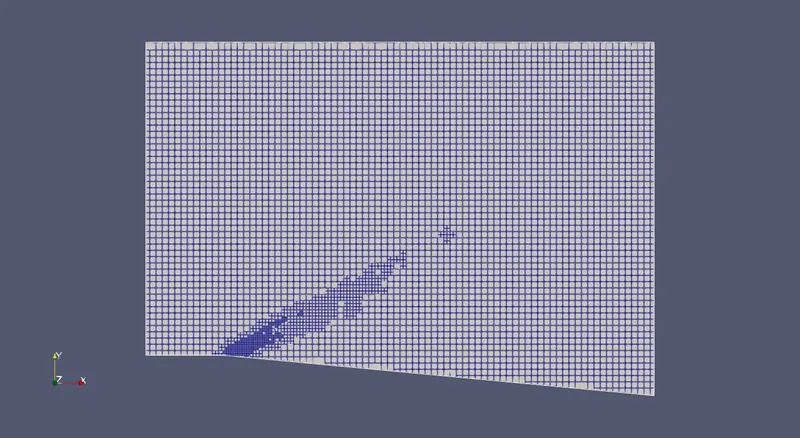
Velocity Contour:
Pressure Contour:
Temperatue Contour:
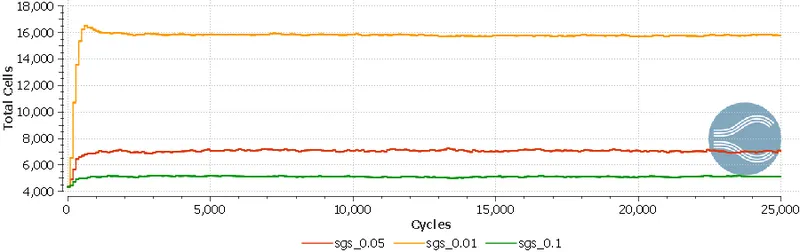
Effects on the total number of cells due to the adaptive mesh
Conclusions:
From the contour and the line plots, we note the following observations
- The theoritical description of the expansion fan is fairly captured in all the three meshes i.e. the temperature and the pressure values drop while the velocity increases across the expansion fan
- The sub scale criterion has a inverse effect on the resolution of the expansion fan. We conclude that for simulation containing shocks and expansion fans should consider having a smaller sub-scale value
- The total number of cells are inversely proportional to the sub grid scaling, but the relationship is non-linear. Hence, care should to be taken while chosing the SGS criterion depending on the required accuracy and available computational resources.
- In this project, we verified the analytical solution of the Prandtl Meyer problem by carrying out supersonic flow simulations in CONVERGE. The effects of advanced meshing techniques such as Adaptive Mesh Refinement was used and its effects on the simulation results were documented.