Solving the steady and unsteady 2D heat conduction problem
2D Heat Conduction equation is a partial differential equation that explains how heat gets distributed over a while. Based on the time, the transfer of heat occurs may occur in two ways
- Steady-state condition
- Transient State condition
For any system to achieve a steady state, it has to first undergo an unsteady process. Only after a period of unsteadiness, steady-state is achieved.
The steady-state 2D heat conduction equation is
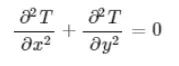
The Transient state 2D heat conduction equation is
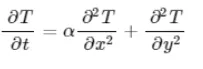
The above described Partial Differential Equations needs to be discredited, a central difference scheme in space is used to discretize this equation.
Discretization of the above PDE leads to a set of equations, which can be solved either Implicitly or Explicitly.
In laymen's terms, Explicit means clear; this is a direct way or an easy way t solve these equations. It is less complex when compared to its counterpart. In this case, we use terms from (n)th iteration or timestep to find terms in (n+1)th iteration or timestep. This seems normal.
In an Implicit method, we use terms from both (n)th time step and (n+1)th time step to form coupled equations and solve them to get the terms in (n+1)th time step.
This explanation of Implicit and Explicit methods is not accurate, but it is easy to understand. For an accurate definition, one may refer to standard Textbooks or videos from youtube.
Now, these Implicit and Explicit methods can further be solved using various iterative methods. In this project, we are limiting to only 3types of methods
- Jacobi Method
- Gauss Sidel Method (GS)
- Successive Over-Relaxation Method (SOR)
The user of the code is given the freedom to select whichever method he/she may want to use.
Temperature Function :
%% Temperature matrix

function T = temperature_matrix(ttop,tbot,tleft,tright,nodex,nodey)


T=298*ones(nodex);
T([1:nodex],nodey)=ttop;
T([1:nodex],1)=tbot;
T(1,[1:nodey])=tleft;
T(nodex,[1:nodey])=tright;

T(1,1)=0.5*[T(2,1)+T(1,2)];
T(nodex,1)=0.5*[T(nodex-1,1)+T(nodex,2)];
T(1,nodey)=0.5*[T(1,nodey-1)+T(2,nodey)];
T(nodex,nodey)=0.5*[T(nodex,nodey-1)+T(nodex-1,nodey)];

end
Program - This program is written in the form of a tree, using loops and conditions, where the selection of Type of Heat flow is at the top level followed by the Explicit/Implicit Method ( for Transient flow ) further followed by the type of iterative method.
clear all
close all
clc

nodex=10;
nodey=10;
x=linspace(0,1,nodex);
delx=x(2)-x(1);
y=linspace(0,1,nodey);
dely=y(2)-y(1);
denominator=2*[(delx)^2+(dely)^2];

T =temperature_matrix(600,900,400,800,nodex,nodey);
Told=T;
Tprev=T;
T_SOR=T;
Threshold=1e-4;
error=1;

display('Type 1 for Steady and 2 for Transient ')
Flow=input('');


% Steady Flow

if Flow==1

    display('Type 100 for Jacobi; 101 for Gauss and 102 for SOR')
    Method=input('Choose the method-');

    %Steady - Jacboi

    iteration=1;
    if Method==100
        while error > Threshold
            for i=2:nodex-1
                for j=2:nodey-1
                    T(i,j)=[(Told(i+1,j)+Told(i-1,j))*(dely)^2+(Told(i,j+1)+Told(i,j-1))*(delx)^2]/denominator;
                    error=max(max(abs(T-Told)));
                end
            end
            Told=T;
            iteration=iteration+1;
            [xx,yy]=meshgrid(x,y);
            figure(1)
            surfc(xx,yy,T)
            colorbar
            shading interp
            pause(0.01)
            title_text=sprintf('Steady state-Jacobi iteration number= %d',iteration);
            title(title_text)

            figure(2)
            contourf(x,y,T)
            [a b]=contourf(x,y,T);
            clabel(a,b);
            colorbar
            pause(0.01)
            title_text=sprintf('Steady state-Jacobi iteration number= %d',iteration);
            title(title_text)


        end
        Jacobi_iterations=iteration
    end


    % Steady - Gauss Sidel

    if Method==101
        while error > Threshold
            for i=2:nodex-1
                for j=2:nodey-1
                    T(i,j)=[(Told(i+1,j)+T(i-1,j))*(dely)^2+(Told(i,j+1)+T(i,j-1))*(delx)^2]/denominator
                    error=max(max(abs(Told-T)));
                end
            end
            Told=T;
            iteration=iteration+1;
            [xx,yy]=meshgrid(x,y);
            figure(1)
            surfc(xx,yy,T)
            colorbar
            shading interp
            pause(0.01)
            title_text=sprintf('Steady state-GS iteration number= %d',iteration);
            title(title_text)

            figure(2)
            contourf(x,y,T)
            [a b]=contourf(x,y,T);
            clabel(a,b);
            colorbar
            pause(0.01)
            title_text=sprintf('Steady state-GS iteration number= %d',iteration);
            title(title_text)
        end
        GS_iterations=iteration
    end


    % Steady - SOR - GS

    if Method==102
        SOR_Factor=input('Relaxation Factor = ')
        while error > Threshold
            for i=2:nodex-1
                for j=2:nodey-1
                    T(i,j)=Told(i,j)+SOR_Factor*[[[(Told(i+1,j)+T(i-1,j))*(dely)^2+(Told(i,j+1)+T(i,j-1))*(delx)^2]/denominator]-Told(i,j)];
                    error=max(max(abs(Told-T)));
                end
            end

            Told=T;
            iteration=iteration+1;
            [xx,yy]=meshgrid(x,y);
            figure(1)
            surfc(xx,yy,T)
            colorbar
            shading interp
            pause(0.01)
            title_text=sprintf('Steady state-SOR iteration number= %d',iteration);
            title(title_text)

            figure(2)
            contourf(x,y,T)
            [a b]=contourf(x,y,T);
            clabel(a,b);
            colorbar
            pause(0.01)
            title_text=sprintf('Steady state-SOR iteration number= %d',iteration);
            title(title_text)
        end
        SOR_iterations=iteration;
    end

end

% Transient Flow

if Flow==2

    display('Type 1 for Explicit; 2 for Implicit')
    Method=input('Choose the method-');

    delt=1e-3;
    nt=1400;
    alpha=1.1;
    CFLx=(alpha*delt)/(delx^2);
    CFLy=(alpha*delt)/(dely^2);

    %For explicit schemes CFLx+CFLy < 0.5

    % Explicit
    if Method==1
        iteration=1
        for t=1:nt
            error=1
            while error > Threshold
                for i=2:nodex-1
                    for j=2:nodey-1
                        Term1=1/(1+2*CFLx+2*CFLy);
                            Term2=CFLx*(Told(i-1,j)+Told(i+1,j));
                            Term3=CFLy*(Told(i,j-1)+Told(i,j+1));
                            T(i,j)=Term1*(Told(i,j)+Term2+Term3);
                    end
                end
                error=max(max(abs(Told-T)));
                Told=T;
                iteration=iteration+1;
            end

            [xx,yy]=meshgrid(x,y);
            figure(1)
            surfc(xx,yy,T)
            shading interp
            colorbar
            pause(0.01)
            title_text=sprintf('Unsteady-Explicit iteration number= %d',iteration);
            title(title_text)

            figure(2)
            contourf(x,y,T)
            [a b]=contourf(x,y,T);
            clabel(a,b);
            colorbar
            pause(0.001)
            title_text=sprintf('Unsteady-Explicit iteration number= %d',iteration);
            title(title_text)

        end

    end

    % Implicit

    if Method==2
        display('Type 100 for Jacobi; 101 for Gauss and 102 for SOR')
        Method=input('Choose the method-');


        % Transient - Implicit - JAcobi
        if Method==100
            iteration=1
            for t=1:nt
                error=1;
                while error > Threshold
                    for i=2:nodex-1
                        for j=2:nodey-1
                            Term1=1/(1+2*CFLx+2*CFLy);
                            Term2=CFLx*(Told(i-1,j)+Told(i+1,j));
                            Term3=CFLy*(Told(i,j-1)+Told(i,j+1));
                            T(i,j)=Term1*(Tprev(i,j)+Term2+Term3);
                        end
                    end
                    error=max(max(abs(Told-T)));
                    Told=T;
                    iteration=iteration+1;
                end
                Tprev=T;
                [xx,yy]=meshgrid(x,y);
                figure(1)
                surfc(xx,yy,T)
                shading interp
                colorbar
                pause(0.01)
                title_text=sprintf('Unsteady-Jacobi iteration number= %d',iteration);
                title(title_text)

                figure(2)
                contourf(x,y,T)
                [a b]=contourf(x,y,T);
                clabel(a,b);
                colorbar
                pause(0.001)
                title_text=sprintf('Unsteady-Jacobi iteration number= %d',iteration);
                title(title_text)

            end
        end

        % Transient - Implicit - GS
        if Method==101

            iteration=1
            for t=1:nt
                error=1;
                while error > Threshold
                    for i=2:nodex-1
                        for j=2:nodey-1
                            Term1=1/(1+2*CFLx+2*CFLy);
                            Term2=CFLx*(T(i-1,j)+Told(i+1,j));
                            Term3=CFLy*(T(i,j-1)+Told(i,j+1));
                            T(i,j)=Term1*(Tprev(i,j)+Term2+Term3);
                        end
                    end
                    error=max(max(abs(Told-T)));
                    Told=T;
                    iteration=iteration+1;
                end
                Tprev=T;
                [xx,yy]=meshgrid(x,y);
                figure(1)
                surfc(xx,yy,T)
                shading interp
                colorbar
                pause(0.01)
                title_text=sprintf('Unsteady-GS iteration number= %d',iteration);
                title(title_text)

                figure(2)
                contourf(x,y,T)
                [a b]=contourf(x,y,T);
                clabel(a,b);
                colorbar
                pause(0.001)
                title_text=sprintf('Unsteady-GS iteration number= %d',iteration);
                title(title_text)

            end
        end

        % Transient - Implicit - SOR

        if Method==102
            Tprev=Told;
            SOR_Factor=input('Relaxation Factor = ')
            iteration=1
            for t=1:nt
                error=1;
                while error > Threshold
                    for i=2:nodex-1
                        for j=2:nodey-1


                            Term1=1/(1+2*CFLx+2*CFLy);
                            Term2=CFLx*(T(i-1,j)+Told(i+1,j));
                            Term3=CFLy*(T(i,j-1)+Told(i,j+1));
                            T(i,j)=Term1*(Tprev(i,j)+Term2+Term3);
                            T_SOR(i,j)=((1-SOR_Factor)*Tprev(i,j))+(T(i,j)*SOR_Factor);

                        end
                    end
                    error=max(max(abs(Told-T)));
                    Told=T;
                    iteration=iteration+1;

                end
                Tprev=T;
                [xx,yy]=meshgrid(x,y);
                figure(1)
                surfc(xx,yy,T_SOR)
                shading interp
                colorbar
                pause(0.01)
                title_text=sprintf('Unsteady-SOR iteration number= %d',iteration);
                title(title_text)

                figure(2)
                contourf(x,y,T_SOR)
                [a b]=contourf(x,y,T_SOR);
                clabel(a,b);
                colorbar
                pause(0.001)
                title_text=sprintf('Unsteady-SOR iteration number= %d',iteration);
                title(title_text)

            end
        end
    end
end
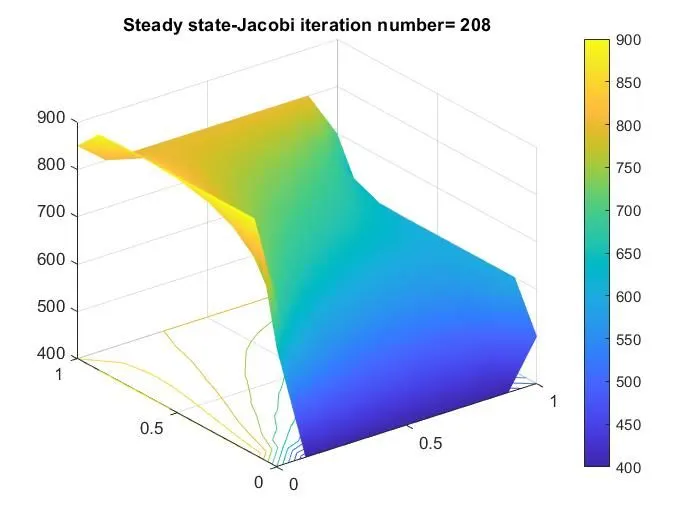
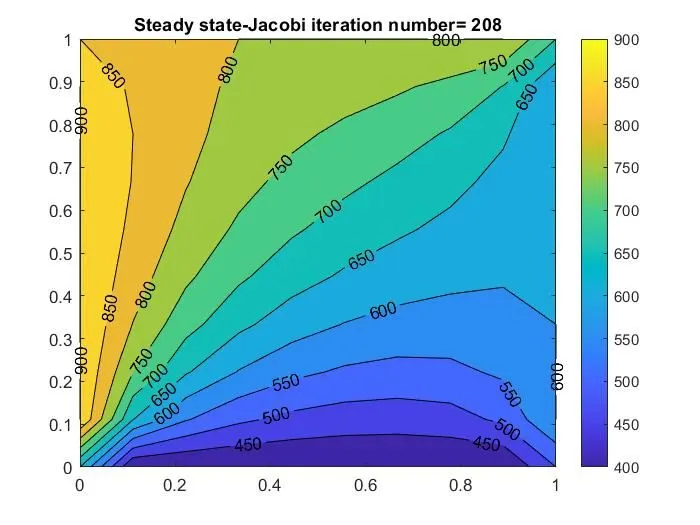
Output for Steady Flow:
1. Jacobi
2. Gauss-Sidel
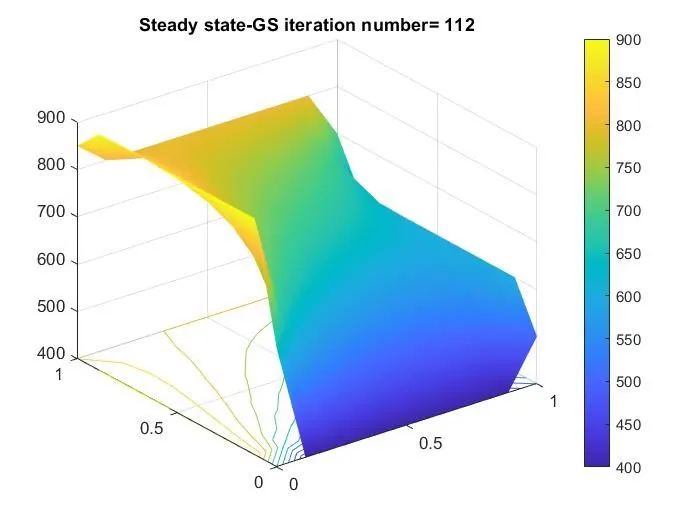
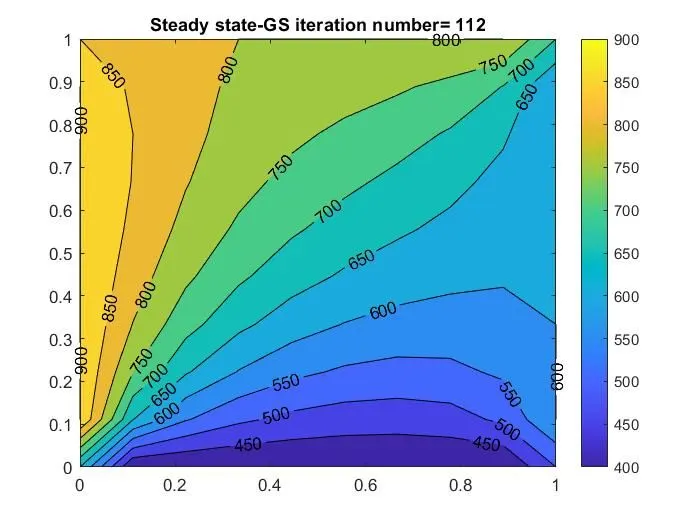
3. Successive Over Relaxation (SOR Factor =1.4)
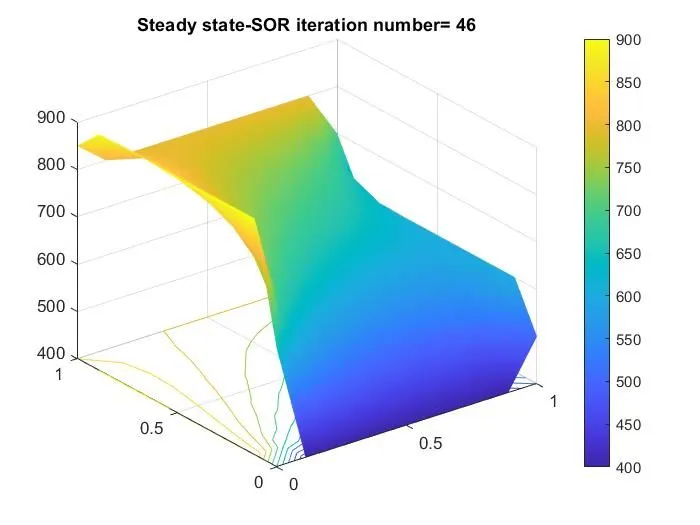
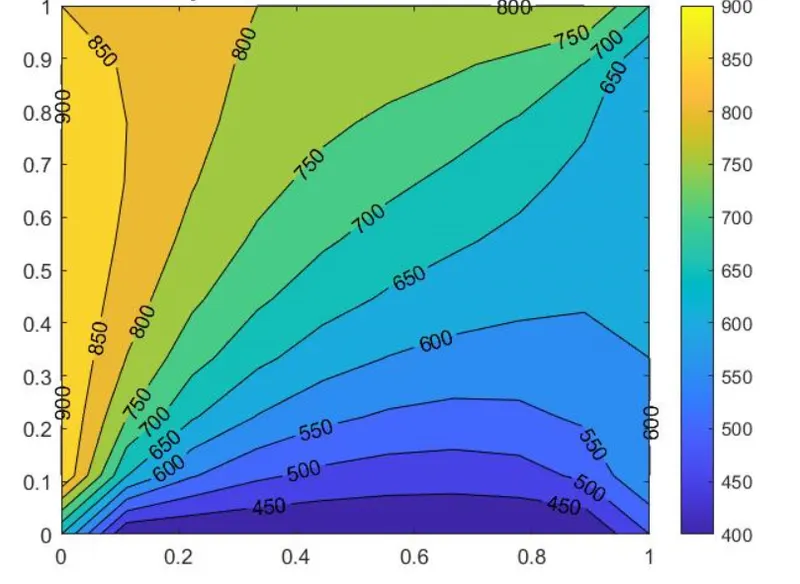
From the above graphs, it is clear that the number of iterations required for the solution to converge decreases as we move from Jacobi to Gauss Sidel to the SOR method.
Output for Transient Flow:
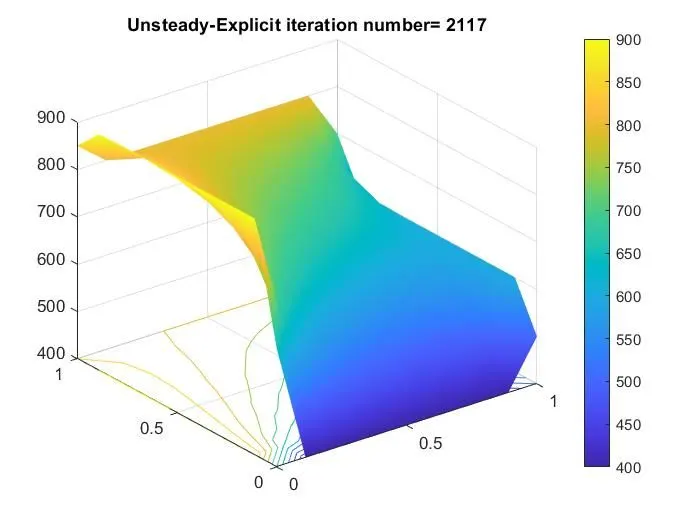
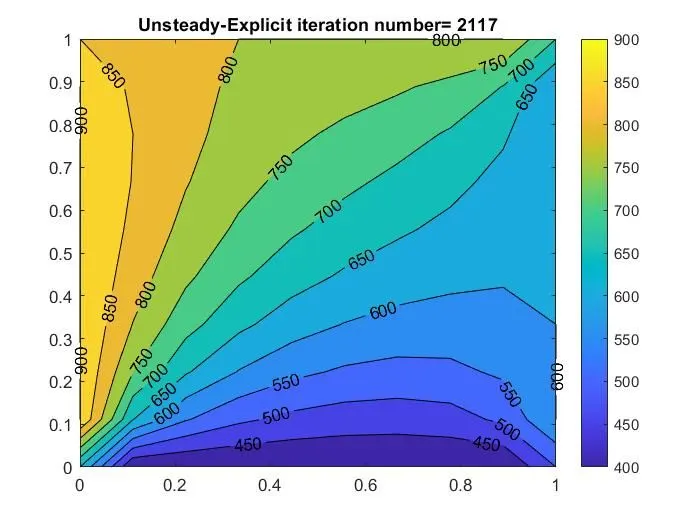
1. Explicit Method
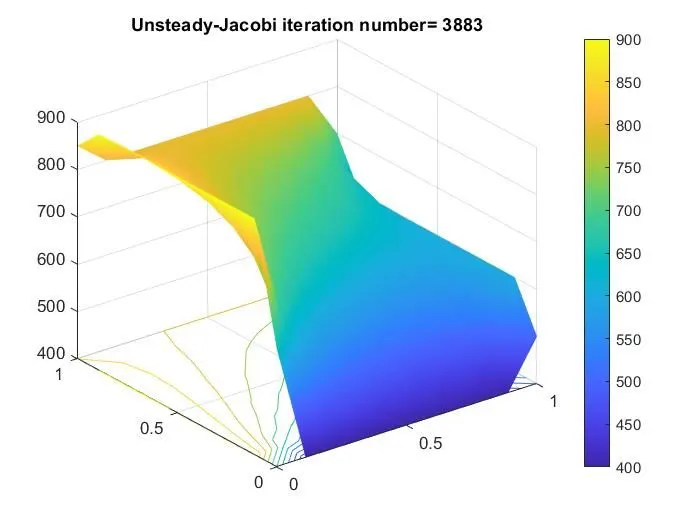
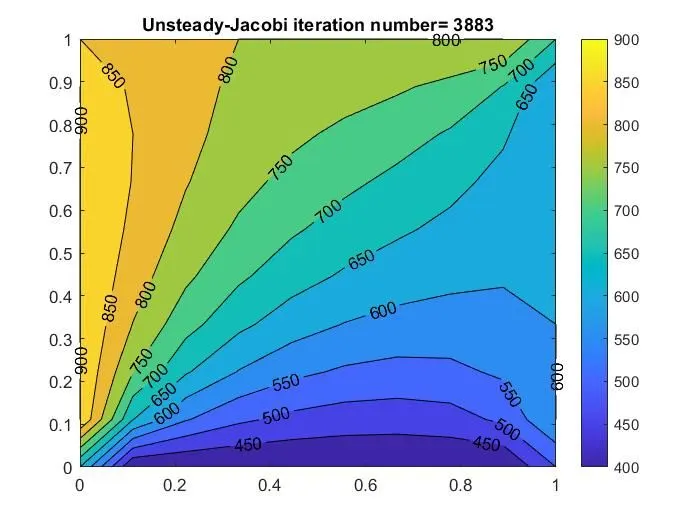
2. Implicit-Jacobi Method
3. Implicit- Gauss Sidel Method
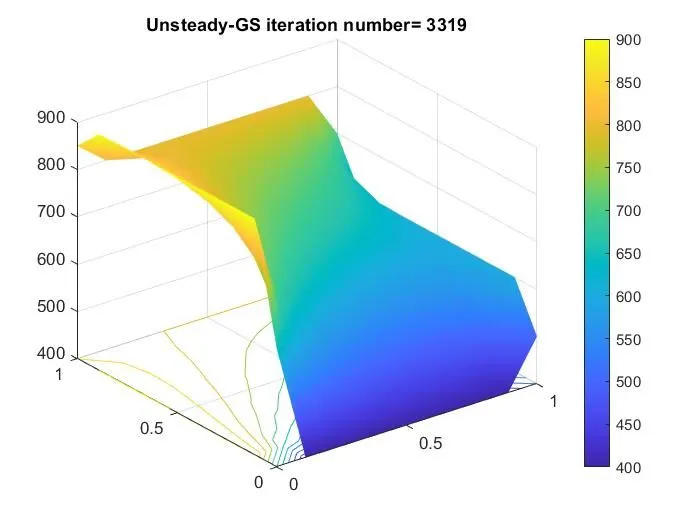
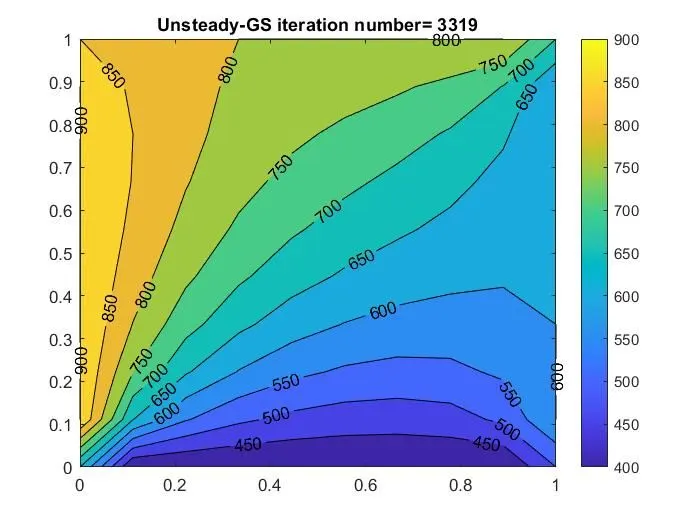
4. Implicit- Successive Over Relaxation (Relaxation Factor = 1.4)
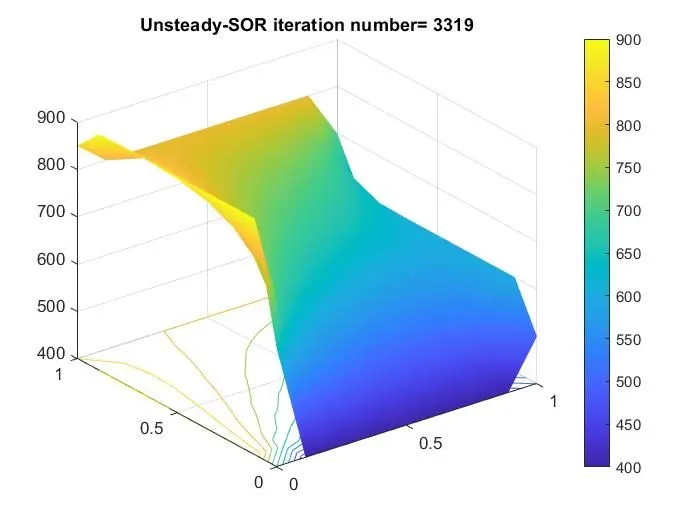
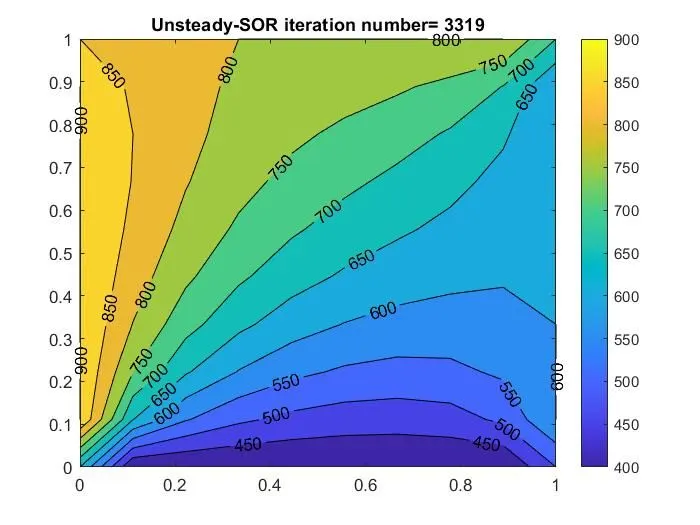
Here, we can observe that the number of iterations for Explicit is far less when compared to Implicit Methods. Further observation into Implicit Methods provides similar results as seen in Steady flow. But the number of iterations for Transient flow is very high when compared to Steady-state flow. One thing that seems wrong is that the number of iterations required for implicit methods of Gauss Sidel and SOR methods is the same, which does not make any sense.