Week 4 - CHT Analysis on Exhaust port
Aim
To create a CHT analysis on an exhaust port of a 4-cylinder engine.
objectives and results
1.Give a brief description of why and where a CHT analysis is used.
--> CHT analysis is used to generate increase resolution thermal inputs on the stage wetted surfaces. Whereas the standard approaches uses constant heat transfer coefficients.CHT analysis allows the simulation of heat transfer between solid and fluid domains by exchanging thermal energy at the interfaces between them. Typical application of CHT analysis exist as, but are not limited to, the simulation of heat exchanger, cooling of electronic equipment and general-purpose cooling and heating systems.
In addition to this, a CHT model enables the opportunity to explore thermal effects on turbocharger performance and can be used to generate thermal loads in support of higher resolution subsequent damage and thermal mechanical fatigue analysis.
A CHT analysis is used in various other places like
1.Temperature distribution analysis.
2.Heat flux rate analysis
3.Visualization for heat transfer features for improved understanding of system flow phenomenon.
4.Identification of localised hot spots or heat sink in checking against specified requirements.
5.Evaluating variation in temperature peaks for different operating conditions.
6.Assessing insulation or heat shield effectiveness and optimising of material selections.
7.To thermally evaluate induced stresses, expansion or fatigue.
8.Temperature field analysis.
9.CFD thermal analysis.
10.Heat transfer coefficient analysis.
11.Heat transfer rate analysis.
Velocity and temperature contours
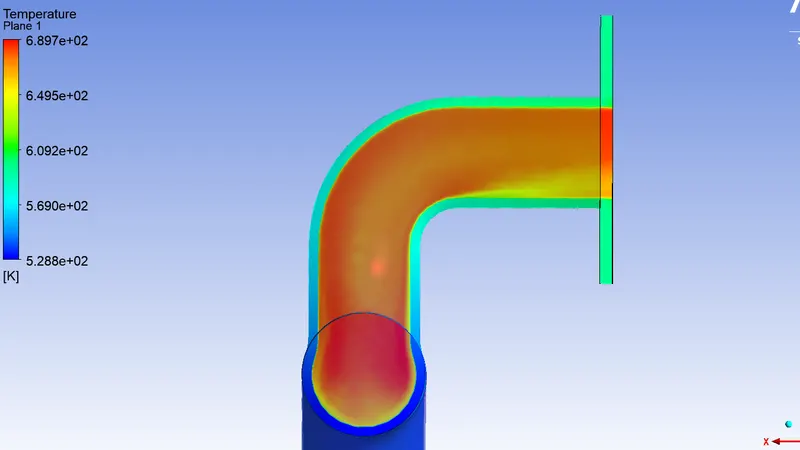
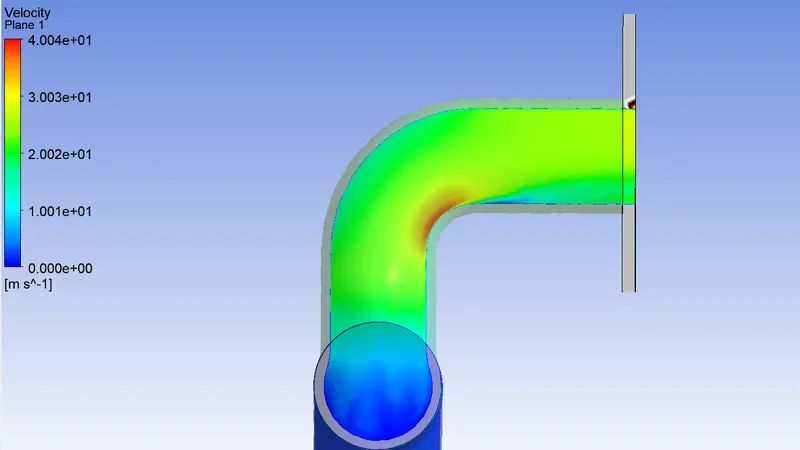
Other plots
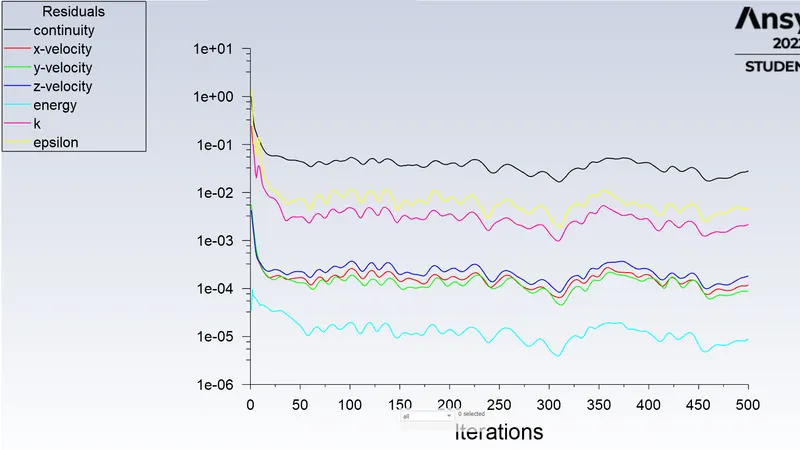
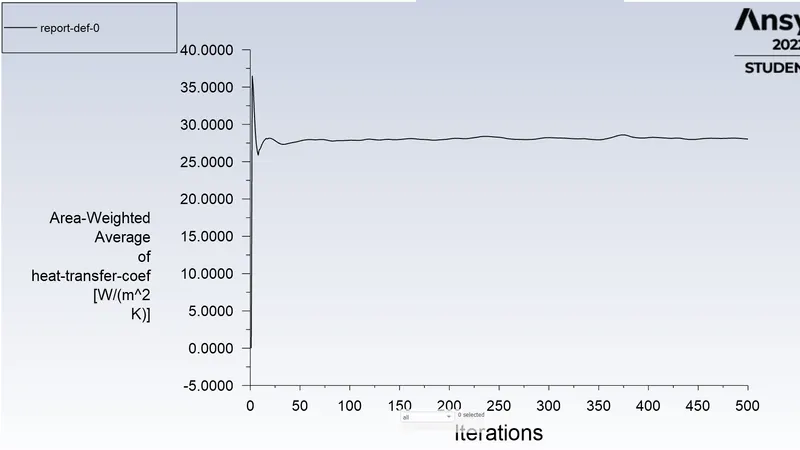
HTC at the interior wall is 28.048272 W/m^2 k
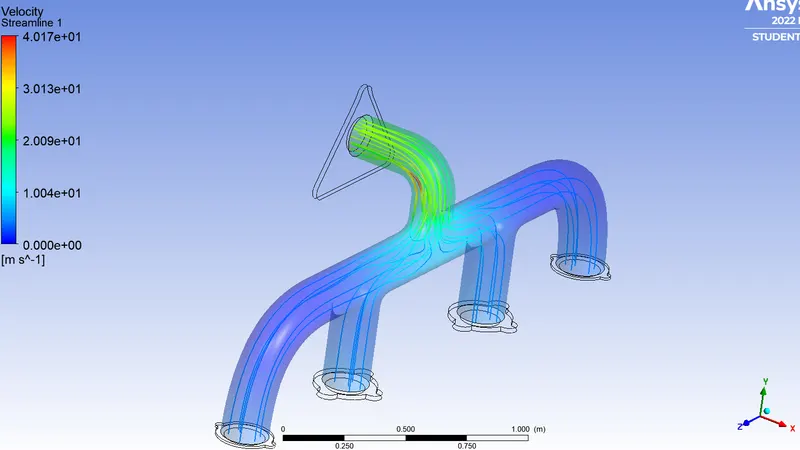
How would you verify if the HTC predictions from the simulations are right? On what factors does the accuracy of the prediction depend on?
-->The Nusselts number is given by
`Nu=(h.L)/K`
Nu - Nusselts number
L - Characteristic length
h - Thermal conductivity coefficient
Since Nusselts number is a function of Reynolds number it is afuction of flow velocity .Hence, HTC is directly proportional to flow velocity.
The accuracy depends upon
1.Properties of fluid
2.Element size
3.Geometrical domain
4.Inflation layer
5.Mesh at the solid-fluid interface