Week 4 - CHT Analysis on Exhaust port
WHAT DO YOU MEAN BY CONJUGATE HEAT TRANSFER??
- HEAT TRANSFER IN SOLIDS
There are basically three modes of heat transfer named conduction, convection, radiation.
The conduction effect dominates in the heat transfer through solid which is usually due to free electrons of the solids. The heat transfer due to conduction follows the Fourier law of conduction which says that
“The time rate of heat transfer is directly proportional to negative temperature gradient to area at right angles to that gradient”
For one dimensional
Qx= KAdT/dx
- HEAT TRANSFER IN FLUIDS
Heat transfer in fluids is due to the following reasons heat transfer in fluid occurs due to the bulk motion of the fluid, which is called convection.
- Conjugate heat transfer
“The conjugate heat transfer involves both phenomena of conduction and convection”, this is used when there is heat transfer between fluids and solid.
It is a coupled problem involving the heat transfer in the fluid domain as well the surrounding solid domain.
WHY DO WE NEED TO ANALYZE THE CONJUGATE HEAT TRANSFER??
In the modern-day, every cooling system or any thermodynamic system involves fluid as a medium to carry heat to the solid substance or to take the heat from the solid substance so to analyze the effectiveness of the system it is necessary to analyze the effect of conjugate heat transfer.
Heat transfer by conduction and convection simultaneously occurs in the majority of engineering applications such as heat exchangers and fins etc.
Setting up the geometry in spaceclaim
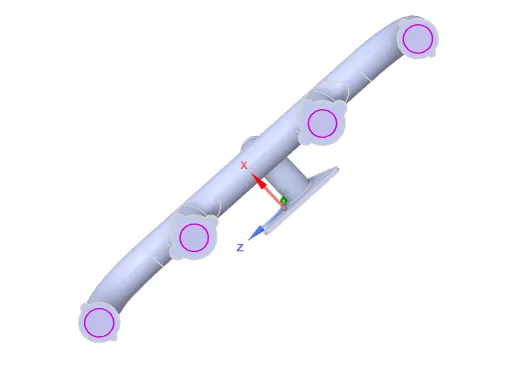

here we have to enable the topology share option so that the mesh is connected for the solid as well as fluid domain,this type of mesh is called conformal mesh,which can transfer the information to each domain.
Meshing
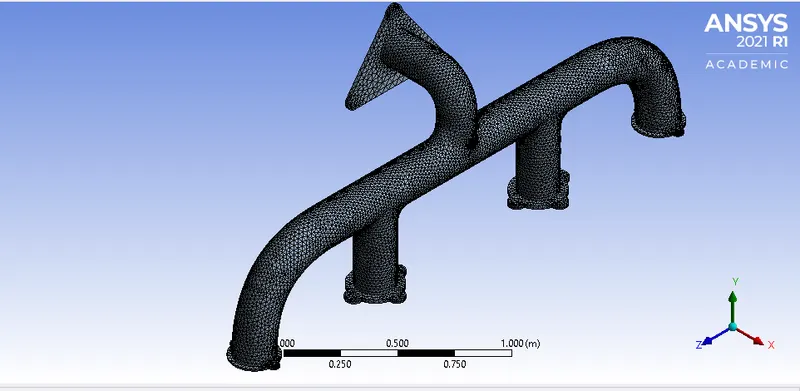
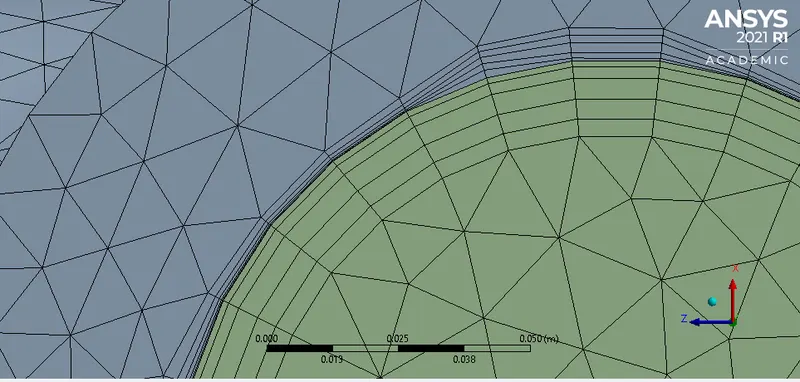
Mesh Inflation layers

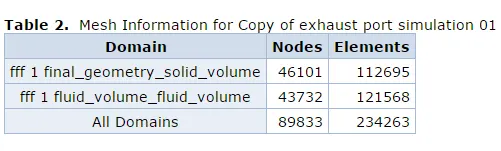
In the meshing we have created an inflation layer for the solid as well as the fluid domain of 5 layers with the first layer height calculated as 0.056 mm, Y+ is selected as 1, the viscous model selected for this simulation is K-epsilon.
Setting up the case in Fluent
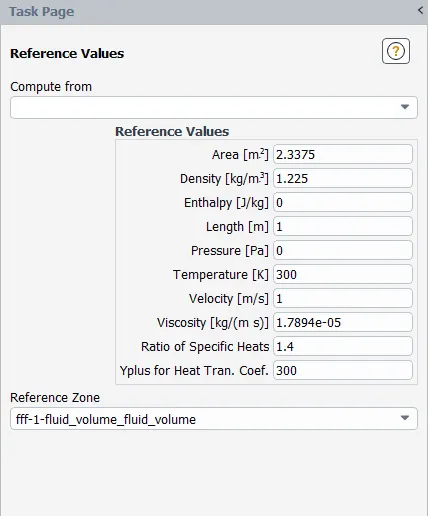
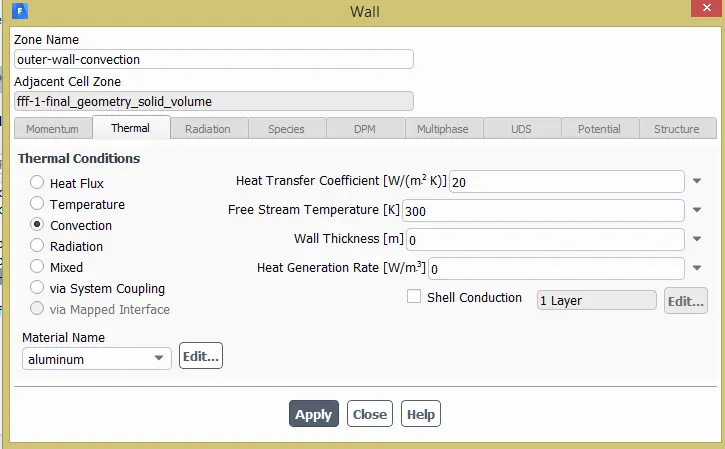
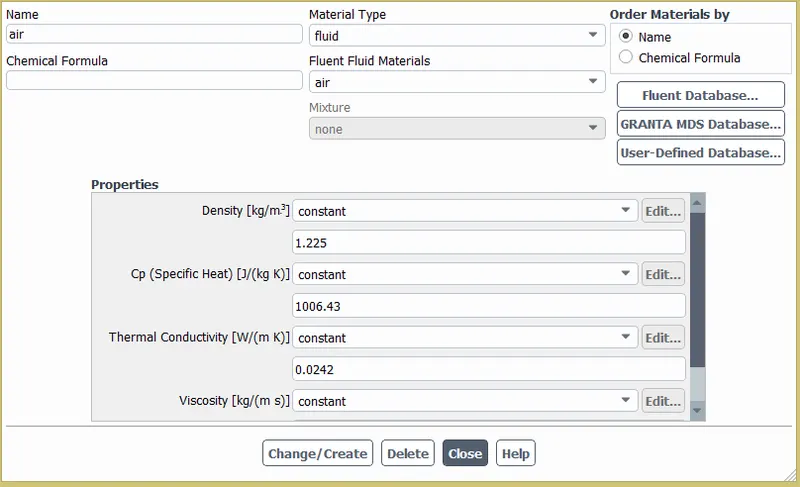
The energy equation is turned on because we are interested in temperature distribution, a pressure-based solver is used.Reynolds number is high for the flow so the K- epsilon turbulence model is used for the solution.

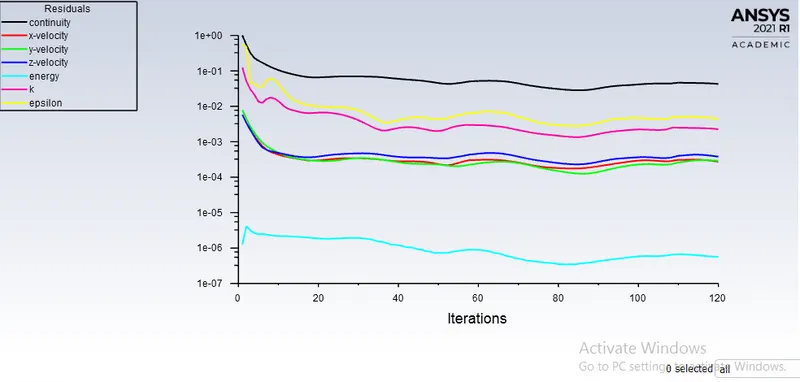
Solution
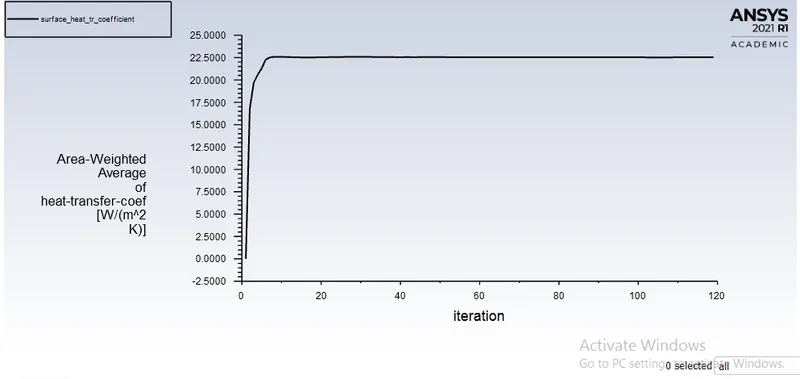
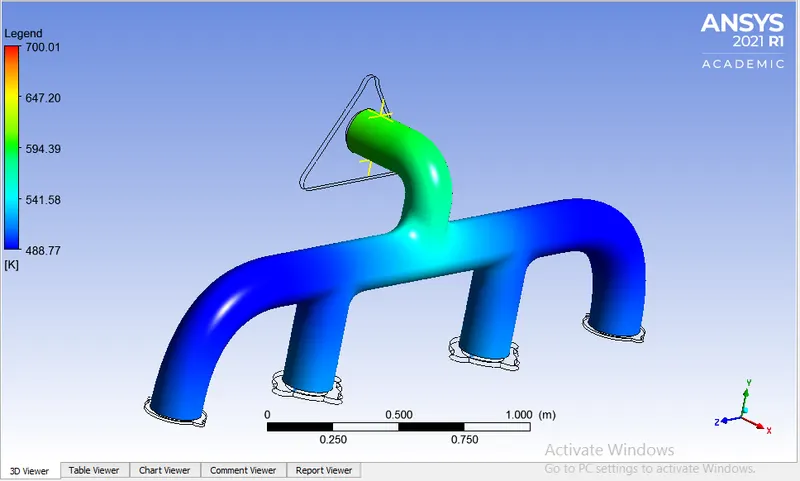
Validation of heat transfer coefficient
Analytical solution
CALCULATION OF THE SURFACE HEAT TRANSFER COEFFICIENT FOR THE INTERNAL FLOW
Free stream velocity=5 m/s
properties of air
density(`rho`)=1.225 kg/m3
dynamic viscosity(`mu`)=0.0000178 Pa.s
Prantl number(Pr)=0.7032
Thermal conductivity of air(k)=0.0242 W/m K
Characteristic length=internal diameter = 0.170 m
Reynolds number(Re)=`rho`*`V`*D/`mu`
=1.225*5*0.170/0.0000178
=58180
here Re>5000 so the flow is turbulent
so,Nusselt number is given by
Nu=0.023*(Re^0.8)*(Pr^0.4)
=0.023*(58180^0.8)*(0.7032^0.4)
=129.53
Now surface heat transfer coefficient
ha=Nu*k/L
=129.53*0.0242/0.170
=18.43 W/m2 K
Numerical solution
hn=22.54 W/m2 K

hn=22.52 W/m2 K
Heat transfer predictions lie upon maintaining the Y+ value less than one so the effect of heat transfer from the wall is captured effectively.