CHT Analysis on Exhaust port
Aim:
The main purpose of this work is to model the flow and perform the conjugate heat transfer (CHT) analysis in an exhaust port using ANSYS Fluent.
Objectives
- Understand the importance of CHT analysis
- Understand the flow structure inside the exhaust port
- Learn the conservation of mass and energy in such a system
- Learn how to use the wall function through the non-dimensional wall distance y+
- Calculate the wall /surface heat transfer coefficient on the internal solid surface
- Show the velocity and temperature contours in appropriate areas
- Justify the rightness of the CHT predictions from the simulations
Introduction
The exhaust port in automobile engineering is the opening in the cylinder that collects the spent and burned mixture from the cylinder into the exhaust pipe. Due to the high temperature of the exhaust steam, the conjugate heat transfer problem between the exhaust gas and the solid material of the exhaust port deserves a special attention. Thus, in the following simulation, we will model the exhaust gas flowing through an aluminium exhaust port consisting of four inlet pipes and one collector pipe. The working fluid used is air with constant properties.
Theory
Conjugate heat transfer in simple words is the combination of heat transfer in solids and heat transfer in fluids as conduction is mostly observed in solids and convection is dominant in fluids. Conjugate heat transfer is needed since it allows the simulation of heat transfer between solid and fluid domains by enabling the thermal energy exchange at the interfaces between them. This type of analysis is required to perform the simulation of heat exchangers, cooling of electronic equipment and many more general-purpose cooling and heating systems such as heat sinks.
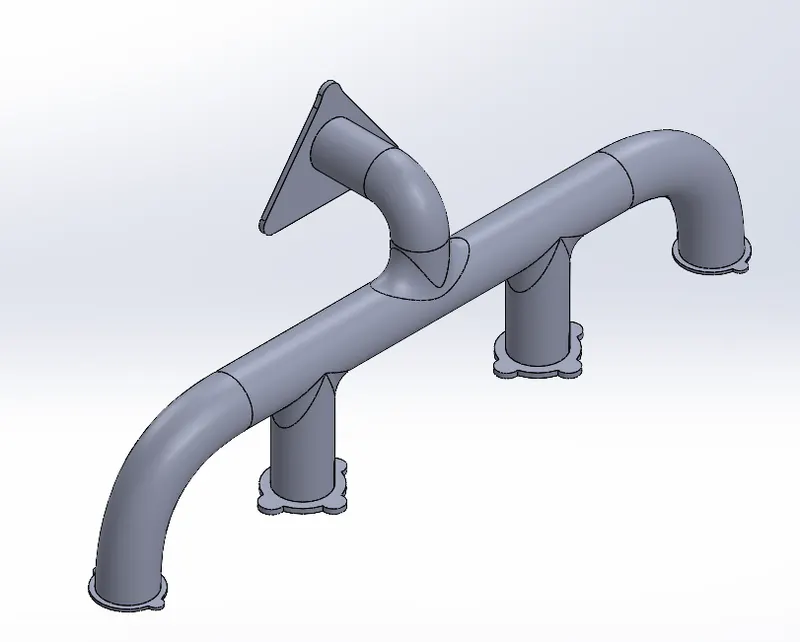
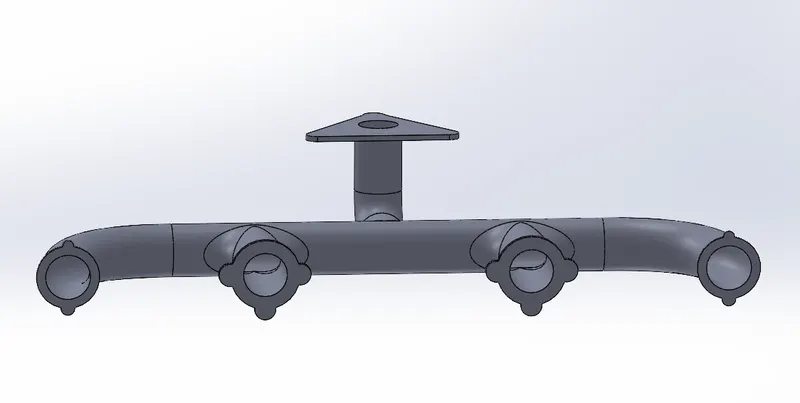
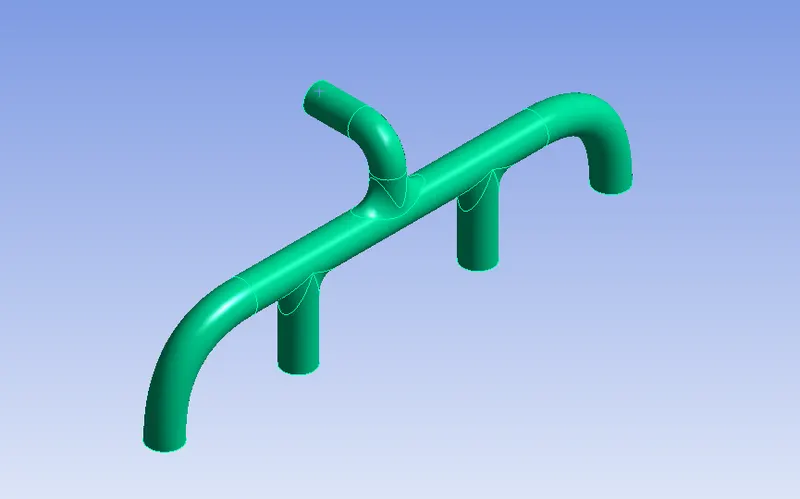
Physical Model
The exhaust port consists of 4 inlets and 1 outlet; all circular in shape and 0.1661 m in diameter. Exhaust gases enter the port at the same speed and temperature of 5 m/s and 700 K respectively.
The working fluid in the exhaust port is air while the exhaust port is made of aluminium.
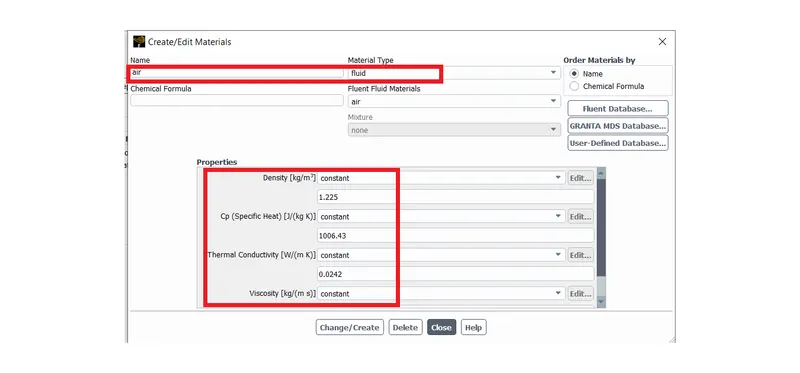
- Air: `ρ=1.225 kg/m^3 ,μ= 1.7894e-05 kg/(m.s),Cp=1006.43 J/(kg.K) ,k=0.0242 w/(m.K)`
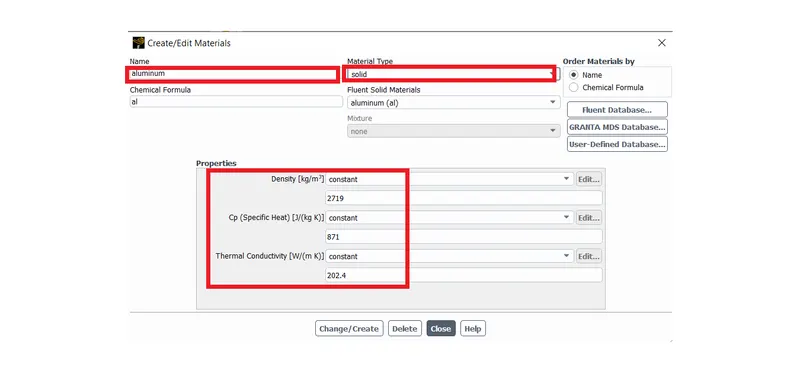
- Aluminium: `ρ=2719 kg/m^3 ,Cp=71 j/(kg.K) ,k=202.4 w/(kg.K)`
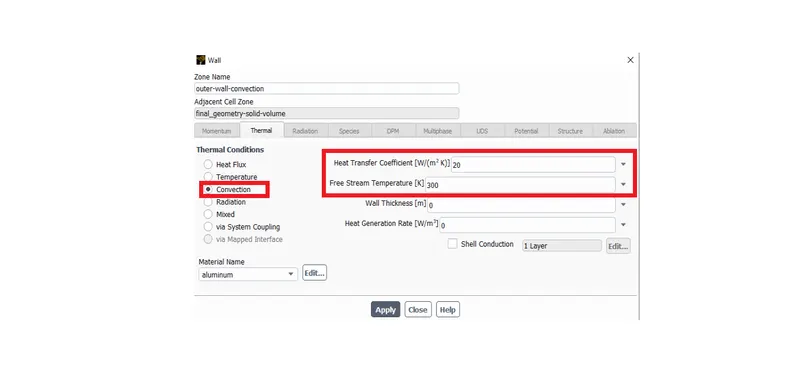
The outer wall of the exhaust port is exchanging heat with the ambient through thermal convection.
Problem Description
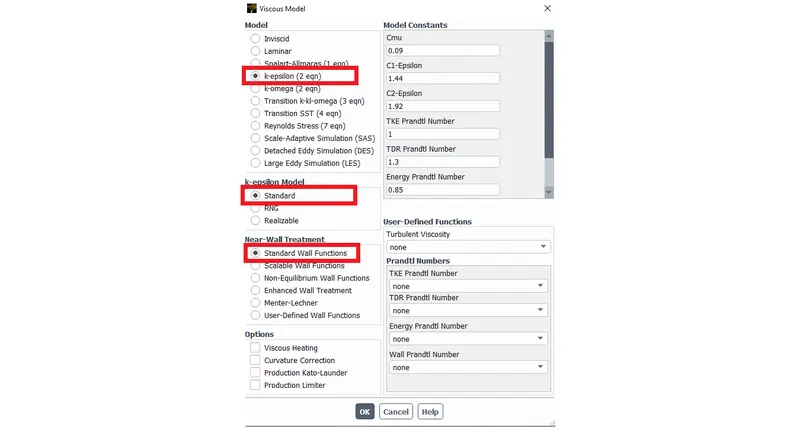
Since the flow Reynolds number is high, the flow is fully fluent. The `k- ε m o d el` is used to simulate the turbulence effects.
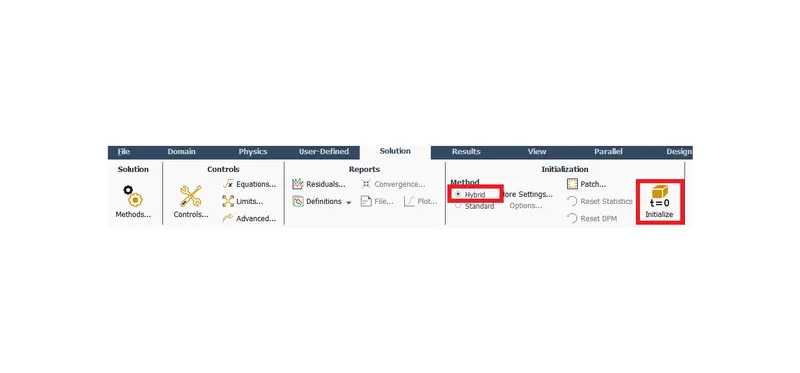
Steady state simulation is performed using a pressure-based solver in Ansys fluent.
Boundary conditions for the model:
- Inlets: the velocity inlet is the same at all four inlets: v=5m/s, T=700K
- Outlet: The pressure outlet p =0Pa (gauge)
- The solid-wall-outer: Convection with h = 20w/(m^2.k),T=300K
- final_geometry-solid-volume-shadow: walls coupled for conjugate heat transfer.
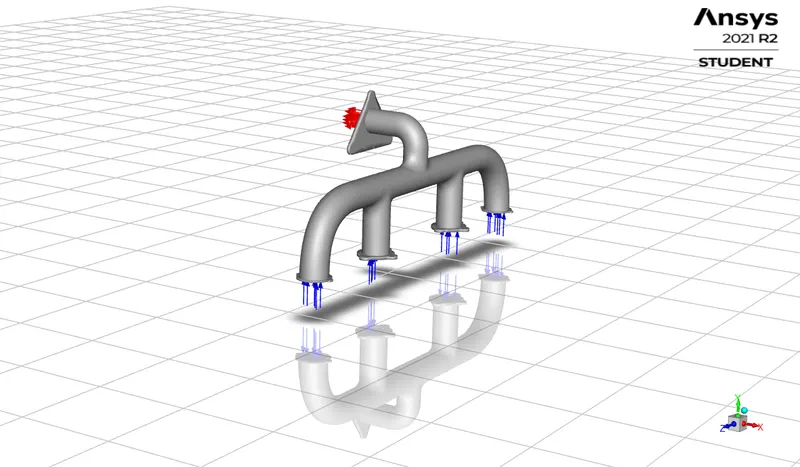
the blue arrows represent the inlets and the red arrows represent the outlet.
Geometry:
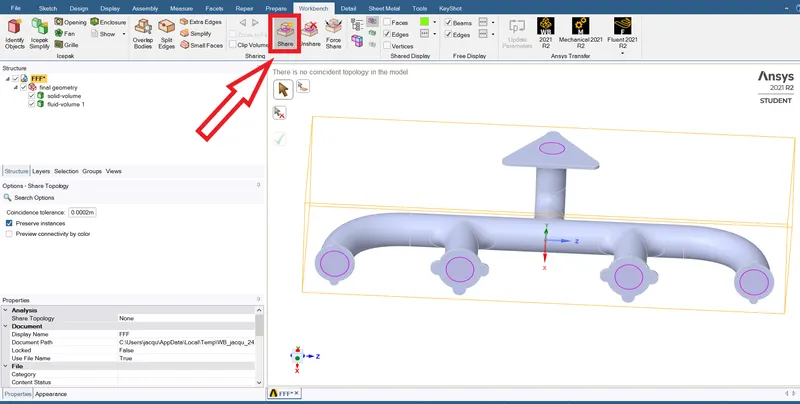
The CAD model is imported in SpaceClaim and the fluid volume as well as solid volume are created. To allow both geometries to share information, the “Share topology” is enabled.
Meshing
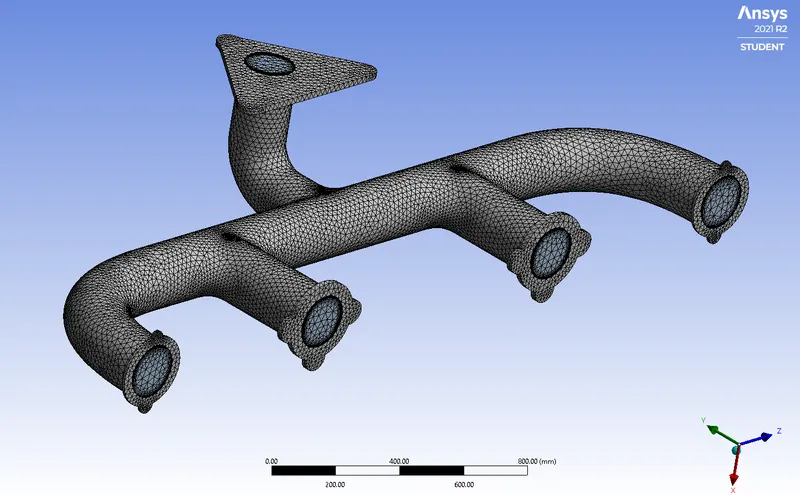
Once the geometry preparation is done, the model is then imported in the mesh module for meshing. Here, the boundary tags are created by name definition for different parts of the model.

Mesh refinement
The mesh is refined adding the inflation layer. The first layer thickness is calculated as follows:
The fluid properties are considered at a standard temperature of 300 K.
Thus,
`Density of Air =ρ=1.1755 kg/m^3 ,`
`Dynamic viscosity=μ=1.846×10^(-5) kg/(m s)`
`Kinetic viscosity= μ/ρ=1.57×10^(-5) m^2/s`
`Re= (ρ.v.L)/μ` Where `v` is the freestream velocity and L is the characteristic length.
`Re=(1.1755×5×0.1661)/(1.846×10^(-5) )=52884.764355362946≈52884`
The characteristic length is taken as the inlet diameter D=0.1661 m.
`The skin friction,C_f=0.058×Re^(-0.2)=0.058×52884^(-0.2)=6.588×10^(-3)`
`The wall shear stress,τ_w=0.5×C_f×ρ×v^2=0.5×6.588×10^(-3)×1.1755×25=0.0968`
`The frictional velocity,u_t=(τ_w/ρ)^0.5=0.28696 m/s`
`Y^+=(∆y.u_t.ρ)/μ hence ∆y=(μ.Y^+)/(u_t.ρ)`
For `Y^+=33,∆y=(1.846×10^(-5)×33)/(1.1755×0.28696)=0.00198 m`
Hence the first layer thickness is 0.00198 m.
For a growth rate of 20%, the total thickness for 5 layers can be calculated using the following formula:
`S_n=a_1.((1+q)^n-1)/q where q is the growth rate,n the number of layers and a_1 is the first layer thickness`
Hence, for n=5, q=0.2 and a1= 0.00198 m, the total thickness is 0.0147 m.
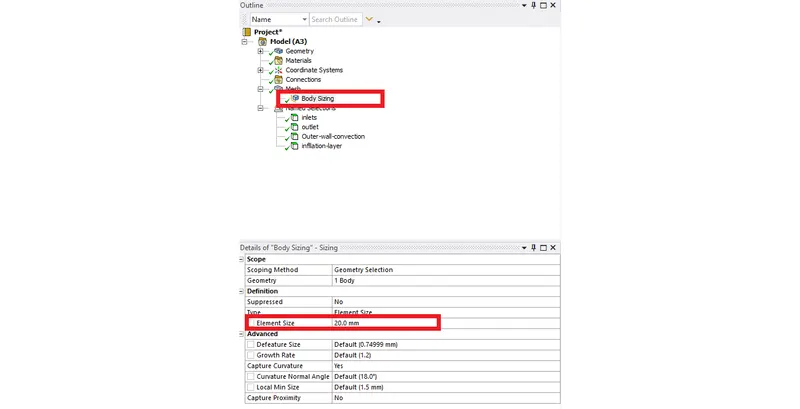
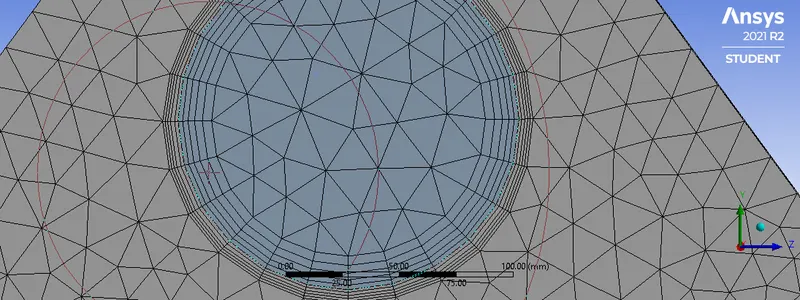
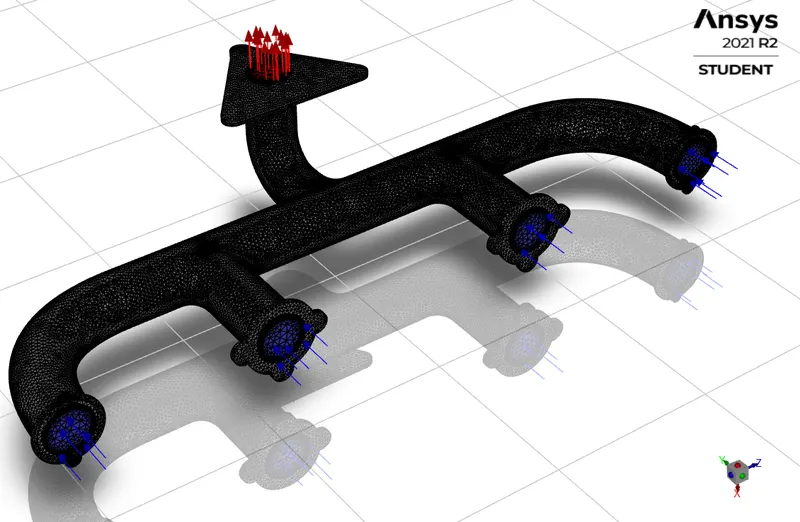
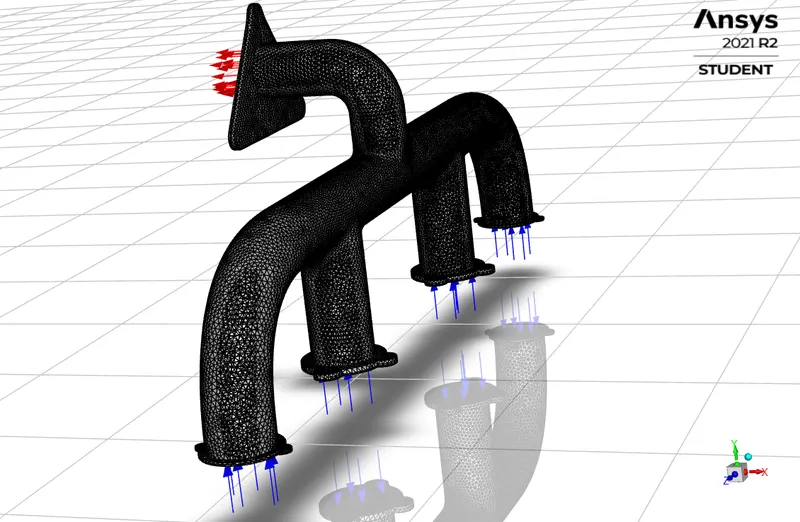
The mesh after refinement
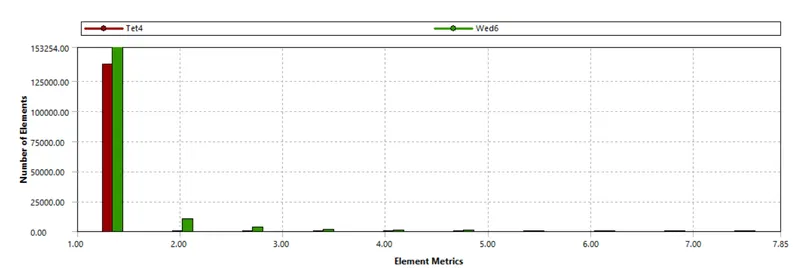
The mesh quality
Setting Up the case
As stated previously, the case set up is done in Ansys Fluent as shown on the images below.
Results
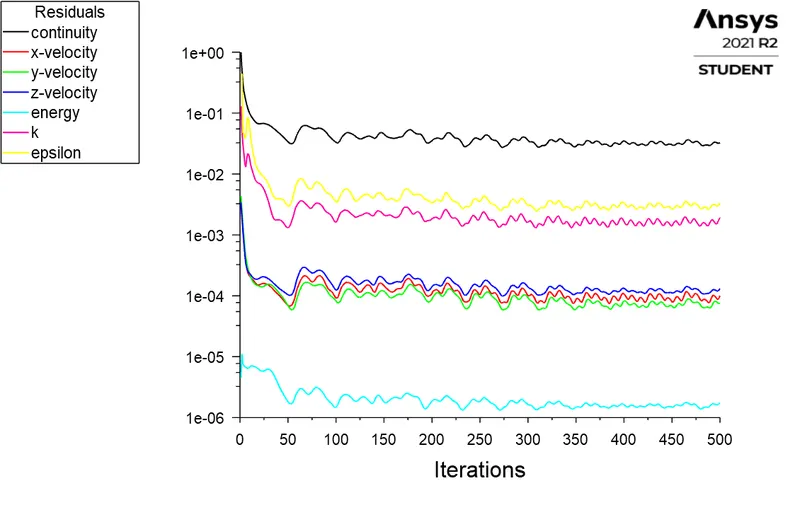
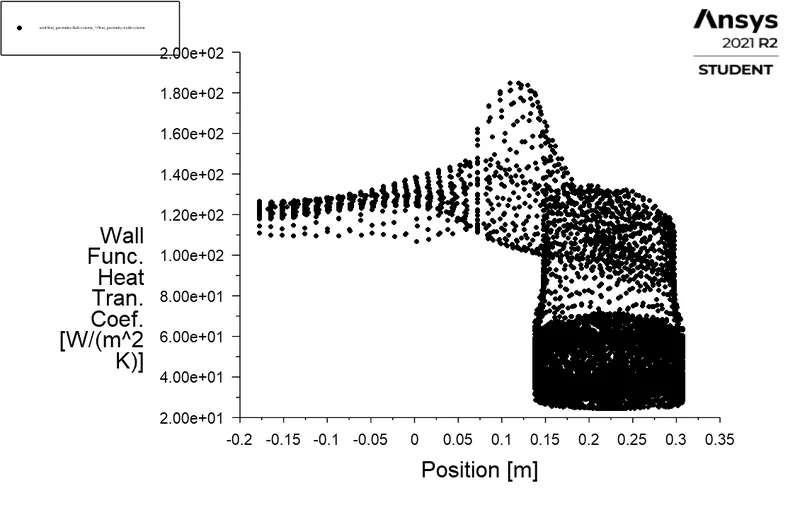
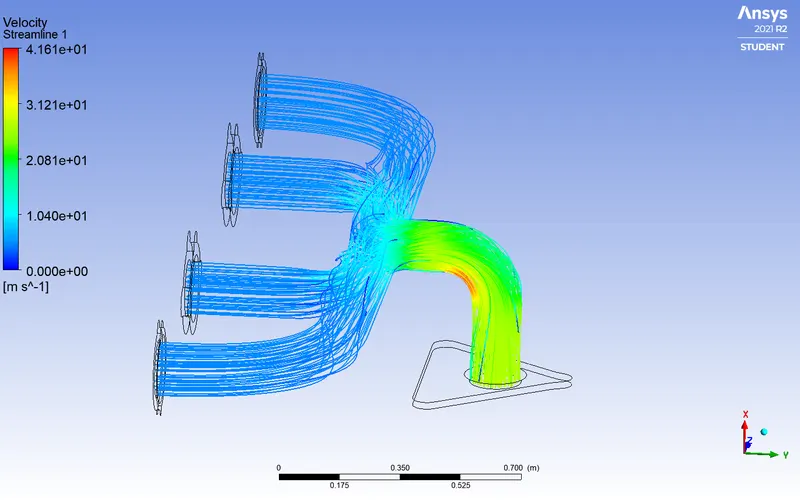
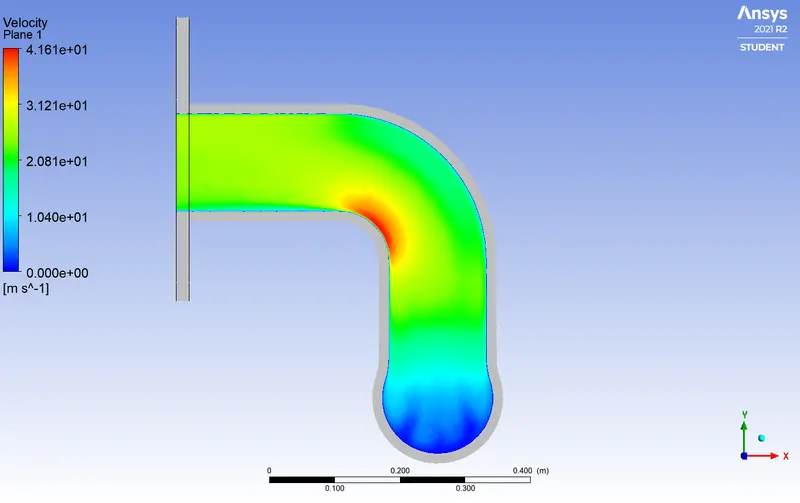
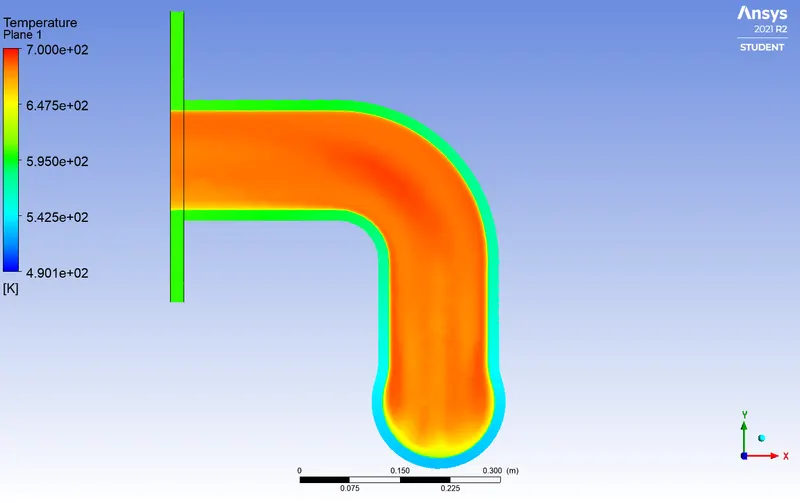
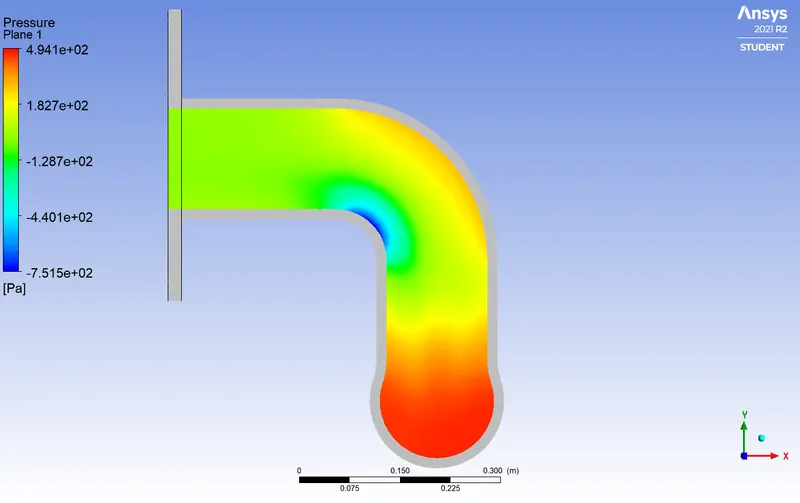
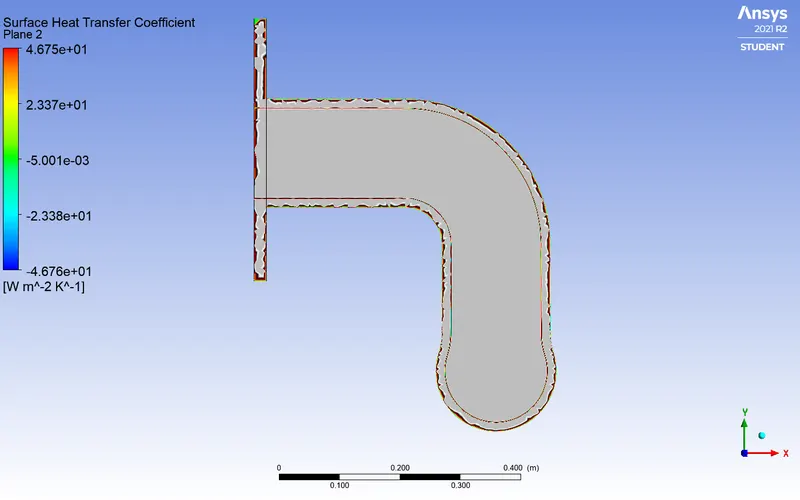
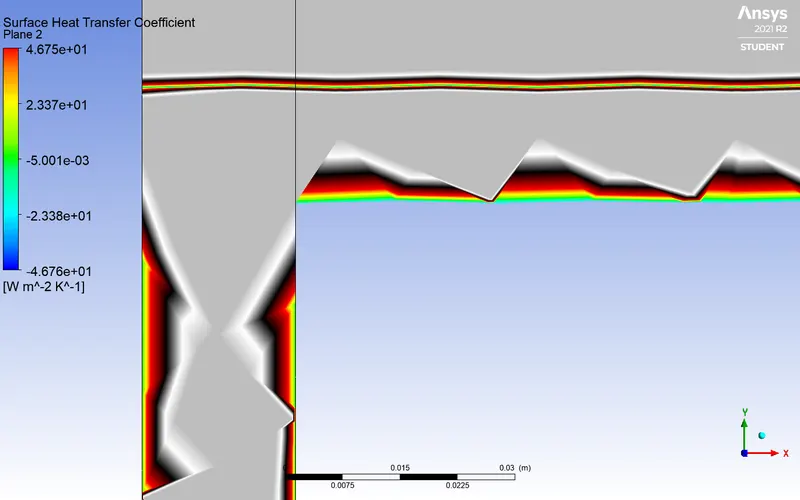
Verification of prediction Results:
Analytical Solution
Since the flow is turbulent (Re= 52884.764), the empirical relation shown below can be used to compute the Nusselt number.
`Nu=0.664×Re^0.5×Pr^0.33`
`Pr= (μ×Cp)/k=0.74401`
`Nu=0.664×52884.764^0.5×0.74401^0.33=138.5014626`
`h=(Nu.k)/D=20.179W/m^2 K`
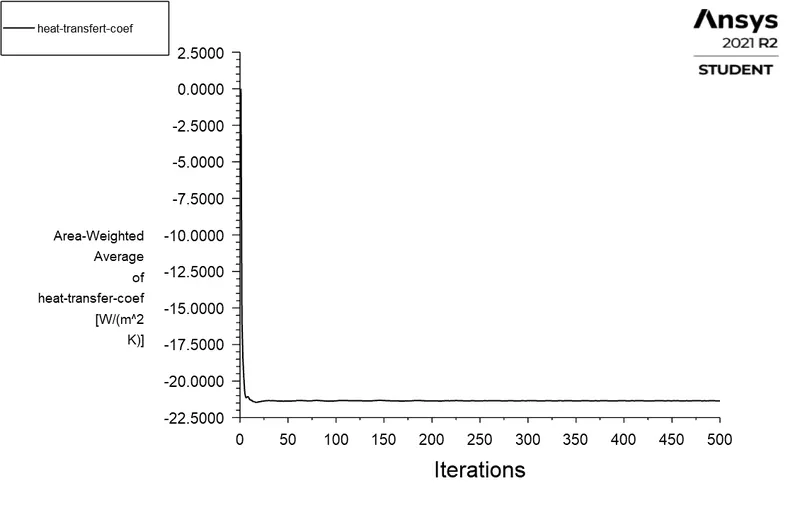
The numerical surface heat transfer coefficient is -21.354605.The negative sign means that the flow is from inside of the geometry.
The deviation is 1.175605.
Conclusion
The CHT analysis is performed successfully using a pressure-based coupled solver. The was used maintaining the y+ value between 30-300. The predicted values of heat transfer coefficient were validated against the analytical values and the percentage of deviation of surface heat transfer coefficient was found to be 5.5. This means that the predictions are satisfactory. The accuracy of the predictions depends up on the accuracy of the turbulence model chosen. And that choice is based on the Reynolds number value. Moreover, the mesh refinement at some region of the geometry was found helpful in capturing the heat flux more accurately.