Week-4 Challenge WOT Condition Part-2
AIM:- To Compare HEV & EV Vehicle by evaluating Simulink Models.
Objective:-
- What is the difference between the mapped and dynamic models of engine, motor, and generator? How can you change the model type?
- How does the model calculate miles per gallon? Which factors are considered to model fuel flow?
- Run the HEV ReferenceApplication with the WOT drive cycle. Change the grade and wind velocity in the environment block. Comment on the results.
- Keeping all other parameters the same, compare the simulated results of hybrid and pure electric powertrains.
#Ques 1- What is the difference between the mapped and dynamic models of engine, motor, and generator? How can you change the model type?
Powertrain Blockset provides two types of combustion engine models: Mapped and Dynamic.
Mapped models- Mapped engines represent macro engine behavior as a set of lookup tables (brake torque, fuel flow, air mass flow, exhaust temperature, efficiency, and emissions) as functions of commanded load and measured engine speed.
Dynamic models- Dynamic engines decompose engine behavior into individual component models that account for engine dynamics, most notably intake airflow and turbocharger dynamics.
You can switch between engine model types based on your application.
- Dynamic engine models are suitable for designing control, estimator, and diagnostic algorithms that depend on dynamic subsystem states,
for example, in closed-loop AFR control algorithm development.
- Mapped engine models are suitable for analysis and design activities that do not require engine subsystem dynamic characteristics,
for example, in engine and transmission powertrain matching analysis for fuel economy, emissions, and performance tradeoffs.
~ To change the model type- I am taking the Pre-Build Hybrid Electric Multimode example, from MATLAB Helpdesk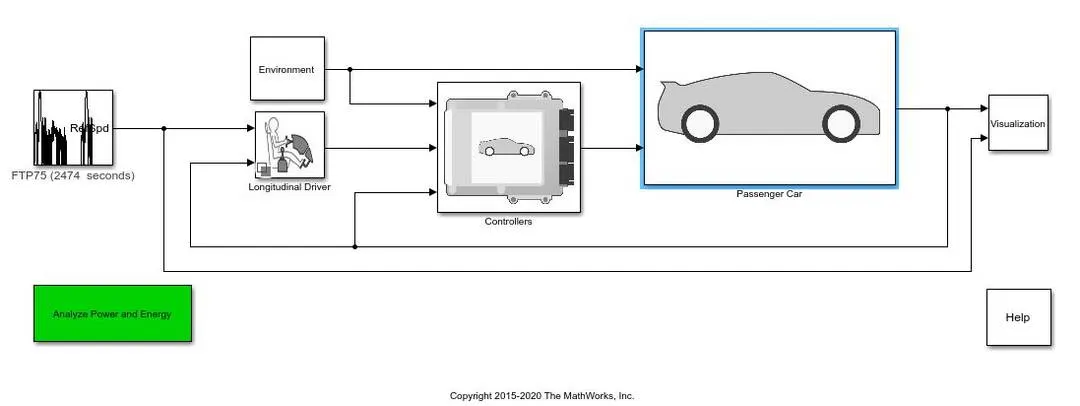
In the HEV Vehicle Model, there are Pre-made two types of engine, motor & generator are define (Mapped & Dynamic).
1. We can switch from one model to another-
For engine
- First, enter the Passenger Car Block.
- Right-click on the engine block
- Click on variant than Label Mode Active Choice.
- Then select the desired Model
For Motor & Generator.
- We have to further enter the Electric Plant Block in Passenger car Block.
- Then we can switch by right click on the motor & generator block and then on the variant, then Label Mode Active Choice.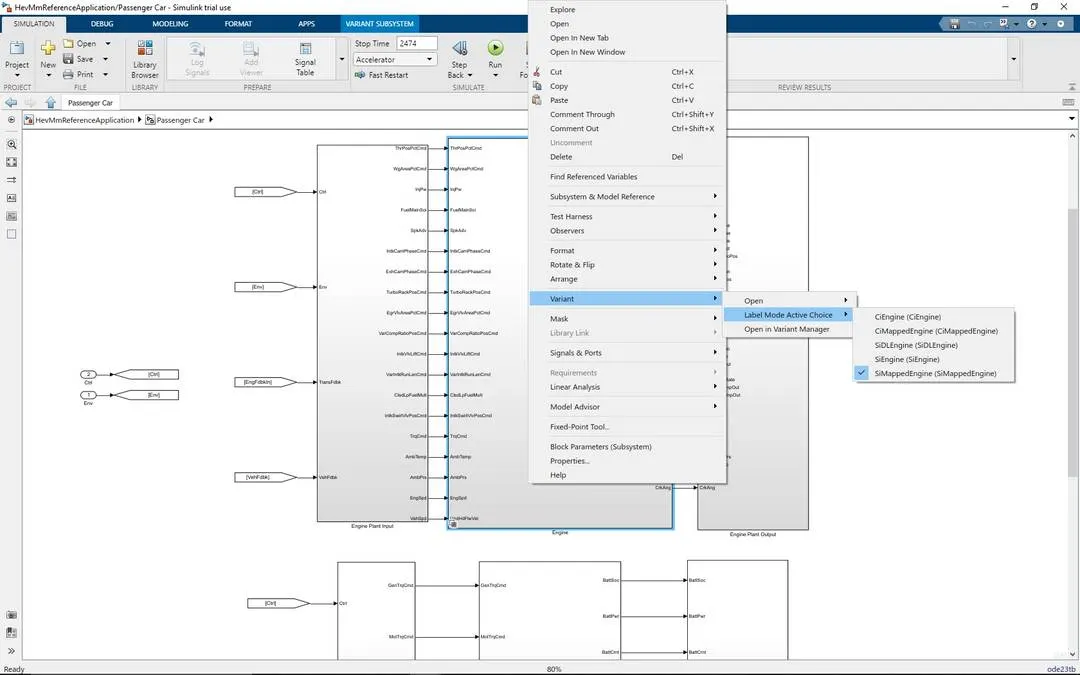
2. Or we can do switch between models by-
- Go to Modeling Tab -Go to Variant Manager.
- Then we can Switch any model by click & Activate it from the Variant Manager window.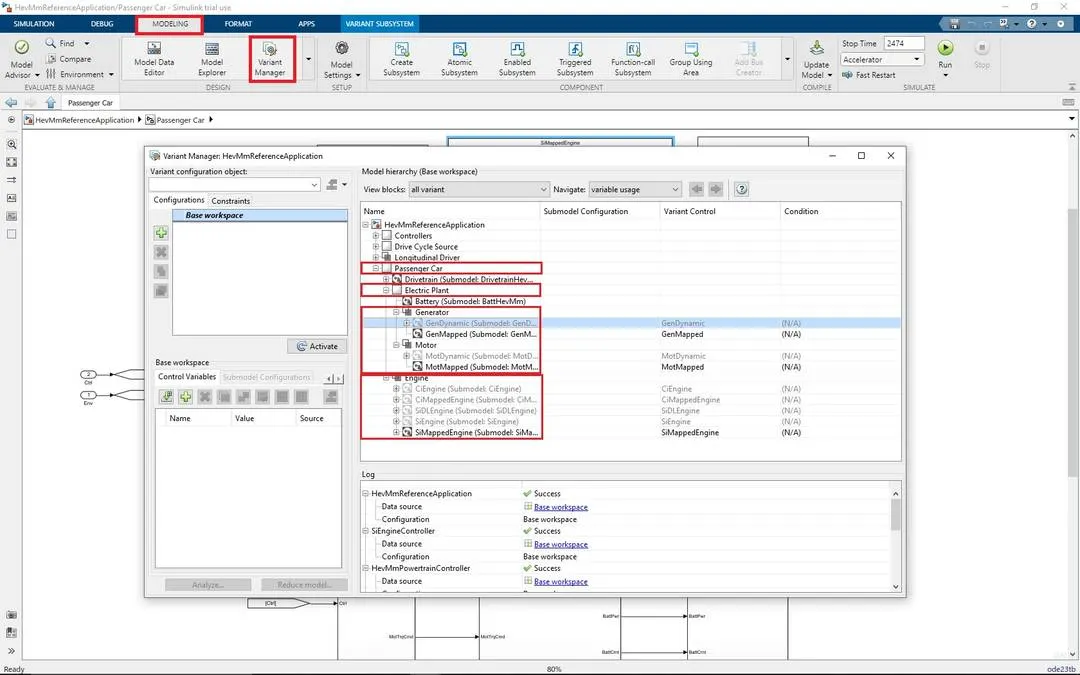
#Ques 2- How does the model calculate miles per gallon? Which factors are considered to model fuel flow?
Fuel efficiency is a form of thermal efficiency, meaning the ratio of effort to result of a process that converts chemical potential energy contained in a carrier (fuel) into kinetic energy or work.
- Fuel efficiency is dependent on many parameters of a vehicle, including its engine parameters, aerodynamic drag, weight, AC usage, fuel, and rolling resistance.
- Hybrid Vehicles use two or more power sources for propulsion. In many designs, a small combustion engine is combined with electric motors. Kinetic energy that would otherwise be lost to heat during braking is recaptured as electrical power to improve fuel efficiency.
Calculate miles per gallon in Simulink Model.
Taking the Hybrid Electric Multimode example, from MATLAB Helpdesk to show, How to Calculate the Efficiency in the model.
-In this model fuel consumption is calculated in miles gallon, which can be found in the visualization block.
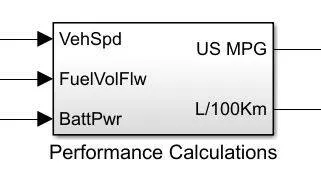
- The Performance Calculation block in the model is used to calculate the mileage and fuel consumption.
- As it is An Hybrid Electric vehicle, battery power is also coming into consideration to calculate the mileage.
- On entering the block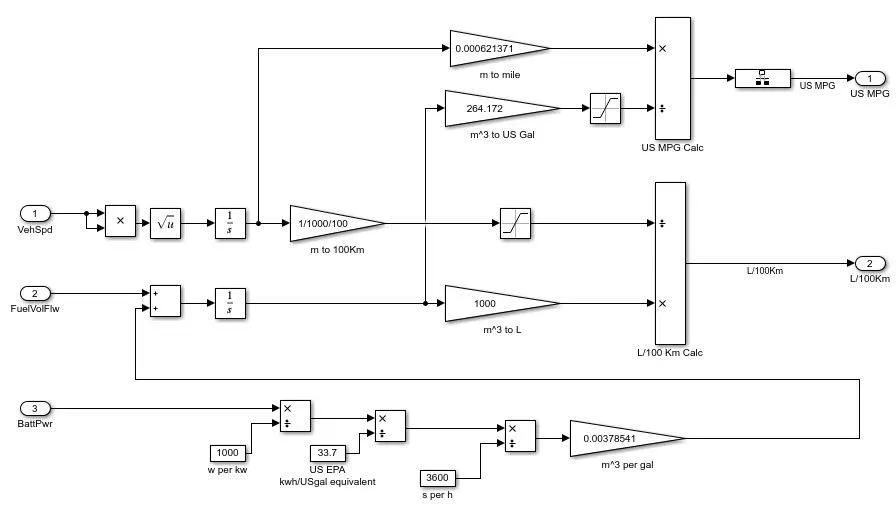
- In this above model, it is used to calculate the miles per gallon(mileage) of the vehicle,
- Battery consumption is also added to calculate the mileage, 1st battery power unit is converted from W to kW by dividing it by 1000, & then output power is divided by 33.7 to convert into US EPA standard per hour and then calculated kW/h is converted to kW/s by dividing by 3600.
- This calculated power of the battery is equivalent to fuel quantity, it is done so as the vehicle is running on conventional fuel, so it is necessary to convert the battery power equivalent to that.
- Now both fuel flow and battery power are of the same unit, so now that can be added and integrated.
- Velocity of the vehicle also depends on fuel consumption, on integrating the output velocity we get the distance in meter, which is now converted to km by multiplying by 1/100/1000 for 100km using gain block.
- Then saturation block is used to give the upper and lower limit to the distance.
- In order to get the final output of two separate quantities, the fuel unit and distance into miles/ gallon, the product is used.
- so, In order to calculate the performance of the vehicle, vehicle speed, fuel flow & battery power are the important factors that are taken into consideration.
#Ques 3- Run the HEV Reference Application with the WOT drive cycle. Change the grade and wind velocity in the environment block. Comment on the results.
The hybrid electric vehicle reference application represents a full multimode hybrid electric vehicle (HEV) model with an internal combustion engine, transmission, battery, motor, generator, and associated powertrain control algorithms. Use the reference application for powertrain matching analysis and component selection, control and diagnostic algorithm design, and hardware-in-the-loop (HIL) testing.
By default, the HEV multimode reference application is configured with:
- Mapped motor and generator
- 1.5–L spark-ignition (SI) dynamic engine
This diagram shows the powertrain configuration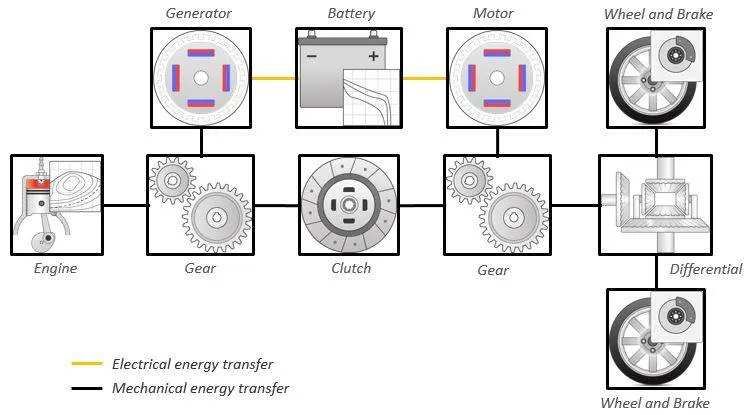
- Model Of Hybrid Electric Vehicle on WOT Drive Cycle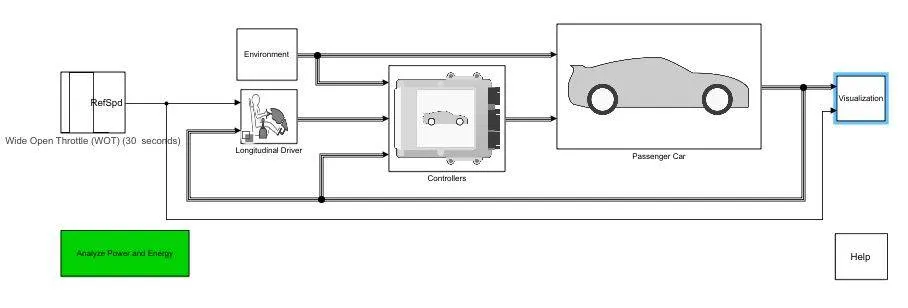
- Configuring Environmental Condition.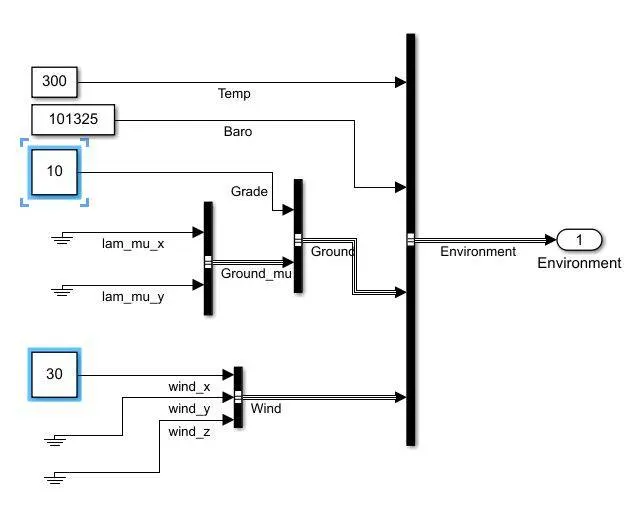
Results:-
|
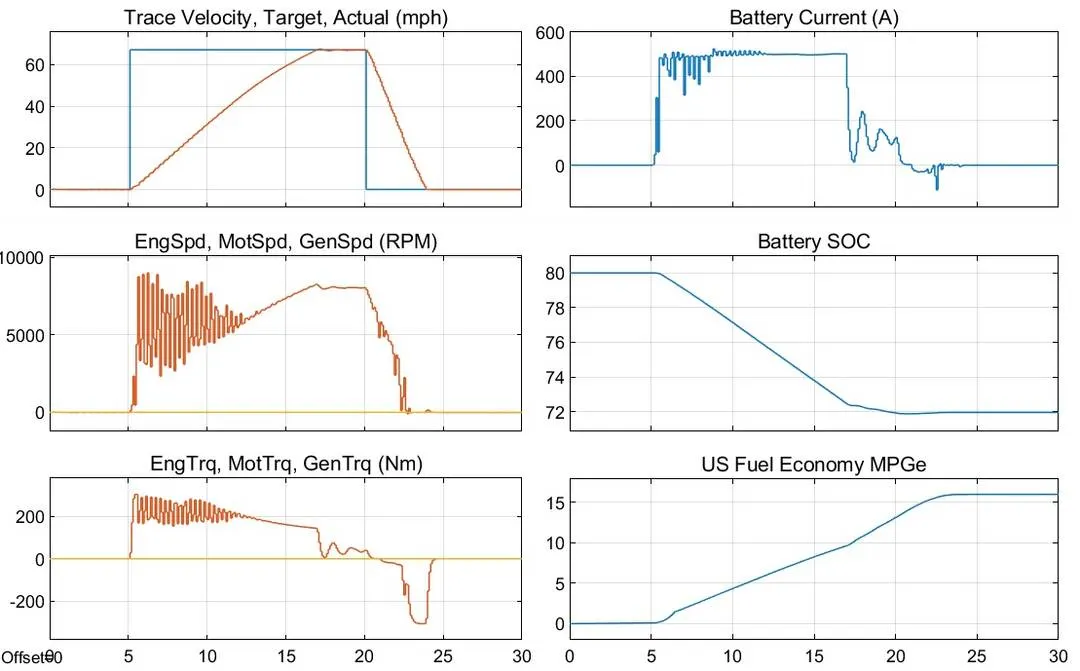
# The result of the WOT Drive cycle on the default parameter.
- From the above Graph, it is for the WOT Drive Cycle of HEV on default parameters with wind velocity=0 and Grade =0. |
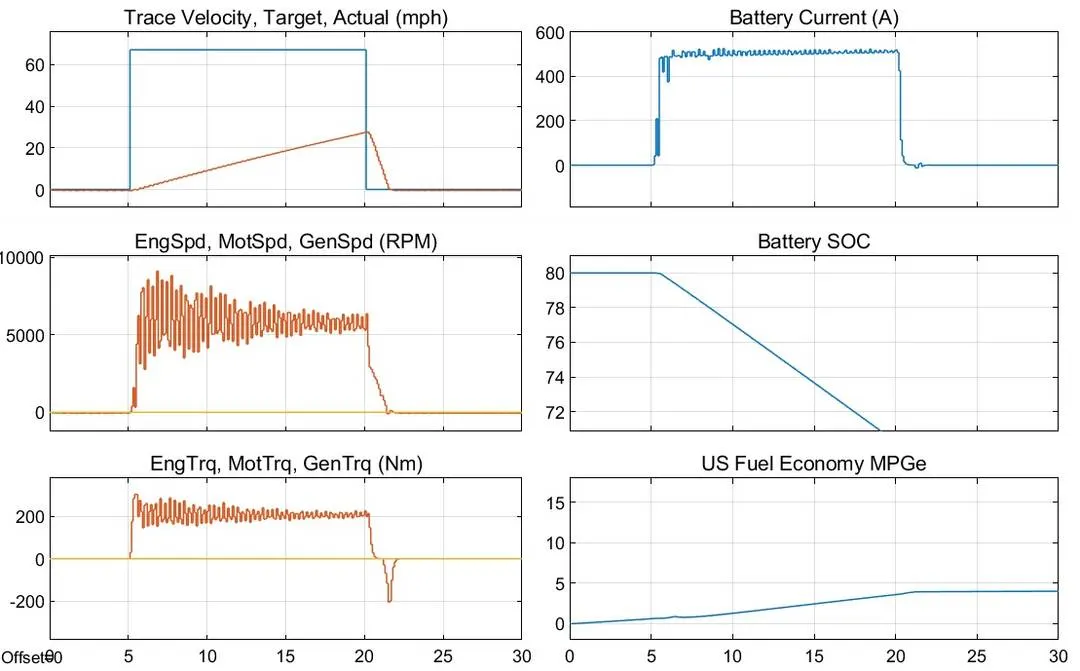
# The result of the WOT Drive cycle on the Configured parameter of Winds speed and Grade.
- From the above Graph, it is for the WOT Drive Cycle of HEV on default parameters with wind vwlocity=30 and Grade =10. |
#Ques 4- Keeping all other parameters the same, compare the simulated results of hybrid and pure electric powertrains.
For the comparison, I am using the HEV & EV model with the same configuration for both.
Grade = 10
Wind speed = 30
|
# WOT Drive cycle on the Configured parameter for Hybrid Electric Vehicle
|
#WOT Drive cycle on the Configured parameter for Electric Vehicle.
|
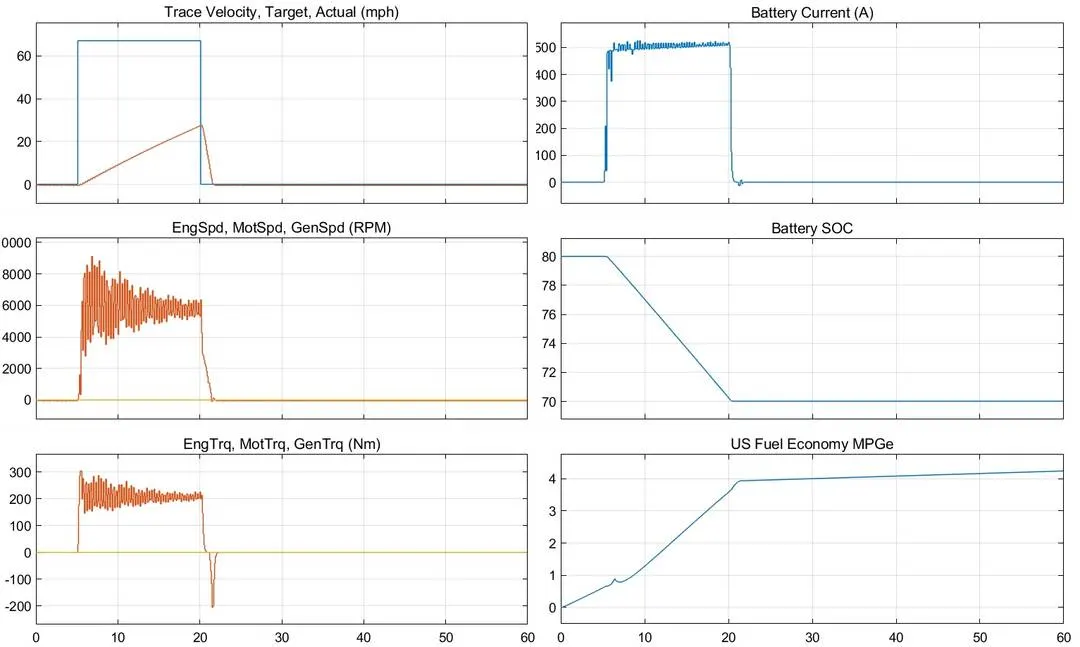
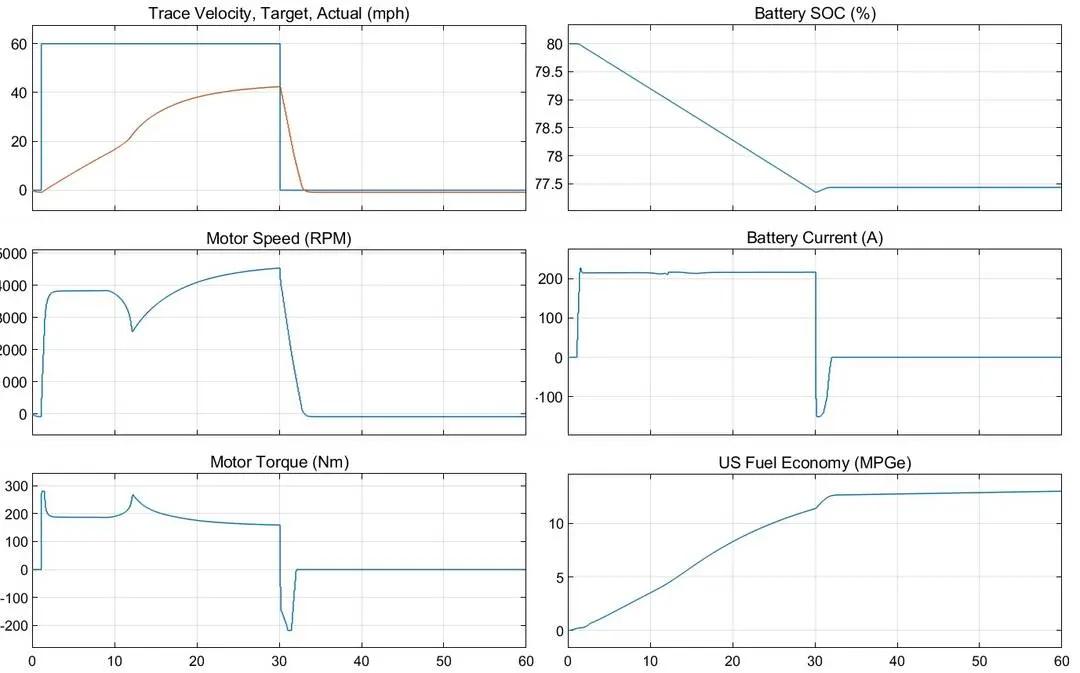
- In HEV Engine, Motor & Generator are the components used to drive the vehicle, whereas, in EV, Motor is the only component is used which is driven by Battery.
- From the graph, it is shown that the even on same input cycle (WOT Drive Cycle), and the same input parameter (Grade & Velocity), the maximum acceleration of the Electric vehicle is more
- SOC doesn't go beyond 75 in EV, whereas in HEV it reaches 70.
- In HEV the battery current fluctuation is high, in EV battery current fluctuation is less, even constant for most of the time span.
- Drivetrain Power loss is high in HEV, whereas the Power loss in EV is very less.
- Therefore, Electric vehicle is more efficient as compared to Hybrid Electric Vehicle.
Learning Outcome:-
- Learn The Mapper and Dynamic MOdels
- Learn how battery Power is converted to make equivalent to fuel so as to calculate the Mileage of the vehicle.
- Understand the effect of WTO Condition on HEV and EV vehicle
- Learn the Difference between EV & HEV.