Week-4 Challenge WOT Condition Part-2
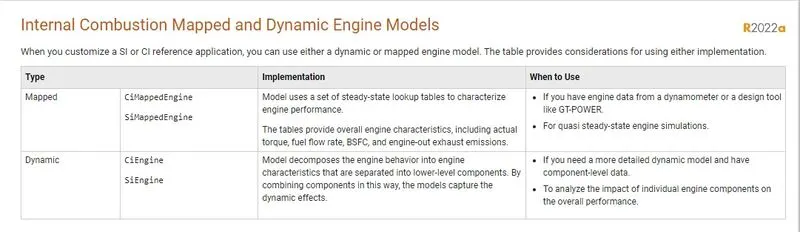
Question 1) What is the difference between mapped and dynamic model of engine, motor and generator? How can you change model type?
The powertrain blockset provides two types of propulsion models:
- Mapped Model : It uses a set of steady state 2D lookup tables to characterise engine/motor performance. The tables provide overall engine characteristics, including actual torque, fuel flow rate, BSFC, and engine out exhaust emissions.
Mapped Engine is the default settings in powertrain blockset. It is used to measure performance parameters of the vehicle by using standard lookup tables which are preferred to the system. This type of modelling is less accurate. The lookup tables value are based on the values of brake torque, commanded torque and engine speed.
Mapped motor works in torque control mode. This type of motor is used when the user requires a faster simulation and doesn’t have knowledge of motor parameters. The output torque and reference torque is compared and changes are made.
Mapped Generator: The mapped generator block is also similar like other blocks. Most of the data required is taken from the lookup tables corresponding to the given input parameters. Its simulation time is less.
- Dynamic Model: It decomposes the engine behaviour into engine/motor characteristics that are separated into lower level components. By combining components in this way, the models capture the dynamic effects.
Dynamic Engine uses real time data fed by the user at run time for modelling. This model is more accurate than mapped engine model. This type of model is used when the data of subsystems of vehicle is required.
Dynamic Motor In the dynamic motor a three phase interior permanent magnet synchronous motor(PMSM) is used. The block uses three phase input voltages to regulate the individual phase currents, allowing control of the motor torque or speed.
Dynamic Generator involves user entering the parameters manually during the run time for their particular applications. The results take time and are more accurate.
Process to change model type:
- Open powertrain module blockset for the required vehicle.
- click on passenger car/vehicle block and select electric plant or engine.
- Right click on engine/motor/generator based on model and select variant.
- Under variant, scroll to label model active choice and choose mapped or dynamic for the required calculation.
Question 2) How does the model calculate miles per gallon? Which factors are considered to model fuel flow?
Mile per gallon (MPG) is a fule economy rating determined by how far a car can travel on a gallon of gasoline or diesel for a conventional IC engine vehicle. In case of an electric vehicle, this is a measure how much electrical energy is consumed by a battery pack to travel a fixed distance.
MPGe : In US to compare the effuciency of a gasoline vehicle with the BEVs, PHEVs or other EVs MPGe unit was formulated. It stands for Miles per Gallon equivalent. It is foundthat 1 gallon of a gas has the same amount of energy as 33.7kwh of electricity.
Example A battery propells the vehicle for the 3.125 mile per Kwh of battery .So,
3.125 miles/kwh* 33.7Kwh/gallon = 105 MPGe
The powertrain blockset has an inbuilt model for this calculation inside visualization block.
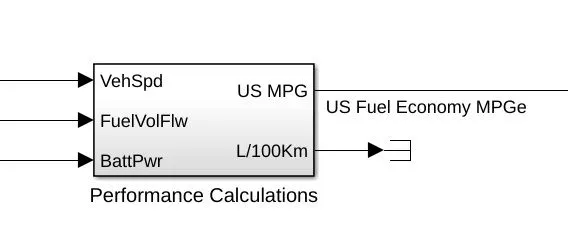
we can see the simulation blocks which calculates the MPGe
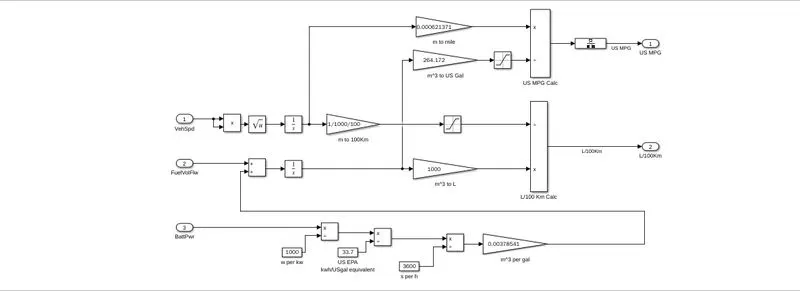
Here, three inputs are taken under consideration:
1. Vehicle speed
2.fuel flow
3.battery power
The vehicle speed inputs is in m/s which is converted into mile by multiplying with 0.000621371
similarly the kg of fuel is converted into cubic meter by multiplying by 1/(1000*0.739)
this cubic metre value is converted into gallon value by multiplying it with 264.172
now the battery value converted from watt to kwh by dividing with 1000and then gallon equivalent by again dividing it with 33.7
then divide the value by 3600 to get in per seconds and multiply by 0.00378541 to gat the value in cubic meter per gallons.