Week-4 Challenge WOT Condition Part-2
#1. What is the difference between mapped and dynamic model of engine, motor and generator? How can you change model type?
a. Difference between Mapped and Dynamic Model
A mapped system model parameters are plotted in the using the data given in the steady-state lookup tables which governs the performance of the model. The data in the lookup cannot be used in real time conditions, it can only run the test conditions according the data in the lookup table.
In Dynamic system models the parameters of each block is given manually so that we can setuo the performance of the model. It can be set for real time condition simulations.The dynamic system is more better than the mapped system when it comes to modelling and simulation.
| Mapped Model | Dynamic Model |
|
|
b. Change model type
- Modelling --> Varient Manager
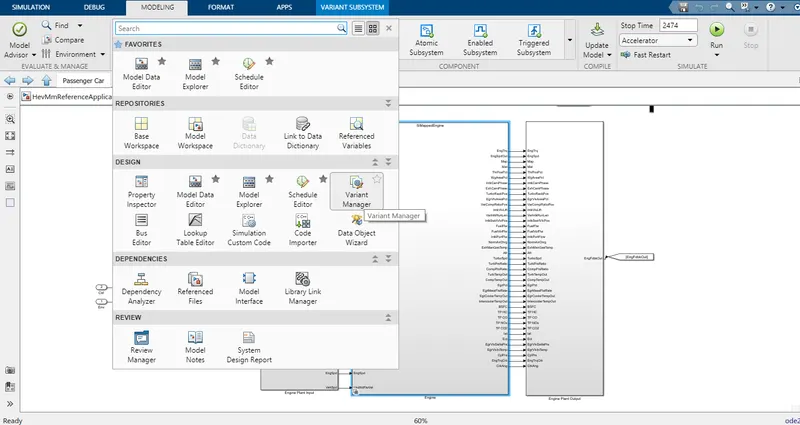
- Choose Electric or Engine as per requirement.
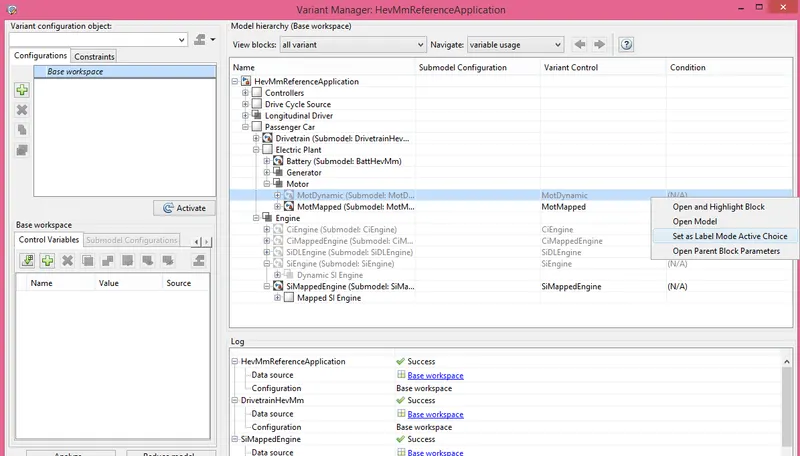
- Here as an example we choose to change Motor Mapped --> Motor Dynamic
- Choose the model which has to be change to and right click and set as Label Model Active Choice.
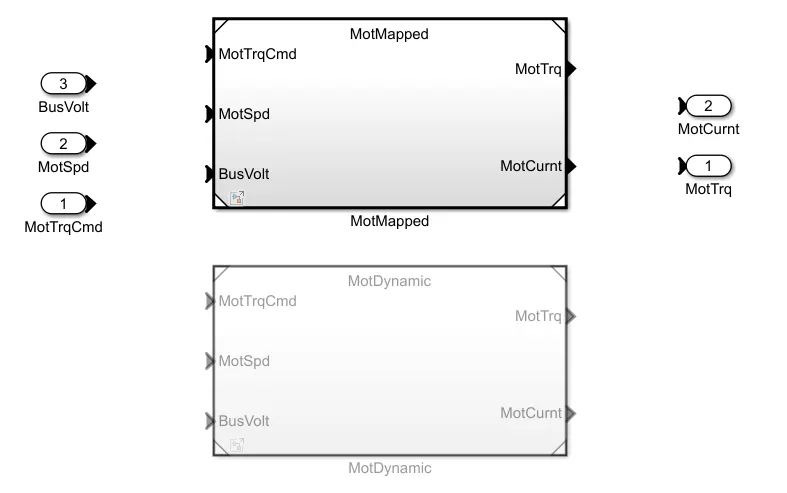
- The below model is the Motor Mapped (Active) and Motor Dynamic (Inactive)
- The below model is the Motor Dynamic (Active) and Motor Mapped (Inactive)
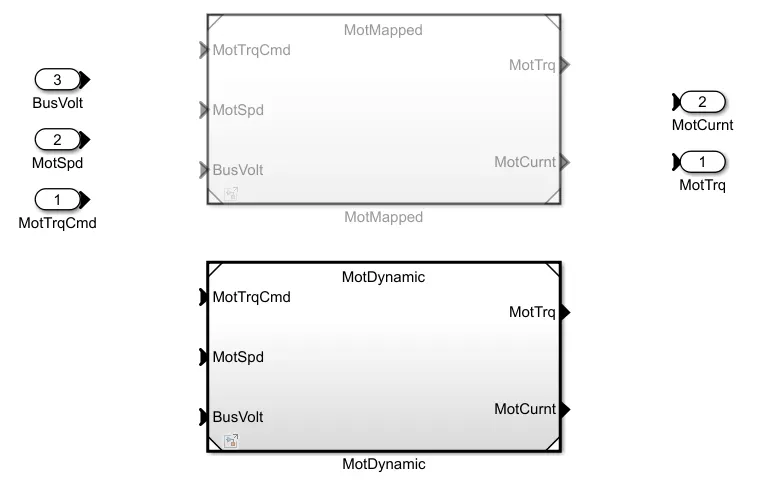
Similarlly to the above process can be done to Engine, Motor and generators as per requirements.
#2. How does the model calculate miles per gallon ? Which factors are considered to model fuel flow?
Miles Per Gallon - The distance in miles that can be travelled using 1 gallon of fuel. It measures the fuel efficiency of the vehicle.
- To calculate MPG - Fuel flow, Vehicle Speed, Battery power values are required.
- The below model is the MPG calculation of an HEV, where fuel and battery energy both taken into consideration.
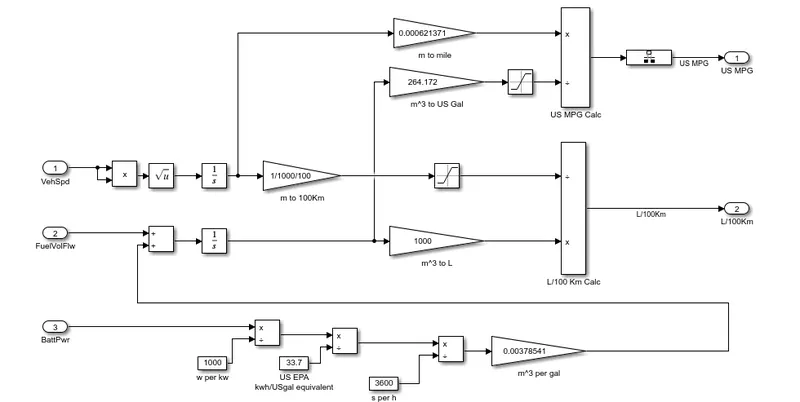 \
\
1. Battery Power is calculated.

- The Batter power is converted from Watt - Kilowatt
- This is converted into US gallon equivalent energy by dividing 33.7(Standard Value).
- Then it is converted into US per gallon second.
- To get the m^3 per gallon the values is multiplied with 0.00378541(Standard Values).
- This Final Value is added to the Fuel flow of the vehicle.
2. Fuel Flow Is Calculated.
- The Volume of fuel and battery energy is added and then integrated.
- This value is converted to m^3 to US Gal by multipliying 264.172(Standard Values).
- The value is given to a saturation lock with upperlimt as inf and lower limit as 1e-3.
3. Vehicle Speed is calculated.
- The vehicle speed is squared to avoid decelaration values.
- This value of speed is square rooted and then integrated.
- The vehicle speed is converted to m - mile by multiplying 0.000621371(Standard Values).
4. MPG = Vehicle Speed/(Fuel Flow + Battery Power)
The Factors considered :-
- Vehicle Speed
- Battery Power
- Fuel Flow
#3. Run the HEV ReferenceApplication with WOT drive cycle. Change the grade and wind velocity in the environment block. Comment on the results.
Skipped
#4. Keeping all other parameters same, compare the simulated results of hybrid and pure electric powertrains.
Skipped