Week-4 Challenge WOT Condition Part-2
AIM:
1. Differentiate between the mapped and dynamic model of the engine, motor, and generator? How can you change the model type?
2. How does the model calculate miles per gallon? Which factors are considered to model fuel flow?
1. Difference between the mapped and dynamic model of engine, motor, and generator
Mapped Model:
- A model is defined to be mapped when it uses a steady-state lookup table to characterize engine performance wherever the information features are preassigned in lookup tables.
- The engine or motor torque needed is sensed and the motor or engine block generates the needed torque producing just as needed easily without analyzing the real-time motor or engine, parameters.
- The output values are collected to the corresponding delivered input values of the engine motor and generator.
- The accuracy of this type is not that high but the simulation will be done in much less time as it does not run by real-time parameters.
Dynamic Model:
- The dynamic model on the other hand uses the combination of the outputs from various subsystems to generate the output.
- As per the drive cycle requirements the initial Bus voltage, the current is given along with the vehicle feedback so that it runs the actual simulation at that particular moment throughout the drive cycle.
- The accuracy of this model is very high as it considers the real outputs from all the subsystems to generate the output.
- It runs by real-time simulation where the required input from the drive cycle is taken and for that Individual real-time simulation gets performed and summing all the results of the subsystem gives the output for the simulation.
- The simulation will take a very long time to complete as it has so many individual simulations running by all the subsystems of the engine, motor/and generator.
Mapped Engine:
Mapped Engine is the default setting in the powertrain blocks.
This modeling type is less accurate. The lookup tables value is based on the values of brake torque, commanded torque, and engine speed. If any other parameter like Input engine temperature is selected then lookup table values are also a function of the temperature parameter.
It is used to measure the performance parameters of the vehicle by using standard lookup tables. The data extracted from lookup tables are air mass flow, fuel flow, emission data, exhaust temperature, and efficiency. This data is used to find out other parameters which are needed by the end-user.
Dynamic Engine:
We can calculate Brake torque, fuel flow, port gas mass flow, exhaust temperature, exhaust mass flow rate, and exhaust emissions.
This type of model uses real-time data fed by the user at run time for modeling.
This model is more accurate than the mapped engine model.
This type of model is used when the data of subsystems of a vehicle is required.
Mapped Motor:
The output torque and reference torque are compared and changes are made. Input torque or speed can be specified, and electrical losses and maximum motor power and torque can be defined.
The mapped motor works in torque control mode. This type of motor is used when the user requires a faster simulation and doesn’t have the knowledge of motor parameters.
Dynamic Motor:
In the dynamic motor, a three-phase interior permanent magnet synchronous motor (PMSM) is used.
The block uses three-phase input voltages to regulate the individual phase currents, allowing control of the motor torque or speed.
This block is used when the user knows what parameters are to be used in that particular Simulation. This motor is more accurate.
Mapped Generator:
The mapped generator block is also similar to other blocks. Most of the data required are taken from the lookup tables corresponding to the given input parameters. Its simulation time is less.
Dynamic Generator:
The dynamic generator involves users entering the parameters manually during the run time for their particular applications.
The results take time and are more accurate. To change the model from mapped to dynamic.
2. How does the model calculate miles per gallon? Which factors are considered to model fuel flow?
Miles per Gallon is a fuel economy rating determined by how far a car can travel on a gallon of petrol or Diesel for an Engine powered car.
In the case of an electric vehicle, it recognizes the energy which is equivalent to that of an engine-powered car to propel the car through a distance.
factors that are considered to model fuel flow:
1. Battery Power
2. Fuel Flow
3. Vehicle Speed
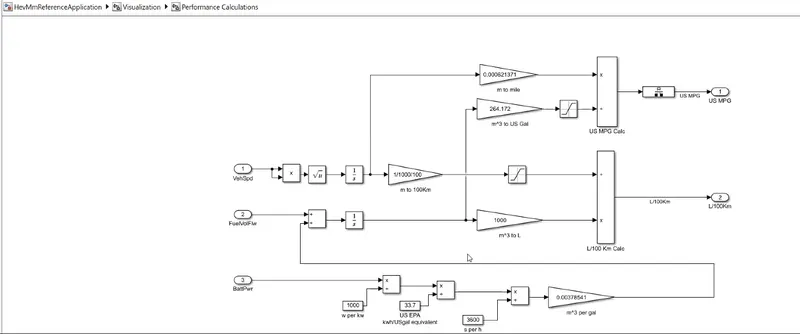
The amount of Fuel Energy required to move an engine-powered car through a distance is determined and then it is compared to the equivalent amount of electric energy required to move the car through the same distance and is expressed as the miles per gallon.
The powertrain block set has a model that calculates the miles per gallon for all kinds of vehicles. The transformation from a Mile per Gallon to Fuel Flow is mentioned below step
Conversion from cubic Meter to Gallon (m^3 to a gallon), As we know 264.172 US Gallons is 1000L The reference model taken here for consideration is HEV and as it operates on both the Battery and the Fuel injection Engine.
The final output/Fuel Efficiency is calculated by keeping into consideration of the Battery Output. Fuel Output and the vehicle Speed/Kilometres are Driven. Therefore the fuel efficiency is calculated and it is converted after the saturation thus the FE is calculated.
To convert speed to Distance we can Integrate with time and we are doing the same by converting the velocity to get the distance covered by integrating.
The amount of energy from battery power required to propel the vehicle Equivalent to that of the Engine is calculated here.
The battery power is given in watts and it is converted to Kw by dividing by 1000. Then we convert the power into energy by multiplying the time into KWh. Then we convert the Energy from kWh to equivalent energy in US gallons of automotive gasoline by dividing by 33.7.
Finally the Battery energy equivalent in kg/s is given as an input for the fuel flow parameter to find the equivalent Us Gallons of energy and estimate the Miles per Gallon.