Week-4 Challenge WOT Condition Part-2
1. What is the difference between mapped and dynamic model of engine, motor and generator? How can you change model type?
Answer:
Powertrain Blockset:
Powertrain blockset provides fully assembled reference application models of automotive powertrain, including gasoline, diesel, hybrid and electric systems. It includes a component library for simulating engine subsystems, transmission assemblies, traction motors, battery packs and controller models. Powertrain blockset also includes a dynamometer model for virtual testing. MDF file support provides a standards-based interface to calibration tools for data import.
Powertrain blockset provides a standard model architecture that can be reused throughout the development process. You can use it for design trade off analysis and component sizing, control parameter optimization, and hardware-in-the-loop testing. You can customize models by parameterizing components in a reference application with your own data or by replacing a subsystem with your own model.
Difference between mapped and dynamic model of engine, motor and generator
Mapped models:
- Mapped model uses a set of steady state look up table for simulation and its operation.
- Simulation becomes easier and gives the result based on the data interpreted.
- This model is also called global based model.
- The more data has to be collected and we need to make certain assumptions.
Dynamic Models:
- Dynamic model represents the behaviour of the model in term of the lower level component.
- It operates dynamically depending upon the situation of operation, detailed data and simulation gives the detail analysis of each component
- This model is called real time model.
- It takes more time for simulation and the accuracy of the system is high.
Changing the model type:
- To see how to change the model type, the HEV Multimode Reference Application is taken as reference:
- Figure below shows the powertrain blockset of HEV Multimode Reference Application.
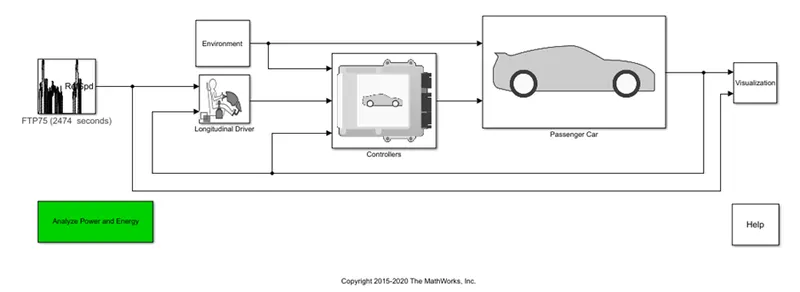
- In this application mapped generator, motor and SI engine are used.
To convert mapped generator to dynamic
- In the passenger car subsystem, to access the mapped generator navigate through following path – Passenger Car<Electric Plant
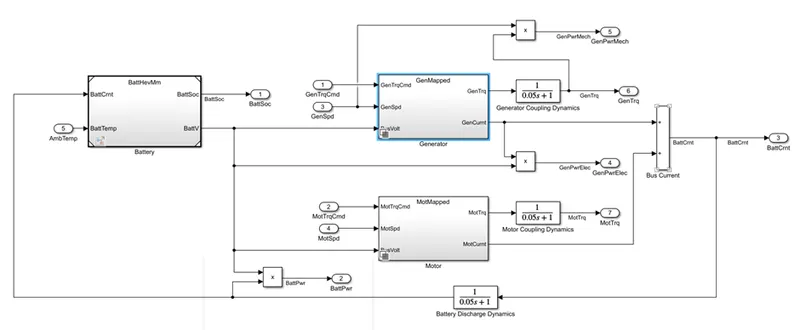
- The mapped generator contains two blocks. One is mapped generator block and other is dynamic generator block.
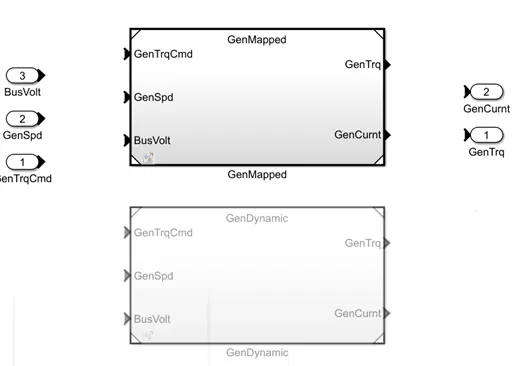
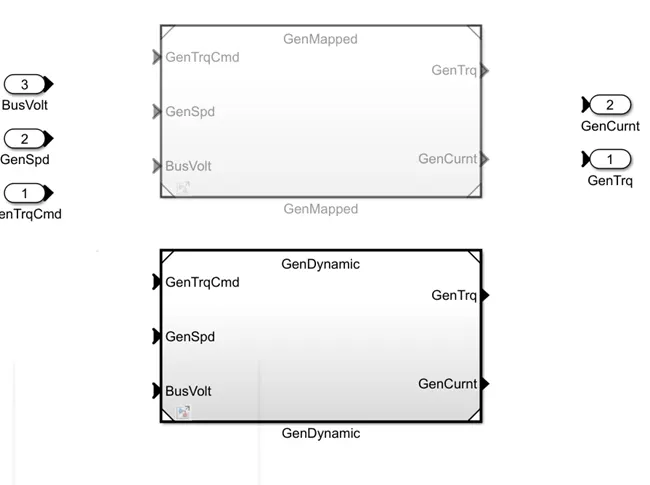
- As the model contains the mapped generator so the 'GenMapped' block is active and ‘GenDynamic’ block is inactive.
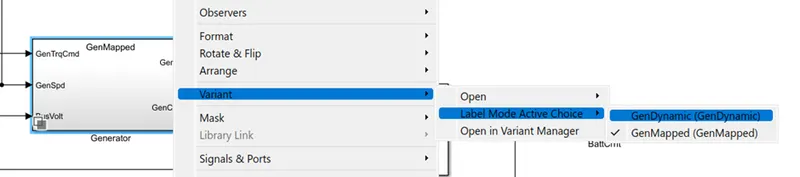
- To make a generator dynamic right click on the generator block then in variant option choose 'Lebel Mode Active Choice' and click on 'GenDynamic' option as shown.
- In this way mapped generator is converted to the dynamic generator as shown
- As shown in the following figure, 'GenDynamic' block is active and the 'GenMapped' Block is inactive.
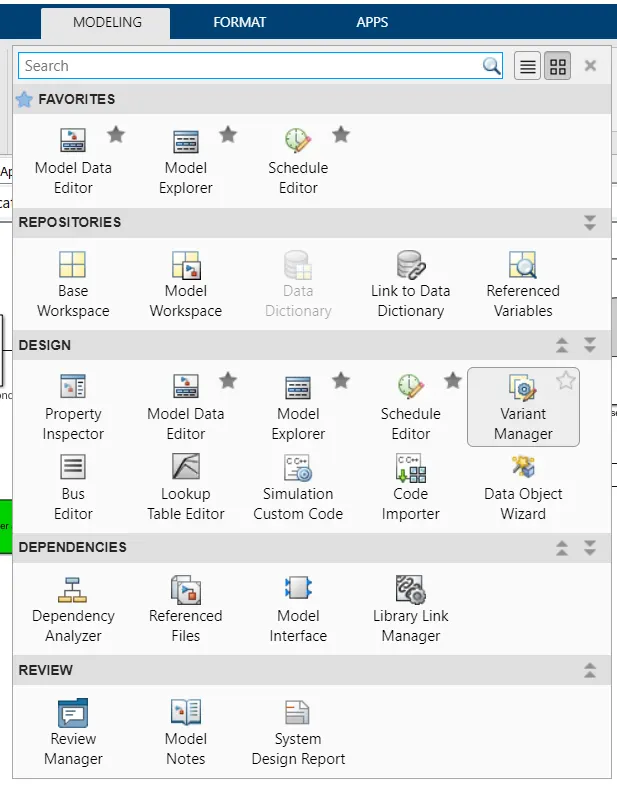
- Another way is to go the modelling section of task bar and click on ‘variant manager’.
- The Figure below shows the variant manager option in the task bar of modelling.
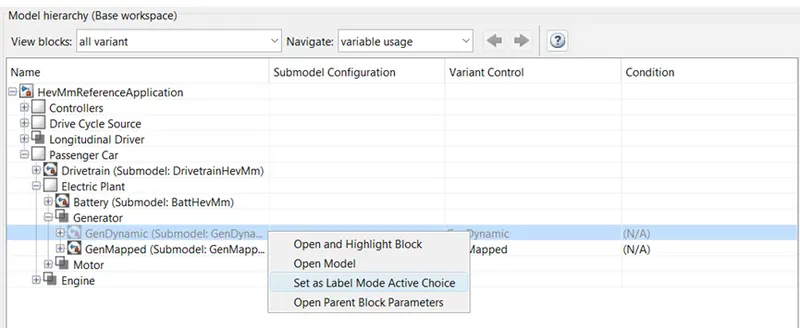
- It will open a variant manager window as shown in following figure.
- Then in the passenger car subsystem, right click on the ‘GenDynamic’ option and click on ‘Set as Label Mode Active Choice’
2. How does the model calculate miles per gallon? Which factors are considered to model fuel flow?
Answer:
- The following block is used to calculate the miles per gallon
- As shown in the below figure, following factors are consider to model the fuel flow.
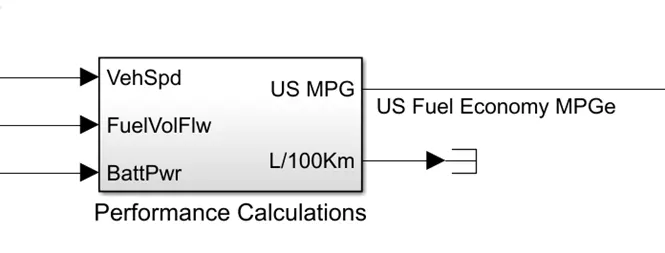
- Factors consider for calculation of miles per gallon:
- Vehicle speed
- Battery power
- Fuel flow
- Subsystem of the ‘Performance block’ contains the following mathematical model to calculate the miles per gallon.
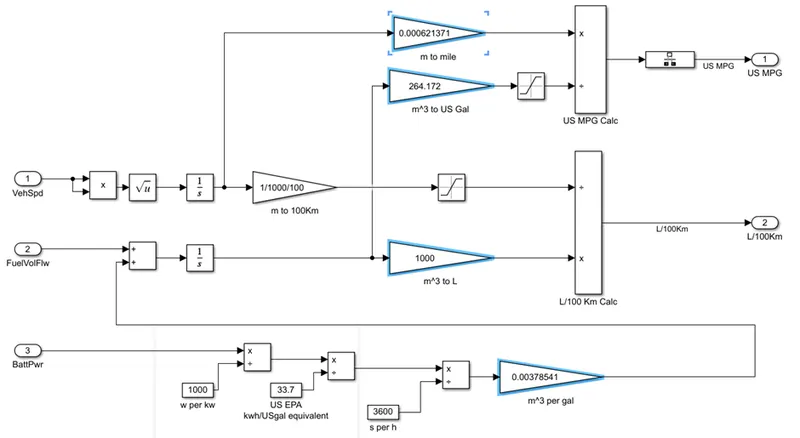
- As shown in the above figure, the battery power is converted into the kW first by dividing 1000, then it is converted into US EPA kwh/USgallon equivalent and by dividing it by 3600 it gives m3/gal value.
- The battery power and fuel flow values are added to get m3 value
- This value in converted into the US gallons.
- By integration of the vehicle velocity data we get the distance and this distance is converted into the miles.
- Now the distance id divide by US gallons to give miles per gallon.
3. Run the HEV Reference Application with WOT drive cycle. Change the grade and wind velocity in the environment block. Comment on the results.
Answer:
Drivetrain Blockset of HEV Multimode Reference Application:
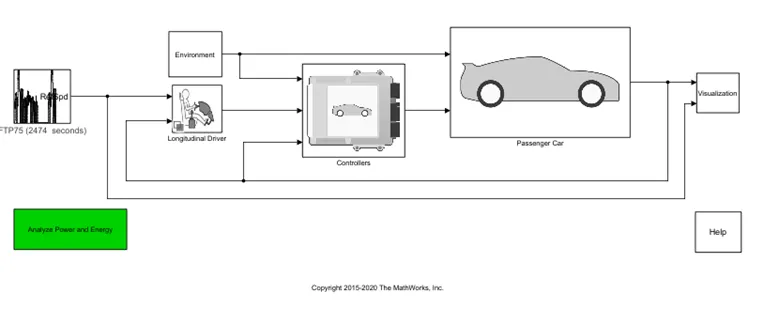
- The figure above shows the drivetrain blockset of the HEV Multimode Reference Application.
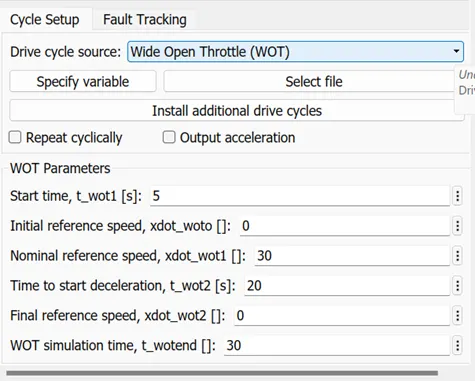
- In the drive cycle source change the drive cycle source parameter to the Wide Open Throttle (WOT) for the simulation of the vehicle as shown in the below figure.
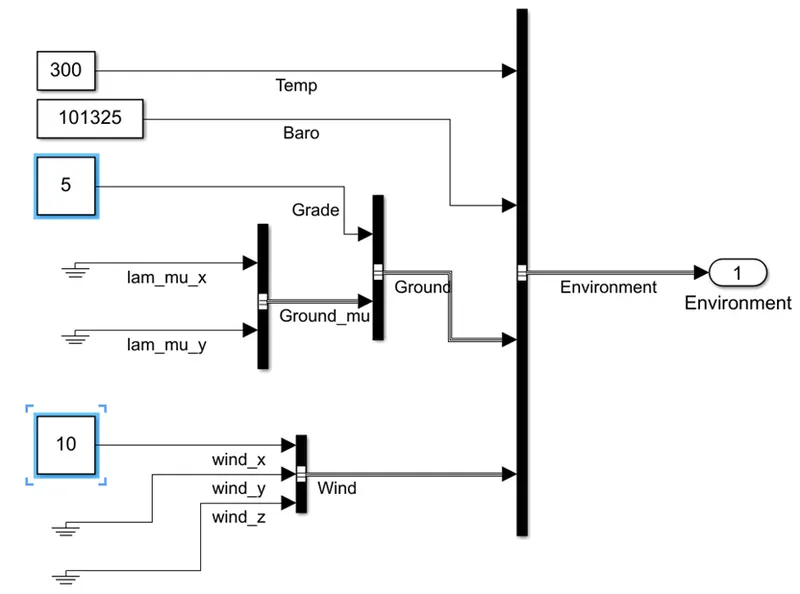
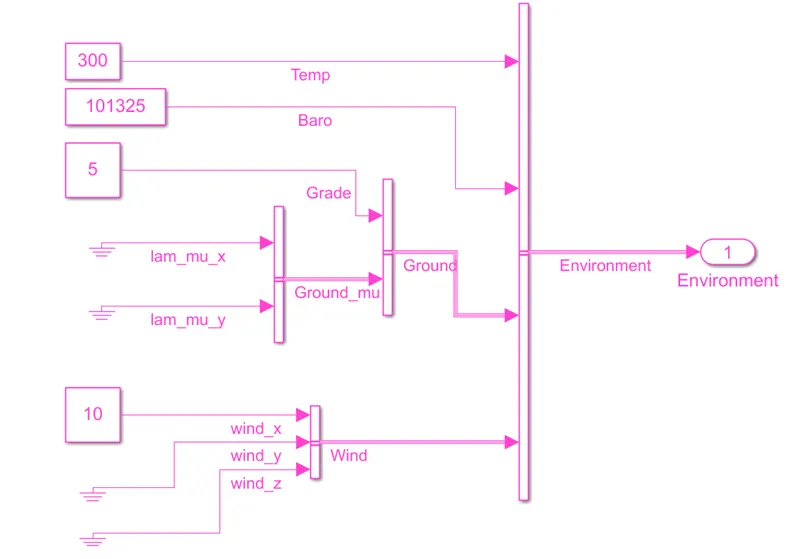
- Now in the subsystem of the environment block, the grade value is changed to 5% and the wind velocity value is changed to the 10 m/s as shown below:
- The default simulation time for the model is 2474sec which takes more time for simulation therefore the simulation time is changed to 100 sec
Results:
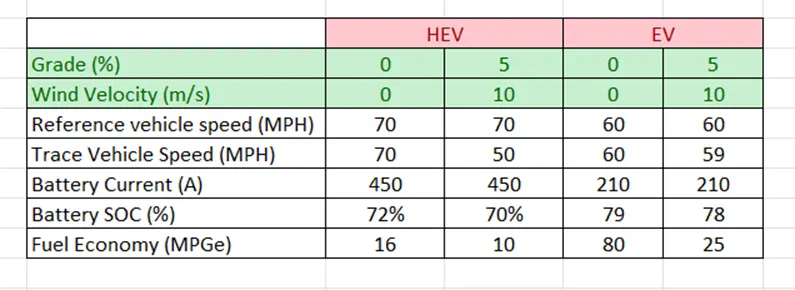
- Following figure gives the result of wide open throttle for grade = 0 % and wind velocity = 0 m/s.
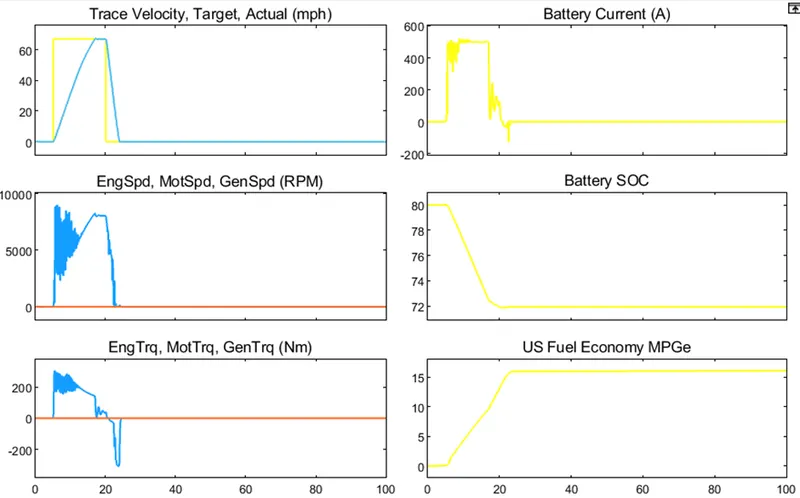
- Reference velocity is achieved in this case.
- Battery SOC reduced from 80% to 72%.
- Fuel economy is 16 MPGe.
- The following figure gives the result for grade = 5 % and wind velocity = 10 m/s.
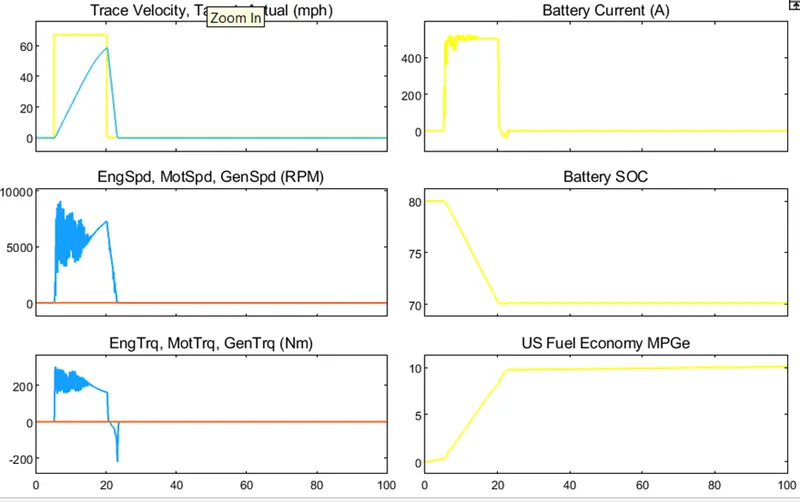
- The reference velocity of vehicle is approximately 70 MPH which is achieve in the first case and failed to chieve in the second case.
- Battery SOC id depleted from 80% to 70%.
- Fuel economy is reduced to 10 MPGe.
- After 20 seconds motor goes into the regenerative mode.
4. Keeping all other parameters same, compare the simulated results of hybrid and pure electric powertrains.
Answer:
Drivetrain blockset of the pure electric vehicle reference application:
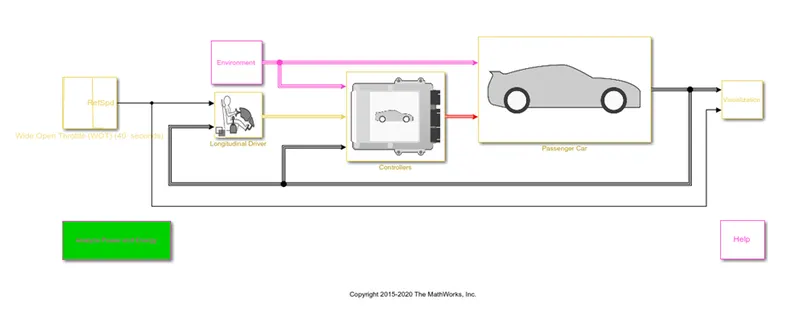
- In the above drivetrain blockset of electric vehicle, all the parameter of the model are kept same as in the above HEV drivetrain blockset.
Results:
- The following figure gives the result for grade = 0 % and wind velocity = 0 m/s.
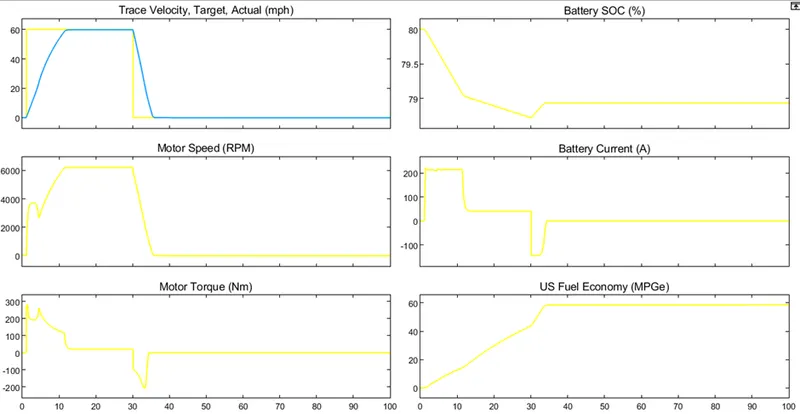
- The required WOT drive cycle is run for 30 seconds.
- For 0 % grade and 0 m/s of wind velocity, the battery achieve the require WOT condition and it takes less time to achieve the condition.
- The motor speed is 6000 RPM in this case and speed becomes zero after 35 sec.
- Battery SOC is decreased from 80% to 79%.
- The fuel economy is 80 MPGe.
- The following figure gives the result for grade = 5 % and wind velocity = 10 m/s.
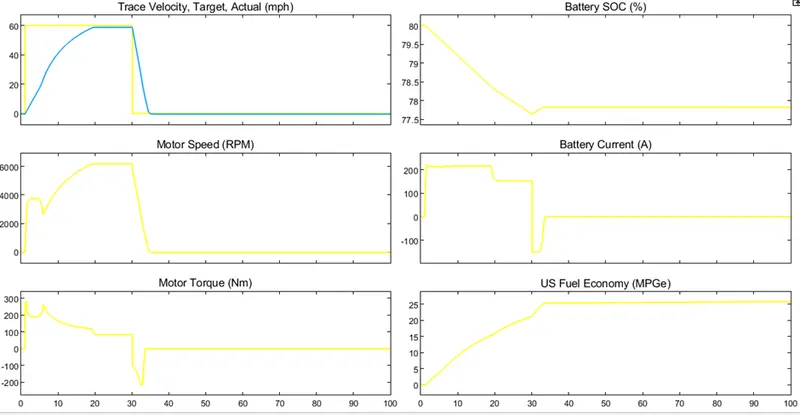
- The required WOT drive cycle is run for 30 seconds.
- For 5 % grade and 10 m/s of wind velocity, the battery does not achieve the require WOT condition and it takes more time to start achieving the condition.
- The motor speed is 5000 RPM in this case and require more time to achieve this speed and speed becomes zero after 35 sec.
- Battery SOC is decreased from 80% to 78%.
- The fuel economy is less which is 25 MPGe.
HEV Application example link: https://in.mathworks.com/help/autoblks/ug/hev-multimode-reference-application.html
EV example link: https://in.mathworks.com/help/autoblks/ug/electric-vehicle-reference-application.html