Week-4 Challenge WOT Condition Part-2
Week 4 Challenge - WOT Condition Part 2
1. What is the difference between mapped and dynamic model of engine, motor and generator? How can you change model type?
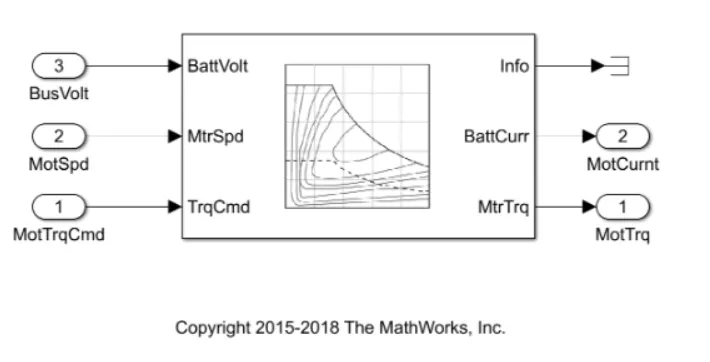
Mapped Model of Engine, motor/generator:
Ignition timing and fuel mixture data are stored in an ECU memory in open-loop digital systems. A characteristic map can be used to graphically portray the data contained in the individual cells of the computer's memory. The information for this map is obtained by a series of engine tests, and the programme used to execute these tests is known as engine mapping. These tests measure engine performance and look into the affects of each variable that has an impact on the engine's output. When the consequences are known, the ideal performance settings may be identified and documented.
Because it can be configured to imitate road conditions, a dynamometer is vital equipment for conducting these tests.
The mapped model is one that uses a lookup table to pre-assign data points. The required engine or motor torque is sensed, and the motor or engine block simply creates the required torque output without taking into account the real-time motor or engine parameters. The output values of the engine motor and generator are saved for the corresponding provided input values. This form of simulation has a low level of accuracy, but it will take significantly less time to complete because it does not use real-time parameters.
Dynamic Model of Engine, motor/generator :
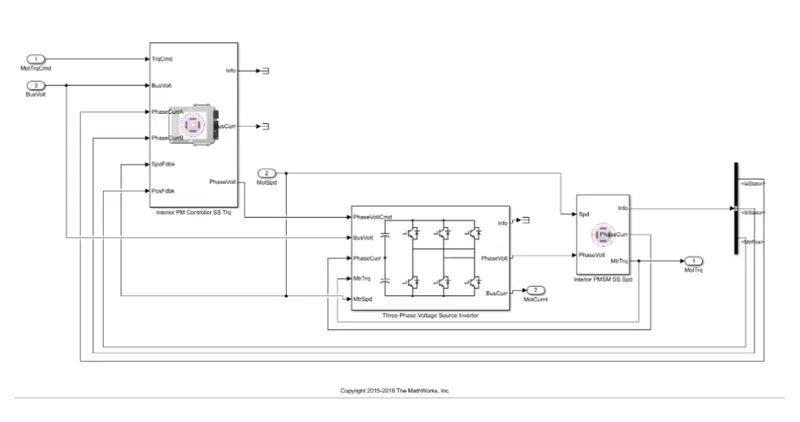
The dynamic model, on the other hand, generates the output by combining the outputs of several subsystems. It operates using real-time simulation, in which the required input from the drive cycle is obtained and an individual real-time simulation is run for that subsystem, with the sum of the subsystem's results providing the simulation's output. Because there are so many subsystems functioning, the simulation will take a long time to finish.
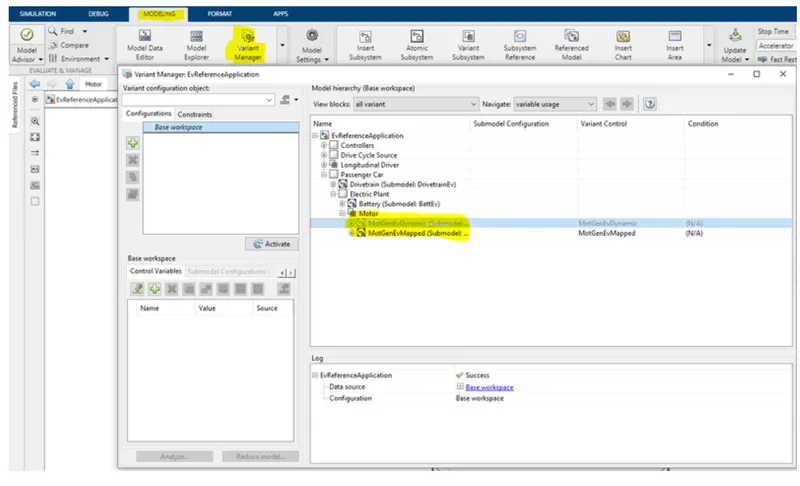
How can you change the model type ?
To locate the variant systems we have, we can use the variation manager in the modelling tab to change the model type. Set as Label mode active by right-clicking on the model you wish.
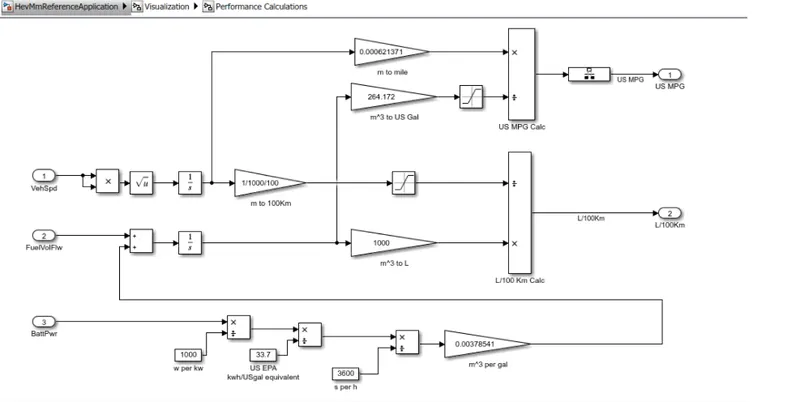
2. How does the model calculate miles per gallon? Which factors are considered to model fuel flow?
The distance travelled in metres is calculated using vehicle speed data, which is then translated to miles.
The data from the battery is used to calculate the amount of power utilised in kWh, which is then converted to gasoline equivalent using the US EPA value by dividing by 33.7. 1 gallon of gasoline is equivalent to 33.7 kWh.
We may calculate miles per gallon by multiplying the distance travelled in miles by the number of gallons. This gallon is combined with the gallon used by the IC engine to compute miles per gallon for HEVs.
3. Run the HEV Reference Application with WOT drive cycle. Change the grade and wind velocity in the environment block. Comment on the results.
A hybrid electric vehicle (HEV) is a hybrid vehicle that combines an internal combustion engine (ICE) with an electric propulsion system. The inclusion of an electric powertrain is designed to deliver either better fuel economy or better performance than a traditional car.
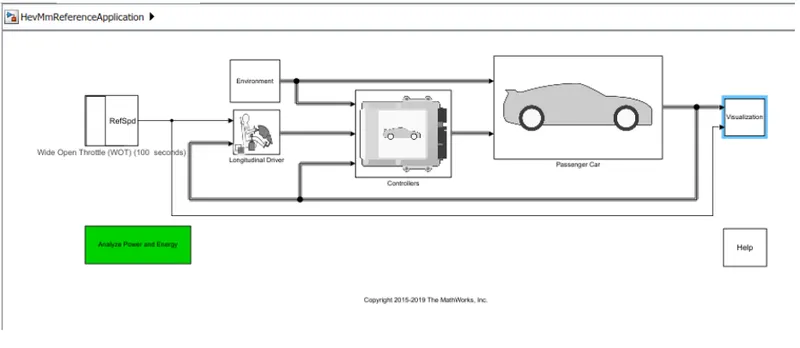
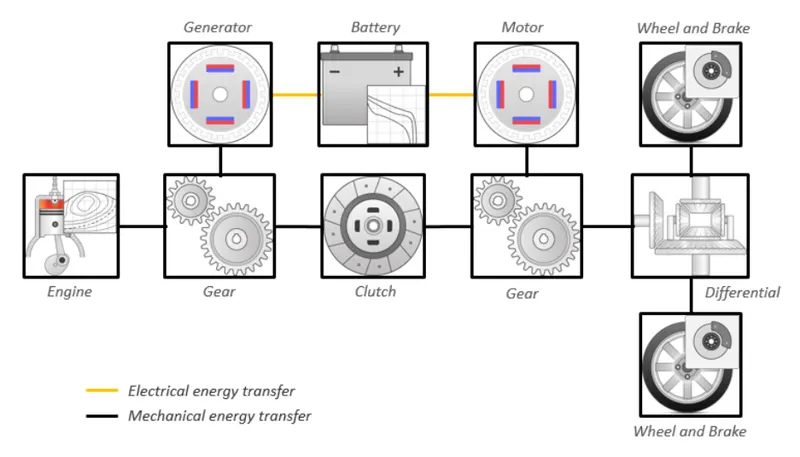
Simulation Output
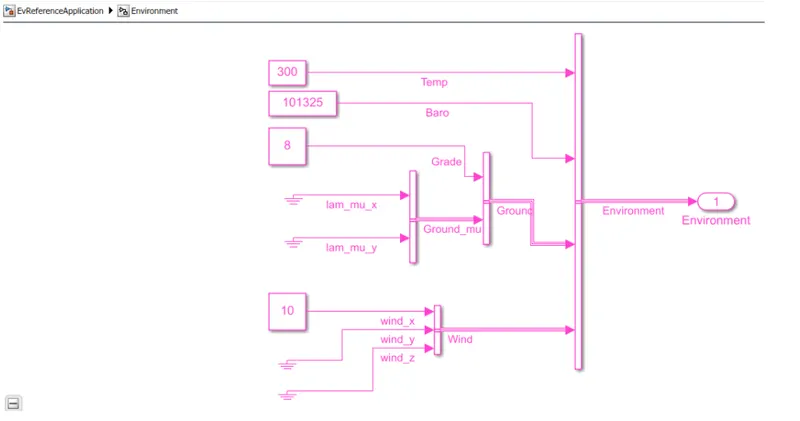
In the above given block diagram,
we see the Total cycle time is 100 seconds
Grade angle is 8 degrees
Top Speed of the cycle is 80 mph
Wind Velocity is 10 m/s.
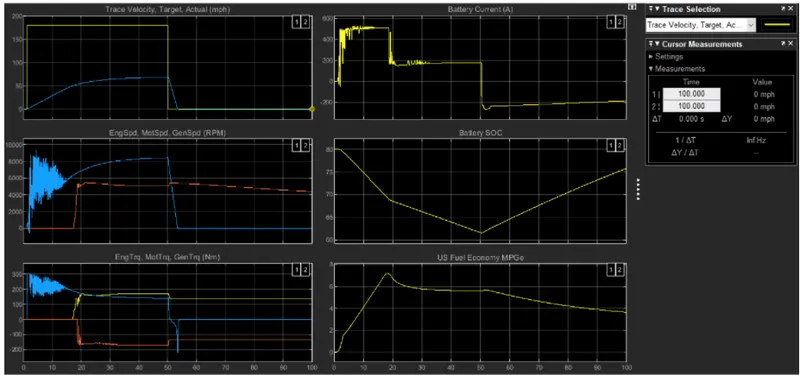
Graph 1 :
The time scale on the x axis depicts the vehicle's velocity in relation to the driving cycle data. Because of the additional forces at work, a top speed of 80 mph is not possible, and the car can only reach 67.2 mph. It takes 44.5 seconds to accelerate to a top speed of 67.2 mph. The time it takes to go from 80 to zero is 5.06 seconds.
Graph 2 :
The second graph shows the rpm changes in the engine, motor, and generator during the driving cycle. The engine's maximum speed is 4676 rpm, the motor's maximum speed is 8103.5 rpm, and the generator's maximum speed is 12858.5 rpm.
Graph 3 :
Displays the torque characteristics of the engine, motor, and generator in Nm during the course of the driving cycle. 139.6 Nm of peak engine torque, 206.4 Nm of peak motor torque, and 48.2 Nm of peak generator torque.
Graph 4 :
Shows the battery current levels and changes during the drive cycle for varied acceleration inputs. The battery's highest current discharge is 167.6 A. The battery is charged at a peak current of -152.4 A.
Graph 5 :
Indicates the percentage change in battery state of charge (SOC) as a function of driving inputs. For the indicated driving conditions, the state of charge decreased from 60 percent to 25.98 percent in a time period of 49.3 seconds.
Graph 6 :
Provides the relevant input driving circumstances' fuel economy in miles per gallon. For the supplied vehicle under the aforementioned driving conditions, the maximum miles per gallon of gasoline equivalent for the car is 17.93 miles.
4. Keeping all other parameters same, compare the simulated results of hybrid and pure electric powertrains.
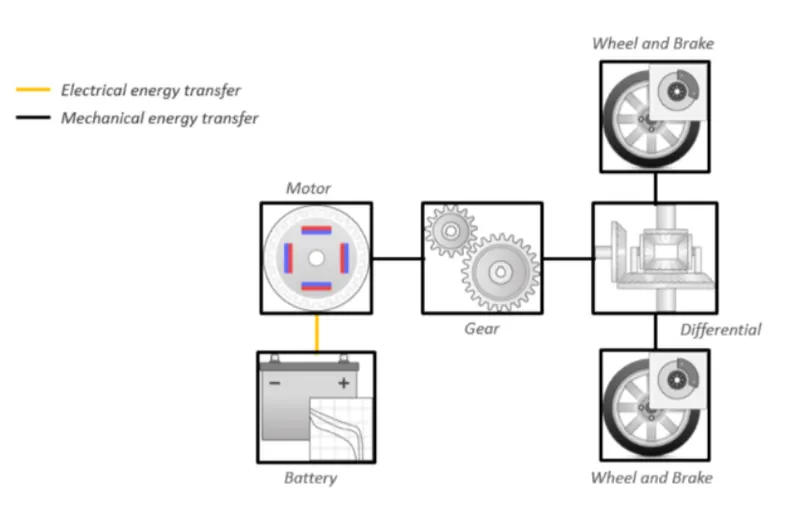
A battery electric vehicle, also known as a pure electric vehicle, is an electric vehicle that relies solely on chemical energy stored in rechargeable battery packs for propulsion. BEVs are propelled by electric motors and motor controllers rather than traditional internal combustion engines.
They get all of their energy from battery packs. They are environmentally beneficial because they do not emit any waste gas. They also have their own limitations such as range.
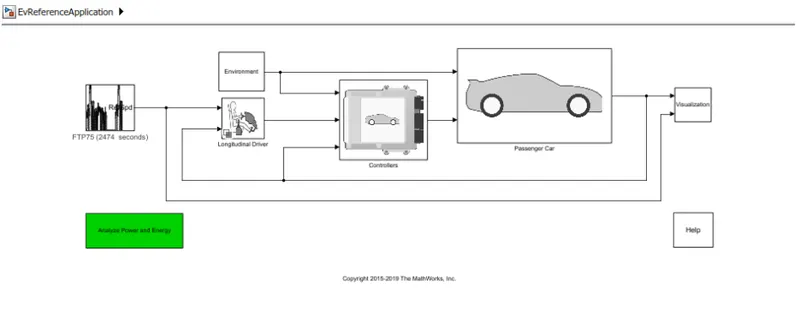
Simulation Output :
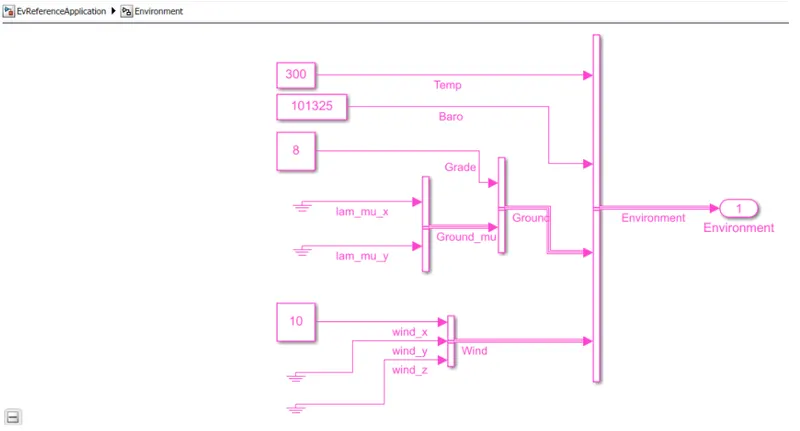
The Simulation is done for Pure Electric Vehicle,
The Total cycle time is 100 seconds, Grade angle is 8 degrees.
Top Speed of the cycle is 80 mph, Wind velocity is 10 m/s.
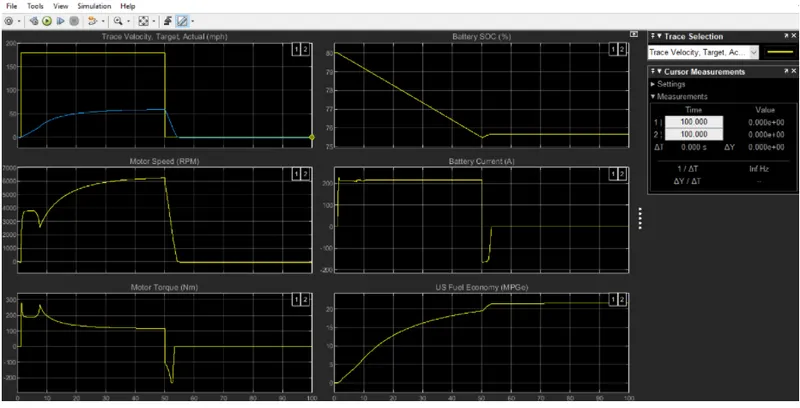
Graph 1 :
Depicts the vehicle's velocity in relation to drive cycle data, with the time scale on the x axis. Because of the additional forces at work, a top speed of 80 mph is not possible, and the car can only reach 58.9 mph. The time it takes to get to a top speed of 58.9 mph is 48.8 seconds. The time it takes to go from 80 to zero is 4.63 seconds.
Graph 2 :
Displays how the motor's speed fluctuates in rpm during the course of the drive cycle. The maximum speed of the motor is 6254 rpm.
Graph 3 :
Illustrates the torque characteristics of the motor and how they change in Nm over the course of the drive cycle. The maximum torque of the motor is 280 Nm.
Graph 4 :
Displays the battery current values and changes over the drive cycle for various acceleration inputs. The battery's max current discharge is 225.8 A, while its peak current charging is -163.7 A.
Graph 5 :
Indicates the percentage change in battery state of charge (SOC) as a function of driving inputs. For the indicated driving conditions, the state of charge declined from 80 percent to 75.5 percent in a time period of 49 seconds.
Graph 6 :
With the matching input driving conditions, shows the equivalent fuel economy in miles per gallon. Although there is no fuel in a pure electric car, the battery energy required is equal to the fuel energy, and the fuel efficiency is calculated. For the present vehicle and driving conditions, the maximum miles per gallon of gasoline equivalent that the car can go is 21.45 miles.
Observation:
When comparing an electric car to a hybrid electric vehicle under the same environmental and drive cycle circumstances, the electric vehicle achieves a lower top speed. The electric car produces higher values of motor speed and torque than the hybrid vehicle's motor alone, but the hybrid vehicle's torque is higher than the electric vehicle's torque when the torque of both motor and engine is combined. This is what allows the hybrid automobile to reach a higher peak speed than a pure electric vehicle.
Because the pure electric car here employs lithium-ion batteries rather than nickel metal hybrid batteries, the pure electric car's discharge capacity and charging rate are both higher. In comparison to a hybrid car, the motor can produce a lot of torque quickly since it can discharge at a fast rate. Also, the level of charge shows that the pure electric vehicle's battery efficiency is higher than the hybrid vehicle's, which is related to the battery type utilised in these cars.