Week 4 Challenge : CFD Meshing for BMW car
Aim
Perform a detailed topological cleanup on the given BMW car model and generate a surface mesh with the given element sizings and quality criteria. Further, construct a wind tunnel domain outside the car for volume meshing.
Learning Outcomes
- Perform detailed topological cleanup on half body of the car.
- Generate surface mesh on the car with specified sizings and quality criteria.
- Fix all the off elements on the mesh using mesh reconstruction and reshape.
- Conduct geometry and surface mesh checks to verify the final model before volume meshing.
Procedure
The given BMW car model was opened using ANSA v23 as shown below.
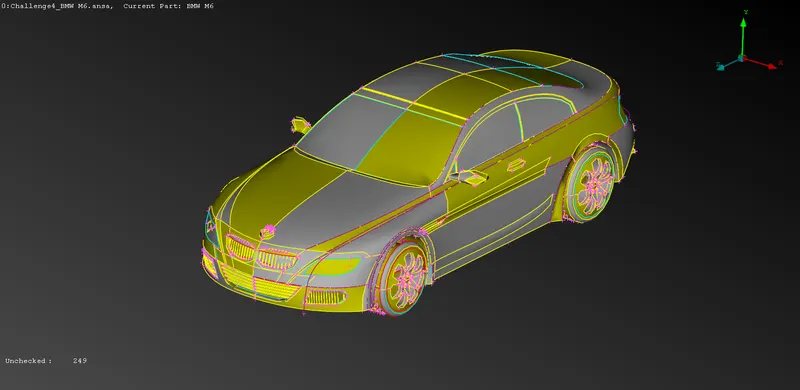
From the image above, it is evident that the resolution on the CONS of the model was poor and led to the creation of 249 unchecked faces. To overcome this an element sizing of 3mm was given to all the CONS on the model as shown below.
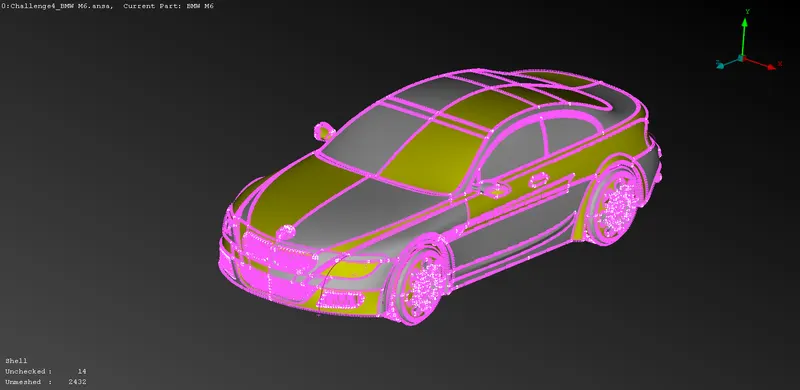
As seen above, the number of unchecked faces has now dropped to 14 faces from the previous 249 which is a drastic improvement.
The given BMW car model was symmetric in design on its longitudinal axis. To make it easy for cleanup and meshing, half the body of the car was considered as shown below.
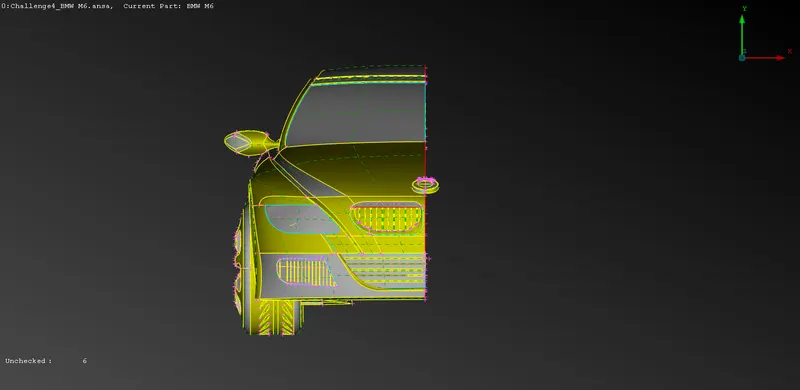
With the half body of the car established, the topological cleanup was then commenced in the component-wise order of:
- Logo
- Grills
- Rims and Tyres
- Optimal Rear View Mirror
- Windows
- Silencer
- Lights
- Body
Logo
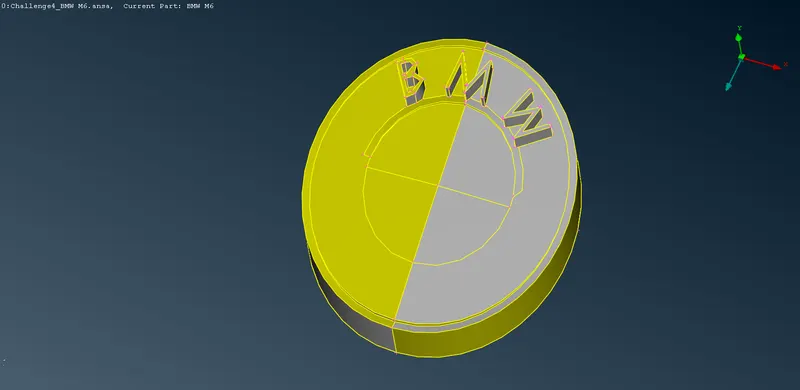
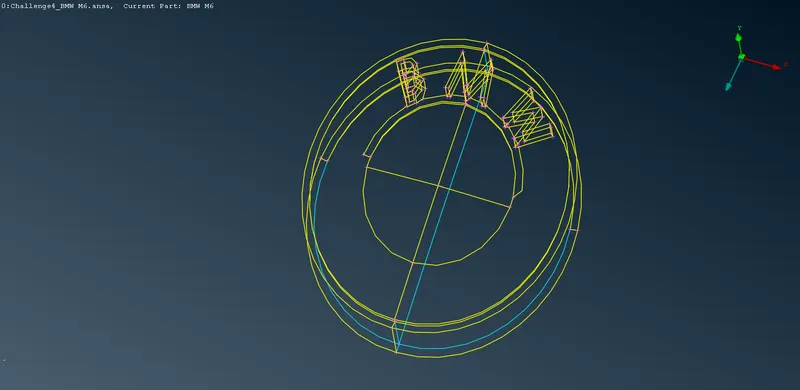
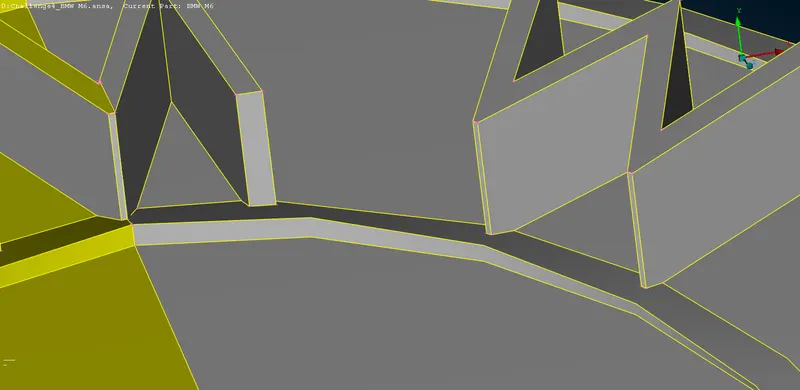
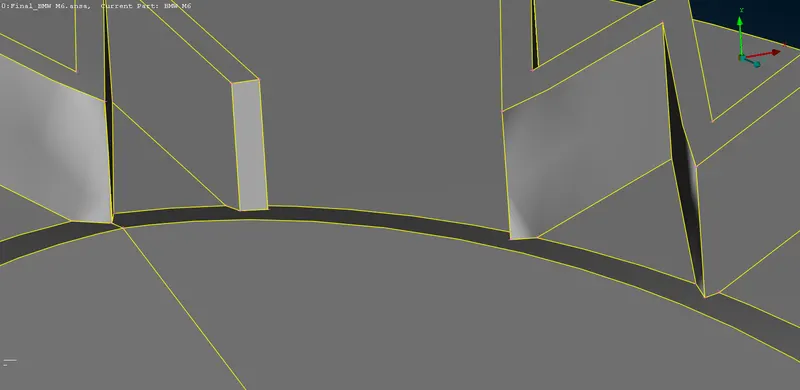
The images below show the logo of the BMW prior to the topological cleanup. A number of triple CONS can be observed on the logo. Additionally, very thin faces were also observed on the M and W alphabets on the logo.
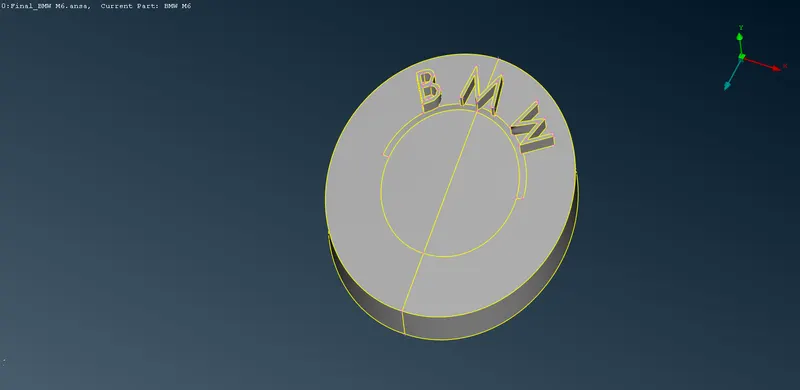
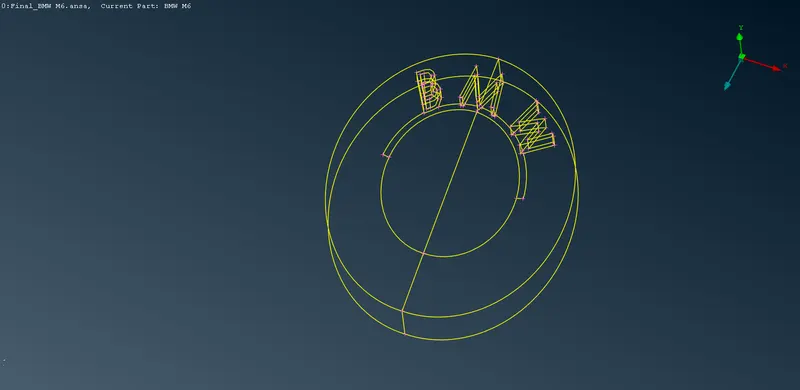
The following images show the cleaned final version of the logo. Only double CONS can be observed on the logo which means the geometry is now closed. The thin faces on the alphabets were also deleted and recreated as shown below to ease the surface meshing process.
Grills
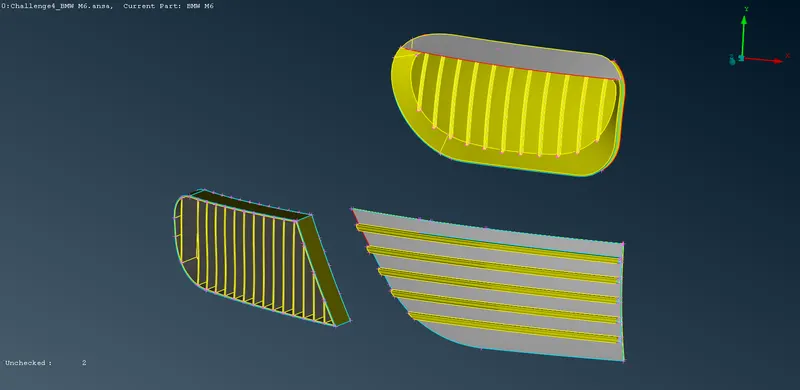
The images below show the various grill on the BMW car before cleanup. A number of single and triple CONS can be spotted on the geometry. It is crucial that all of them are addressed prior to surface meshing.
A close-up view of the individual grill components prior to cleanup can be seen in the images below
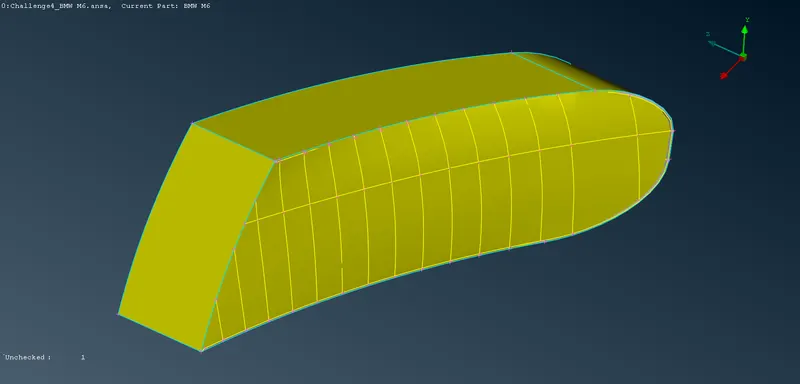
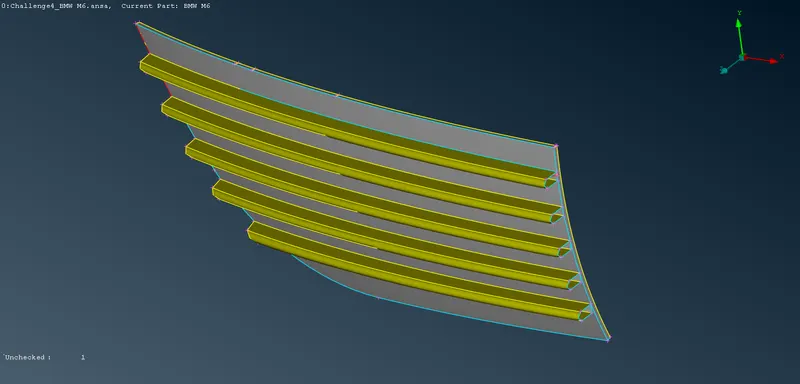
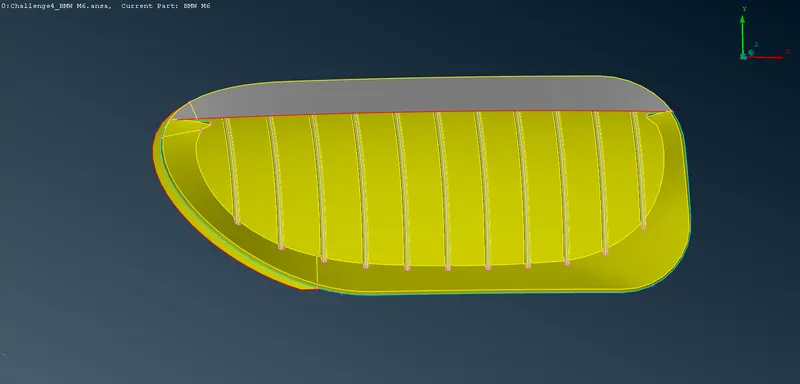
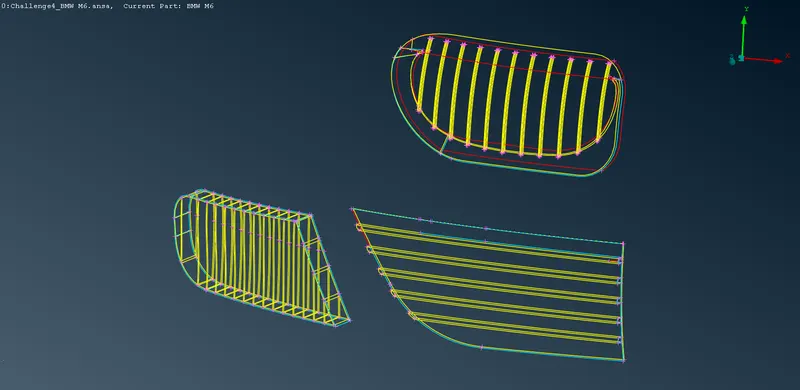
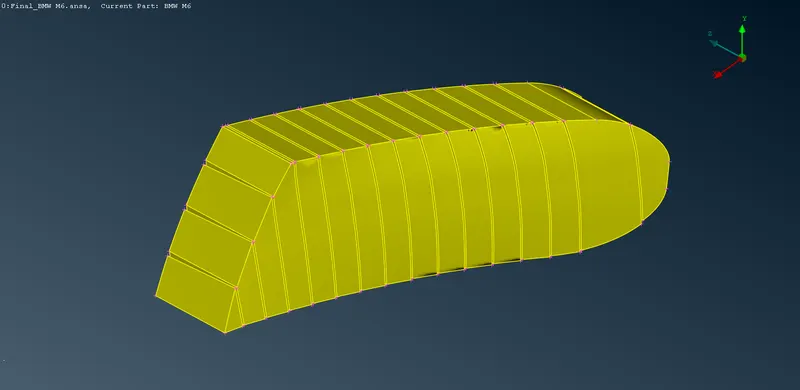
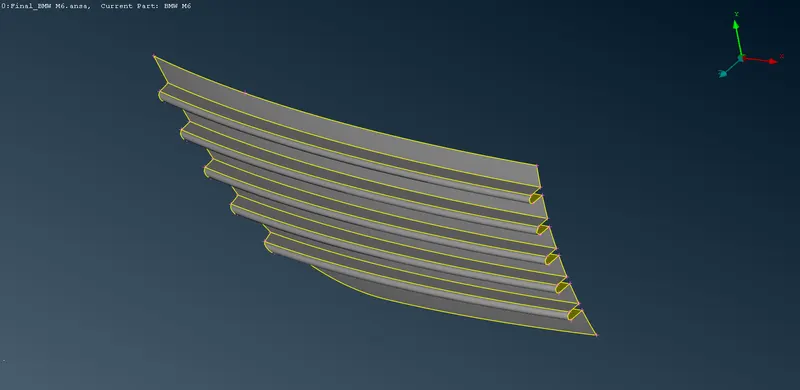
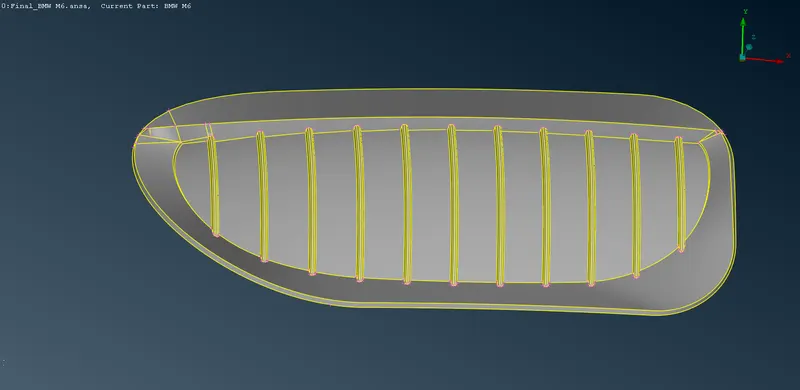
As can be seen above, all the grills require a rigorous topological cleanup and the creation of pocketed volumes for each grill slot to avoid multiple fluid volumes within the grills. The final cleaned version of the grills can be seen in the images below.
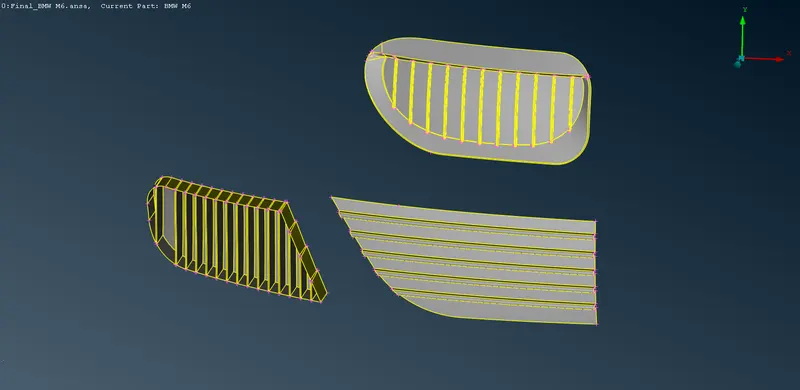
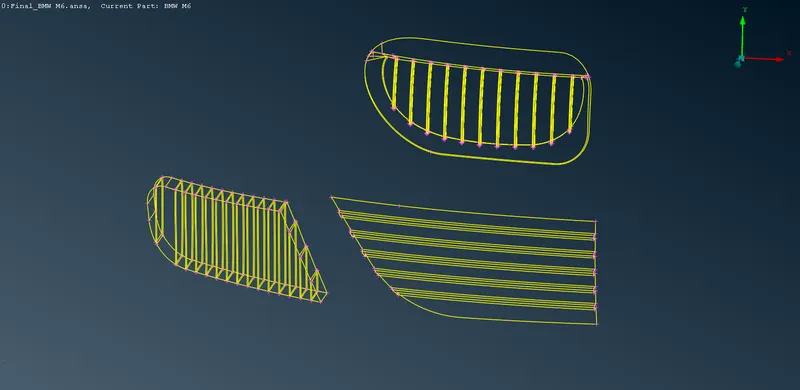
As seen above, all faces on the grills are made to orient in their proper direction (grey outside) and all the triple and single CONS were addressed leaving only double CONS resulting in a closed geometry. A close-up view of the individual grill components can be seen to detect the exact modifications conducted to create the pocketed volumes for the grill slots.
Rims and Tyres
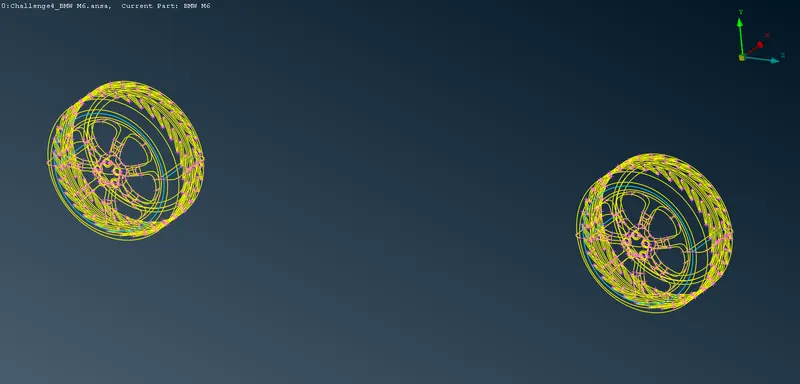
The images below show the Rims and Tyres of the car prior to the cleanup. The surfaces are seen to be relatively clean compared to the other components of the car. Only two triple CONS can be observed which were addressed swiftly by deletion of the respective surfaces.
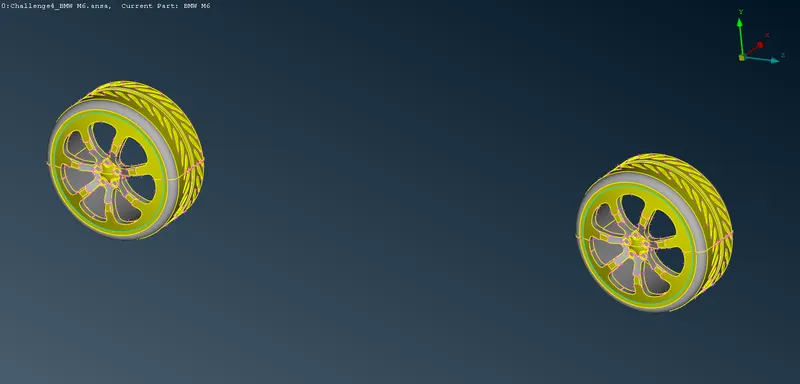
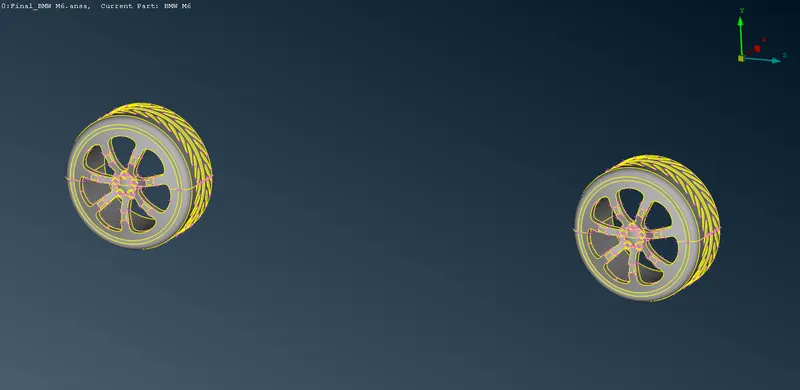
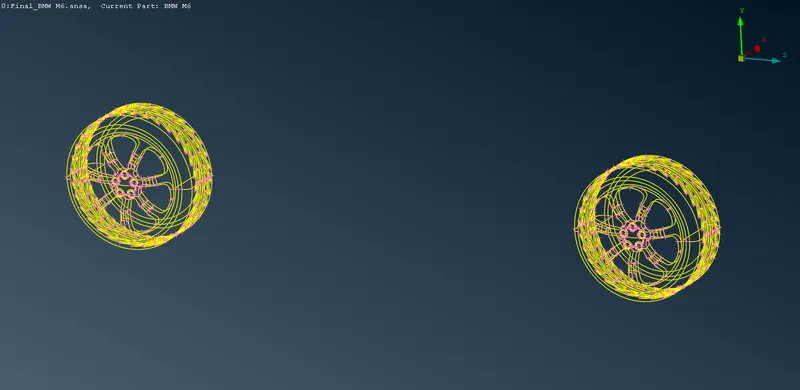
The following images show the cleaned version of the rims and tyre geometry.
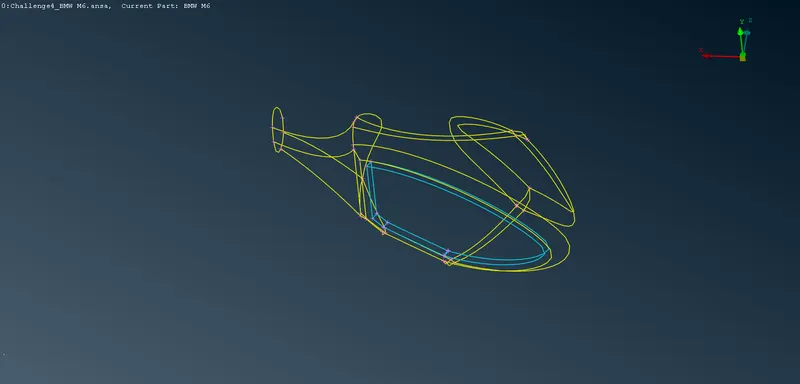
Optical Rear View Mirror
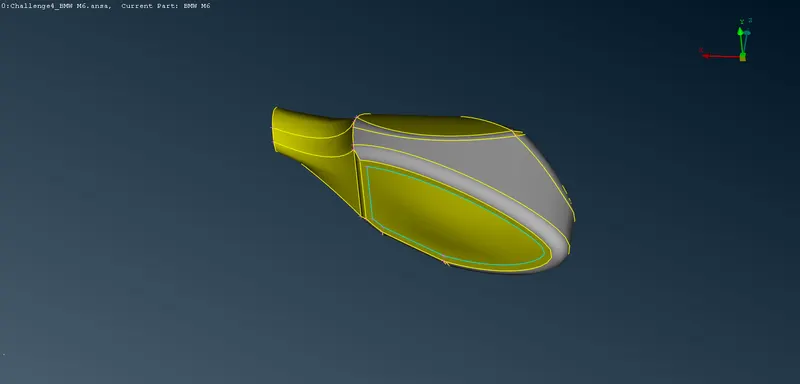
The images below show the Optical Rear View Mirror of the car prior to the cleanup. Similar to the rims and Tyres, the majority of the surfaces are already well cleaned with the exception of a few triple CONS seen in the mirror face.
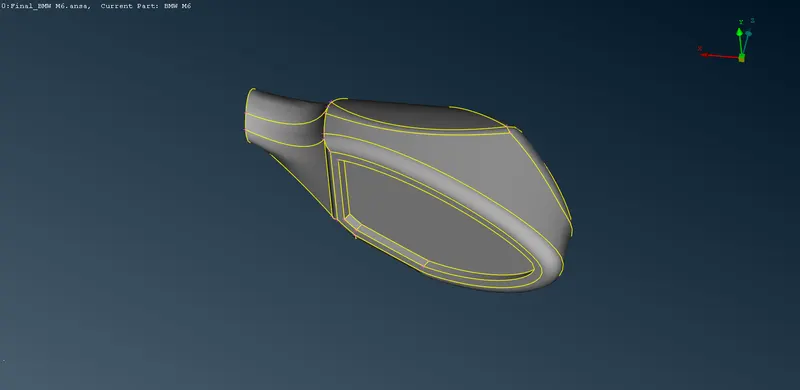
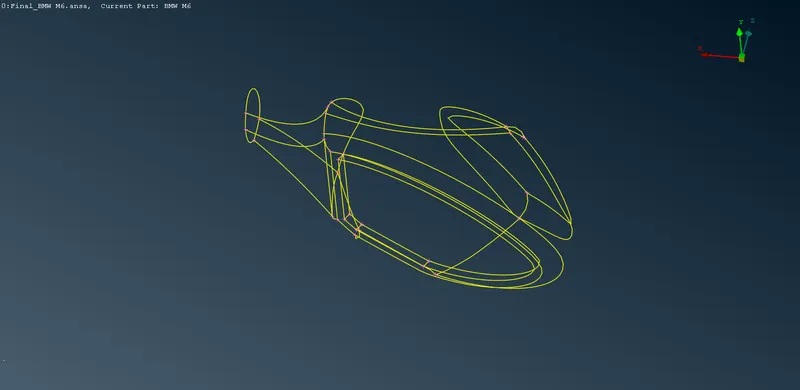
The following images show the cleaned version of the optical rear view mirror geometry.
Windows
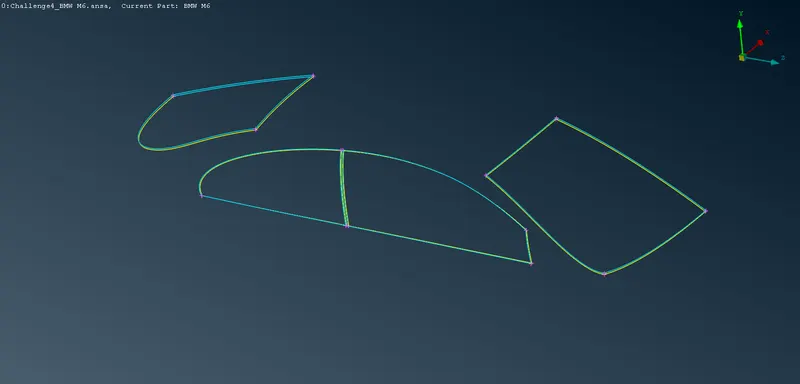
The images below show the Windows of the car prior to the cleanup. Similar to the previous components, the majority of the surfaces were already well cleaned with the exception of a few triple CONS as seen below
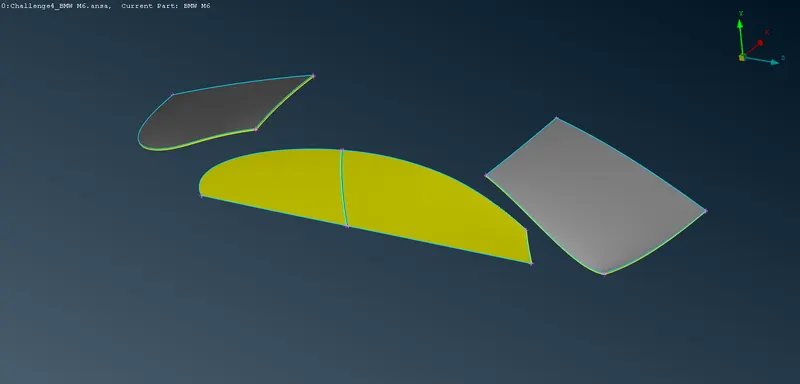
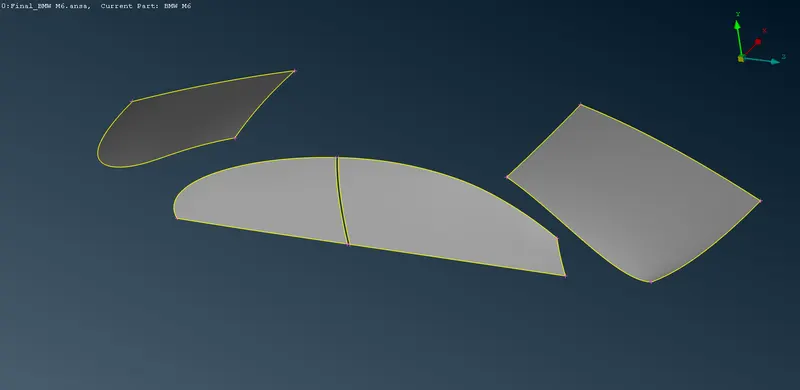
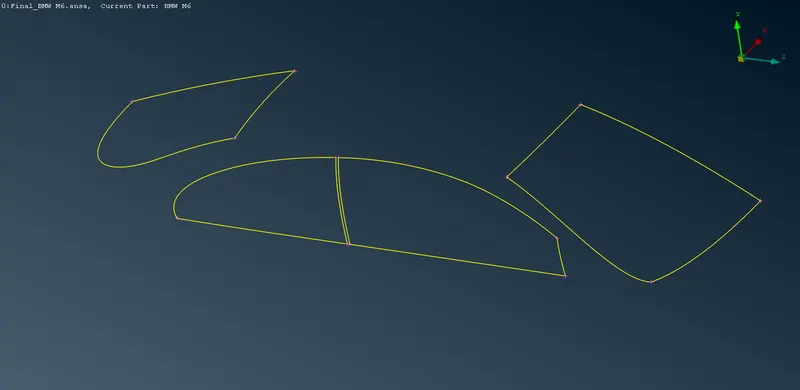
The following images show the cleaned version of the Windows geometry.
Silencer
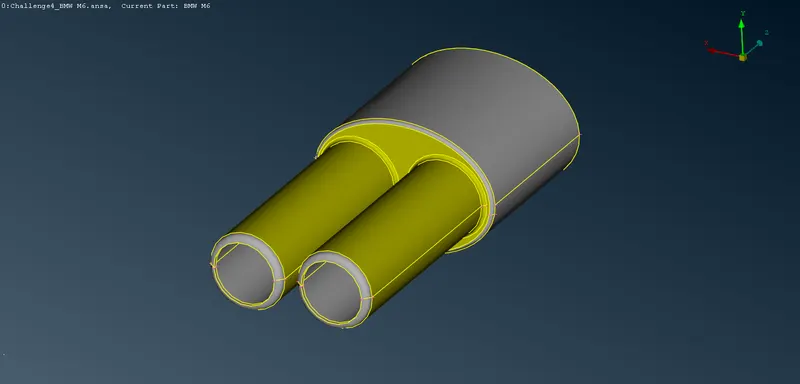
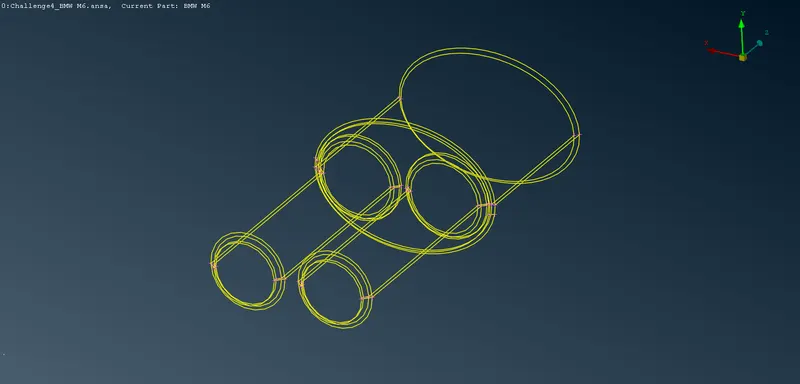
The images below show the silencer of the car prior to the cleanup. Similar to the previous components, the majority of the surfaces were already well cleaned. The lip of the silencer nozzle required modification to ease meshing.
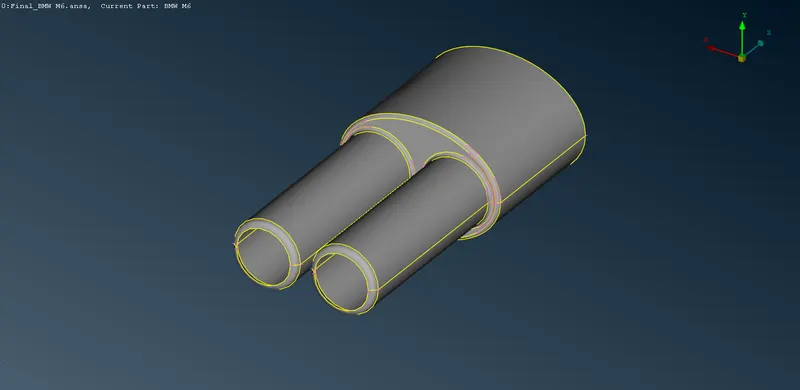
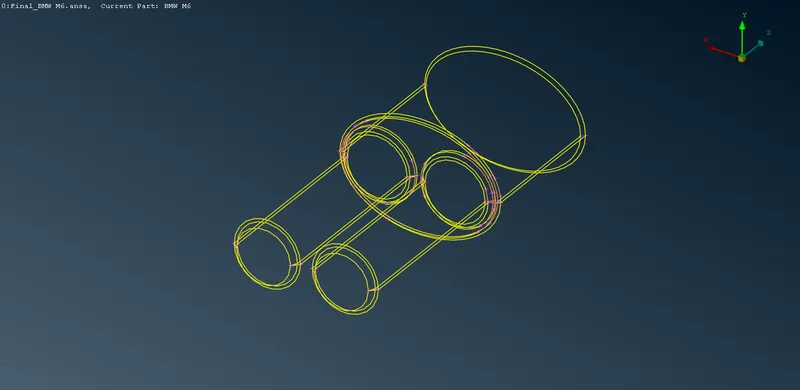
The following images show the cleaned version of the silencer geometry with the modified lip at the nozzle.
Lights
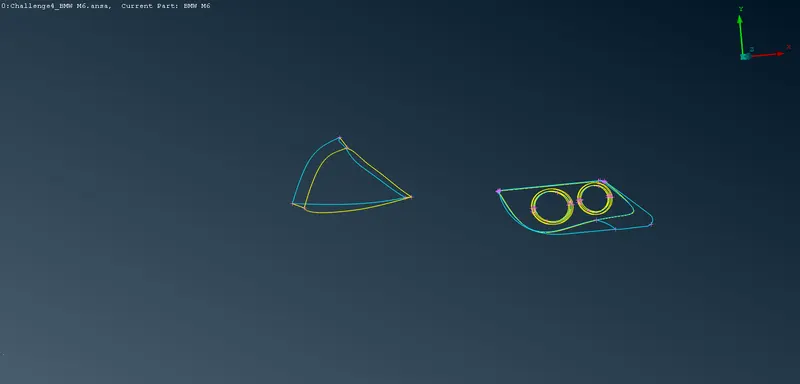
The images below show the Lights of the car prior to the cleanup. A number of internal components were observed as seen below which are not required for an external aerodynamics simulation. These internal components were deleted and the triple CONS were also subsequently resolved.
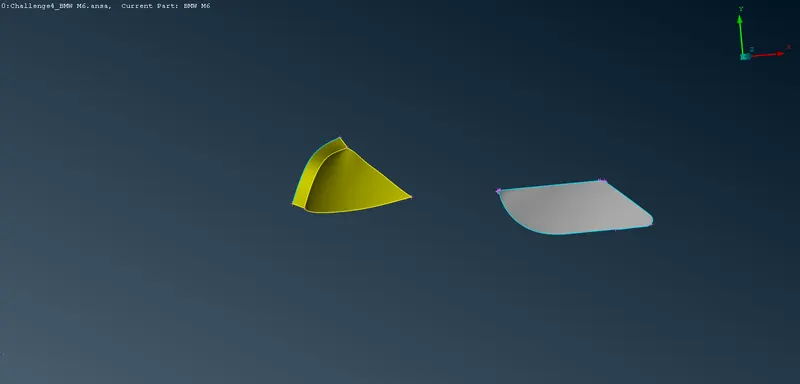
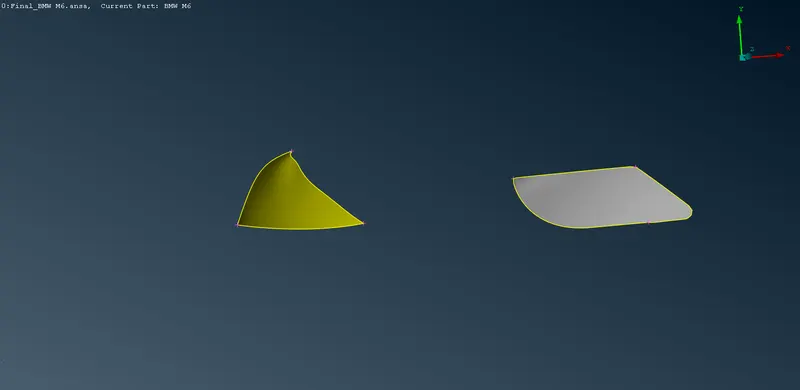
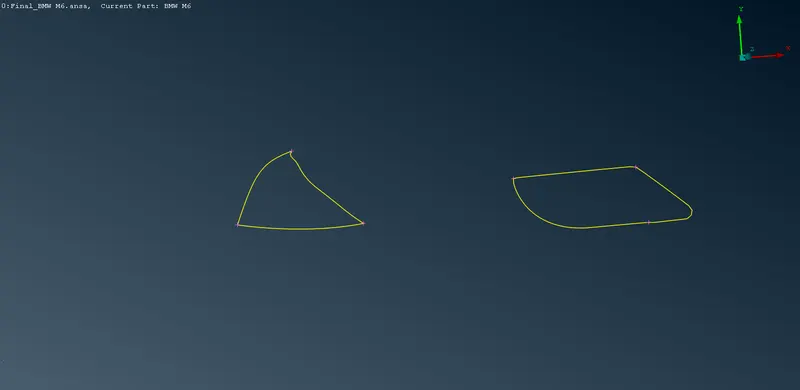
The following images show the cleaned version of the Lights geometry.
Body
The images below show the Body of the car prior to the cleanup. Major geometric errors and penetrating faces were observed and required detailed attention to each individual section of the body.
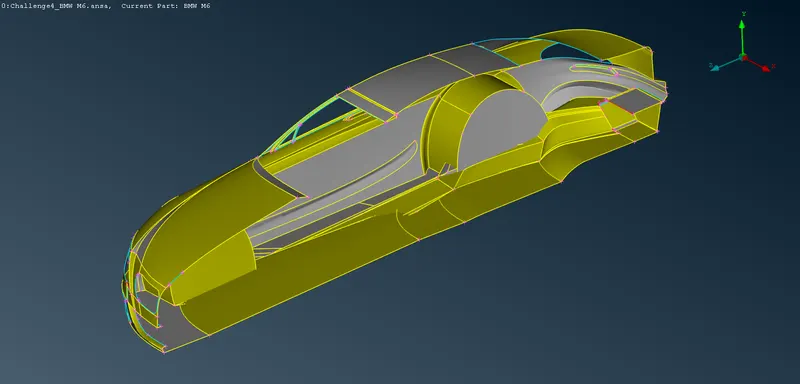
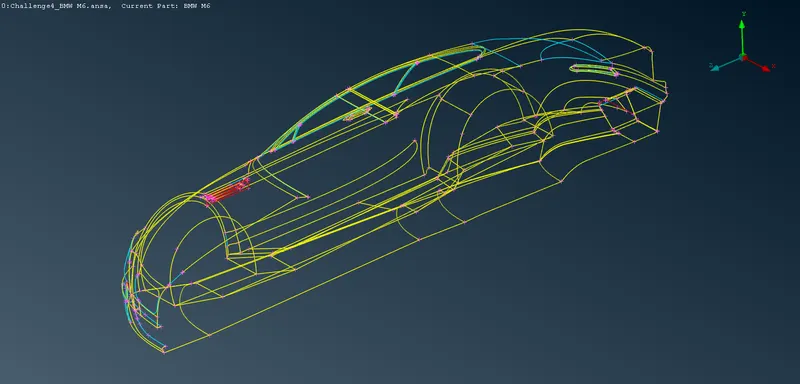
The images below show sections of the body which contained very poor geometric coherence and a multitude of single/triple CONS and penetrating faces.
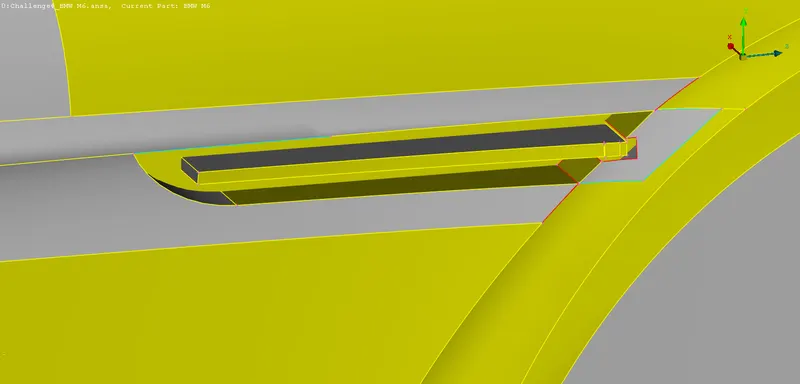
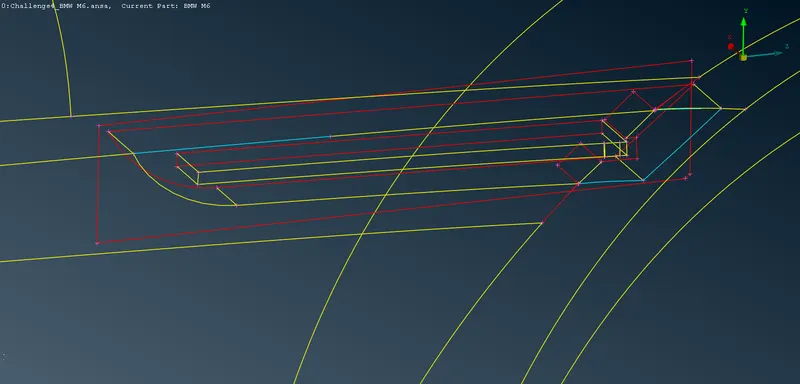
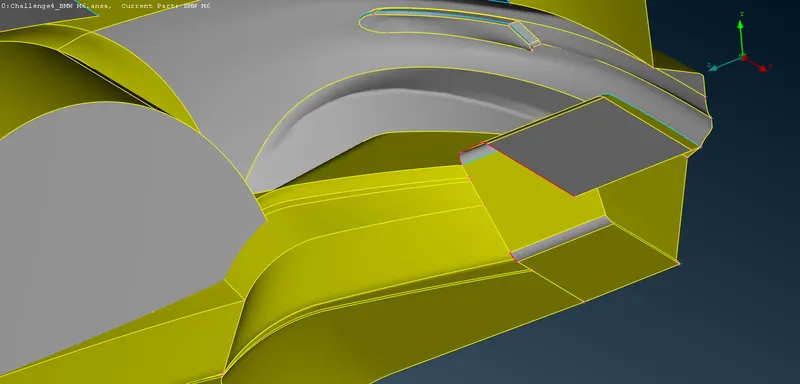
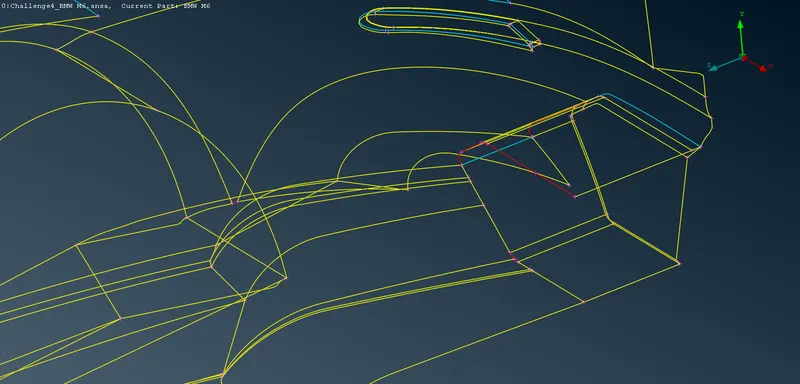
The floor of the body also contained major errors and intersected with the wheel housing as shown below.
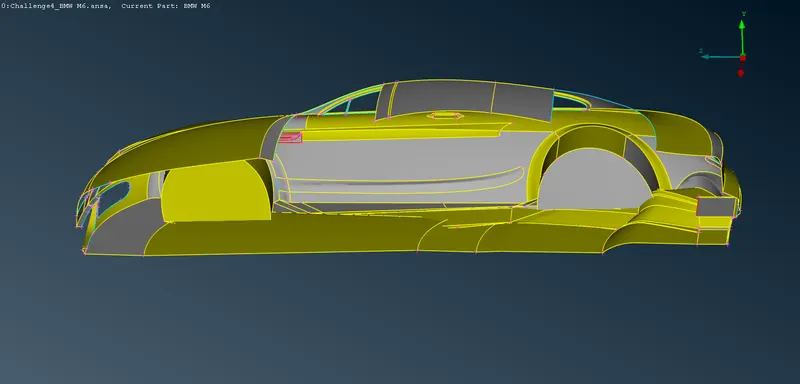
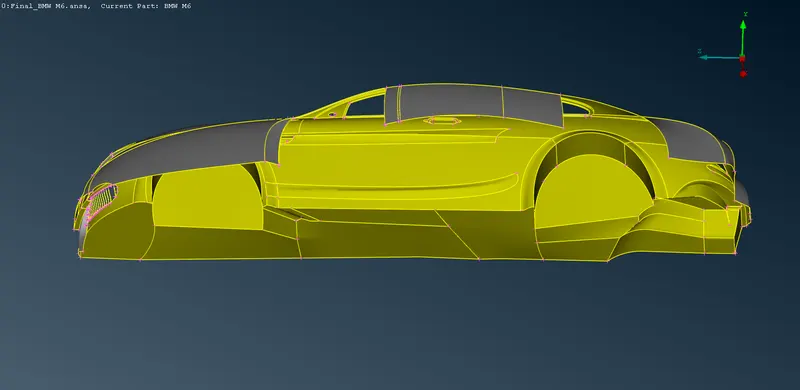
With a step-by-step topological cleanup, all the errors of the geometry were resolved and new faces were generated wherever required. The resulting final cleaned version of the body of the car can be seen below.
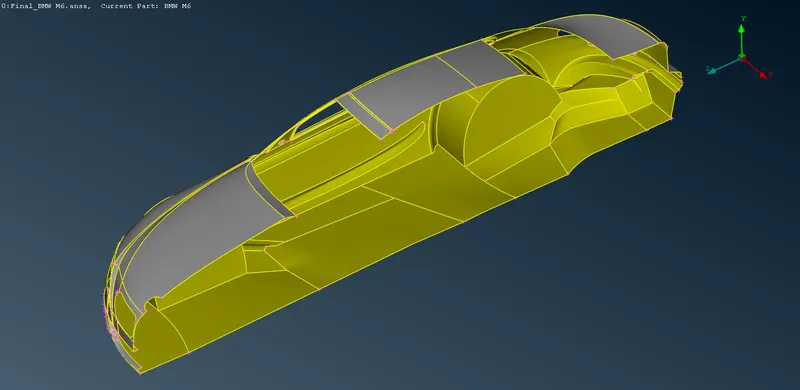
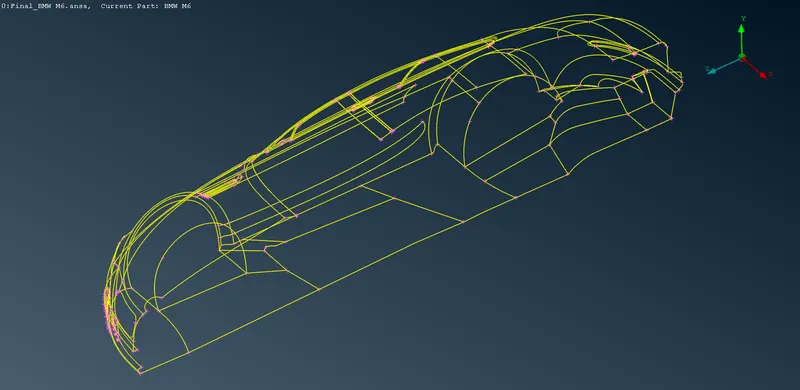
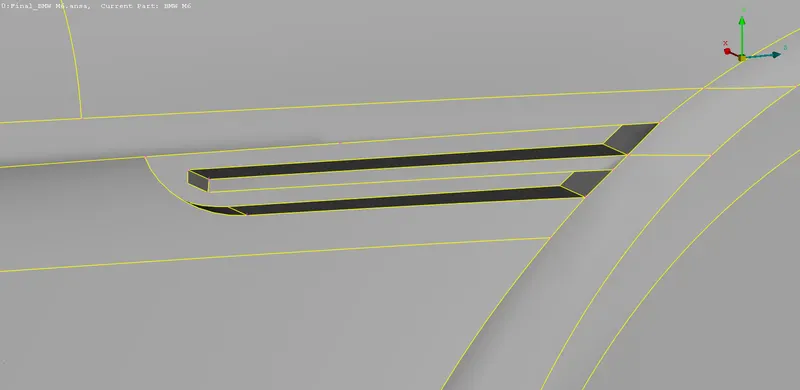
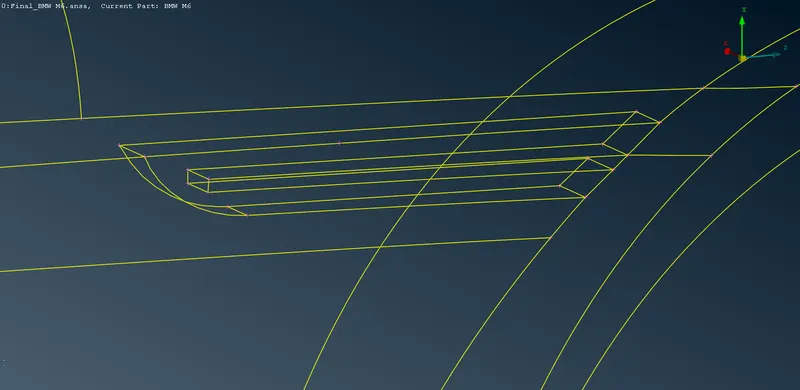
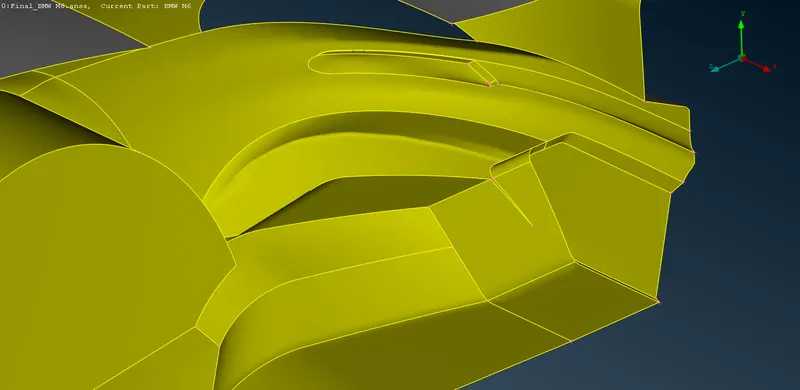
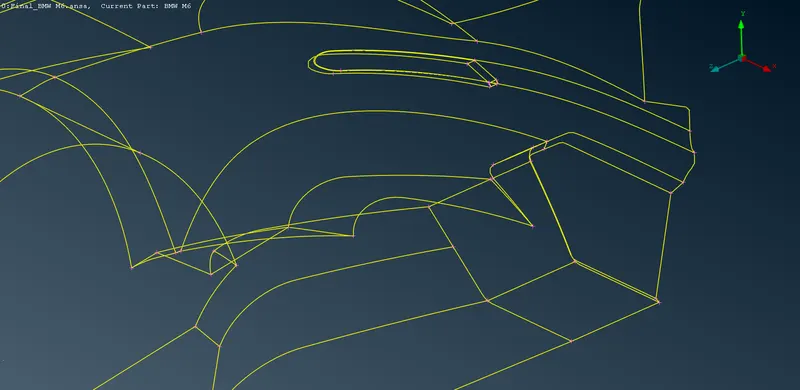
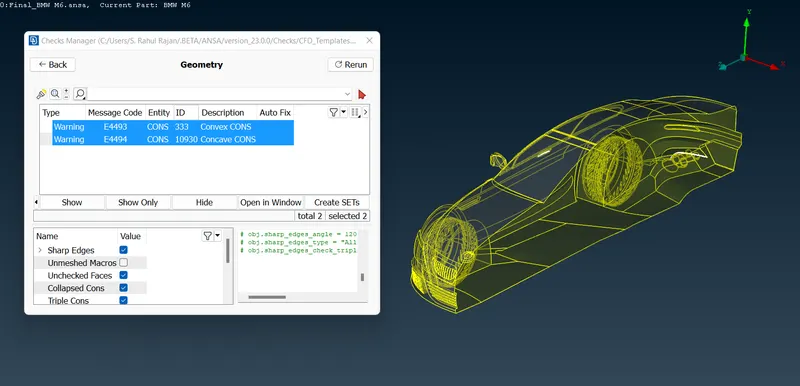
A final geometry check was conducted to verify the topological cleanup as shown below. Warnings of convex and concave CONS were shown on the regions on the handle and near the rear bumper of the car. These warnings do not affect the geometry or the cleanup process but are important to take note of prior to the meshing operations.
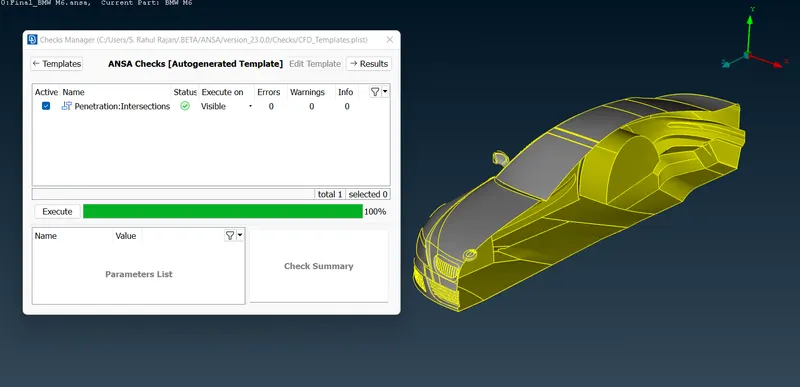
The intersection check is shown below and shows no intersection of components. It can now be established that the geometry is now watertight from the checks.
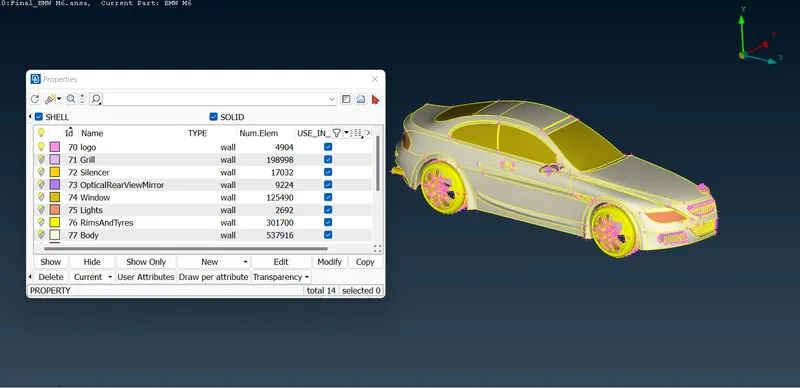
With the full topological cleanup of the car completed, PIDs were assigned to the various components of the car as shown below.
The surface mesh on the car was conducted based on the sizing settings and quality criteria shown in the table below.
| Component | Element Sizing [mm] | Min Length - QC [mm] | Max Length - QC [mm] | Skewness - QC |
| Logo | 1 | 0.4 | 2 | 0.5 |
| Grills | 1 | 0.4 | 2 | 0.5 |
| Rims and Tyres | 2 | 1 | 3 | 0.5 |
|
Optimal Rear View Mirror |
2 | 1 | 3 | 0.5 |
| Windows | 2 | 1 | 3 | 0.5 |
| Silencer | 3 | 2 | 4 | 0.5 |
| Lights | 4 | 3 | 5 | 0.5 |
| Body | 3 | 0.5 | 5 | 0.5 |
The surface mesh was generated by specifying the lengths of the elements on the perimeters based on the table above. The CFD mesh tool was then used to create the surface mesh. A check was conducted on the generated mesh to verify if the mesh adhered to the quality criteria and spot the regions where the mesh did not satisfy the criteria.
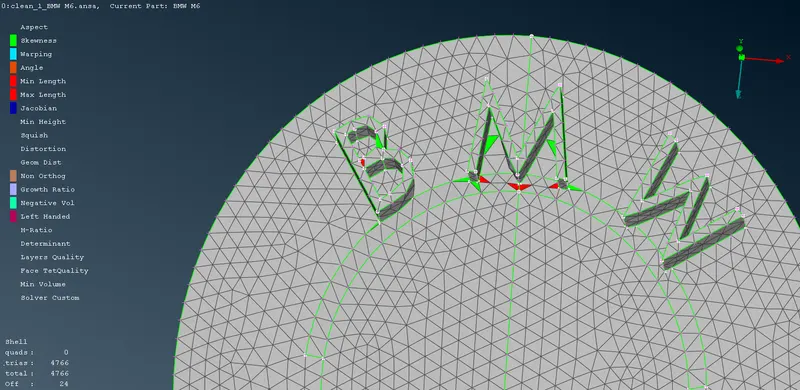
The image below shows an example of the OFF elements generated on the BMW car logo. A total of 24 off elements were observed.
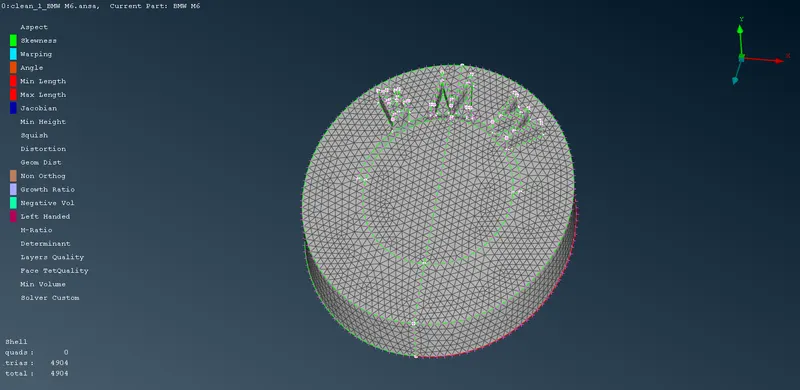
Upon mesh reconstruction based on the quality criteria, the OFF elements were resolved leading to the mesh shown below.
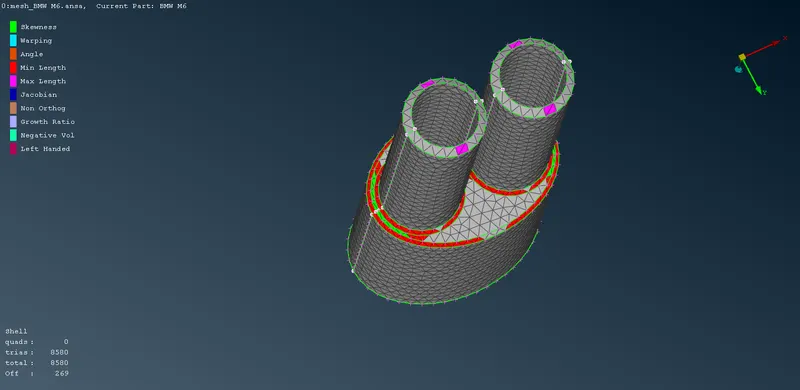
The image below shows the initial surface mesh generated on the silencer with 269 off elements.
Using mesh reconstruction, a majority of the OFF elements were reduced as shown in the image below. However, still few OFF elements remained.
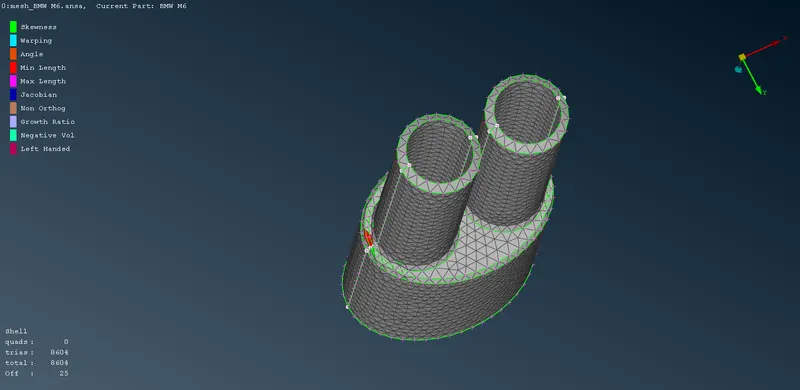
To resolve the remaining OFF elements, mesh reshaping was perfomed on the localised cells and the results can be seen below.
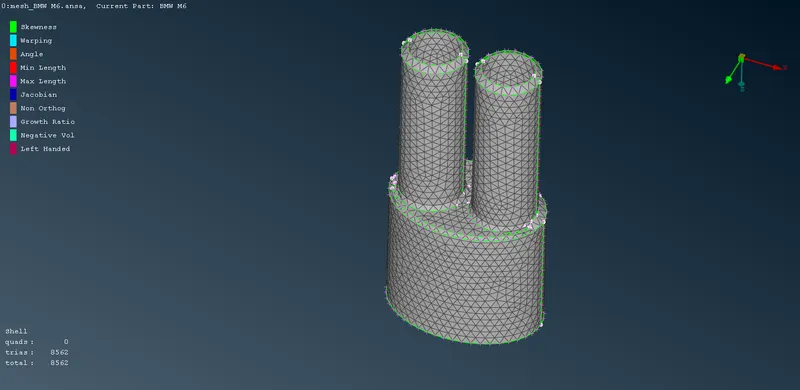
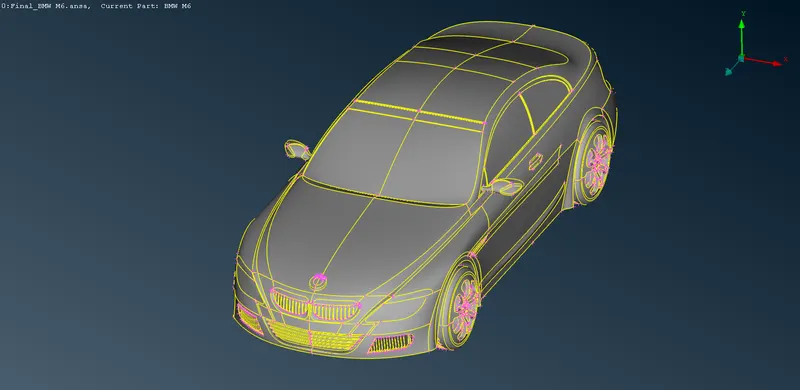
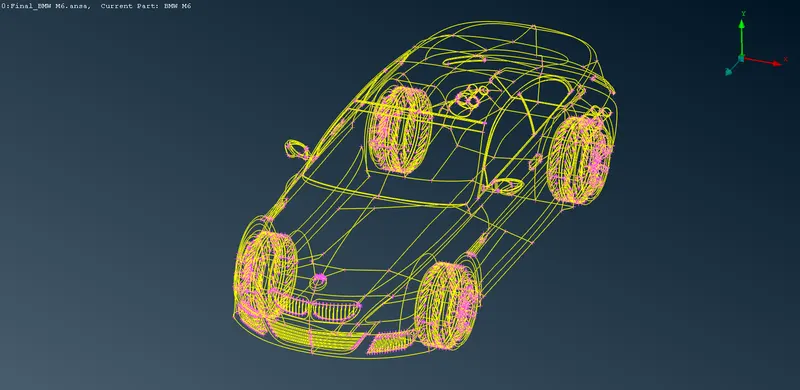
This meshing process was conducted for all the components of the car to complete the surface mesh. Once the surface mesh was complete, the symmetry tool was used to copy the half geometry of the car onto the other side using a 3point mirror plane along the longitudinal axis. The final car geometry can be seen in the images below.
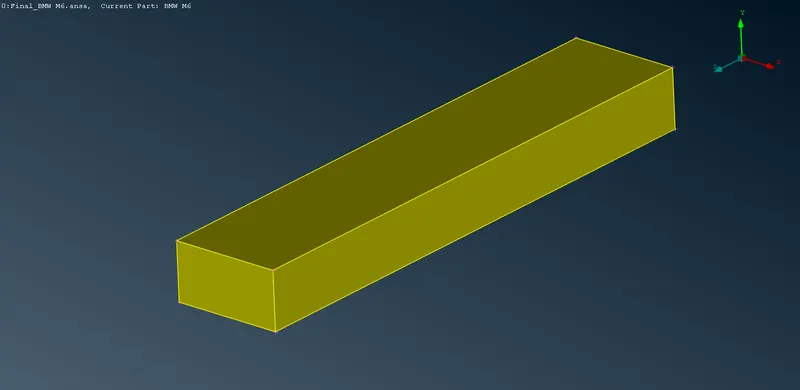
The wind tunnel domain around the car was then created with sizings of 4 car lengths infront of the car and 6 car lengths behind the car. The width of the wind tunnel had sizings of 1 car length from either side of the car. The bottom of the wind tunnel was placed 20mm below the wheels and the top face was placed at a distance of 1 car length from the roof of the car. The images below show the resulting wind tunnel domain.
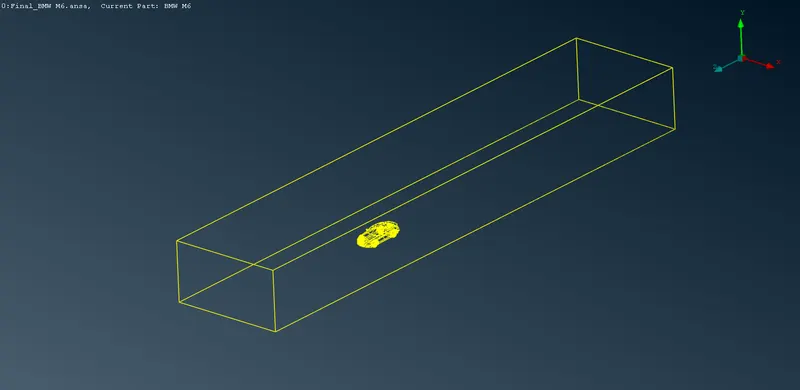
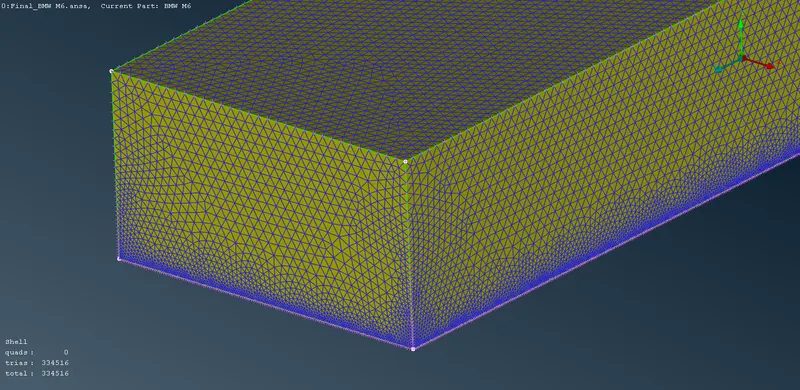
A surface mesh was generated over the wind tunnel domain faces with 20mm element sizing at the floor and 100mm element sizing at the top. The faces in between were meshed with variations of 20-100mm lengths between the floor and top faces of the wind tunnel domain as seen below. Only skewness of 0.5 was set as the quality criteria for the mesh on the domain.
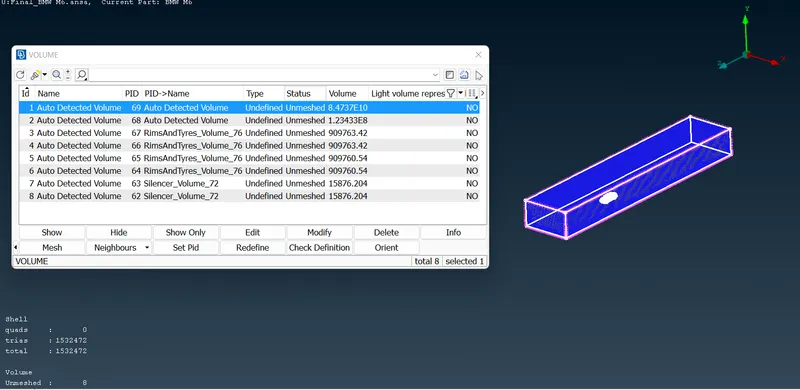
With the complete surface mesh of the BMW car model and domain complete, the fluid volumes were then checked to ensure a watertight geometry was created.
The image below shows the desired fluid volume that needs to be meshed for the external aerodynamics analysis.
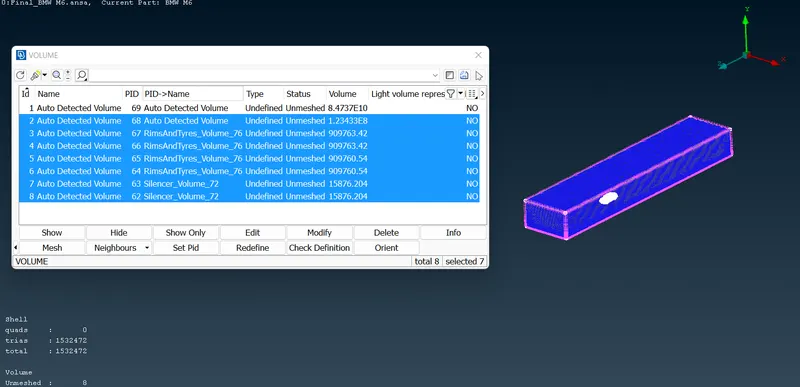
The image below shows the internal volumes within the body, two silencers and the four wheels of the geometry. These internal volumes may be deleted as these will not be considered for an external aerodynamic simulation.
The model is now ready to be volume meshed. Volume meshing was skipped for the current study as it would require excessive computational resources.
Results
The final surface mesh of the full BMW car can be seen in the image below.
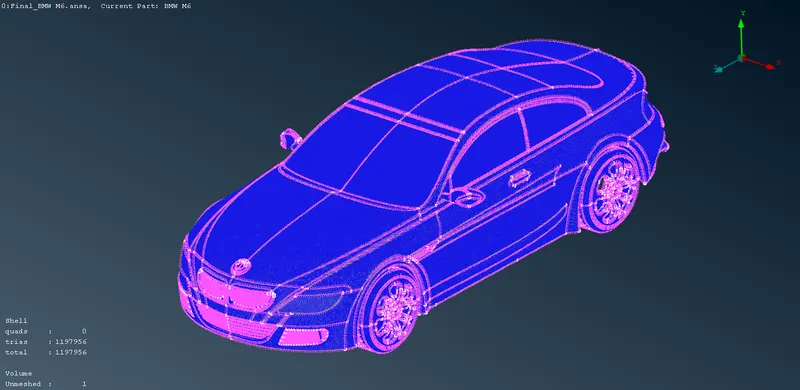
The results of the quality criteria check for the various components of the car be seen in the images below.
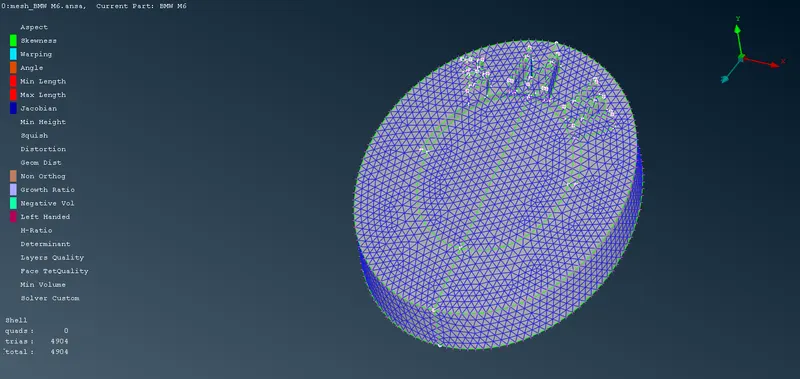
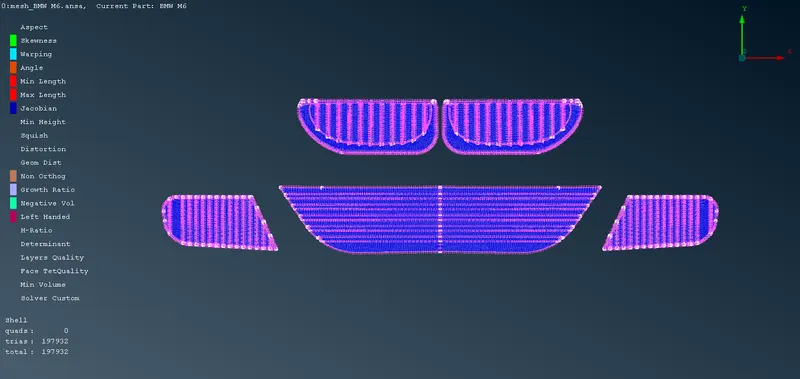
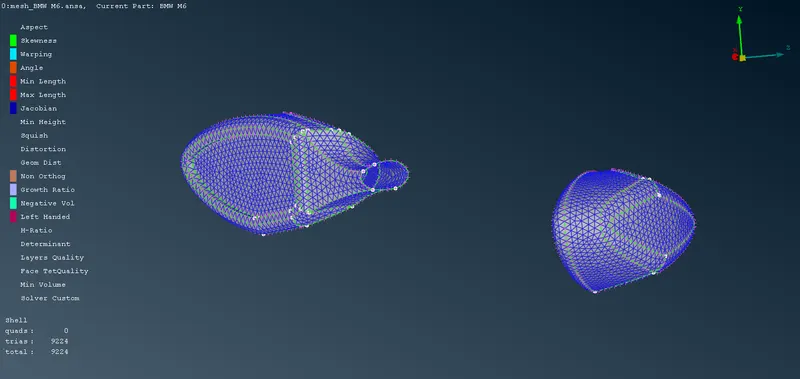
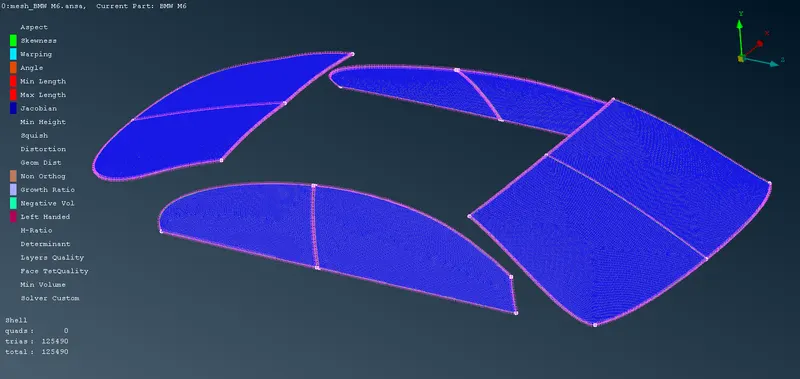
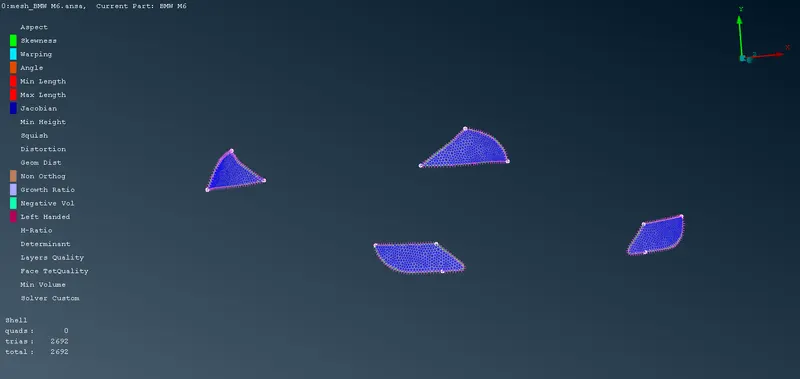
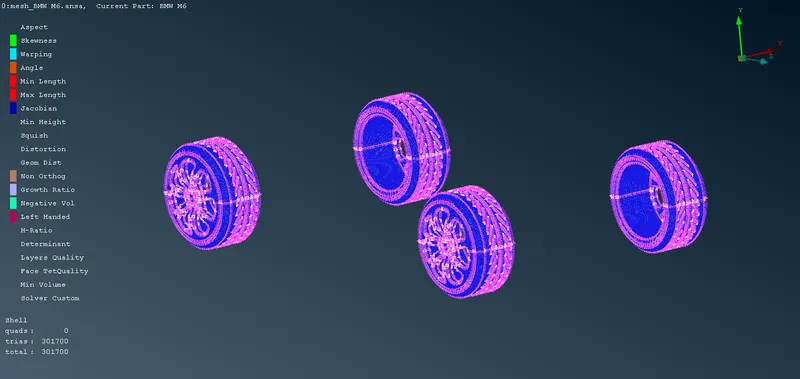
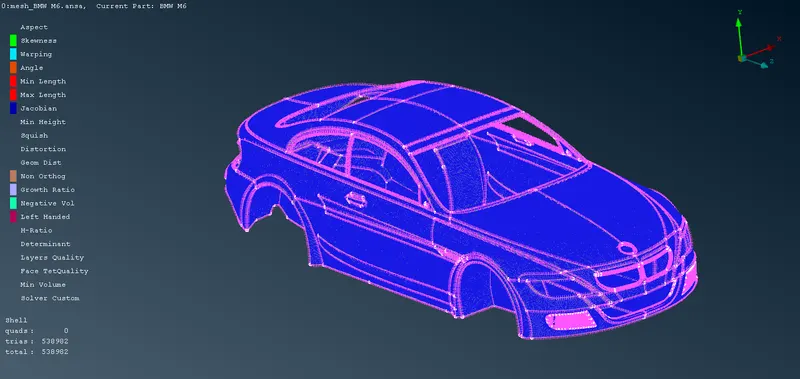
From the images above, no OFF elements were present on the final surface of the car and hence the given BMW car model can thus be deemed ready for volume meshing and simulation.
Drive Link to the ANSA file
https://drive.google.com/file/d/161uQbuV2uvM4ADoEJ4VkGpkMrDLP6-7K/view?usp=sharing
Conclusion
A topological cleanup was performed on the given BMW M6 car model where multiple faces were deleted, generated and reconstructed to create a water-tight geometry. PIDS were assigned to the various components of the car to aid ease of meshing and simulation. A surface mesh was then generated on the car using the specified element sizings and quality criteria. A wind tunnel domain was then created around the car and meshed with appropriate sizings. Finally, geometry and surface mesh checks were conducted to verify the final geometry and mesh. The resulting surface mesh contained no OFF elements and was deemed ready for volume meshing and simulation.