Week - 4
Washing machine working
The main principles behind the working of a washing machine are the centrifugal and centripetal forces, Where centrifugation helps quicken the process of sedimentation of different density particles to clean the laundry in the washing machine.
The washing machine operates in two primary cycles. These are the wash cycle and the rinse cycle.
The wash cycle involves the principle of centrifugal force. This force’s direction is from inside to outside, which makes sure that every part of the cloth is rinsed adequately in the soap water mixed in the machine.
The rinse cycle involves the principle of centripetal force. This force acts from outside to inside and creates a vacuum-like space in the middle of the washing machine.
These two cycles work one after another several time, and as a result, the entire cleaning process occurs.
Step by step mechanism of the working of washing machine
Firstly before the washing machine starts to operate, you need to get it ready for the washing. Getting the machine ready includes filling the washing machine with water held in the outer drum and stopping the water from leaking while operating. Then you put the clothes inside the inner drum.
The inner drum is the drum on which the different forces will give you a cleaner version of your clothes. Then you put the detergent into the machine, and after plugging in the device, we are ready to go.
There is a thermostat present inside the washing machine. After you turn on the device, the thermostat measures the temperature and increases the heat according to its need. When the water is hot enough for operation, the inner drum rotates back and forth on time, mixing the cloth properly with the soap water.
Now the work of the detergent begins. We have all studied how soaps and detergents work, and due to the motion of the particles, detergents can do their job correctly and scrub off all the dirt molecules from the clothes.
In the next step, if one is using a fully automatic washing machine, then the machine itself opens the valves and lets the dirty water flow away. Then, the programmer opens the valves again to allow clean water to come into the drum.
After the clean water comes in, the inner drum again starts to rotate to rinse the clothes properly. This rinsing process, removing the dirty water, taking new water, and rinsing again is repeated several times to improve efficiency.
After the clothes’ proper rinsing, the machine starts to rotate the inner drum vigorously at a high speed of around 130 km/h. these force is from the inside to outside and flung apart the clothes from the inner edge to the drum’s outer edge.
This final churning allows the proper cleaning of clothes, and after this step, the remaining water is let out from the valve, and you get your set of clean clothes.
1. State Flow
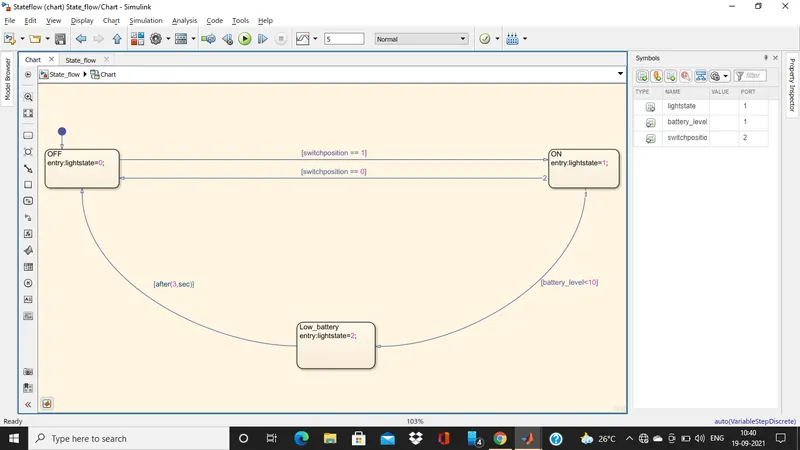
Stateflow is a control logic tool used to model reactive systems via state machines and flow charts within a simulink model. Stateflow uses a variant of the finite state machine notation established by David Harel, enabling the representation of hierarchy, parallelism and history within a state chart. Stateflow also provides state transition tables and truth tables.
2. Control logic of washing machine
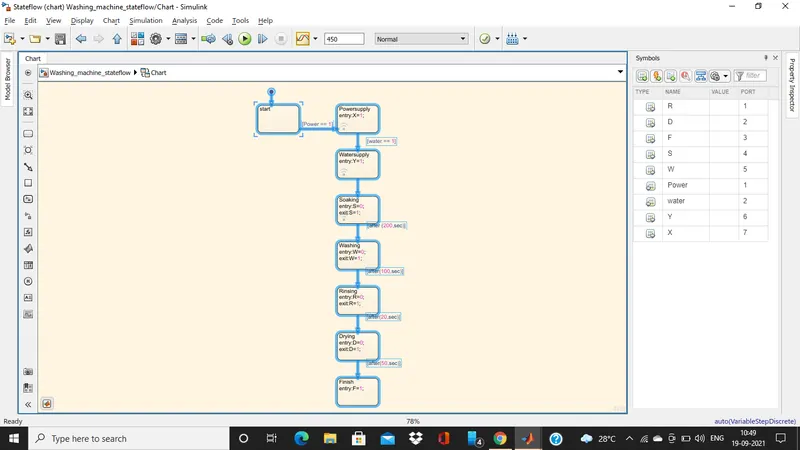
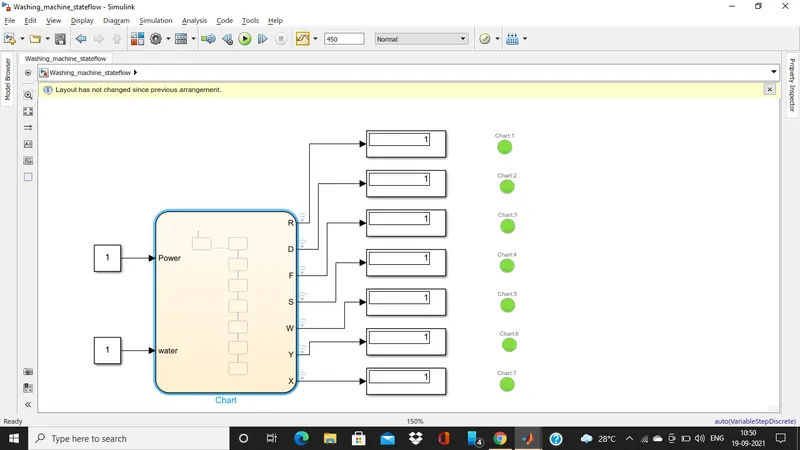
The logic checks for the extent of dirt and grease, the amount of soap and water to add, direction of spin, and so on. The machine rebalances washing load to ensure correct spinning. Else, it reduces spinning speed if an imbalance is detected. Even distribution of washing load reduces spinning noise.Neuro logic incorporates optical sensors to sense the dirt in water and a fabric sensor to detect the type of fabric and accordingly adjust wash cycle.
3. Gear shift logic
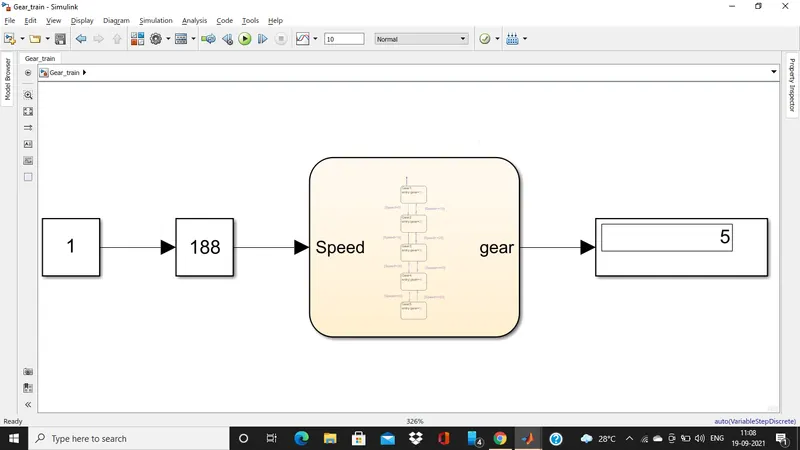
Mechanical devices that enable the driver to engage gears in such a way as to obtain the desired transmi- -ssion ratio are called shifting mechanisms.They are called internal mechanisms if they are contained in the gearbox casing; they are called external when they are mounted partly on the outside of the gearbox casing, partly on the vehicle body; they connect the gearshift lever with the internal shifting mechanisms.
Shifting mechanisms perform an import function, because they are responsible for the response, the driver receives from the shift stick, and therefore for the easy use of the gearbox itself. An ideal response should be positive and precise.
Refrences
https://pikthebest.com/washing-machine-working-principle/
https://en.wikipedia.org/wiki/Stateflow
https://link.springer.com/chapter/10.1007/978-1-4020-8676-2_10