Combustion Efficiency Calculation after Preheating
Combustion
In layman's terms, combustion is the burning of any substance in presence of air (more specifically, an oxidizer). All modern-day engines use combustion. When combusted, the products formed are at high temperatures and have high velocity. These exhaust gases are used to rotate turbine blades/shafts to generate useful work/power. Often there is still a considerable amount of energy left in the exhaust gases even after using them to rotate turbine blades or shafts. If not utilized this energy is dissipated into the atmosphere and is no longer useful for the operation.
A recuperator is a device used to extract some part of the energy from exhaust gases. Deep down it is just a heat exchanger which moves energy from the exhaust gas to the air which will be mixed with fuel in the later stages. Since the air entering the carburetor or any other mixing device is already heated, this process is called the pre-heating of air. It has been observed that pre-heating of air can cause a significant improvement in combustion efficiency and Adiabatic flame temperature.
This project aims to study the behavior of Pre-heating of air on Adiabatic Flame Temperature and Combustion Efficiency.
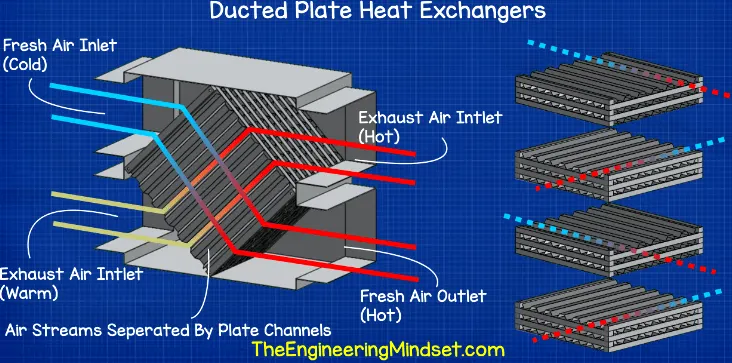
For more information on Recurparator, check Ducted plate heat exchanger Recuperator working principle by The Engineering Mindset.
GRI30
Cantera comes with a small collection of pre-defined input files, and one of these is gri30.yaml. There are other formats of gri30 files such as gri30.ct and gri30.ctml, these file formats will not be supported in the upcoming versions of Cantera, i.e, Canter3.0.
The gri30 represents the GRI-3.0 mechanism for natural gas combustion developed in the 1970s (pretty old) and was last updated in the 1990s. It should be clear by now that this mechanism cannot be used for top-end research purposes as it is not updated. So, this mechanism is mostly suitable for demonstration purposes.
Since this project is only a study and not a research-oriented project, we can safely use gri30.yaml.
1. Effect of Pre-heating on Adiabatic Flame Temperature
Code
import cantera as ct
import matplotlib.pyplot as plt
import math
import numpy as np

gas=ct.Solution('gri30.yaml')

air=ct.Quantity(gas)
Tin_air = np.linspace(298,600,100)

fuel=ct.Quantity(gas)
Tin_fuel = 298
fuel.TPX=Tin_fuel,ct.one_atm,{'CH4':1}
fuel.moles=1

AFT_temp=[]

for T_air in Tin_air:

    air.TPX=T_air,ct.one_atm,{'O2':0.21,'N2':0.79}
    air.moles=9.52

    mixture=air+fuel
    mixture.equilibrate('HP')

    AFT=mixture.T
    AFT_temp.append(AFT)

plt.plot(Tin_air,AFT_temp,'*')
plt.grid()
plt.xlabel("PreHeat Temperature")
plt.ylabel("AFT")
plt.show()
Code Explanation
- Import the necessary libraries that will be required in this study.
- Import the gri30.yaml file using Solution Class
- Since the reactants are at different operating conditions, use the Quantity class to import different reactants in different variables.
- Use the TPX function to define the operating conditions of the respective reactants.
- Define the number of moles of reactants.
- Since the operating conditions are varying for the air, use a 'for' loop.
- Use Equilibrate class to get the equilibrium condition.
- The temperature at the equilibrium stage is the Adiabatic Flame Temperature.
- Plot the results.
Results
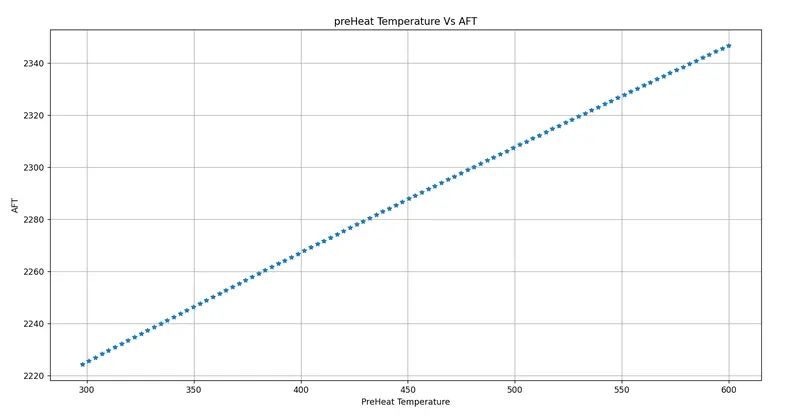
Inference
- As the Pre-Heat temperature increases, the Adiabatic Flame Temperature also increased.
- The correlation between the preheating temperature and AFT looks linear.
- The increase in AFT does not necessarily mean that the combustion efficiency is increased, in fact, a lot of studies show that, it is quite opposite. More on this in the next section.
2. Effect of Pre-heating on Combustion Efficiency
Combustion efficiency is defined as the ratio of energy released by the fuel after combustion to the energy present in the fuel before combustion.
It is given by,
`eta =(( m^.)_(reactants)h_(reactants) - ( m^.)_(Products)h_(Products))/((m^.)_(fuel)LHV)`
As per the Law of conservation of mass, the mass of reactants is equal to the mass of products, so
`eta =(( m^.)_(fuel)h_(fuel)+( m^.)_(air)h_(air) - (( m^.)_(fuel)+( m^.)_(air))h_(Products))/((m^.)_(fuel)LHV)`
Code
import cantera as ct
import matplotlib.pyplot as plt
import math
import numpy as np

gas=ct.Solution('gri30.yaml')

air=ct.Quantity(gas)
Tin_air = np.linspace(298,600,100)

fuel=ct.Quantity(gas)
Tin_fuel = 298
fuel.TPX=Tin_fuel,ct.one_atm,{'CH4':1}
fuel.moles=1
LHV=50*1e6

prod=ct.Quantity(gas)

AFT_temp=[]
comb_eff=[]

for T_air in Tin_air:

    air.TPX=T_air,ct.one_atm,{'O2':0.21,'N2':0.79}
    air.moles=9.52

    mixture=air+fuel
    mixture.equilibrate('HP')

    AFT=mixture.T
    AFT_temp.append(AFT)

    prod.TPX=AFT,ct.one_atm,{'CO2':1/10.52,'H2O':2/10.52,'N2':7.52/10.52}
    prod.moles=10.52

    combustion_effeciency=-((fuel.mass+air.mass)*(prod.enthalpy_mass)-fuel.mass*fuel.enthalpy_mass-air.mass*air.enthalpy_mass)*100/(fuel.mass*LHV)
    comb_eff.append(combustion_effeciency)

plt.plot(Tin_air,comb_eff,'*')
plt.grid()
plt.xlabel("PreHeat Temperature")
plt.ylabel("Combustion Effeciency")
plt.title("preHeat Temperature Vs Combustion effeciency")
plt.show()
Code Explanation
- For code, explanation refers to section 1's code explanation.
- Additionally, in this section, we define a new quantity named prod, which means products.
Results
1. When the temperature of the product is fixed to the AFT of that case
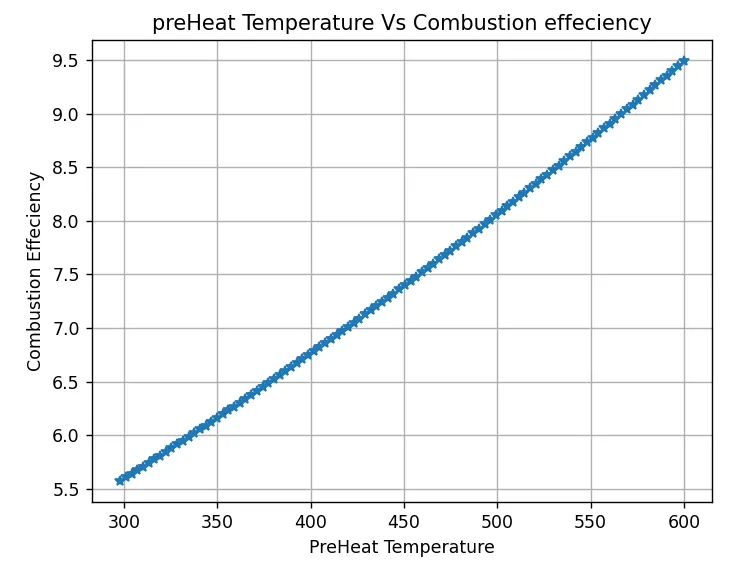
Ideally, the efficiency of the reaction must be calculated considering AFT as the temperature of the products since the products are forming at AFT.
Using this approach is giving us the above plot. One can observe that the efficiency is as low as 10 % even in the best case. There needs to be some explanation for this, which am still trying to figure out! If you know it, then please mention it in the comments section.
But an important thing to notice is the trend of how the efficiency is varying with the pre-heating temperature.
The efficiency is varying linearly with pre-heat temperature.
2. When the temperature of the product is fixed to 1700k
Our AFT temperatures were close to 2200k, which is extremely high. In real cases, this is not the temperature of the exhaust gases. Having such temperatures will instantly melt the turbine blades and make them useless. Also, we are not considering losses in this case. So assuming a temperature of 1700k as the temperature of the exhaust gas/products, we get the below results.
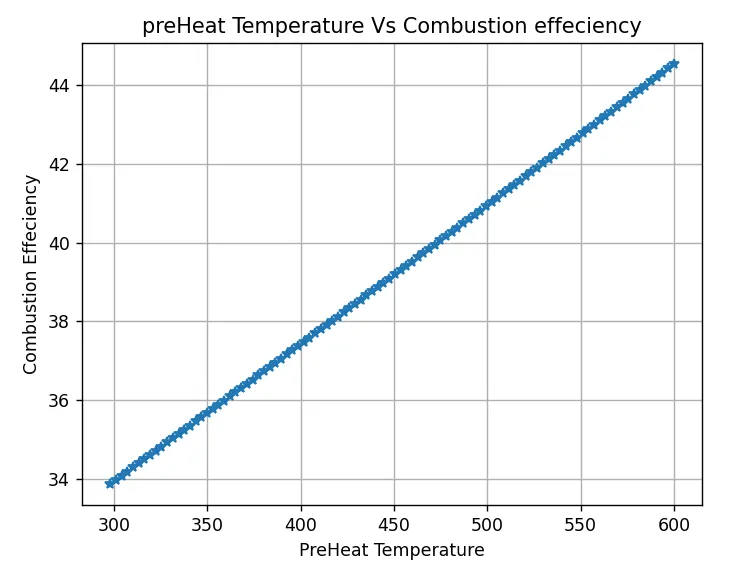
Again, the trend is linear as seen in the AFT case.
Note: Here, we are not considering any combustion chamber design, and also combustion is taking place homogeneously, i.e., the fuel and air mixture is spread out homogeneously across the combustion chamber. This is an assumption.
In real-life scenarios, there is a fuel-air sprayer, atomizer etc. Pre-heating the air will reduce its density and some studies have found out that this leads to the accumulation of air closer to the inlet and increases the combustion in this region. This also leads to excessive NO/soot generation in this spot which reduces the overall combustion efficiency.
"The effect of preheating of air is analysed by heating the inlet air
by using a coil type heater. Preheating improved the brake thermal efficiency
and brought down CO and HC emissions however it slightly increased NOx
emissions." [3]
Fuel-saving
In this project, we have not defined a parameter/formula for fuel-saving, the reason for it is that I simply couldn't find one. Conceptually, in the ideal case, as the pre-heat temperature is increased, efficiency has improved and thus there must be some fuel-saving. But in real cases, one cannot comment unless some experimentation is done.
The exhaust gas temperature must be fixed. A varying exhaust gas temperature will produce varying turbine rpm = varying power generation. Varying temperature = varying thermal stress on the walls, which is not good.
References:
- https://youtu.be/vrkfX2iToXs
- https://theengineeringmindset.com/hvac-heat-exchangers-explained/ducted-plate-heat-exchanger-recuperator-working-principle/
- The Effect of Air Preheating on the performance and emission characteristics of a DI Diesel Engine achieving HCCI mode of combustion. *Sumanlal M. R., Sreeram Nandakumar and Mohanan P