Week 4.2 - Combustion Efficiency Calculation after Preheating
AIM: To calculate the adiabatic flame temperature, combudtion effeciency and the fuel saving with repsect to preheating temperatures of the air through the repurcator.
OBJECTIVES: The major objectives this challenge are :
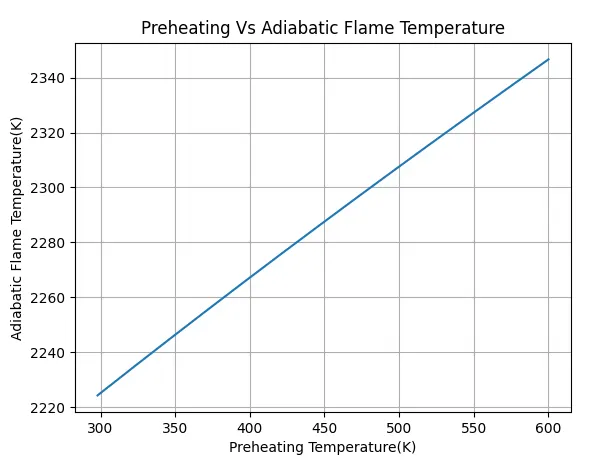
1. To understand and explain the effect of prheating temperature on adiabatic flames temperature.
2. To understand and explain the change in the combustion efficiency with change in prehating temperature.
3. To explain the changes in fuel usage wrt to pre heating temperature and also to give an opinion on exit furnace temperature based on the observed process.
THEORY:
Recuperator:
It is a type of heat exchanger has separate flow paths for each fluid along their own passages and heat is transferred through the separating walls. Recuperators are often used in power engineering, to increase the overall efficiency of thermodynamic cycles. For example, in a gas turbine engine. The recuperator transfers some of the waste heat in the exhaust to the compressed air, thus preheating it before entering the combustion chamber. Many recuperators are designed as counter-flow heat exchangers.
In the given challenge, we need to analyze to effect of preheating on AFT and combustion efficiency.
For the first part, we analyze how preheating affects AFT. This is done by creating instances of fuel and air by using Quantity class. The reaction that follows:
`CH_4+2(O_2+3.76N_2)-> CO_2+2H_2O+7.52N_2`
The initial conditions for the mixture is set as per STP. The number of moles of methane are 1 and for air (2(oxygen) + 7.52(nitrogen)) is 9.52 moles. The preheating temperature is varied and pressure is kept constant at 1atm. The flue gas instance is created, which is mixture of air and fuel instances, which is then equilibrated under constant enthalpy and pressure to calculate AFT.
Further, we need to check combustion efficiency under pre-heating. This indicates how efficiently heat content of a fuel is converted to useful heat. For adiabatic chamber, heat released is given as:
Combustion Efficiency:
`dotQ = dotm_fh_f+dotm_ah_a-dotm_ph_p`
We know that
`dotm_p= dotm_f+dotm_a`
So if we subistute this in the combustion effieciency formual i.e,
combustion efficiency `eta`= `dotQ/(LHV)`
`eta = (dotm_fh_f+dotm_ah_a-(dotm_f+dotm_a)h_p)/(dotm_f*LHV`
`LHV` denotes lower heat value of combustion reaction (assumed to be `50(MJ)/(KG)`.) The exhaust can be estimated from the products and the exit temperature is set to `1700K`. Fuel savings is calculated by the efficiencies;
Fuel Saving:
Fuel savings = `1 - (eta_o)/(eta_1)`
`eta_o` = efficiency without pre-heating
`eta_1` = efficiency after pre-heating
First case :
Code :
import cantera as ct
import matplotlib.pyplot as plt

gas = ct.Solution('gri30.cti')

air = ct.Quantity(gas)
fuel= ct.Quantity(gas)

#defining the intial values as arrays
T_adia = []

T_prheat=[]

for T in range(298,601):


	air.TPX = T,ct.one_atm, 'O2:0.21, N2:0.79'
	air.moles= 9.52
	T_prheat.append(T)

	fuel.TPX = 298,ct.one_atm,'CH4:1'
	fuel.moles=1
	M= air + fuel
	M.equilibrate('HP','auto')

	T_adia.append(M.T)

print('Adiabatic Flame temperature values=', T_adia)
print('Preheating Temperature values=',T_prheat)

plt.plot(T_prheat, T_adia)
plt.xlabel('Preheating Temperature(K)')
plt.ylabel('Adiabatic Flame Temperature(K)')
plt.title('Preheating Vs Adiabatic Flame Temperature',size='12')
plt.grid(True)
plt.show()
Graph:
Explanation:
From the plot we can clearly observe that the adiabatic flame temperature is linear changing with respect to the change in pre heating temperature. The initial AFT at standard temerature is around 2224K and as preheat raised to 600K the AFT gone past 2340K .
Second case:
Code:
import cantera as ct
import matplotlib.pyplot as plt
import numpy as np

gas= ct.Solution('gri30.cti')

air = ct.Quantity(gas)
fuel =ct.Quantity(gas)
product=ct.Quantity(gas)

enthalpy_air= []
T_air = np.linspace(298,600,15)
# energy gnerated by air
for T in  T_air:
	air.TPX = T,ct.one_atm,'O2:0.21, N2: 0.79'
	air.moles= 9.52
	mass_air = air.mass
	enthalpy_air.append(air.enthalpy_mass)

print('Mass of the air at different temperature values=',mass_air)
print('Enthalpy of air at different temperature values=',enthalpy_air)

# energy generated by fuel
fuel.TPX = 298, ct.one_atm,'CH4:1'
fuel.moles= 1
mass_fuel = fuel.mass
enthalpy_fuel= fuel.enthalpy_mass
print('Mass of the Fuel=',mass_fuel)
print('Enthalpy of the Fuel=',enthalpy_fuel)

#energy generated by product
product.TPX = 1700, ct.one_atm, {'CO2':1/10.52, 'H2O':2/10.52, 'N2':7.52/10.52}
product.moles= 10.52
mass_product = product.mass
enthalpy_product = product.enthalpy_mass
print('Mass of the products=',mass_product)
print('Enthalpy of the products=',enthalpy_product)

# Total Energy balance
Total_energy=[]
Q=[]
eta=[]
F_S= []
LHV = 50e6


for i in range(len(T_air)):

	Total_energy = (mass_fuel*enthalpy_fuel)+ (mass_air*enthalpy_air[i])- (mass_product * enthalpy_product)
	Q.append(Total_energy)
	eta.append(Q[i]/(mass_fuel*LHV))

	fuel_saving = (1-(eta[0]/eta[i-1]))
	F_S.append(fuel_saving)

print('Total heat energy generated from the reaction =', Q)
print('Combustion effecinecy at different preheating temperatures =',eta)
print('Fuel saving through pre heating effects =',F_S)

plt.plot(T_air,F_S,color= 'red')
plt.plot(T_air,eta,color= 'blue')
plt.xlabel('Preheating Temperature')
plt.ylabel('Effeciency')
plt.legend(['Fuel saving','Combustion Effeciency'])
plt.title('Combustion Efficiency and Fuel saving with Preheating',size='12')
plt.grid(True)


plt.show()
Graph:
Explanation:
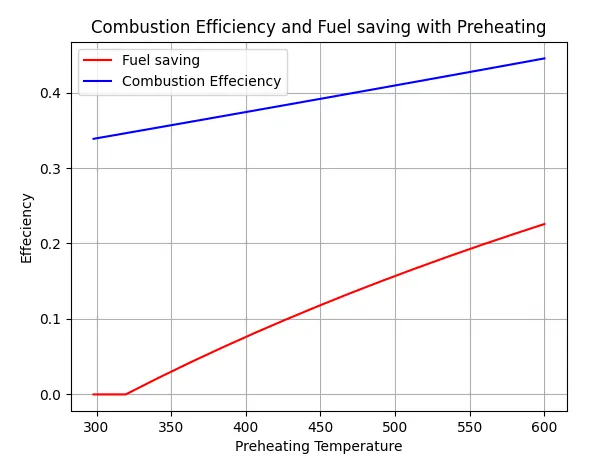
When looking at the plot we can see the combustion efficiency is increased with Temperature and also there is saving in fuel. Initially the fuel saving is neglible amount but as the Air temperature is increased the fuel saving is also increased.
At 298.15 K the Fuel saved is almost 0 kg but at the temperature 600 K the fuel saved is around 0.24kg giving as 199% increase in fuel saving with respect to the preheating temperature
Similarly for the Combustion Efficiency at 298K is 0.338 and combustion efficiency at 600 K is 0.445 giving as 27.1% increase in combustion efficiency.
Yes, Preheating helps the fuel saving and it increses the combustion efficiency of the furnance. As the temperature of the air increases the combustion efficiency is also increased propostionally with respect to the preheating temperature assigned to the air.
Now about the having a fixed exit temperature , it gives the about of heat generated and properties of the products. however , the exit temperature depends on lot of other factors as well. Considering those fcators the value of the exit temperature might be different. From the challenge we can understand that higher the furnace exit temperature higher the preheating wil be and better the efficiency.
CONCLUSIONS:
From the results we obtained we can clealry say that with increase in the preheating temperature the Adiabatic Flame temperature increased, combustion efficency is improved and the fuel saving happened.