Week 4.2 - Combustion Efficiency Calculation after Preheating
Aim: To determine the effect of the air preheating on adiabatic flame temperature and fuel saving using Cantera
Introduction
Preheated air is air that has been heated prior to another operation, such as combustion in boilers. The primary goal of air preheating is to improve the thermal efficiency of heating operations. Preheated air in boilers recovers heat from the boiler's flue gas. As a result of the lower degree of heat loss in the boiler's gas, the boiler's thermal efficiency improves. Preheated air is extremely beneficial in boilers, air heaters, and drying operations. Thus, in this work, we are interested in evaluating the effect of air preheating on adiabatic flame temperature as well as its influence on fuel saving. The work is done using Cantera which is an open-source suite of tools for problems involving chemical kinetics, thermodynamics, and transport processes.
Theory
Preheating the combustion air coming to the burners is one of the most effective techniques to enhance efficiency and productivity in fuel-fired industrial heating operations. The exhaust gas stream, which exits the operation at high temperatures, is the source of this heat energy. A heat exchanger installed in the exhaust stack or ductwork may collect and transfer a considerable amount of the thermal energy in the flue gases to the entering combustion air. Recycling heat in this manner reduces the quantity of bought fuel required by the furnace. Air preheaters are classified into two types: recuperators and regenerators. Placed on the furnace stack, recuperators are gas-to-gas heat exchangers. Internal tubes or plates transport heat from the exiting exhaust gas to the entering combustion air while preventing the two streams from mingling. Recuperators come in a variety of forms, capacities, and temperature ranges. Regenerators are made up of two or more distinct heat storage portions, each of which is referred to as a regenerator. Flue gases and combustion air alternately run through each regenerator, heating and then removing heat from the storage medium. At least two regenerators and their accompanying burners are required for continuous operation: one regenerator is required to fire the furnace while the other is recharging.
Applications
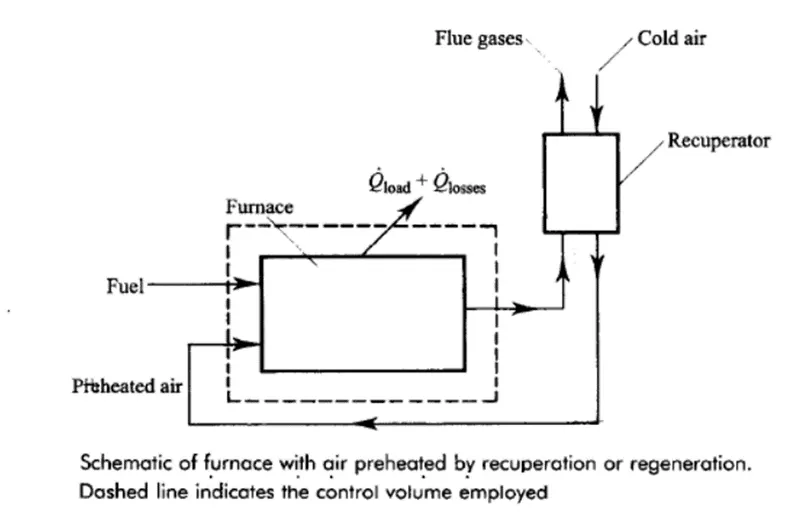
Preheated air is critical for increasing the efficiency of processes such as combustion. All of the wastes created by flue gases may be recovered by preheating the air. Preheated air also provides higher flame temperatures, which are necessary for some operations such as thermal cracking.
Furthermore, preheating the combustion air is common in high-temperature industrial settings and procedures such as:
- Refining of petroleum
- Chemical synthesis
- Metal and glass industries
Preheated air is especially useful in low-temperature industrial operations such as steam production, heating, and drying of nonmetal where flue gas levels are quite high.
Damage to machinery can be avoided by preheating the air. Additionally, it encourages greater energy savings by enhancing heating efficiency.
Combustion Efficiency of Recuperator
Following is the energy balance for a control volume. The assumption made is that, the heat transferred to the load and the heat losses are equal whether with or without preheating. Assuming the flow to be steady, the heat transferred out is as follows:
`-dotQ ̇= -dotQ_load-dotQ_loss=m ̇(h_Products-h_Reactants)`
`-dotQ=(m ̇_A+m ̇_F ) h_Products-m ̇_A h_A-m ̇_F h_F`
`A/F=(m ̇_A)/(m ̇_F )` The above equation becomes
`-dotQ ̇=[(A/F+1) h_Products-(A/F) h_A-h_F ]` The fuel utilization energy can be written as follows:
`η= (dotQ)/(m_F.LHV)` where LHV is the Low Heating Value.
`implies η=((m ̇_A+m ̇_F ) h_Products-m ̇_A h_A-m ̇_F h_F)/(m_F.LHV)`
Assuming a stoichiometric mixture (ϕ=1), we have
`A/F=((A/F)_(St_oic_hiometric))/ϕ`
`A/F=17.1`
Fuel saving is defined as:
`η=1-(η_298/η_600 )`
Part 1
In this part, we are interested in the effect of preheating on the adiabatic flame temperature.
- The preheating temperature varies from 298 to 600K.
Program
"""
This program enable us to determine the effect of preheating air temperature on AFT on the combustion of methane using CANTERA

By ABOUZI
"""

import cantera as ct
import matplotlib.pyplot as plt
import numpy as np


gas = ct.Solution('gri30.cti')

#Defining the range of inlet air preheating temperature

Temp = np.linspace(298,600,100)

#Empty array to store the value of AFT
T_gas = []

#FFor loop to calculate AFT for all values of T

for t in Temp:

	#Reactant definition
	Reactants = ct.Quantity(gas)
	Reactants.TPX = t,ct.one_atm,'O2:1,N2:3.76'
	Reactants.moles = 2

	#Define fuel
	Fuel = ct.Quantity(gas)
	Fuel.TPX = 298,ct.one_atm,'CH4:1'

	Mixture = Reactants + Fuel

	Mixture.equilibrate('HP',solver ='auto')

	T = Mixture.T

	T_gas.append(T)


print(T_gas)
plt.plot(Temp,T_gas)
plt.xlabel('Preheating temperature of inlet air in K')
plt.ylabel('AFT in K')
plt.title('Effect of combustion air preheat on AFT for Methane combustion')
plt.show()
Stepwise Explanation
- Firstly, the relevant libraries are imported which are “Cantera”, “numpy” and “matplotlib.pyplot”. These modules enable us to perform kinetic calculations, numerical calculations and plot the results respectively.
- The different inputs are defined. The preheating temperature range is defined.
- A “For loop” is defined which enable us to compute the adiabatic flame temperature for each value of preheating temperature.
- The output (AFT) is stored in a variable (T_gas) using “append” function.
- Finally, the results are plotted using “plot” command.
Output & Discussion
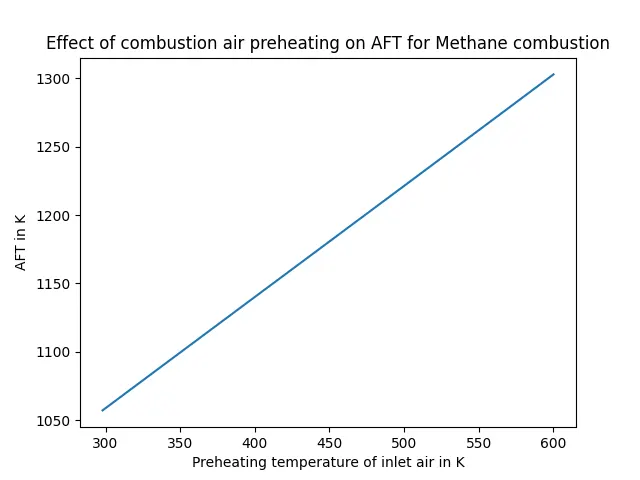
In the graph above, we can see that the adiabatic flame temperature increases linearly with increase in the preheating temperature. As the preheating temperature increases from 298 to 600K, the adiabatic flame temperature increases from 1057.2125 to 1302.8487K.,
Part 2
In this part, we are mainly interested in determining the effect of preheating temperature on the combustion efficiency.
Program
"""
This program enables us to determine the effect of preheating air inlet temperature on combustion efficiency

The fuel is considered as Methane
Heat Loss: Q = (ma + mf )*h_prod - mf*h_fuel - ma**h_air
A/F = mass of air / mass of fuel
Q = -(((A_f + 1)*h_prod) - (A_f*h_React[j]) - h_fuel)
LHV = 50 MJ

A/f = 17.1 assuming phi = 1

By ABOUZI
"""
import cantera as ct
import matplotlib.pyplot as plt
import numpy as np

gas = ct.Solution('gri30.cti')
LHV_fuel = 50e6
A_f = 17.121

#Defining the range of inlet temperature from 298 to 600

Temp = np.linspace(298,600,100)

#Computing the enthalpy of fuel

Fuel = ct.Quantity(gas)
Fuel.TPX = 298, ct.one_atm, 'CH4:1'
h_fuel = Fuel.enthalpy_mass
Fuel.moles = 1

#Computing the enthalpy of products
Prod = ct.Quantity(gas)
Prod.TPX = 1700,ct.one_atm, 'CO2:1,H2O:2,N2:7.52'
h_prod = Prod.enthalpy_mass
Prod.moles = 1


#Determining the enthalpy of reactants at different temperatures
H_Reactants = []

for i in Temp:
	Reactants = ct.Quantity(gas)
	Reactants.TPX = i,ct.one_atm,'O2:1,N2:3.76'
	Reactants.moles = 2

	H_Reactants.append(Reactants.enthalpy_mass)

Q = []

#Empty array to store the combustion efficiency
Eta = []
for j in range(len(Temp)):

	Q = Q = -(((A_f + 1)*h_prod) - (A_f*H_Reactants[j]) - h_fuel)
	Eta.append(Q*100/LHV_fuel)


#Calculation of fuel saving

Fuel_saving = 1-(Eta[0]/Eta[99])
FS = Fuel_saving*100

print("Total fuel saving is",FS,'%')

print(Temp,Eta)
plt.plot(Temp,Eta)
plt.xlabel('Preheating temperature of air')
plt.ylabel('Combustion efficiency of Recuperator(%)')
plt.title('Effect of preheating temperature on combustion efficiency')
plt.grid('on')
plt.grid('on')
plt.show()
Stepwise Explanation
- Firstly, the relevant libraries are imported which are “Cantera”, “numpy” and “matplotlib.pyplot”. These modules enable us to perform kinetic calculations, numerical calculations and plot the results respectively.
- The different inputs are defined such as preheating temperature range.
- The “Quantity” class is used to define the proper mole quantity of involved species and to calculate the enthalpy of products.
- Two “For loop” are used. In the first one, the reactants enthalpy is computed for each value of preheating temperature and the combustion efficiency is determined in the second loop.
Output & Discussion
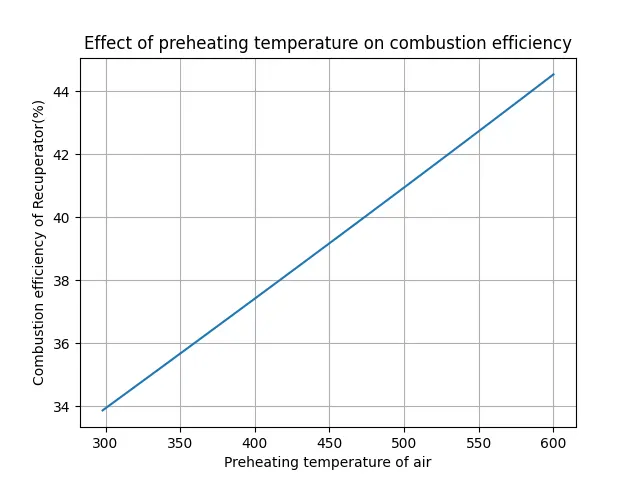
On the above graph, we can see that the combustion efficiency varies linearly with preheating air temperature. Another thing is that, the recuperator’s efficiency increases with increase in the preheating temperature. The total fuel saving is found to be 23.93%. According to me, it is right to assume a fixed furnace exit temperature; because if the furnace exceeds some set temperature, it could possibly lead to a damage.
References
- https://www.corrosionpedia.com/definition/930/preheated-air
- https://cantera.org/
- Energy Tips-Process Heating, sheet #1, November 2007U.S. Department of energy, Energy efficiency and Renewable Energy