Week 4.2 - Combustion Efficiency Calculation after Preheating
COMBUSTION EFFICIENCY CALCULATION AFTER PRE-HEATING BY RECUPERATOR (HEAT EXCHANGER)
A recuperator is a special purpose counter-flow energy recovery heat exchanger positioned within the supply and exhaust air streams of an air handling system, or in the exhaust gases of an industrial process, in order to recover the waste heat. Generally, they are used to extract heat from the exhaust and use it to preheat air entering the combustion system. In this way they use waste energy to heat the air, offsetting some of the fuel, and thereby improve the energy efficiency of the system as a whole.
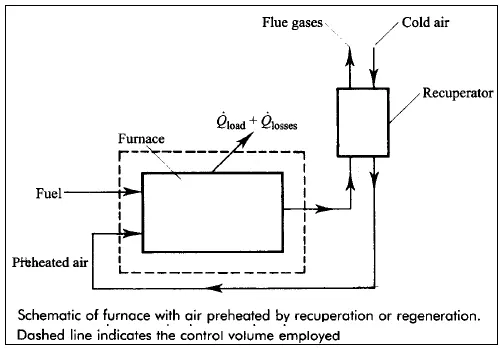
In combustion is used to generate heat, and the recuperator serves to recuperate, or reclaim this heat, in order to reuse or recycle it. The term recuperator refers as well to liquid-liquid counterflow heat exchangers used for heat recovery in the chemical and refinery industries and in closed processes such as ammonia-water or LiBr-water absorption refrigeration cycle.
Recuperators are often used in association with the burner portion of a heat engine, to increase the overall efficiency. For example, in a gas turbine engine, air is compressed, mixed with fuel, which is then burned and used to drive a turbine. The recuperator transfers some of the waste heat in the exhaust to the compressed air, thus preheating it before entering the fuel burner stage. Since the gases have been pre-heated, less fuel is needed to heat the gases up to the turbine inlet temperature. By recovering some of the energy usually lost as waste heat, the recuperator can make a heat engine or gas turbine significantly more efficient.
Normally the heat transfer between airstreams provided by the device is termed as "sensible heat", which is the exchange of energy, or enthalpy, resulting in a change in temperature of the medium (air in this case), but with no change in moisture content. However, if moisture or relative humidity levels in the return air stream are high enough to allow condensation to take place in the device, then this will cause "latent heat" to be released and the heat transfer material will be covered with a film of water. Despite a corresponding absorption of latent heat, as some of the water film is evaporated in the opposite airstream, the water will reduce the thermal resistance of the boundary layer of the heat exchanger material and thus improve the heat transfer coefficient of the device, and hence increase efficiency. The energy exchange of such devices now comprises both sensible and latent heat transfer; in addition to a change in temperature, there is also a change in moisture content of the exhaust air stream.
Applications of Recuperator:-
- Use in Ventilation systems
- Use in metallurgical Furnaces
- Gas Turbines etc
-----------------------------------------------------------------------------------------------------------------------------------------------------
Analysis:
- Part_1: Effect of preheating on the adiabatic flame temperature with Change pre-heating from 298 to 600K.
- Part_2: Effect of pre-heat temeprature on combustion efficiency given furnace exit temperature is 1700K
Combustion Efficiency of Recuperator:
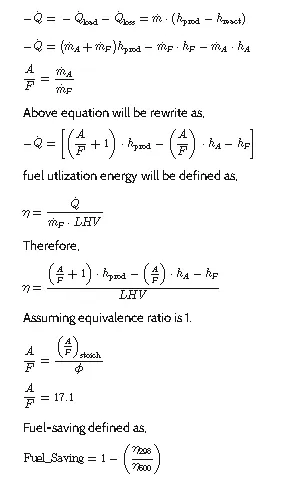
First we have to balance the Energy Balance for the Control Voulme Assume both the heat transferred to th load and the heat losses are same with or without the preheat the temperature.
Assuming, It is a Steady slow heat is transferred out the control Volume.
Part1: Effect of preheating on the adiabatic flame temperature with Change pre-heating from 298 to 600K.
Pyhton code:-
"""
Calculate the Effect of pre-heating on the Adiabatic Flame Temperature
"""

import cantera as ct
import matplotlib.pyplot as plt
import numpy as np


gas = ct.Solution('gri30.cti')

#define the range of preheating inlet air temperature
i = np.linspace(298,600,10)

#Values of AFT stored
T_gas = []

for t in i:
	Reactants = ct.Quantity(gas)
	Reactants.TPX = t,ct.one_atm,'O2:1,N2:3.76'
	Reactants.moles = 2

	Fuel = ct.Quantity(gas)
	Fuel.TPX = 298,ct.one_atm,'CH4:1'

	M = Reactants+Fuel
	M.equilibrate('HP','auto')
	T = M.T
	T_gas.append(T)

print(T_gas)
plt.plot(i,T_gas)
plt.xlabel('preheating Temprature at inlet in K')
plt.ylabel('Adiabtaic Flame Temprature in K')
plt.title('Effect of preheating on the Adiabatic flame Temperature')
plt.grid('on')
plt.show()
Coding Approach:-
- For this study we Assume Methane (CH4) as a fuel is burning in the Furnance and To see how Adiabatic Flame temperature is being affected by varying Inlet Temperature from 298 to 600K of air.
- First of all we have to import the All necessary applications i.e, import Cantera To perform the Chemical Kinetics Calculations, import matplotlib.pyplot to show the graphical representation ofthe data and alalysis it properly. Also import numpy for numerical Calculations.
- Then we create Class= Solution and instants of Class = Gas and also called the "gri30.cti" mechanics to solve this combustion problem.
- After that Defined the range of preheating temperature in the variable of "i" using by Linspace command Temeprature given vlaues 298 to 900 K and 10 values to ease.
- After that For loop is created inside which all the values of pre-heating Inlet air Temperature AFT calculation is done by mole basis System.
- Print and plot the all resulst we have obtained from this data.
Output Got from the Code:
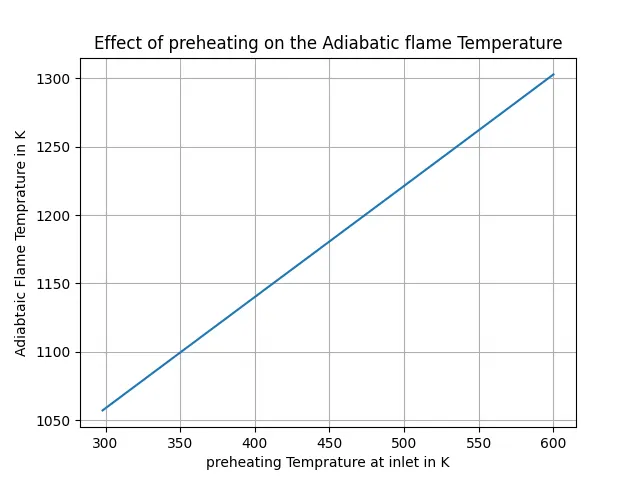
Observation:
- As we can see Pre-heat temperature at the Inlet increases from 298 to 600 K the Adiabatic Flame Temperature of Methane Fuel is also increases simultaneously.
- AFT shows linear relationship with Pre-heating at inlet.
- As we increased the Pre-heat temperature at 600 K we got the maximum AFT temperatrue at 1300K.
-------------------------------------------------------------------------------------------------------------------------------------------------------------
Part_2: Effect of pre-heat temeprature on combustion efficiency given furnace exit temperature is 1700K
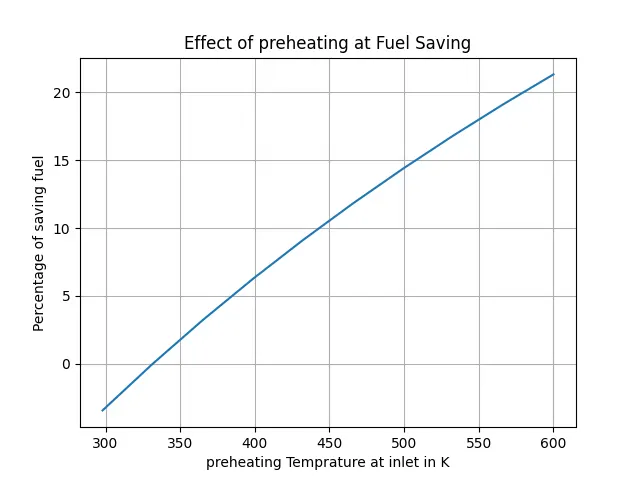
Here, we are utilising the waste heat of flue gases to increase the Temperature of the air at Inlet and see how the Pre-heat temperature Effects on the Combustion Efficiency and the Fuel saving.
Pyhton code:-
"""
Program to calculate the effect of preheat temperature on Combustion Effciency
"""

import matplotlib.pyplot as plt
import cantera as ct
import numpy as np

Gas = ct.Solution('gri30.cti')
LHV_fuel = 50e6
Air_fuel = 17.121

i = np.linspace(298,600,10)

#Calculate enthalpy of fuel
Fuel = ct.Quantity(Gas)
Fuel.TPX = 298,ct.one_atm,'CH4:1'
H_fuel = Fuel.enthalpy_mass
Fuel.moles = 1

#Calculate enthalpy of products
Products = ct.Quantity(Gas)
Products.TPX = 1700,ct.one_atm,'CO2:1,H2O:2,N2:7.52'
H_Products = Products.enthalpy_mass
Products.moles = 1

#Calculate enthalpy of Reactants at a varying Inlet temperature
H_Reactants=[]

for t in i:
	Reactants = ct.Quantity(Gas)
	Reactants.TPX = t,ct.one_atm,'O2:1,N2:3.76'
	Reactants.moles = 2
	H_Reactants.append(Reactants.enthalpy_mass)

#Heat loss
Q = []

#Efficiency of Combustion
eta = []

#Calculate the combustion efficiency at different range of inlet preheating temeprature
for j in range(len(i)):
	Q = -(((Air_fuel+1)*H_Products)-(Air_fuel*H_Reactants[j])-H_fuel)
	heat_loss = Q*100/LHV_fuel
	eta.append(heat_loss)

#Calculate fuel saving
percentage_saving = []

for k in range(0,len(eta)):
	Fuel_saving = 1-(eta[1]/eta[k])
	F_S = Fuel_saving*100
	percentage_saving.append(F_S)

print('total Fuel_saving in %=',F_S)

print(t,eta)

plt.figure(1)
plt.plot(i,eta)
plt.xlabel('preheating Temprature at inlet in K')
plt.ylabel('Combustion Efficiency')
plt.title('Effect of preheat temperature at Combustion Efficiency')
plt.grid('on')
plt.show()

plt.figure(2)
plt.plot(i,percentage_saving)
plt.xlabel('preheating Temprature at inlet in K')
plt.ylabel('Percentage of saving fuel')
plt.title('Effect of preheating at Fuel Saving')
plt.grid('on')
plt.show()
Output Got from the Code:
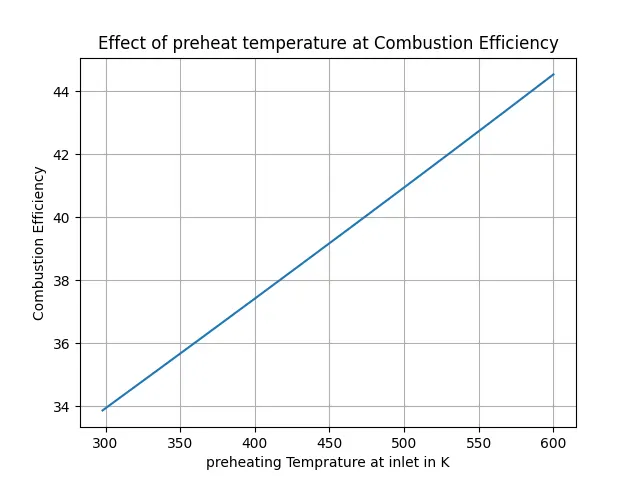
Figure(1)
Figure(2)
Observations:
- In the above plots we can conclude that the as the Pre-heat Temperature at the Inlet increases the combustion Efficiency is also increases linearly.
- In the Second figure also as the Pre-heating increases Fuel-saving Percentage is also increases.
- We got the Fuel saving in percentage almost 21.32% by this preheating the temperature at the Inlet of air.

Conclusion:-
- From this study we can conclude that As the preaheating of temperature increases the Combustion Efficinecy, Adiabatic Flame Temperature ans the Fuel_saving is also Increases. AS we see If the Adiabtic Flame Temperature increases which in turn all the available quantities of fuel to participate in the Combsution process hence increase in the AFT temperature it will increase the Combustion Efficiency and also fuel saving.
- We have taken the products temperature or exit furnace temperature as 1700K which is wrong because there are various Factors such as the type of fuel, flue gase species or composition, Combustion reactions, intermediary species on which exhaust gas temperature depends.