Week 4.2 - Combustion Efficiency Calculation after Preheating
Combustion Efficiency Calculation after Preheating
Aim: To calculate combustion efficiency of a furnace with preheating.
Theory:
A recuperator is a special purpose counterflow energy recovery heat exchanger positioned within the supply and exhaust air streams of an air handling system, or in the exhaust gases of an industrial process, in order to recover the waste heat. Generally, they are used to extract heat from the exhaust and use it to preheat air entering the combustion system. In this way they use waste energy to heat the air, offsetting some of the fuel, and thereby improve the energy efficient of the system as a whole.
Description of the problem:
A furnace is used to burn Methane and Air Mixture. A recuperator is connected to this furnace to recover some energy.
Assume that the furnace exit temperature is 1700K.
Combustion efficiency:
Combustion efficiency is defined as the ratio difference in the enthalpy of reactants and products and the lower heating value of the fuel.
Mathematically,
`(m_(air)*h_(air) + m_(fuel)*h_(fuel) - m_(p roduct)*h_(p roducts))/(m_(air)*LHV)`
In terms of air to fuel ratio (AFR),
`((AFR)*h_(air) + h_(fuel) - (1+AFR)*h_(p roducts))/(LHV)`
Fuel Savings:
It is defined as the ratio of fuel savings because of the use of recuperator and the fuel added without recuperator.
Mathematically,
((Fuel added without preheating)-(Fuel added with preheating))/(Fuel added without preheating)
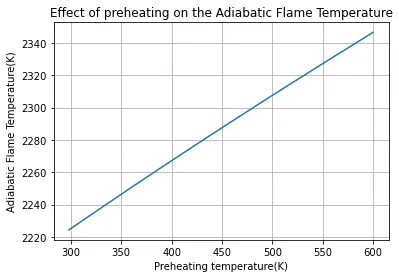
Effect of preheat on Adiabatic Flame Temperature:
Code used for obtaining plots:
import cantera as ct
import matplotlib.pyplot as plt
gas = ct.Solution('gri30.cti')
# defining air object
AFT = []   # adiabatic flame temperature
PT = []    # preheat temperature
for Tpre in range (298,601):
    A = ct.Quantity(gas)
    A.TPX = Tpre,ct.one_atm,{'O2':0.21,'N2':0.79}
    A.moles = 9.52
    # definig fuel object
    B= ct.Quantity(gas)
    B.TPX = 298.15,ct.one_atm,{'CH4':1}
    B.moles = 1
    P = A+B
    P.equilibrate('HP')
    AFT.append(P.T)
    PT.append(A.T)

plt.plot(PT,AFT)
plt.title('Effect of preheating on the Adiabatic Flame Temperature')
plt.xlabel('Preheating temperature(K)')
plt.ylabel('Adiabatic Flame Temperature(K)')
plt.grid(True)
plt.show()
Plot Obtained:
Comments:
As the inlet air is heated the enthalpy of the air is high. So after the reaction the products temperature is also high.
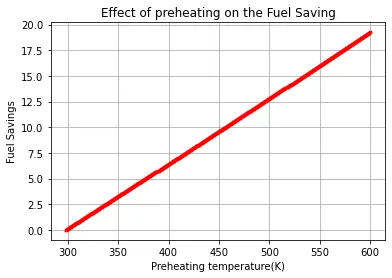
Effect of Preheat on Fuel Savings for the given final Adiabatic Flame Temperature:
Code used for plotting:
import cantera as ct
import matplotlib.pyplot as plt
gas = ct.Solution('gri30.cti')
e = 0.00001
LHV = 50e6


for Tpre in range (298,601):
    tol = 0.001
    error = tol+1
    moles_B_guess = 0.5
    A = ct.Quantity(gas)
    A.TPX = Tpre,ct.one_atm,{'O2':0.21,'N2':0.79}
    A.moles = 9.52
    # definig fuel object
    while abs(error) > tol:
        B= ct.Quantity(gas)
        B.TPX = 298.15,ct.one_atm,{'CH4':1}
        B.moles = moles_B_guess
        C= ct.Quantity(gas)
        C.TPX = 298.15,ct.one_atm,{'CH4':1}
        C.moles = moles_B_guess+e
        M =A+C
        M.equilibrate('HP')
        P = A+B
        P.equilibrate('HP')
        slope = (M.T-P.T)/(e)
        error = -(P.T-1700)/(slope)
        moles_B_guess = moles_B_guess+error
    fuel_saving=(-moles_B_guess + 0.6199652767910161)/0.6199652767910161
    plt.plot(Tpre,fuel_saving,'.',color = 'red')

#plt.plot(PT,AFT)
plt.title('Effect of preheating on the Fuel Saving')
plt.xlabel('Preheating temperature(K)')
plt.ylabel('Fuel Savings')
plt.grid(True)
plt.show()
plot:
Comments:
We get the benefit of fuel savings for the preheated case.