Automated Washing Machine And Gear Shift Logic Using Simulink
AIM:
1.To implement a state flow logic of a washing machine using the following sequence:
If the power is on the system gets activated and if there is no water the system is supposed to indicate it through a LED. Soaking time is for 200 seconds follwed by 100 seconds of washing time. After that there is rinsing time of 50 seconds follwed by 20 seconds of drying time. Once all these processes are complete then it should indicate through LED.
2.To implement a Gear Shift Logic using the following conditions:
Speed Range(kmph) Gear
0 to 15 1
16 to 25 2
26 to 40 3
41 to 60 4
Above 61 5
MODEL SETUP:
1.AUTOMATED WASHING MACHINE:
The model associated with the scenario is as follows
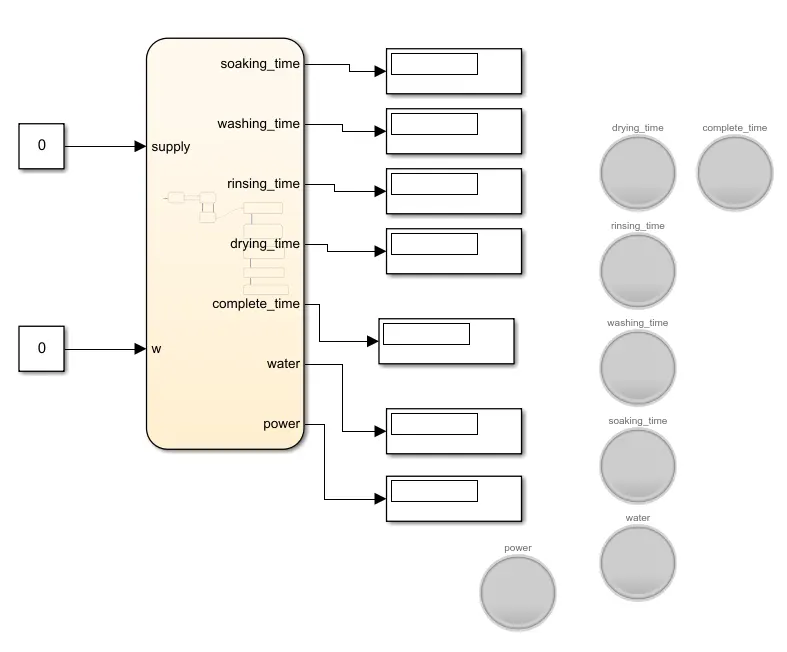
The inputs to the chart which are supply and w are inputed using constant blocks whose values can be changed for each simulation. Based on the input the state flow chart performs various operations at the end of which there is a LED notification or the washing cycle is complete.
2.GEAR SHIFT LOGIC:
The model associated witht the scenario is below
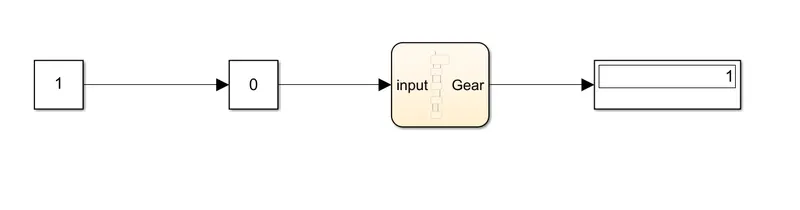
The basic input for the model is variable speed which can be acheive with help of a slider gain whose minimum value can be set at 0 and maximum value can be set at 100. The input of the slider gain block is connected to a constant block of value 1.The slider gain block is connected to a state flow chart whoose output is given to a display block
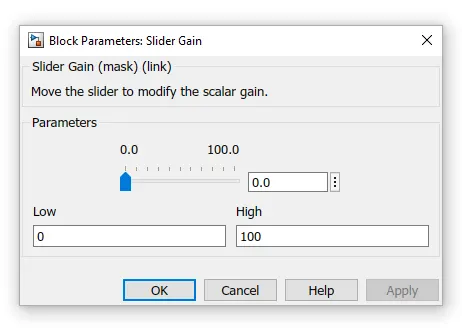
The chart block has various outputs according to the input given in the slider gain block
EXPLANTION:
1.AUTOMATED WASHING MACHINE
The constant blocks provide the input to the chart which according to the input gives an output.The detailed flow of the chart is as follows
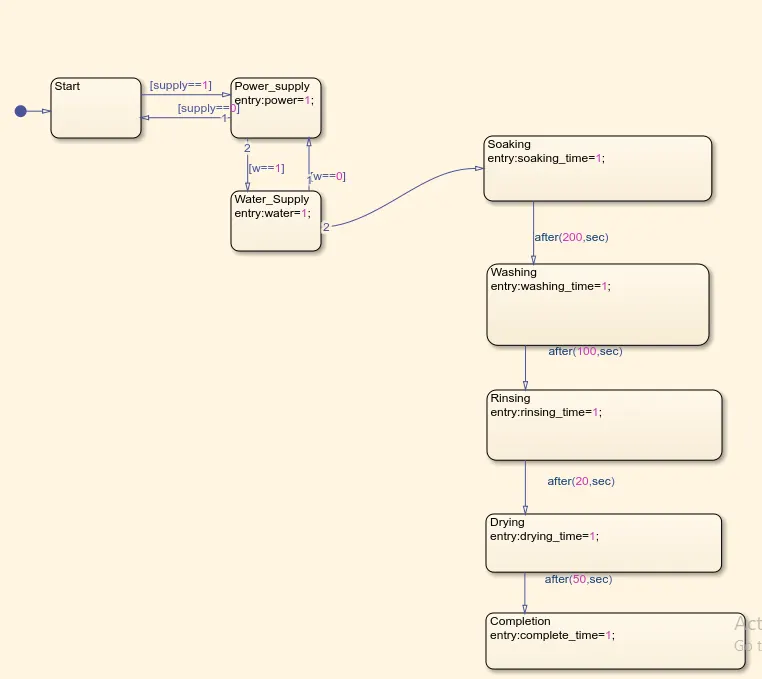
The variables supply and w are assigned the datatype input data while power,water,soaking_time,washing_time,rinsing_time,drying_time,complete_time are all assigned the datatype output data
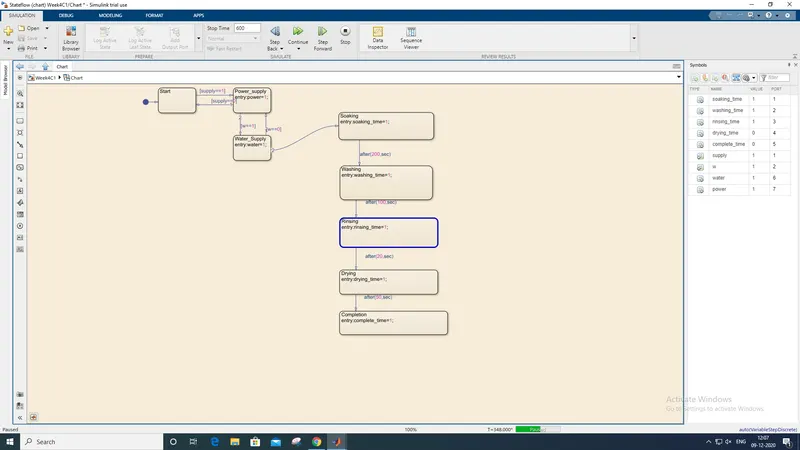
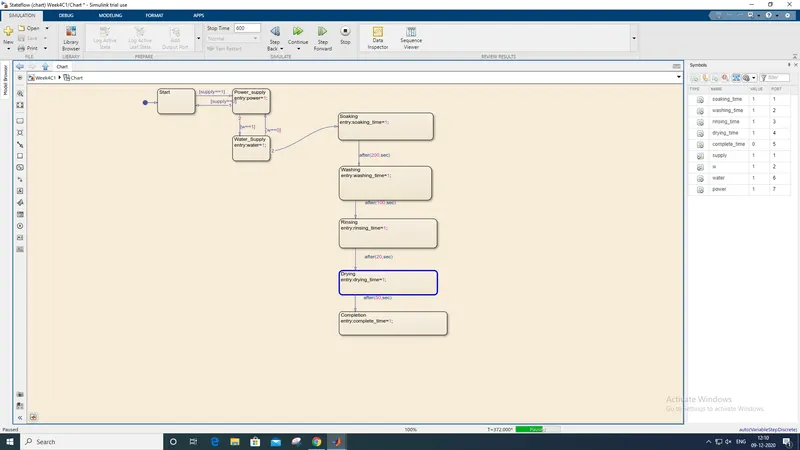
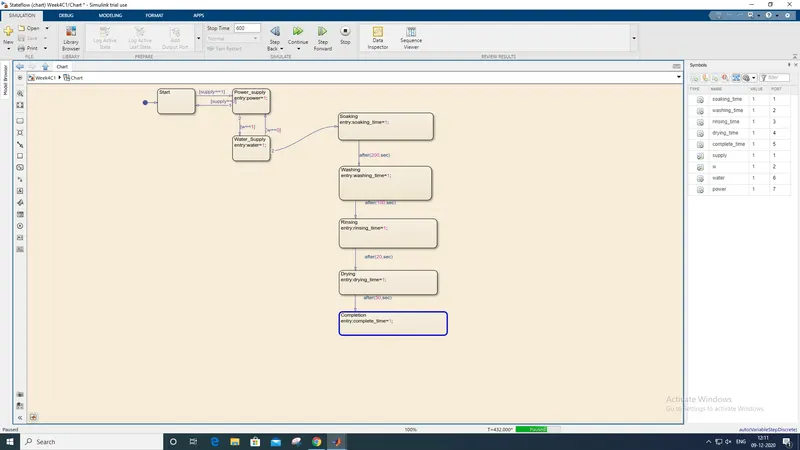
The process first checks if there is supply. If there is no supply then the process ends there itself. If there is power it goes on to check whether there is water supply,if there is waster supply it moves on to the next process if not it gives a lamp notification. Assuming now there is both supply and water supply the process of soaking begins. This goes on for a time of 200 seconds after which the washing process starts. The washing process goes on for 100 seconds after which the rinsing process starts.The rinsing process goes on for 20 seconds after which the drying process begins.It goes on for 50 seconds
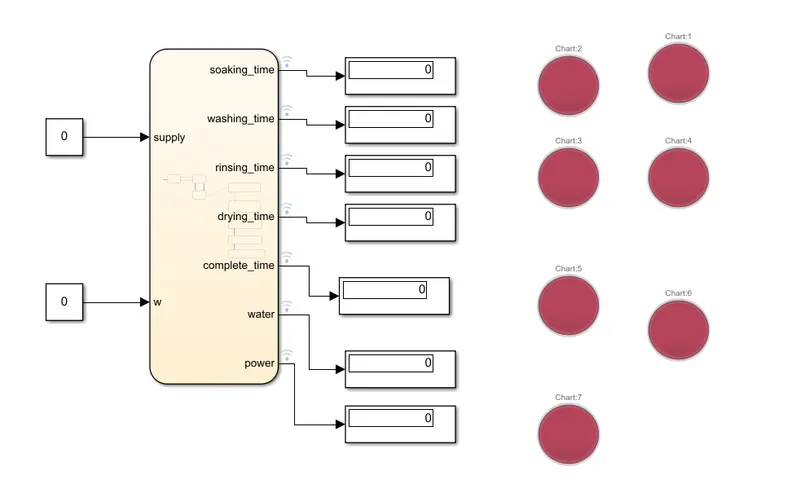
If both the supply and water supply(variable w) are given as zero then the output is as follows. None of the processes are to supposed to be done or in other words all the lamps will light up in red colour.The display blocks will aslo display the value zero.
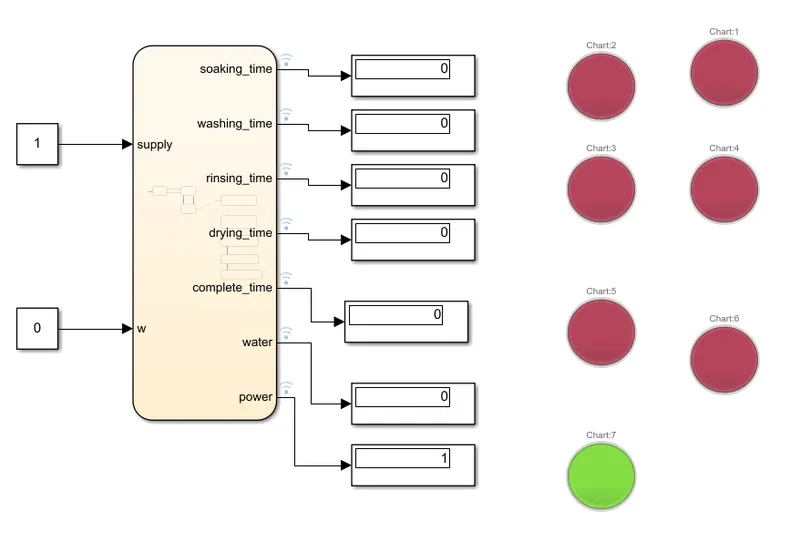
If the supply is given as one and the water supply(variable w) is given as zero then the lamp corresponding to power(chart 7) will light up in green while all the others will light up in red meaning none of the other processes will start unless there is water suppply.The display block connected to the power variable output alone will display the value of one while all the others will display zero.
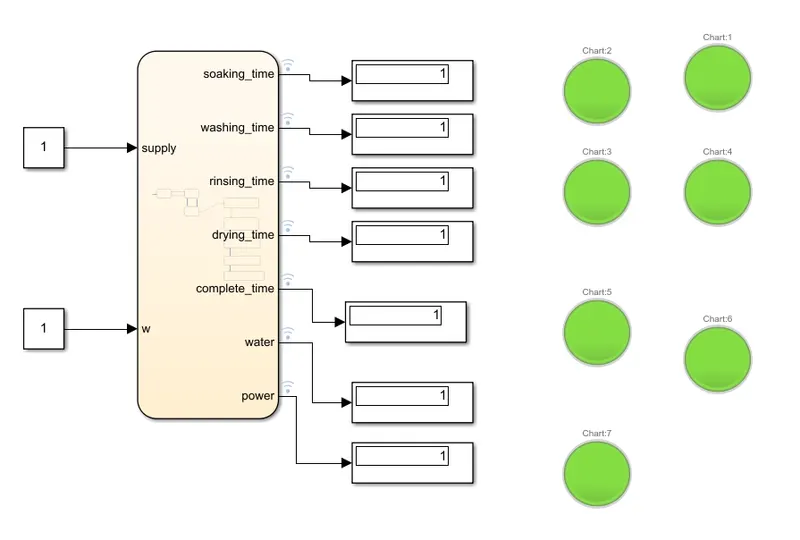
If the both supply and water supply(variable w) is given as one then the process of soaking, washing and rinsing all take place with appropriate delays as set in the conditions. In this case all the displays display the value 1 at the end of the simulation and all the lamps light up in green.
The flow chart at the start of the simulation with various variable values in the symbol pane
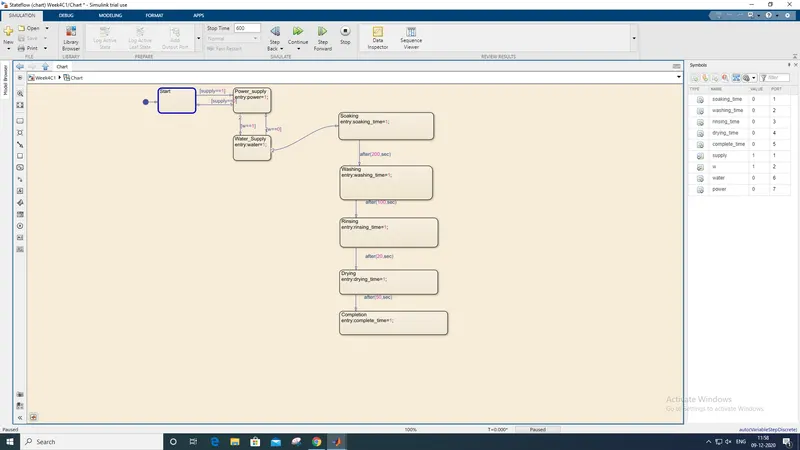
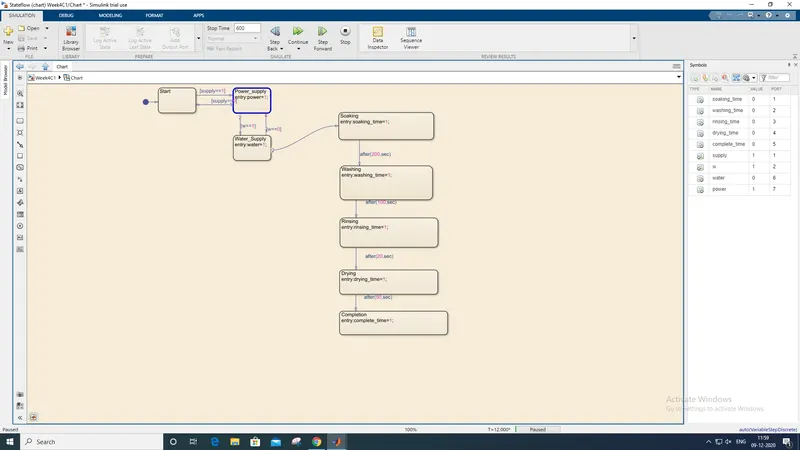
At 12 seconds since the supply is one the power variable chnages accordingly
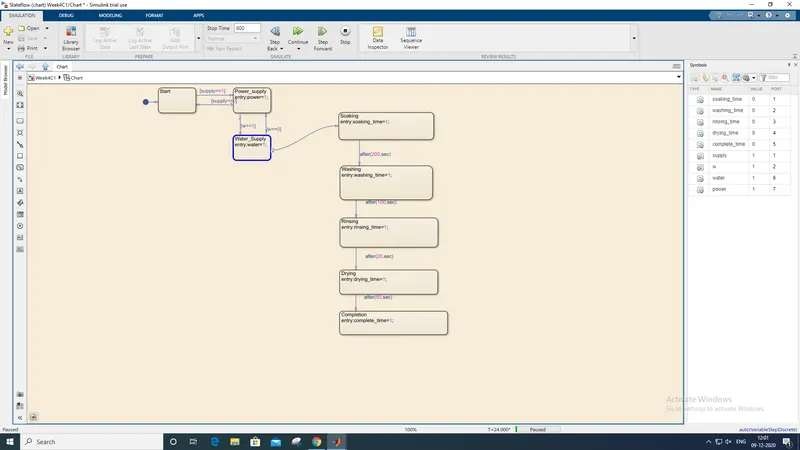
At 24 seconds since the water supply(variable w) is one the water variable changes accordingly
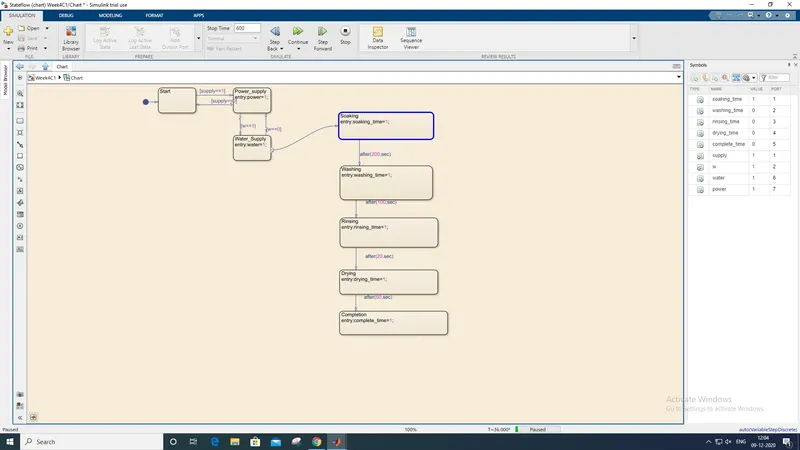
At the end of 36 seconds the process of soaking starts and the variable soaking_time changes accordingly
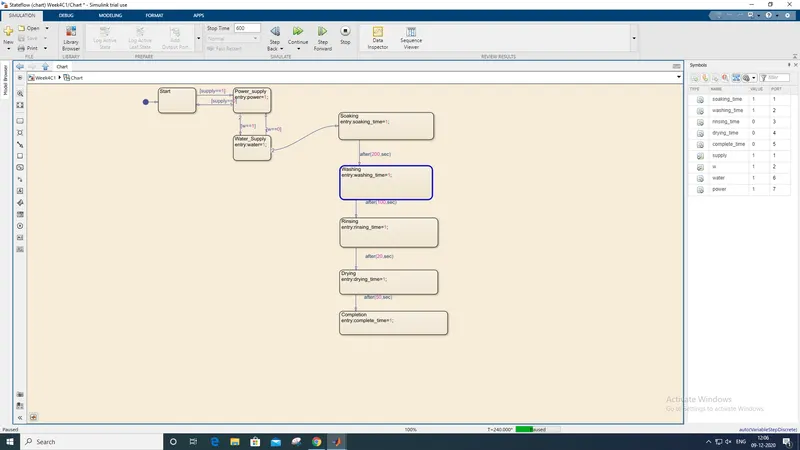
At the end of 240 seconds the wasing process starts and the washing_time variable chnages accordingly
At the end of 348 seconds the rinsing process starts and the rinsing_time variable changes acccordingly
At the end of 372 seconds the drying process starts and drying_time variable changes accordingly
At the end of the 432 seconds the drying process is completed and the washing machines has gone through all the states and the drying_time and complete_time variable change values accordingly
2.GEAR SHIFT LOGIC
The slider gain block provides the input to the chart block which at the end of the process gives gear as the output which is displayed in the display block. The detailed flow of the chart is as follows
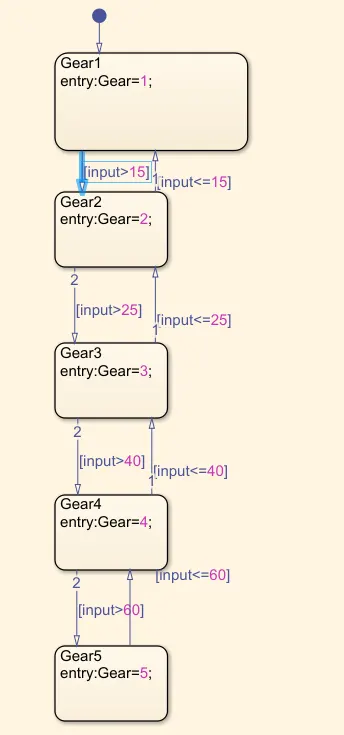
The variable input is assigned input data in the symbol pane while gear variable is assigned output data
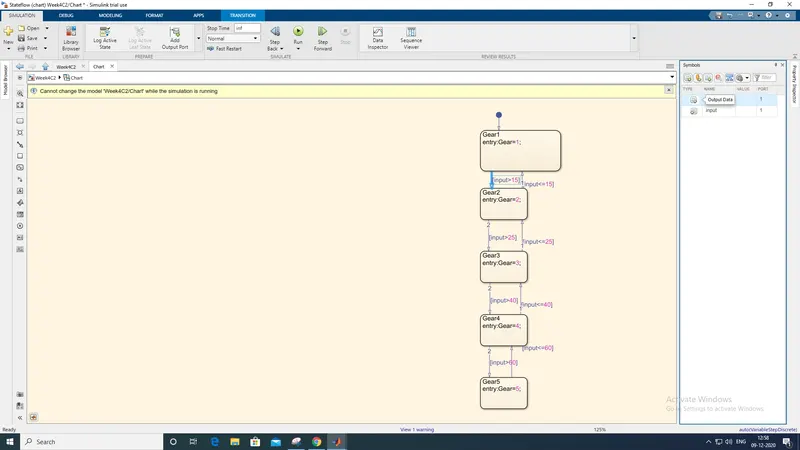
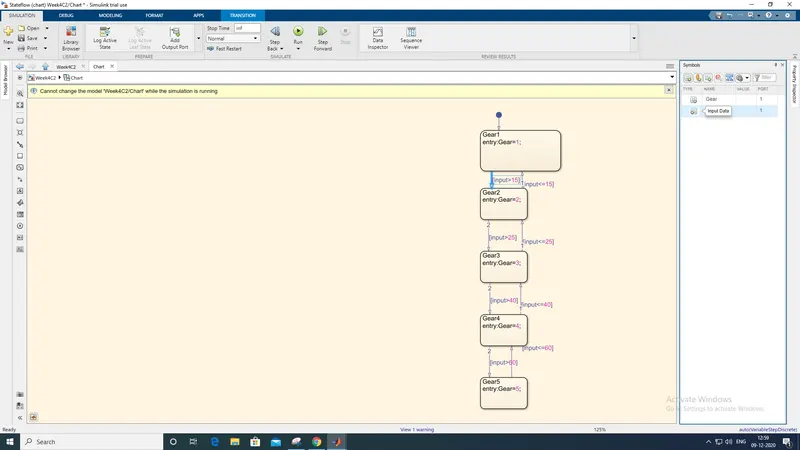
The process shifts from state Gear1 to Gear2 if the input value is greater than 15. Likewise process shifts from Gear2 to Gear3 when the input is greater than 25. The process shifts from Gear3 to Gear4 when the input is greater than 40 and for input values greater than 61 it shifts to Gear5 state.Just like the upshift the downshift also happens based on the value in the slider. For this the simulation time should be set to inf and the value in the slider gain block can be varied in the range of 0 to 100.
If the input value is 10(Lesser than 15), the output is as follows
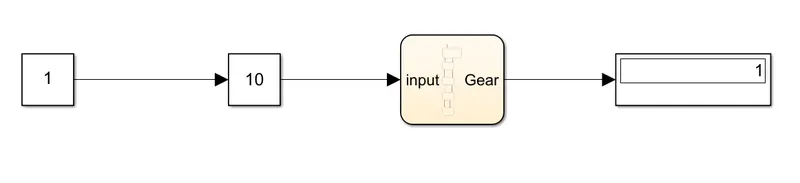
If the input value is 20(Lesser than 25), the output is as follows
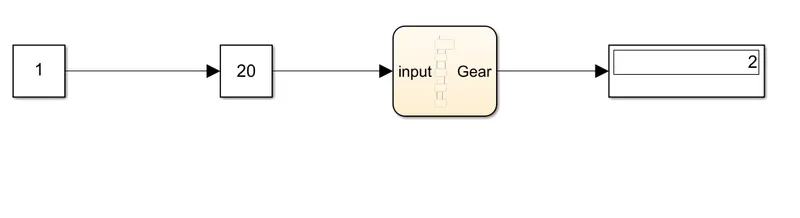
If the input value is 33(Lesser than 40), the output is as follows
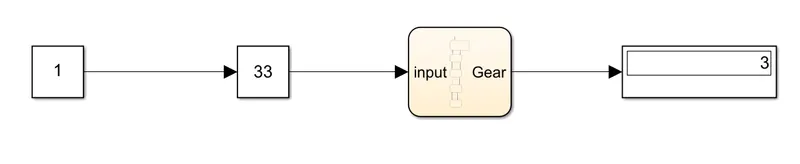
If the input value is 51(Lesser than 60), the output is as follows

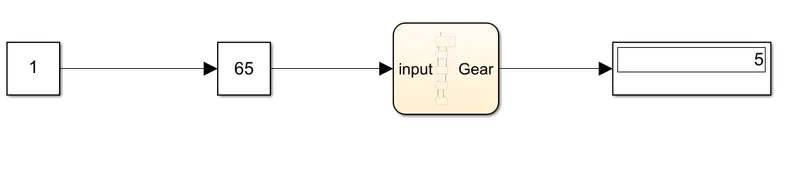
If the input value is 65(Greater than 60), the output is as follows
RESULT:
1.The automated washing machine is made to through all the states and all possible inputs are given and the outputs are analysed usong state flow logic
2.The gear shift logic has been implemented using state flow logic