Motor Braking using MATLAB
AIM:
1.To calculate the braking energy for a given driving cycle
2.To understand braking torque at different speeds of motor and limitations of braking
3.To script a MATLAB program which plots a contour of motor speed , torque and efficiency inputs
MODEL SETUP:
1.There is energy consumption when a vehicle is to be decelerated. The energy required to bring the vehicle to rest depends on factors like mass of the vehicle, its initial velocity and final velocity.The relation between them is as follows
KE=0.5*m*(v2i-v2f)
Where m is the mass of the vehicle
Vi is the initial velocity
Vf is the final velocity
The driving cycle is defined as follows
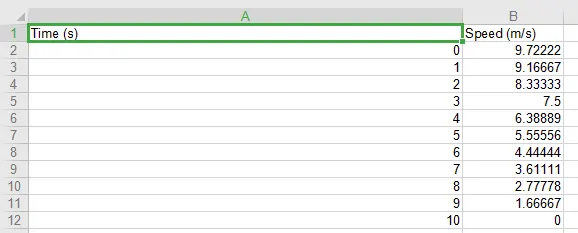
The braking energy is calculated for reducing the speed from initial speed of 9.72222 m/s to rest which turns out to be 47.26J while the other case taken into consideration is to reduce the speed from initial speed of 9.72222 m/s to 7.5 m/s which turns out to be 19.135J
2.The motors that are used for electric vehicle application are induction motors and DC brushless motor. The speed and torque of the above motor are related to each other through the following expression
T=((3*(V2*(R’2/s))/(ωms*((R1+(R’2/s))2+(X1+X’2)2))
where T is the torque developed
V is the per phase voltage
R’2 is the resistance of the rotor referred to the stator
s is the slip developed by the motor
ωms is the synchronous speed of the motor
R1 is the resistance of the stator
X1 is the reactance of the stator
X’2 is the reactance of the rotor referred to the stator
From the above expression it can be concluded that the speed and torque of the motor are inversely proportional
When the motor is starting the speed of motor is low as a result of which the torque produced is high
When braking the speed of the motor is high sometimes equal to the synchronous speed and at such conditions the braking torque produced by the motor is low
In an electric vehicle regenerative braking alone is not enough to meet the braking requiremnets. The disadvantages of regenerative braking include:
i.The regenerative torque created depends on a lot of factors like the motor specifications and the type of battery pack that has been used.
ii. The battery wouldnt be effciently charged under slow moving conditions
iii.Once the battery is completely charged the charge from regenerative braking is restricted as a result of which the regenerative torque is low.
Even if the vehicle were to move at a high speed and the brakes were to be applied the feedback current to the battery cannot exceeda particular value due to safety precautions as a result of which the regenerative torque cannot exceed a predetermined value. The conventional brakes are not constrained to such conditions and hence for optimum braking the electric brake and mechanical brakes have got to be used in tandum.
The brakes can be configured in thwo different ways, series and parallel configuration. In series configuration the application of one kind of brake is followed by another. In parallel configuration both brakes are appled simultaneously.
3.
clear all
close all
clc
v=linspace(1,1000);
t=linspace(1,250);
kc=0.2;
ki=0.008;
kw=0.00001;
constant_loss=20;
[X,Y]=meshgrid(v,t);
cu_loss=(Y.^2)*kc;
fe_loss=X.*ki;
w_loss=(X.^3)*kw;
op_power=v.*t;
ip_power=op_power+cu_loss+fe_loss+w_loss+constant_loss;
efficiency=op_power./ip_power;
V=[0.70,0.75,0.80,0.85,0.90,0.92,0.93];
contour(X,Y,efficiency,V);
xlabel('Speed(rad/s)');
ylabel('Torque(N-m)');
Z=[8000,10000];
contour(X,Y,op_power,Z);
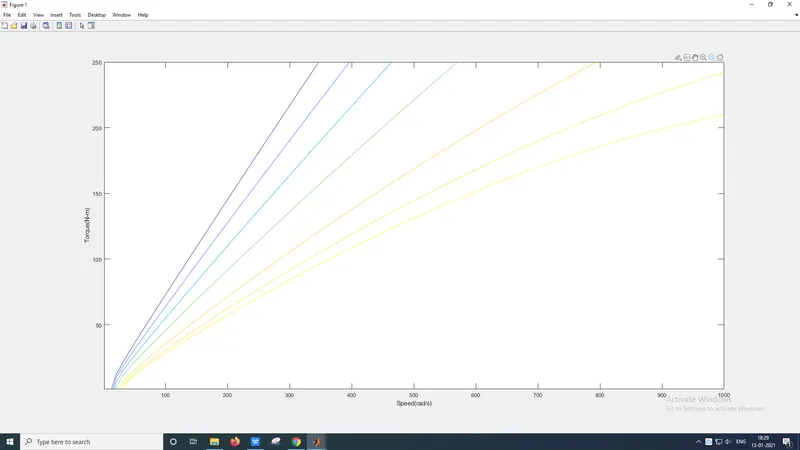
The velocity variable v is assigned values from 1 to 1000 while the torque variable is assigned values from 1 to 250. The copper loss coefficient kc is assigned the value of 0.2. The copper loss is directly proportional to the square of the torque. The iron loss coefficient ki is assigned the value of 0.008.The iron loss is directly proportional to the speed. The windage loss coefficient kw is seet at 0.00001. The windage loss is directly proportional to the cube of the speed. The constant loss is set at a value of 20.The output power is a product of the speed and torque. The input power must be higher than the output so as to compensate for the losses that occur. The input power is the sum of the output power, copper loss, iron loss, windage loss and constant loss. The efficiency is the ratio of output power to that of input power. Generally the peak effiency of the motor is 95%.
RESULT:
1.The braking energy for a given driving cycle is calculated
2.The braking torque at different speeds of motor and limitations of braking are understood
3.A MATLAB script capable of plotting the contour of motor speed, torque and efficiency is implemented