Week 3 Verification of Weld Joints
AIM :
To simulate 3 different types of welding using 3 different weld materials (Stainless steel , Aluminium alloy , Bronze (brazing)).
PROCEDURE:
1. Geometry
- The component assembly was imported to Space Claim and renamed according to convinience .
- The individual components were assingned different materials as per the given 3 Cases :
Case 1 : Plates , ribs and weld beads were all assinged Stainless Steel .
Case 2 : Plates , ribs were assinged stainless steel where as the weld beads were assinged Aluminium alloy (material property was defined in the problem statement) .
Case 3 : Plates were assinged Stainless Steel , ribs were assinged copper and weld beads were assinged Bronze (material property was defined in the problem statement) .
2. Contacts :
- Frictional contact was defined of coefficient 0.2 betwwen the plates , and the ribs (5 contact pairs).
3. Mesh :
- Body sizing of 7 mm was defined for the each of the components of the body .
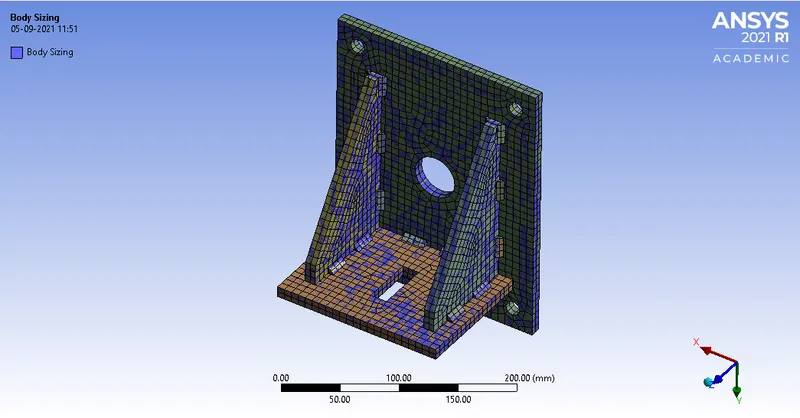
No of nodes =24005
No of elements = 3990
4. Boundary conditions :
- Fixed support was provided on the large plate along the holes provided .
- A Force of 15000 N was input on the hole of smaller plate along y direction .
RESULTS :
1. Directional Deformation :
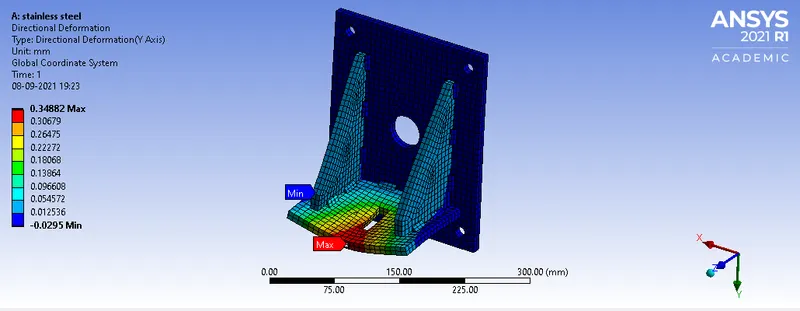
a) For Case 1 :
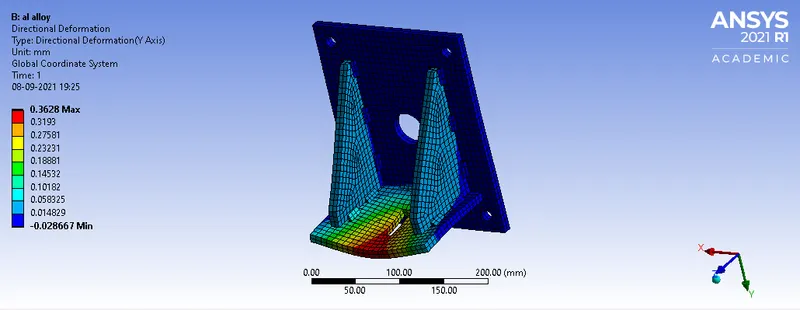
b) For Case 2:
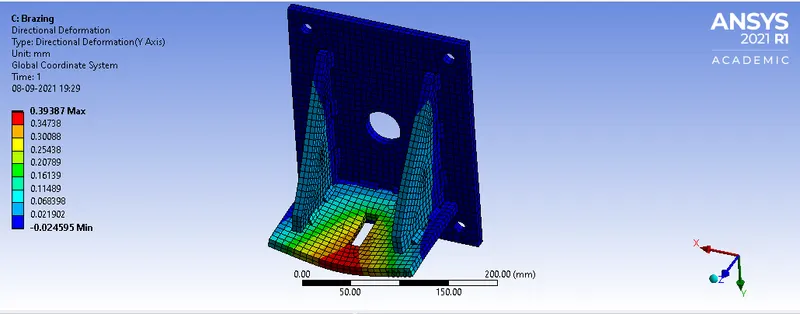
c) For Case 3:
| Case No | Directional Deformation (-y direction) (mm) |
| Case 1 | 0.349 |
| Case 2 | 0.367 |
| Case 3 | 0.394 |
2. Equivalent Strain :
a) For Case 1:
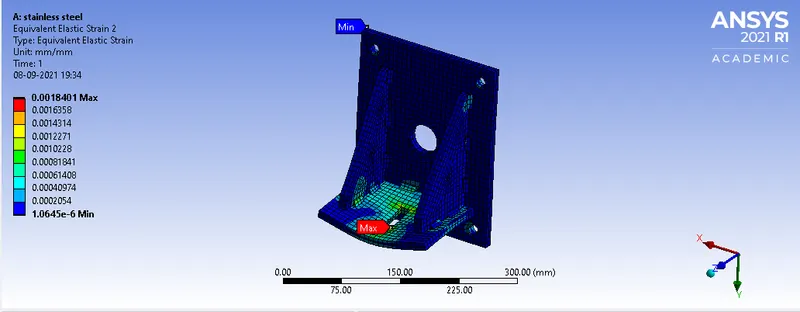
b) For Case 2:
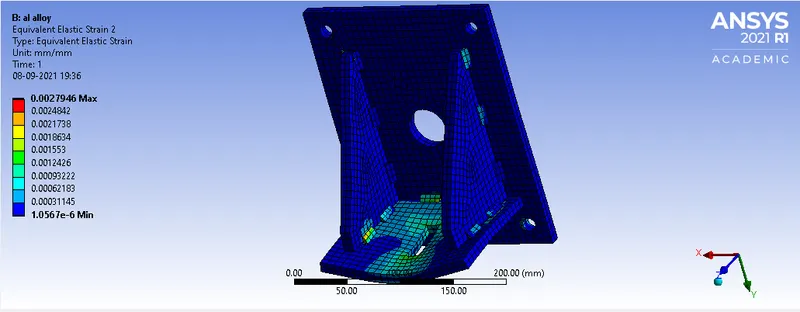
c) For Case 3:
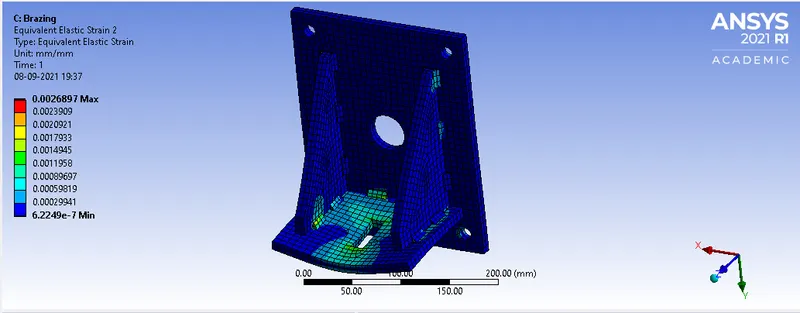
| Case No | Maximum Equivalent Strain (mm/mm) |
| Case 1 | 0.00184 |
| Case 2 | 0.00279 |
| Case 3 | 0.00269 |
3. Maximum Stress on weld joint experienced by each case :
Case 1 :
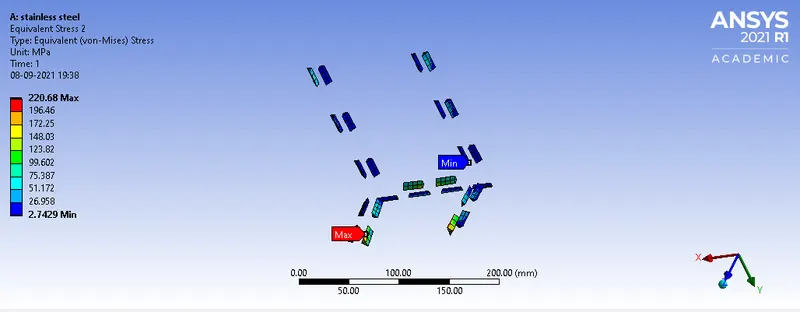
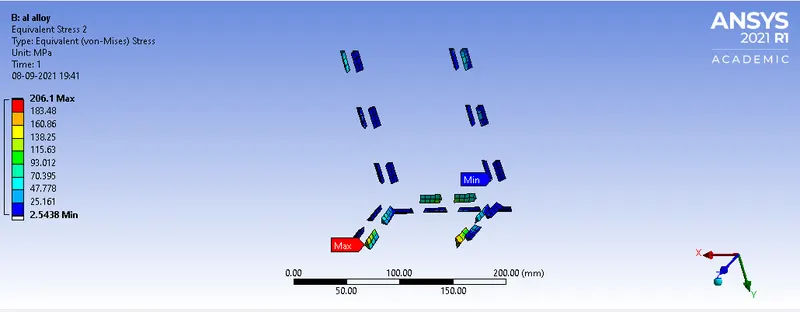
Case 2:
Case 3:
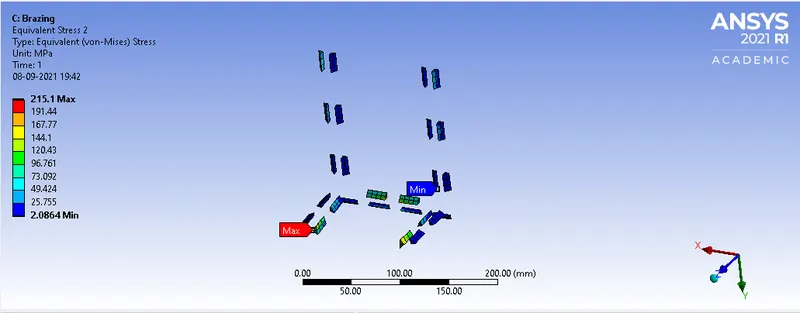
- In all the three cases , the maximum stress is experienced by the weld joint joining the small plate and right rib , since the load is being experienced by the smaller plate , this weld joint experiences a larger stress .
| Case No | Maximum Stress on weld joint (MPa) |
| Case 1 | 220.68 |
| Case 2 | 206.1 |
| Case 3 | 215.1 |
CONCLUSION :
- The maximum stress experienced by weld joint is in Case 1 , where it is the least for Case 2. Hence better stability of the structure will be provided in Case 2 welding .
- The maximum stress is experienced by the weld joint connecting small plate and the right rib , which is due to the load being applied adjacent to the welded part .