Week 3 Verification of Weld Joints
0bjective : To verify weld joints using static structural analysis
1) To simulate three different types of welding using three different weld materials
2) To fine out the directional deformation and equivalent strain experienced by the setup
3) To identify the weld joint that experiences the highest equivalent stress in each case and compare the results for all three cases
Procedure :
1) To verify welds in the setup, we use static structural tool in the analysis system tool box to define the geometry and other input parameters for the same.
First we open spaceclaim to identify and rectify the errors in the geometry. In the below geometry we can see the welds are
2) In the engineering data we input the material and its properties. In this case we are using three different types of materials and its properties.
In this case, the material of the plates must stainless steel. Use Stainless steel for both weldments and plates. No need to add flux to the weldments.
Case 2:
Aluminium Alloy:The material to be chosen for this case is Aluminium alloy(high strength, wrought). [Plate material to be used is stainless steel
Case 3:
Bronze: In order to simulate "Brazing", should be using bronze as the weld material. Assign Stainless Steel to both plates and Copper to the "Ribs".
3) Input the given weld geometry from the geometry tab and naming them.
4) In connection, we have to define the contact faces of the weld geometry by selecting and deselecting as contact or target bodies. In contacts under connection tab we define the type of contact as frictional contact with coefficient of friction as 0.3 for connection between ribs and plates. Connection between the plates and weld joints are kept as bonded.
5) By opening the modelling the tab, we mesh the geometry with element size as default. Generating the mesh thereafter by right clicking on the Mesh icon. Body sizing under mesh tab is used to refine the mesh to 7mm for two plates where contacts are present.
Body sizing of 7mm mesh
Meshing done for whole geometry
6) We open analysis setting where we define step control settings and input the parameters as needed.
Defining Fixed support with one step by selecting the faces
Force applied in the Y direction of 12000N
7) Setting up the solution
Results :
| Sr. No | Max totalDeformation, mm | Max Equivalent strain | Max Equivalent stress, MPa |
| Case 1 | 0.35443 | 0.00075635 | 342.01 |
| Case 2 | 0.3726 | 0.00073876 | 347.25 |
| Case 3 | 0.36245 | 0.00074955 | 344.62 |
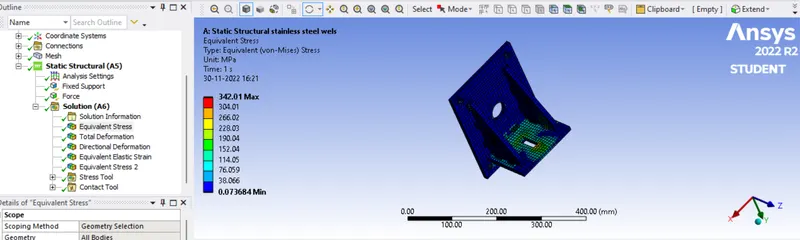
Conclusion :
We can conclude that from the above results stress on the Aluminium Alloy material used for brazing weld joint has the maximum equivalent stress among the other materials. Least stress developed is for structural steel and is best material for weld.
Drive Link : https://drive.google.com/drive/folders/1tarF1VoFyDevHdoi6dH5cVa7hkJhDtXX?usp=share_link