Sheet metal Bending using Ansys Workbench
Aim :
Sheet metal bending is to be performed according to the following conditions :
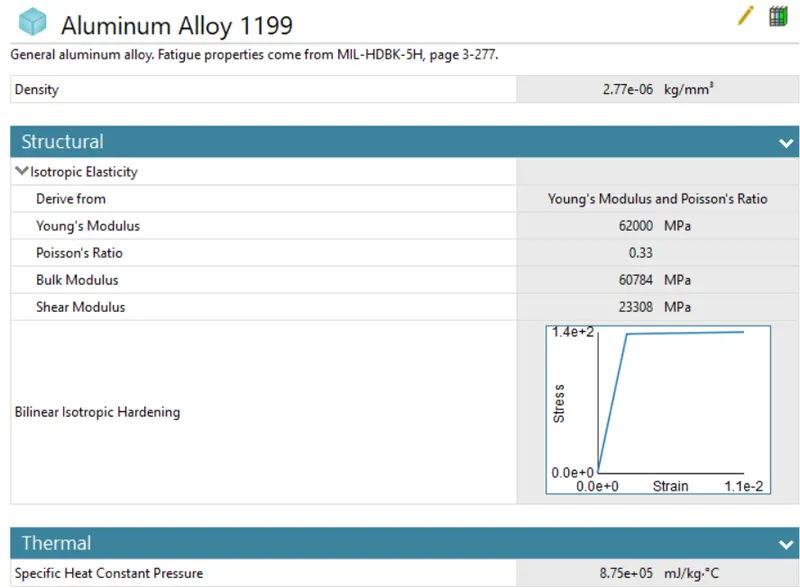
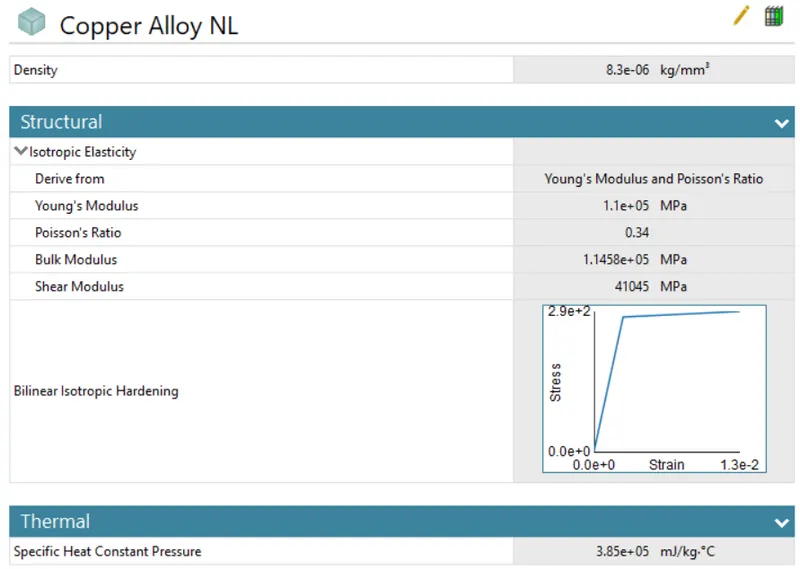
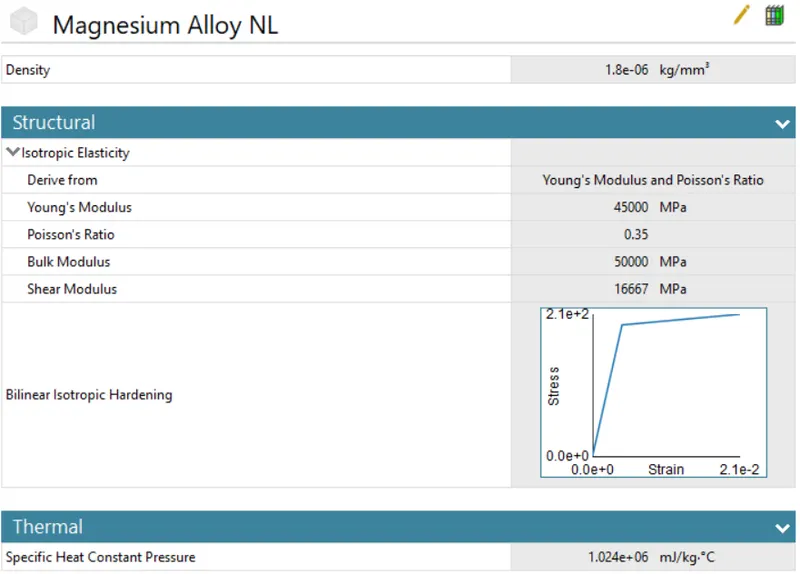
- Aluminium Alloy 1199, Copper Alloy NL and Magnesium Alloy NL. Find out the Equivalent Stress and Total Deformation in Y direction and compare the results.
- With the material as Aluminium Alloy, change the friction coefficient to 0.19 and run the analysis as mentioned in Case 1. Compare the results with that in case 1.
- Refine the mesh on the plate such that it doesn't cross the academic limit. With Aluminium alloy as material, run the analysis as in Case 1 and compare the results.
FILES : Sheet_Metal_Bending
Materials Used :
Procedure :
- The model is imported to the Ansys Workbench
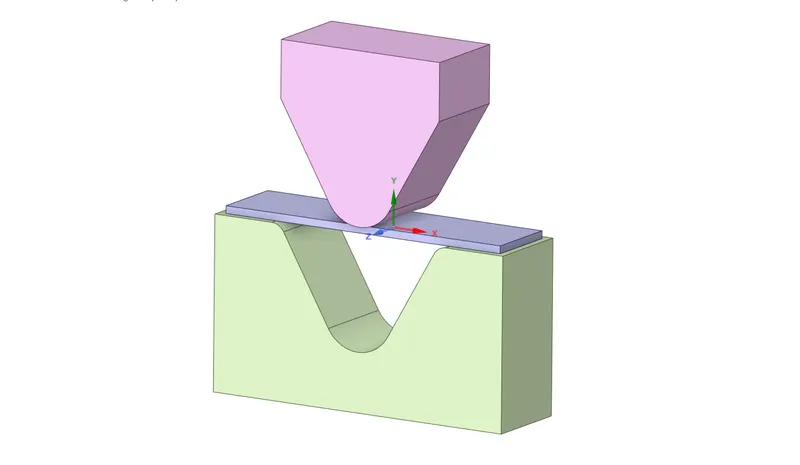
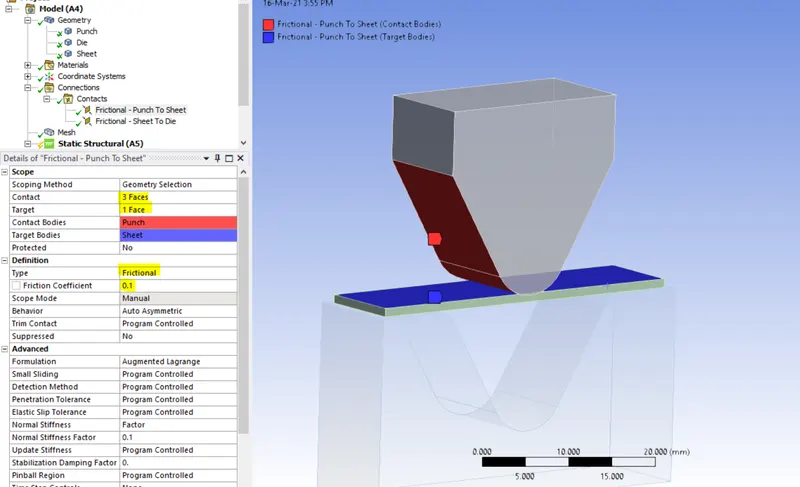
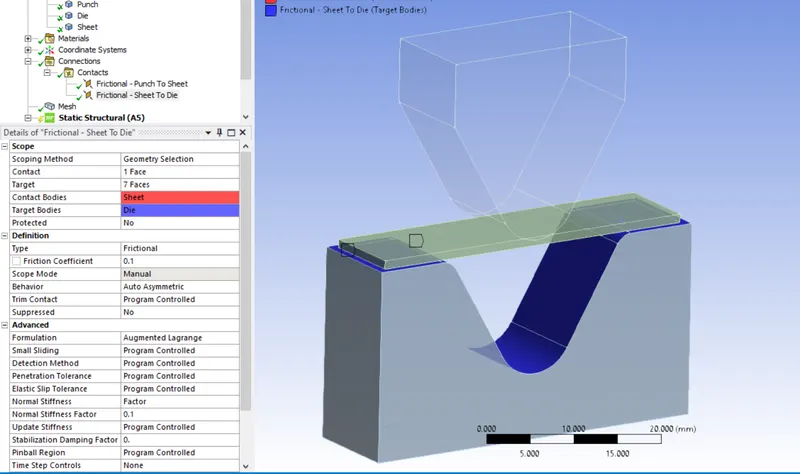
- The following Frictional Contacts where given to the parts of the model.
Contact between Punch and the Sheet :
Contact between the Die and Sheet :
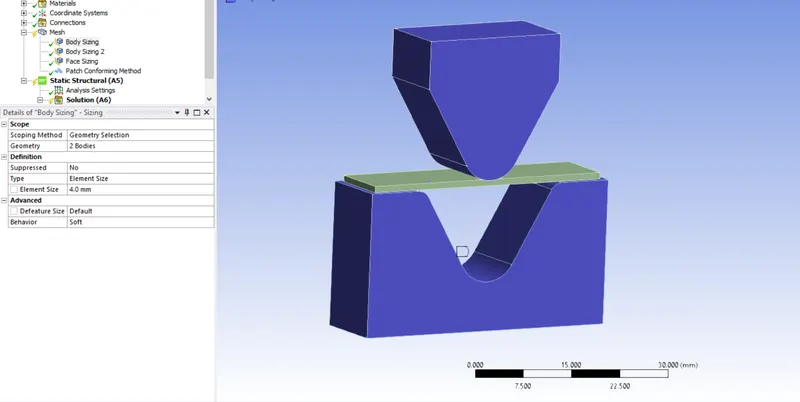
- Meshing Process :
Body sizing was given to the Die and Punch with 4mm as element size :
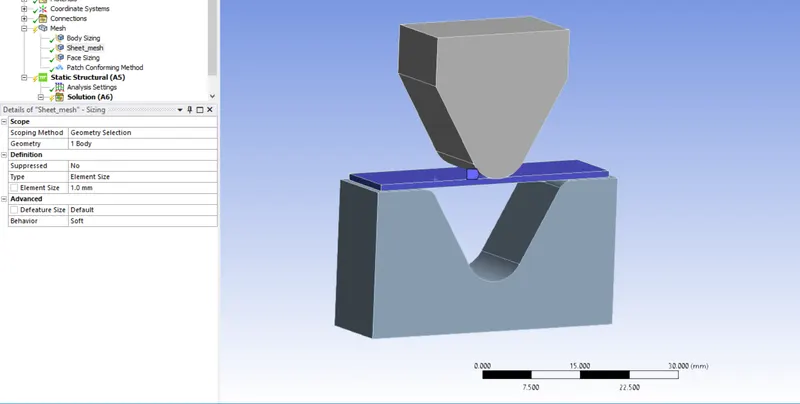
For the Sheet which is to be bend is given a refined mesh of element size 1mm :
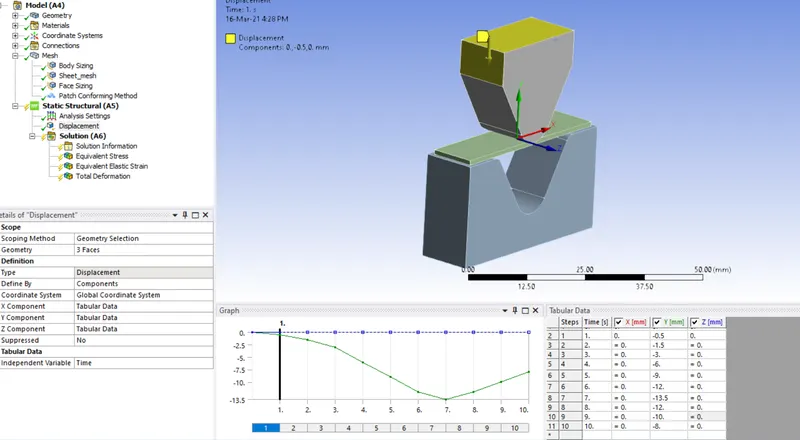
- Now for the displacement of punch we give the values in the Y-direction such that the punch is constrained Y axis only.
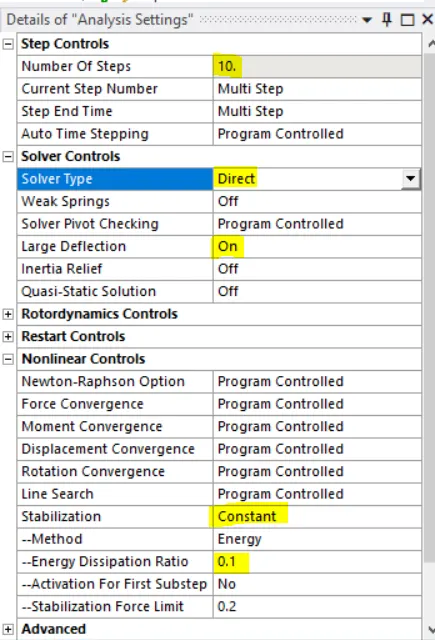
- Given below is the Analysis settings :
Result :
CASE 1 :
Equivalent Stress :
| Aluminium Alloy 1199 | 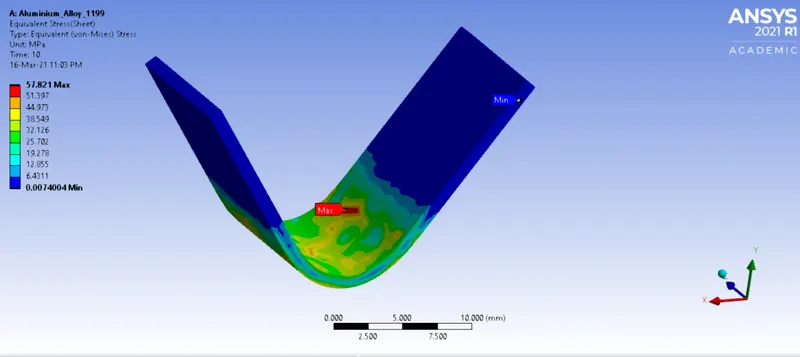 |
| Copper Alloy NL | 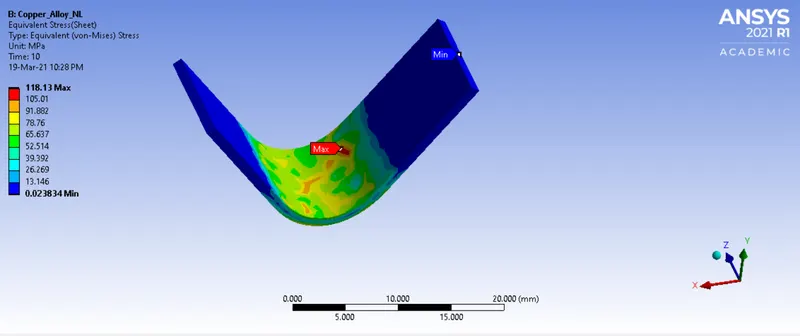 |
| Magnesium Alloy NL | 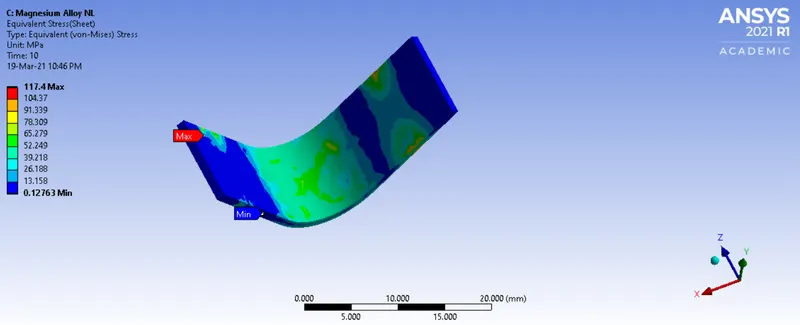 |
Total Directional Deformation in Y-direction :
| Aluminium Alloy 1199 | 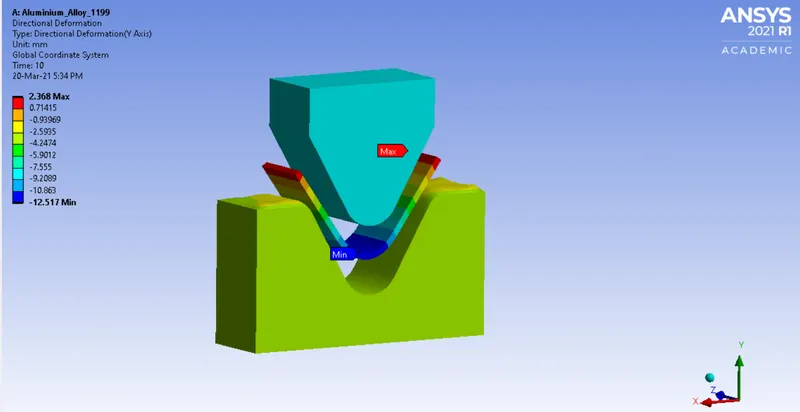 |
| Copper Alloy NL | 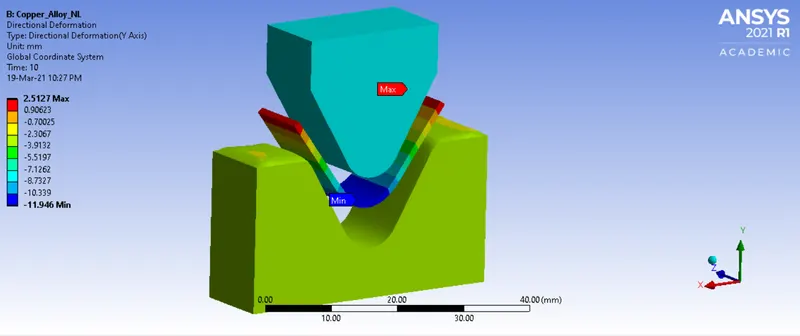 |
| Magnesium Alloy NL | 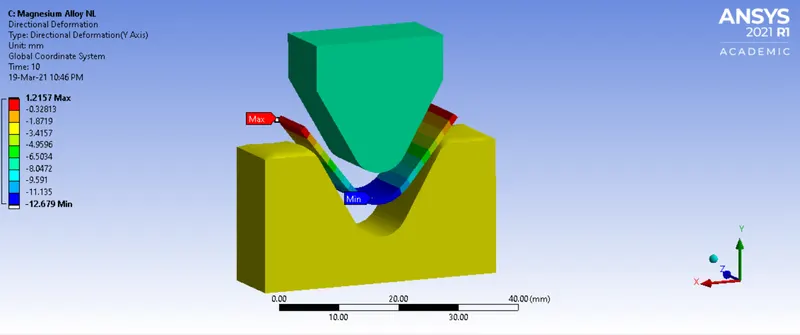 |
Since the Aluminium Alloy 1199 has the lowest Total Equivalent Stress of the three materials, so it is considered.
CASE 2 :
| Friction Coefficient | Total Equivalent Stress(MPa) | Total Equivalent Strain | Equivalent Stress on Sheet alone(MPa) | Directional Deformation(Y-axis) |
| 0.1 | 2.49E+5 | 1.2462 | 57.821 | 12.517 |
| 0.19 | 1.8641E+5 | 0.93412 | 58.8 | 12.382 |
CASE 3 :
Grid Dependency Test :
Here the mesh element size of the Sheet is reduced step by step within the Ansys License Limit. The analysis is done using parametric method to reduce individual simulation time.
| Element Size(mm) | Total Equivalent Stress(MPa) | Total Equivalent Strain | Equivalent Stress on Sheet alone(MPa) | Directional Deformation(Y-axis) |
| 1 | 2.49E+5 | 1.2462 | 57.821 | 12.617 |
| 0.8 | 2.43E+5 | 1.2160 | 61.313 | 12.56 |
| 0.6 | 2.23E+5 | 1.1193 | 77.559 | 12.420 |
As the mesh gets more refined the Equivalent Stress on Sheet is increasing because the simulation is getting more accurate when mesh size is decreased.