Week 3 To perform stress analysis of sheet metal bending for 3 different material of sheet in ANSYS
OBJECTIVE:- To perform stress analysis of sheet metal bending for 3 different material of sheet in ANSYS
Case 1:Aluminium Alloy 1199, Copper Alloy NL and Magnesium Alloy NL. Find out the Equivalent stress, Equivalent elastic strain and Total Deformation in the Y direction and compare the results for the three materials.
PROCEDURE:-
FOR ALUMINIUM ALLOY 1199
- Open Ansys Workbench and choose static structural.
- In the Engineering data, let the material be structural steel with default values and also Aluminium Alloy non-linear from General non-linear material but change its value of Youngs Modulus to 62000 MPa, Yield Strength to 140 MPa and Tangent Modulus to 209.46 MPa
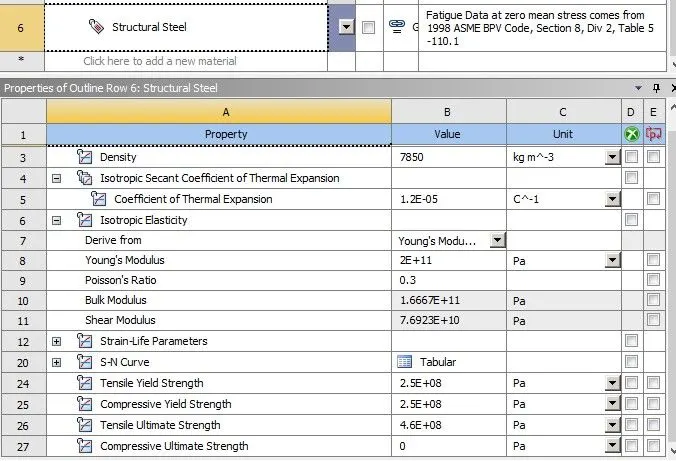
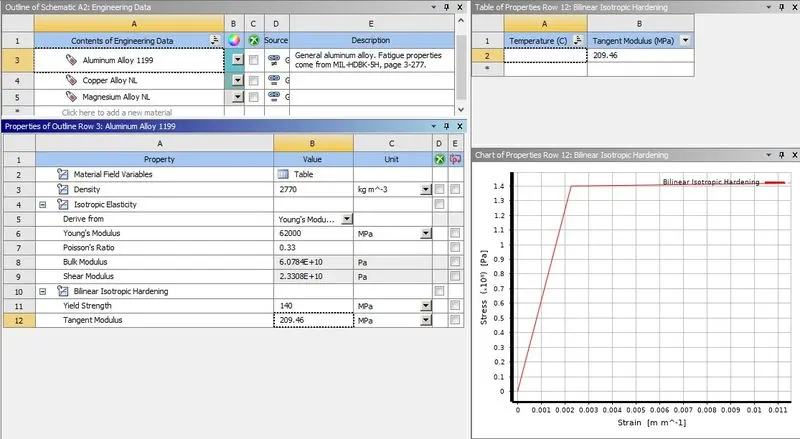
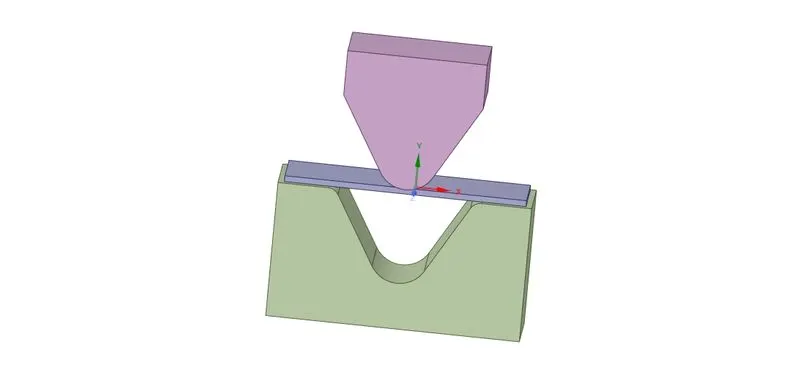
- For the geometry, right-click and import the given Sheet_Bending.x_t and open the space claim to check it.
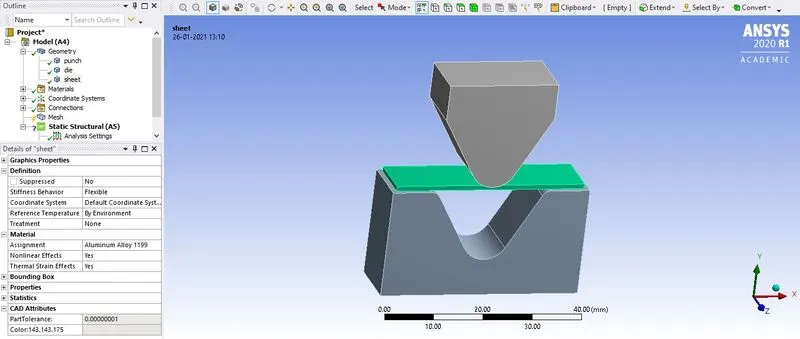
- Now in the workbench goto Model -> Edit, in the model window check the Geometry for the material and assign Structural Steel to punch and die part and Al Alloy 1199 to the sheet.
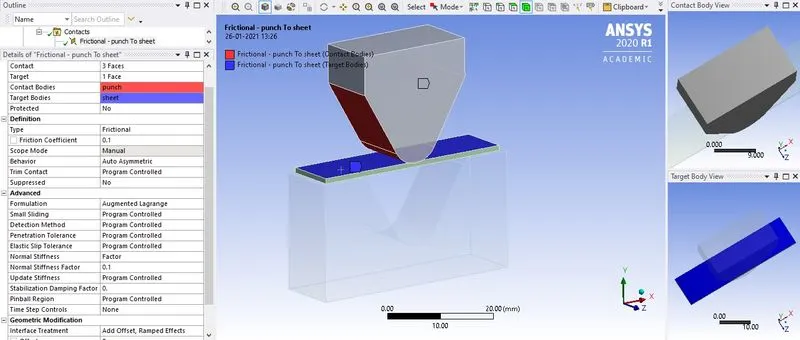
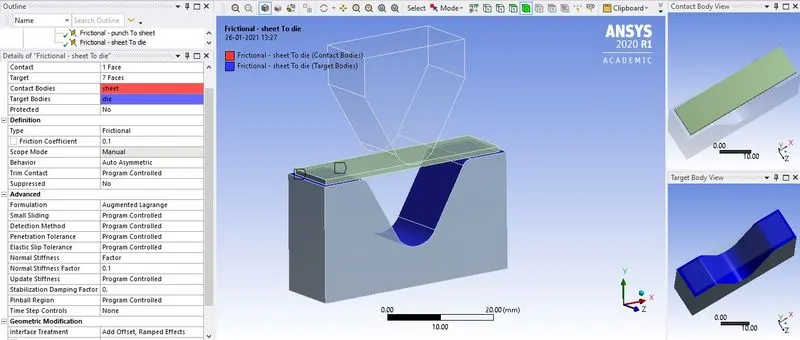
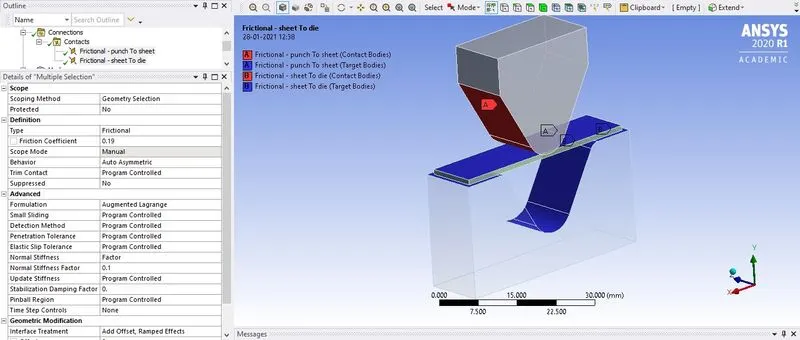
- Now for contacts, delete all the available contact and insert 2 different manual contact region between punch and sheet (punch being the contact and sheet being the target) and sheet and die (sheet being the contact and die being the target) choose required faces and for both the contacts Type= Frictional and Friction coefficient= 0.1, Formulation= Augmented Lagrange, Normal Stiffness= Factor, Normal stiffness factor= 0.1 and Interface Treatment= Add Offset, Ramped Effects.
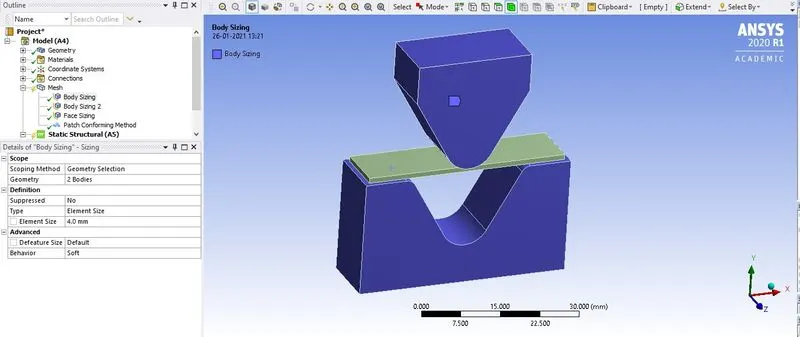
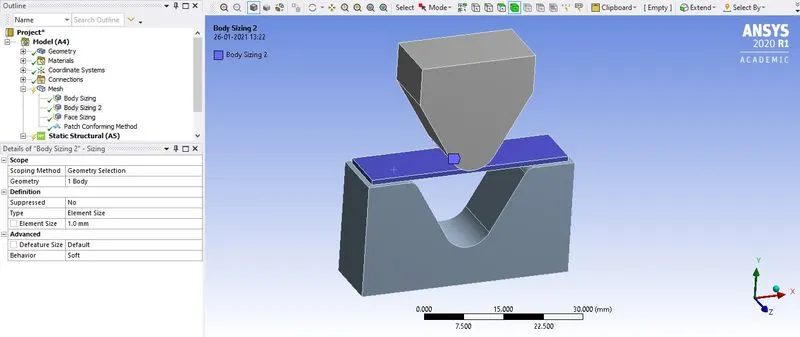
- For mesh, the punch and die body will have 4mm mesh while the sheet body will have 1mm mesh also the face of the punch and die are sized to 1mm and only the sheet will have tetrahedron elements method. Click on generate mesh to mesh the component.
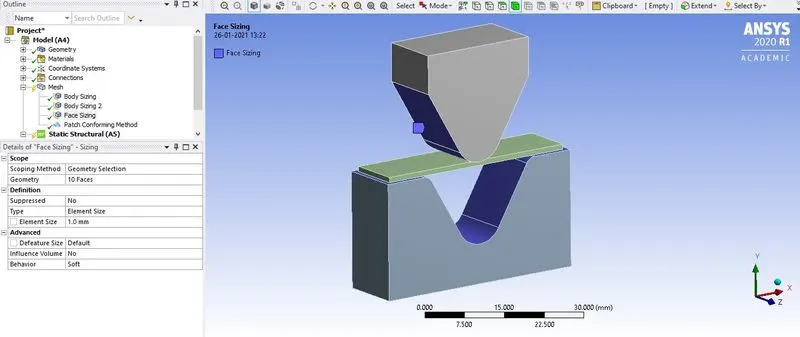
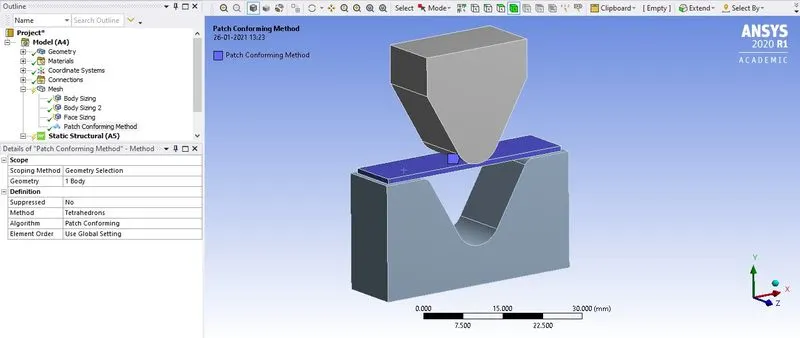
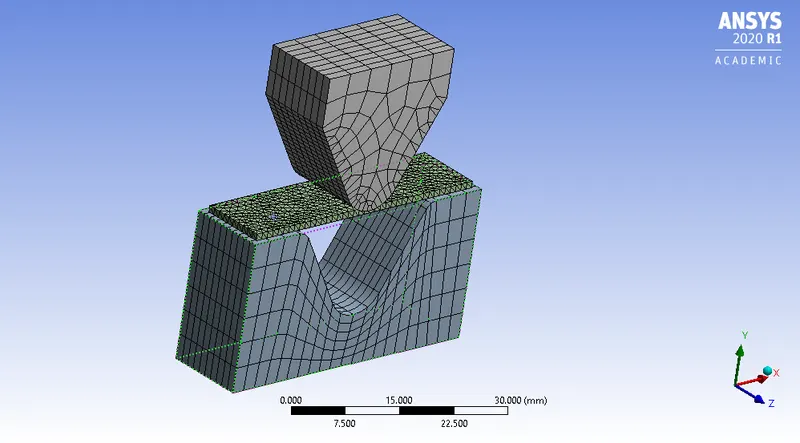
- For analysis setting, Number of steps will be 10 (select all the steps), Solver type= Direct, Large deflection= On, Stabilization= Constant, Method= Energy and Energy Dissipation Ratio= 0.1
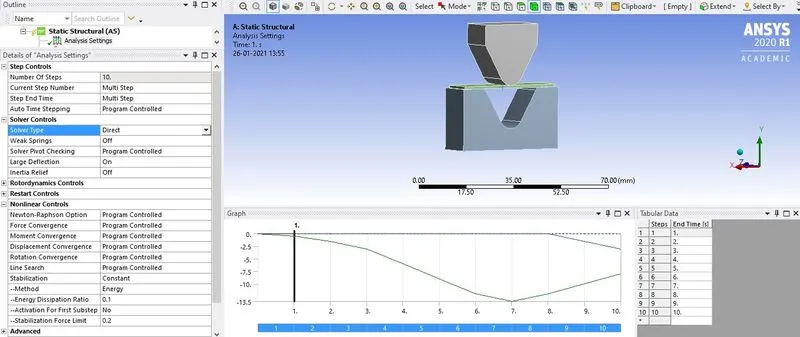
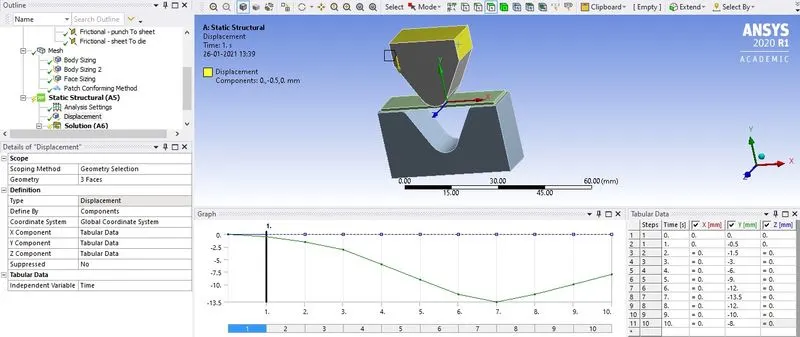
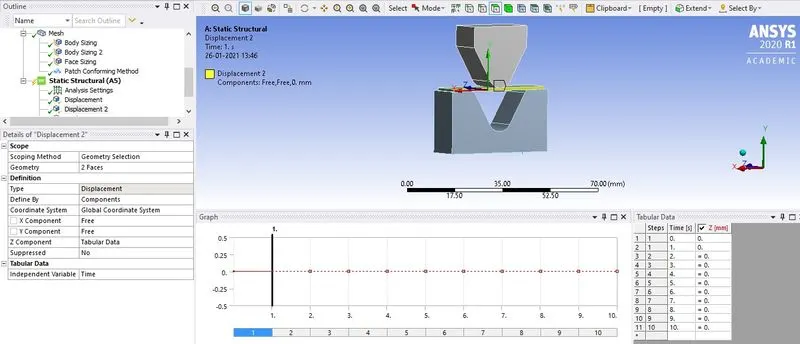
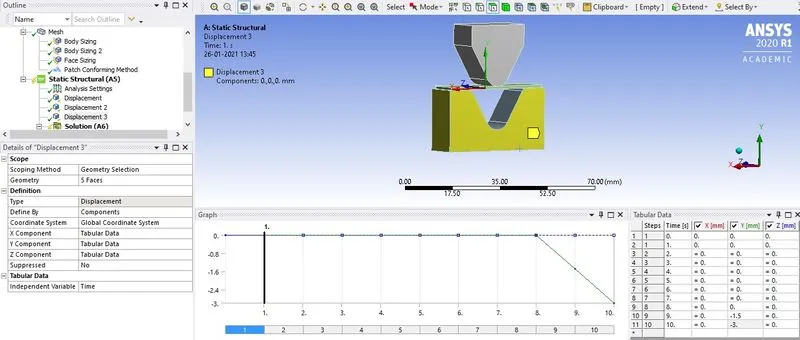
- For load type, 3 different types of displacement will be applied
- 1st will be for the punch, for all the 3 axes will be provided with tabular data out of which the X and Z axis will be 0 for all the steps but Y-axis will have values of displacement.
- 2nd will be for the sheet as the deformation will be in only XY plane to restrict any motion for the Z-axis displacement in the tabular format will be provided for all the steps it will be 0.
- 3rd will be for die, as throughout the bending process the die needs to be constant and after bending it should retract a bit to provide that displacement all the 3 axes of the will have tabular data and value of 0 but to provide retract the Y-axis will have -1.5 and -3 for the last 2 steps.
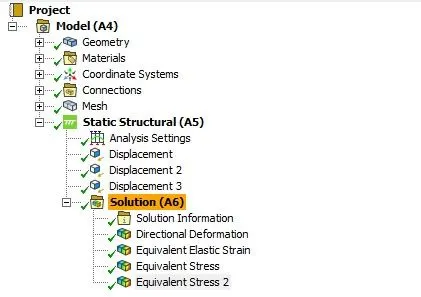
- Provide the required output request for the solution like total deformation in the y-direction, Von-Mises stress and Equivalent elastic strain and click on solve.
FOR COPPER ALLOY
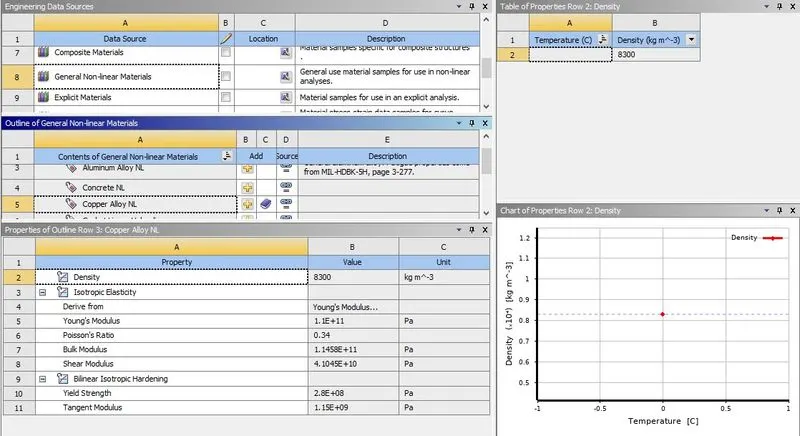
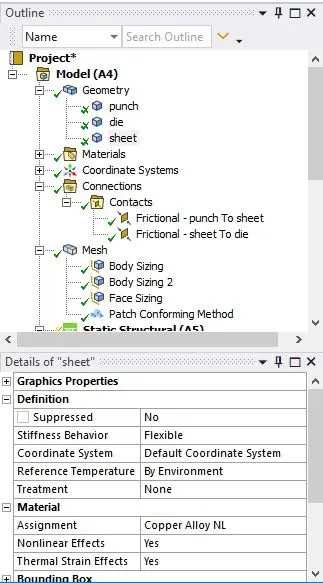
- All the above setting will remain the same only the in the Engineering data, let the material be structural steel with default values and also Copper Alloy non-linear from General non-linear material and in the model edit the material type for the sheet will be changed to Copper Alloy Non-Linear.
FOR MAGNESIUM ALLOY
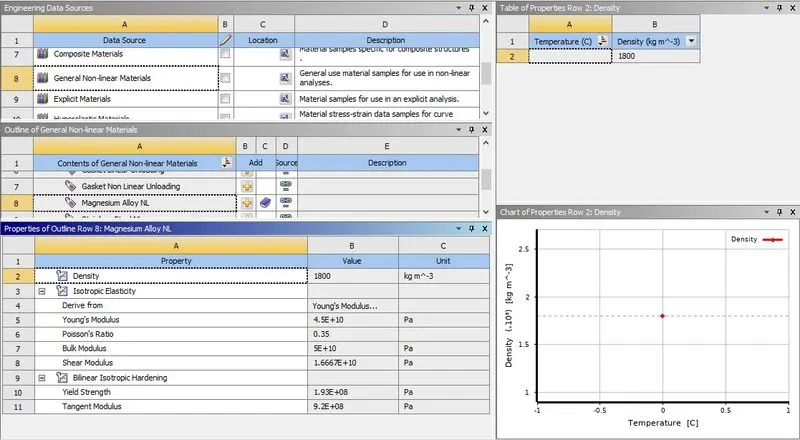
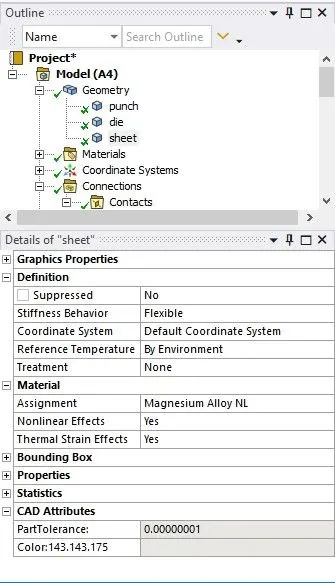
- All the above setting will remain the same only the in the Engineering data, let the material be structural steel with default values and also Magnesium Alloy non-linear from General non-linear material and in the model edit the material type for the sheet will be changed to Magnesium Alloy Non-Linear.
RESULT:-
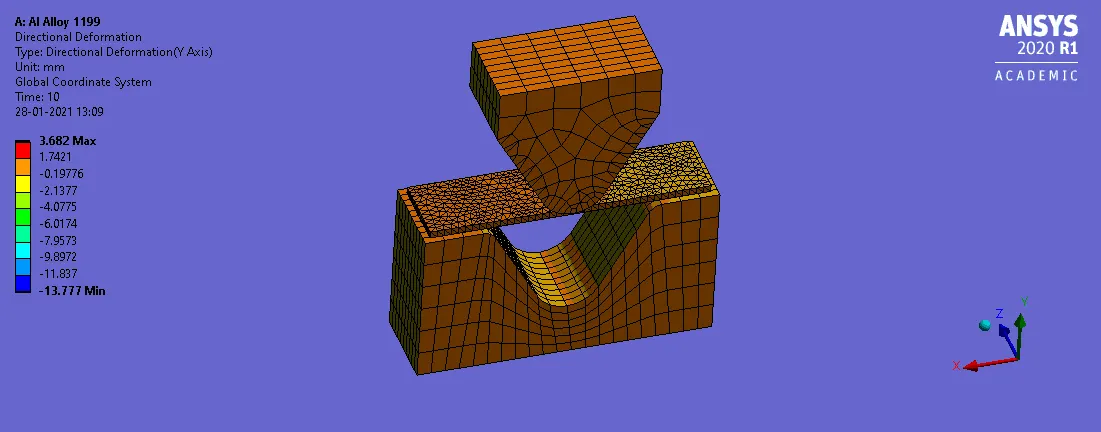
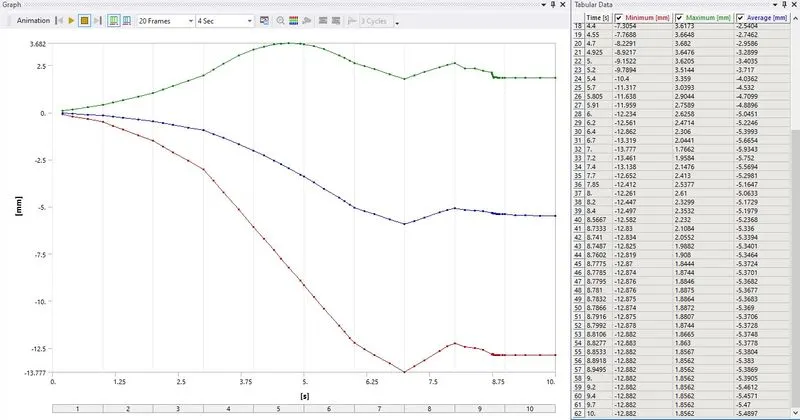
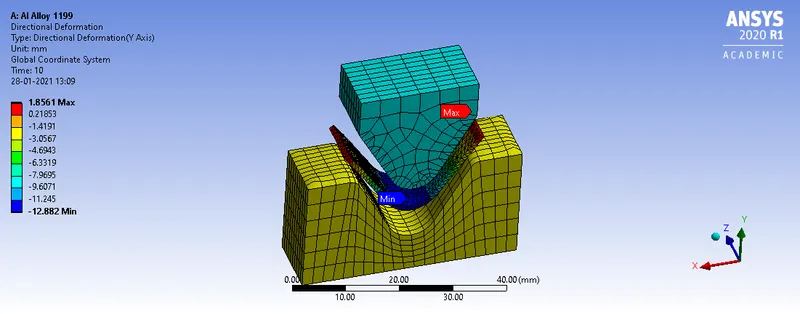
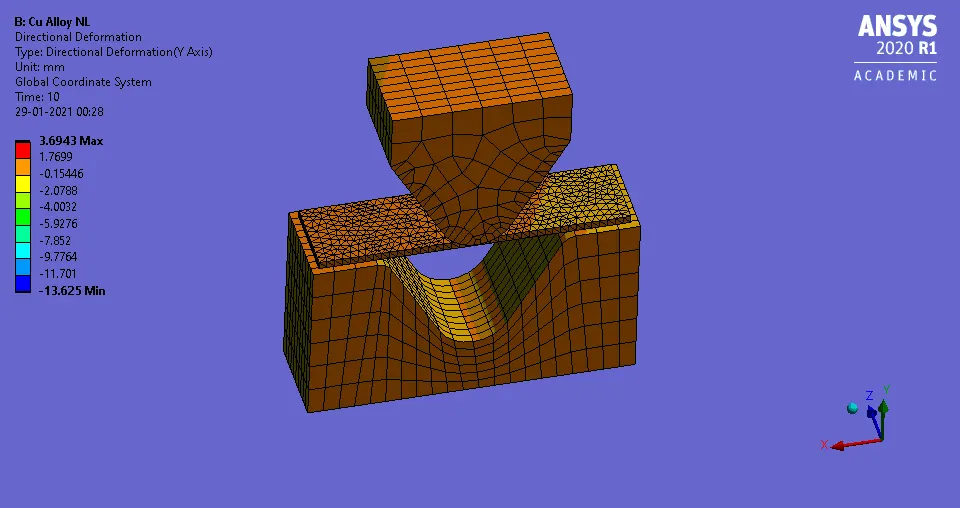
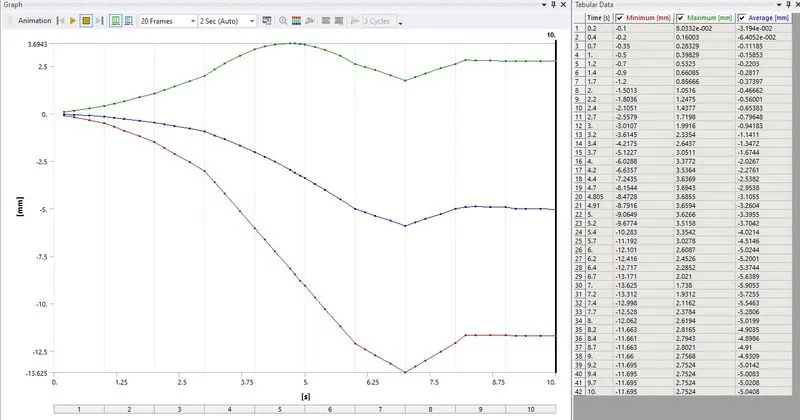
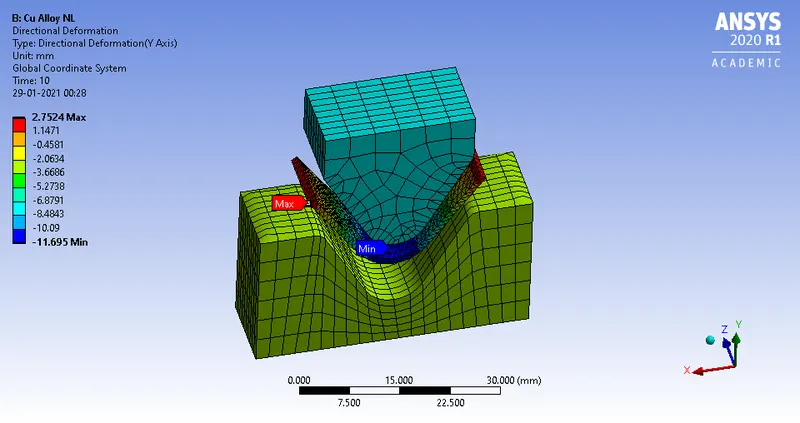
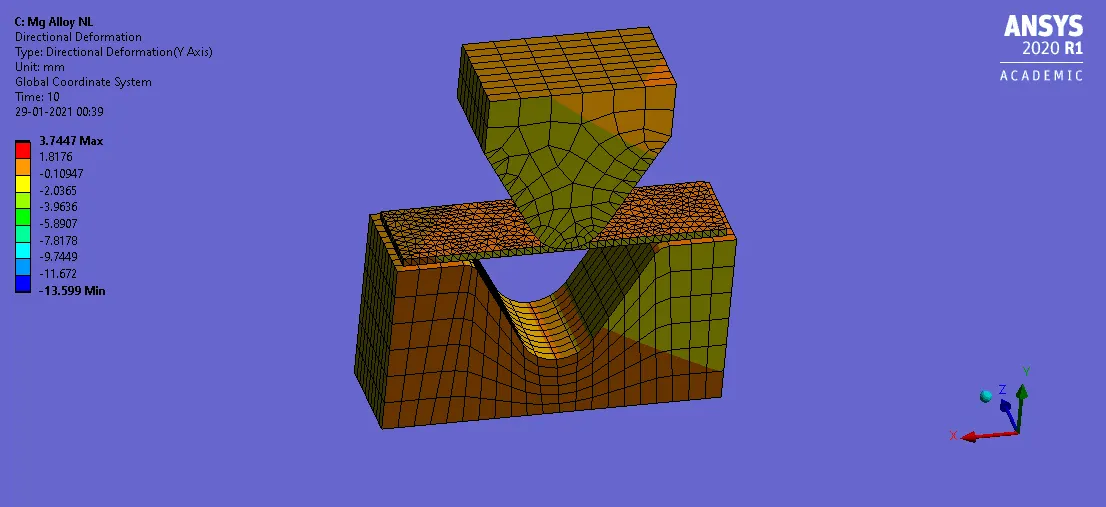
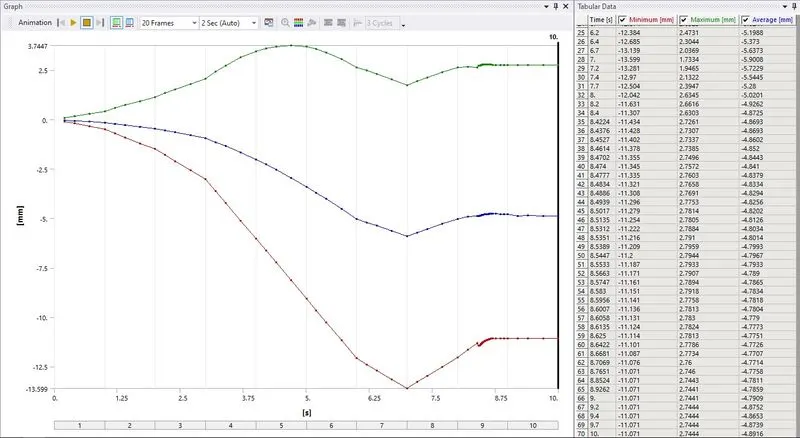
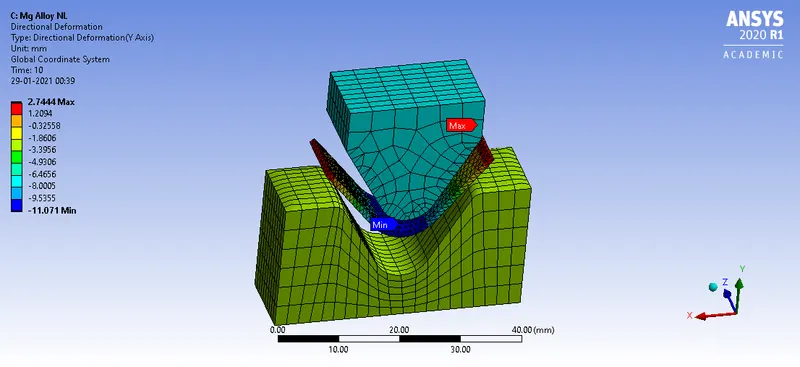
Y- Directional Deformation
Aluminium Alloy 1199
Copper Alloy NL
Magnesium Alloy NL
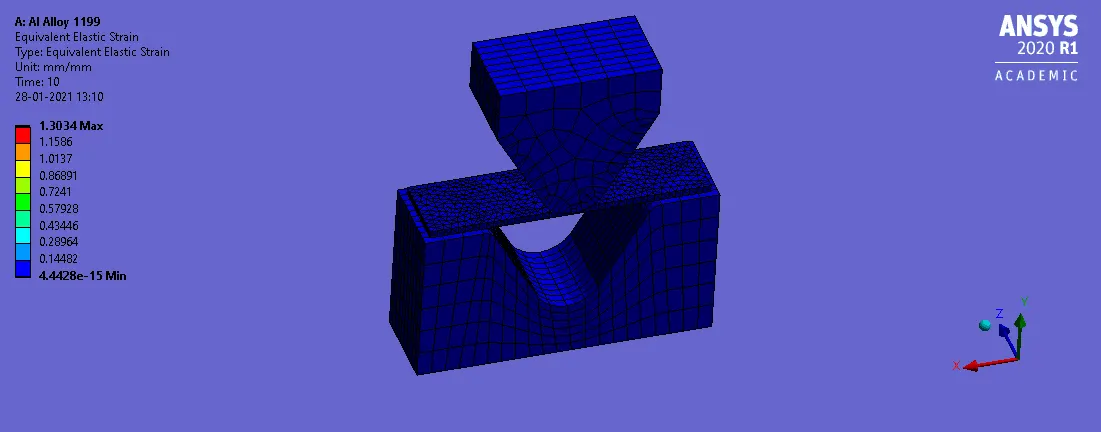
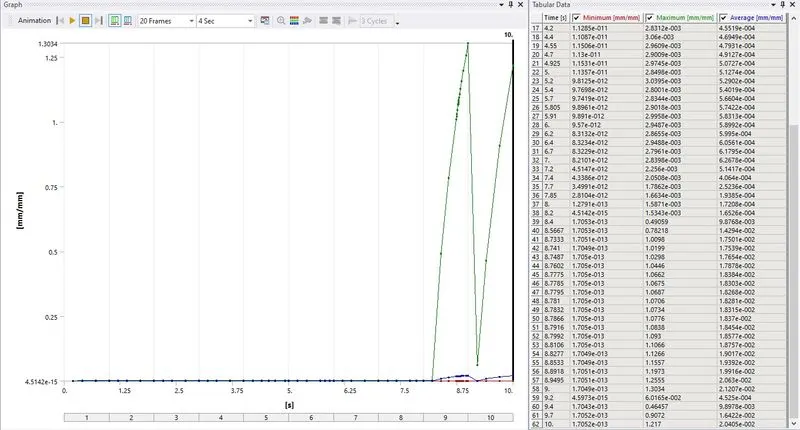
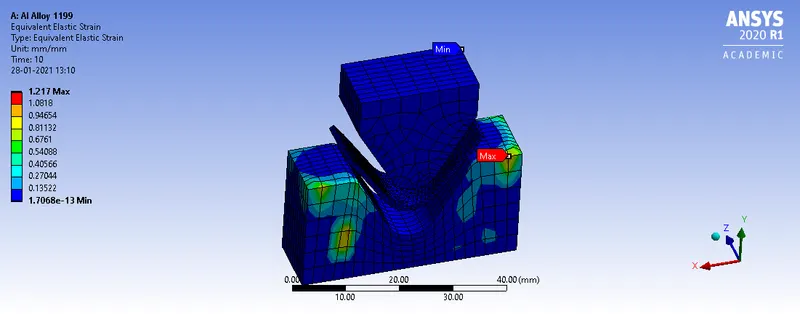
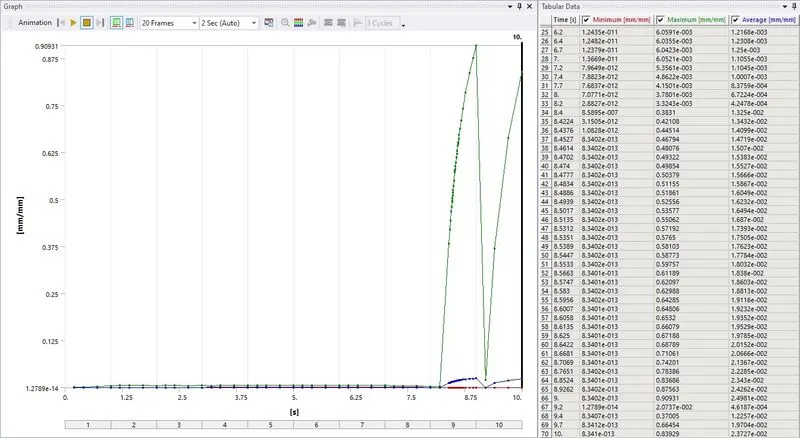
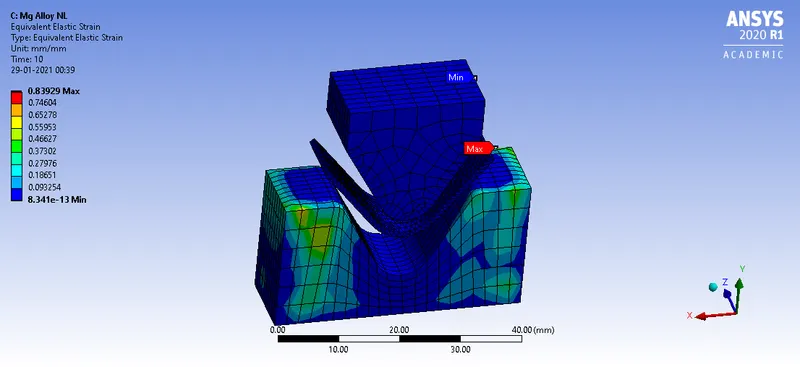
Equivalent Elastic Strain
Aluminium Alloy 1199
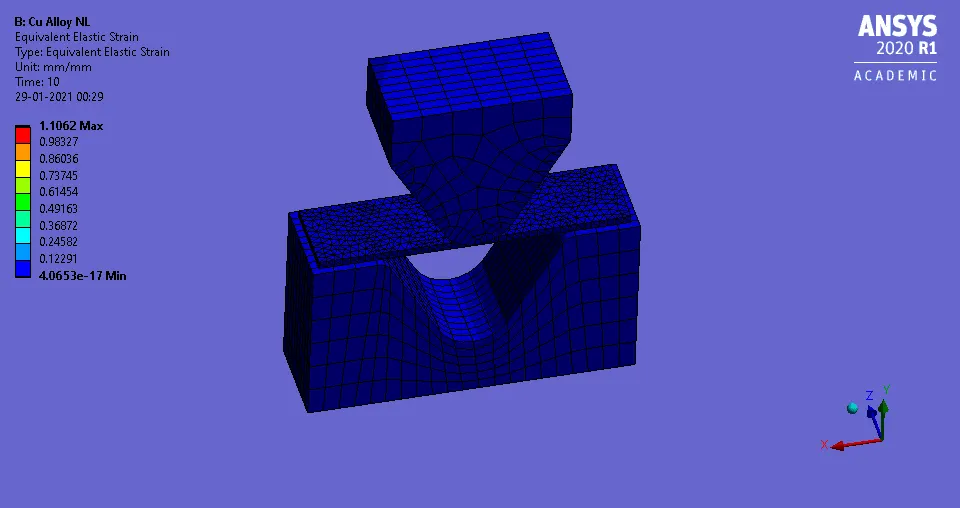
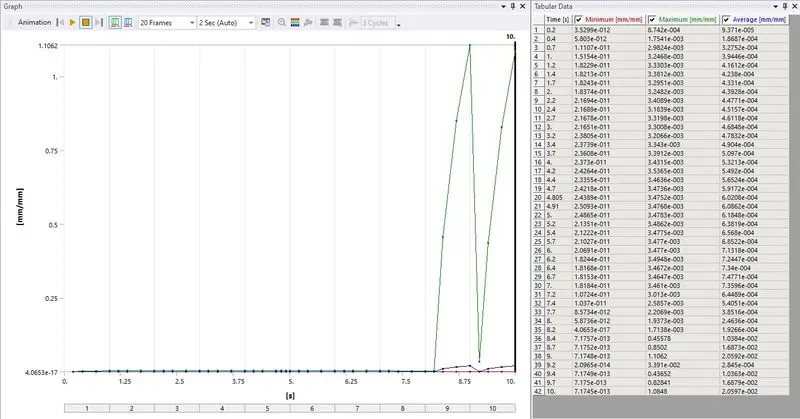
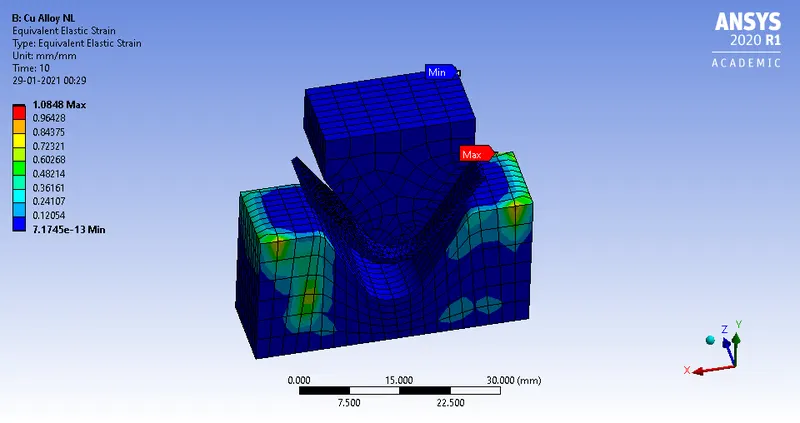
Copper Alloy NL
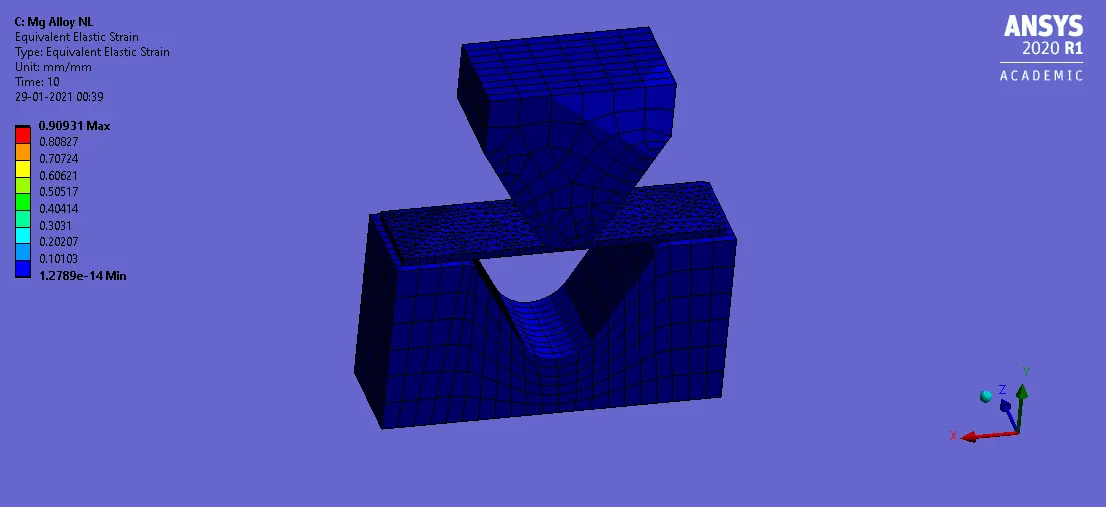
Magnesium Alloy NL
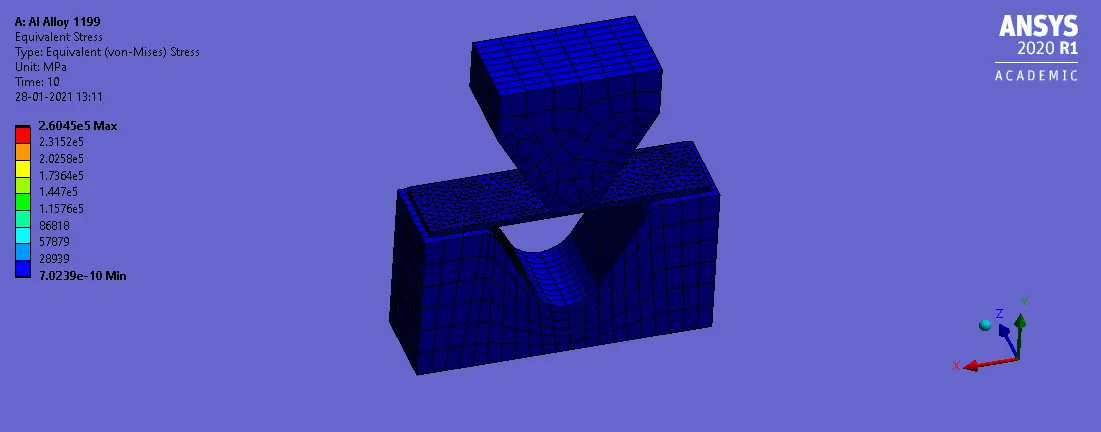
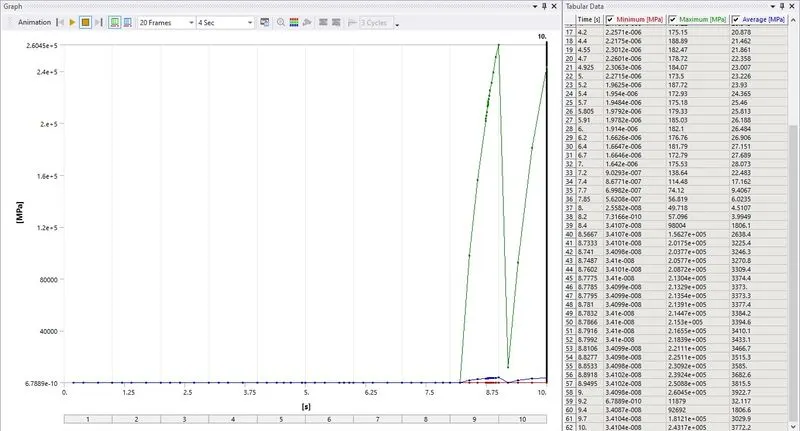
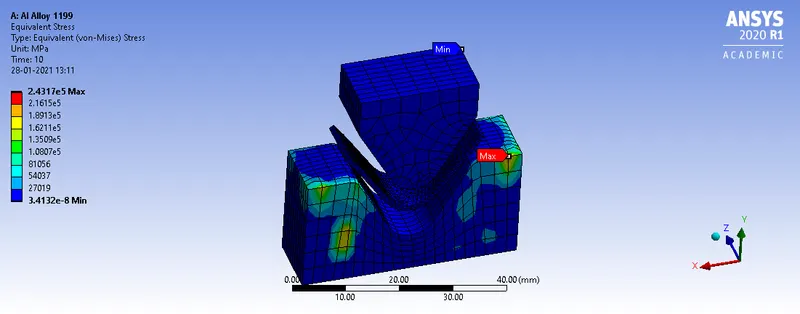
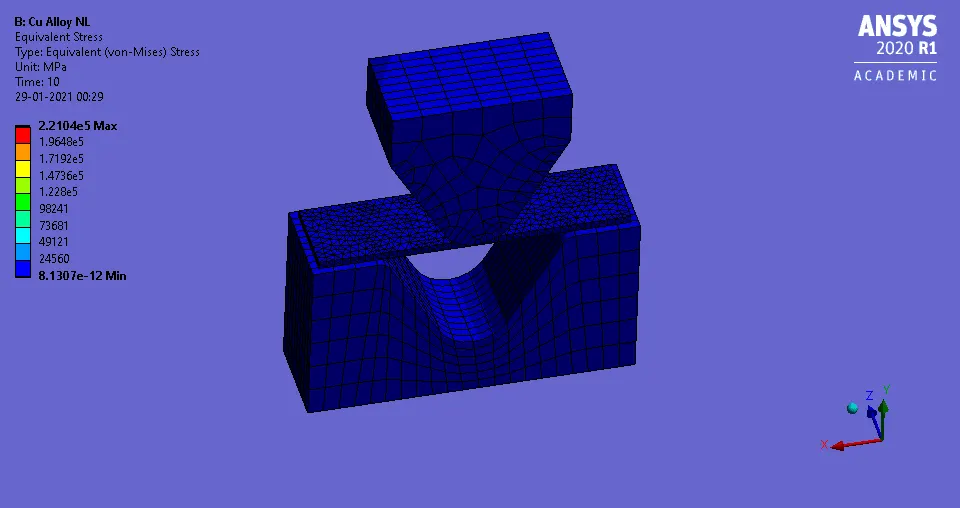
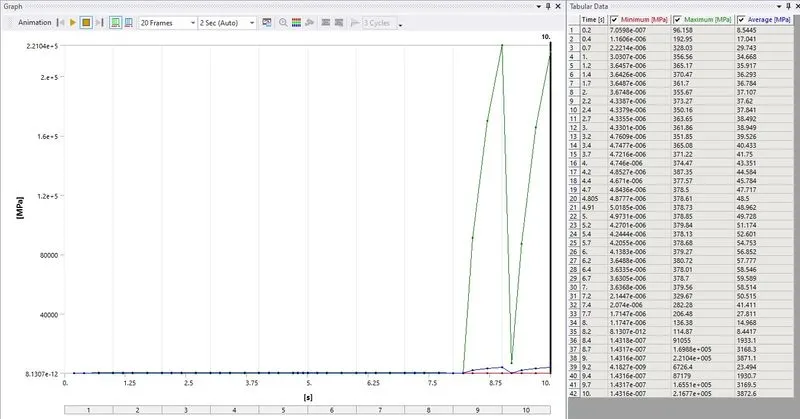
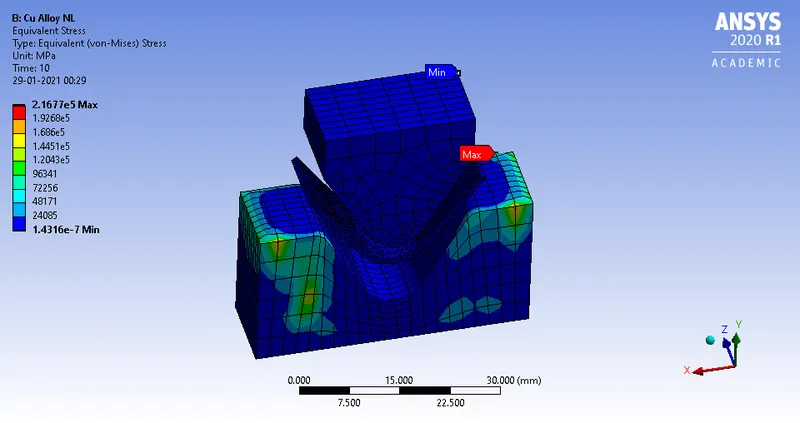
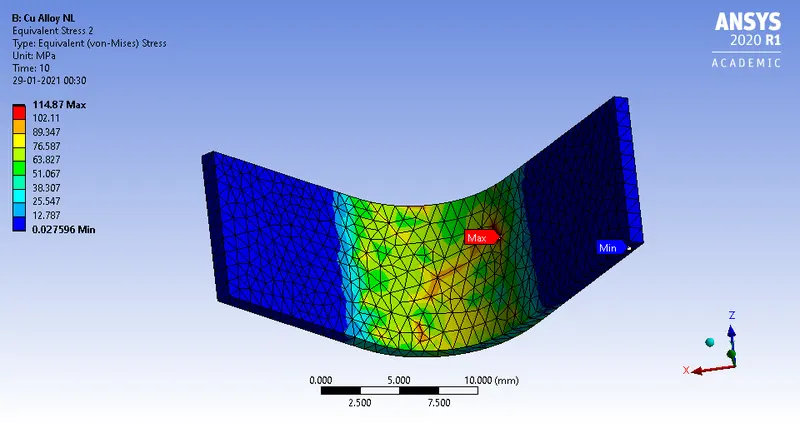
Equivalent Elastic Stress
Aluminium Alloy 1199
Copper Alloy NL
Magnesium Alloy NL
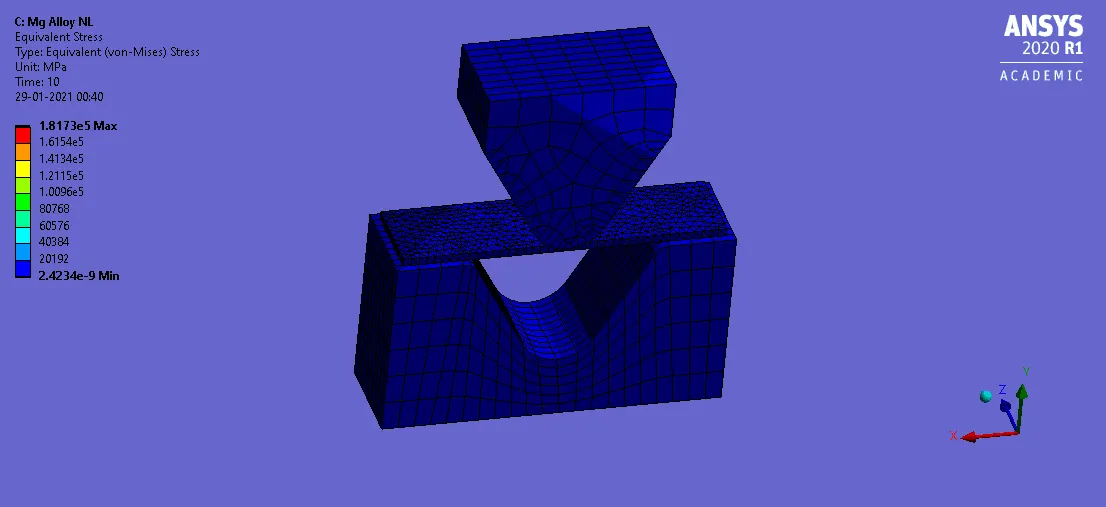
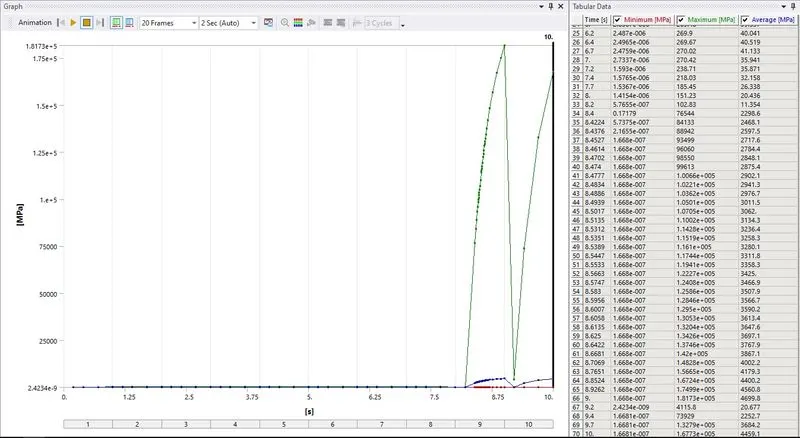
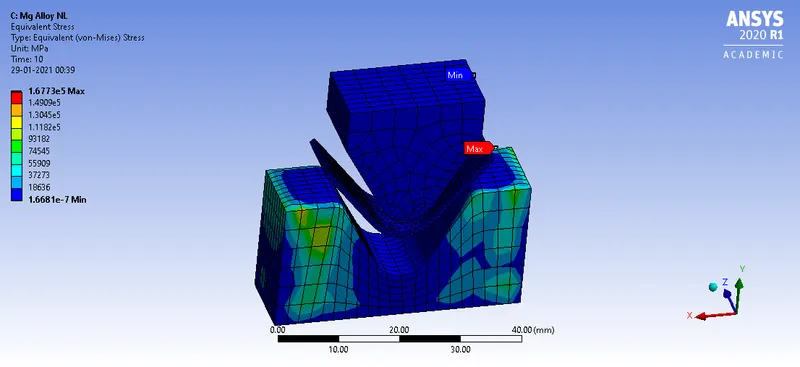
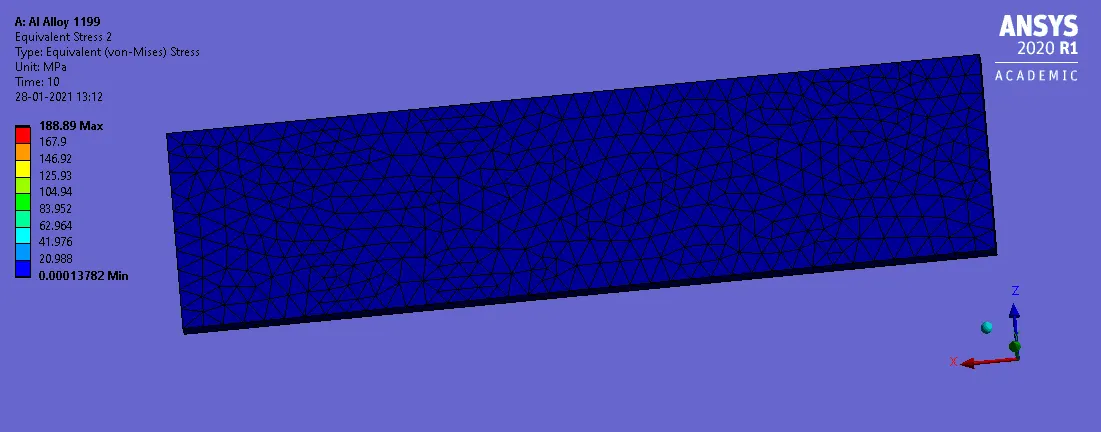
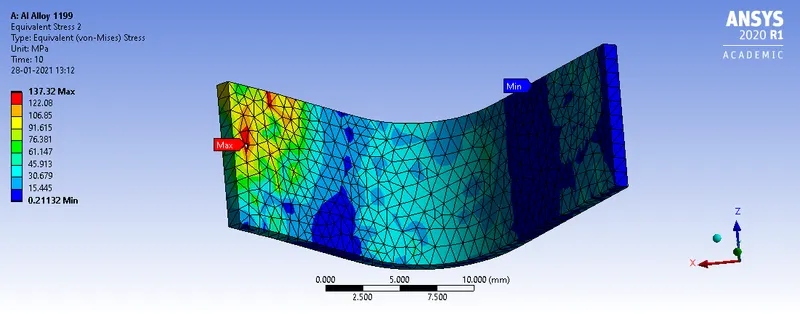
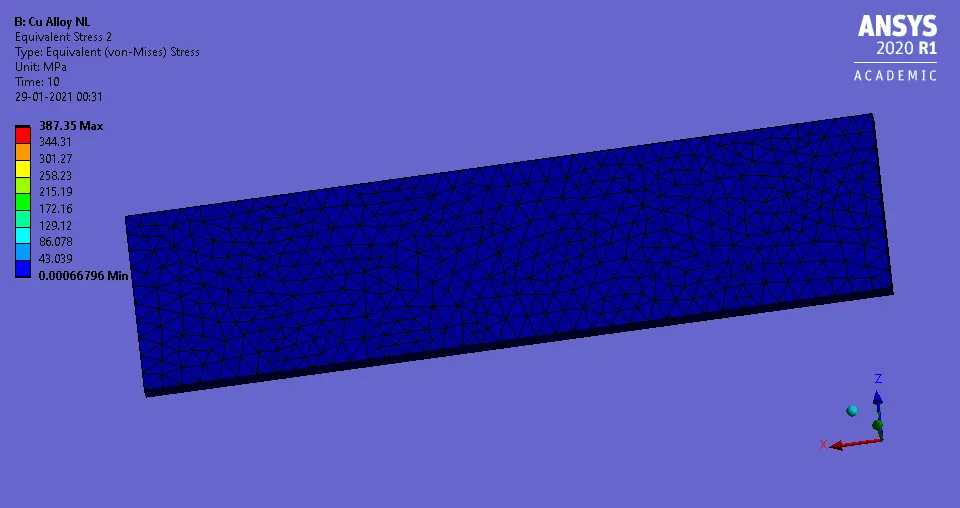
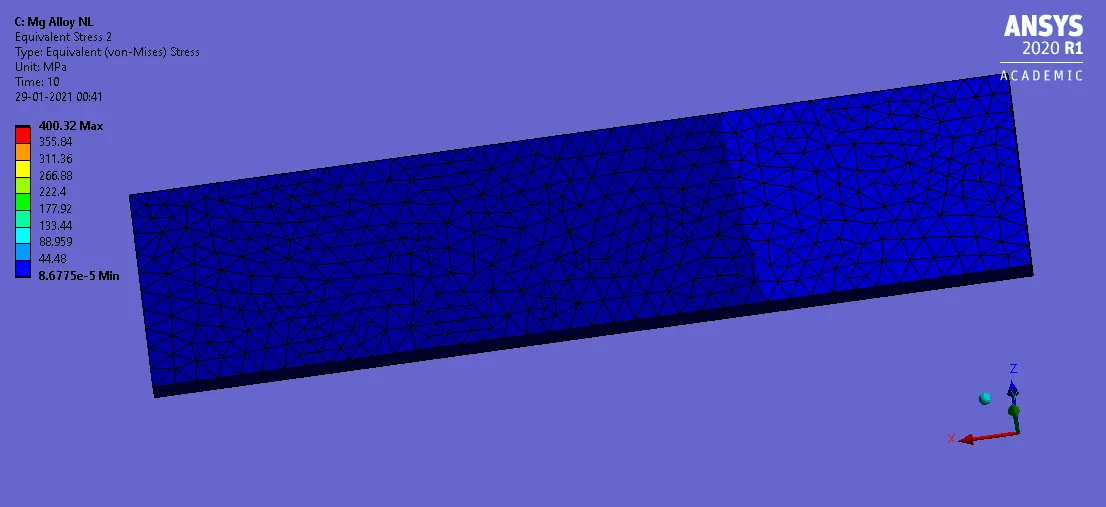
Equivalent Elastic Stress on Plate
Aluminium Alloy 1199
Copper Alloy NL
Magnesium Alloy NL
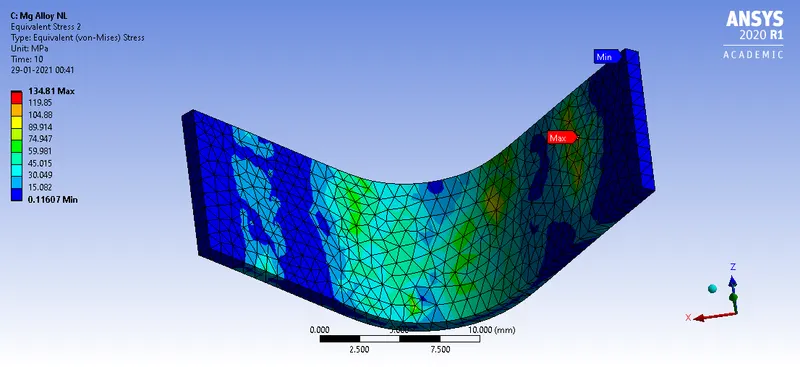
| Material Type | Max. Y-Directional Deformation (mm) | Max. Equivalent Strain (mm/mm) | Max. Equivalent Stress (Von-Mises) (MPa) | Max. Equivalent Stress On Plate (MPa) |
| Al Alloy 1199 | 3.682 | 1.3034 | 2.60E+05 | 188.89 |
| Cu Alloy NL | 3.6943 | 1.1062 | 2.21E+05 | 387.35 |
| Mg Alloy NL | 3.7447 | 0.90931 | 1.82E+05 | 400.32 |
So it can be observed that from the different nonlinear material type, the sheet of Al alloy 1199 experience less stress and Mg alloy experience the highest stress while in total the component with Al Alloy experience the max stress and strain and Mg alloy the least, the directional deformation in Y-axis is least in case of Al alloy and highest in case of Mg alloy.
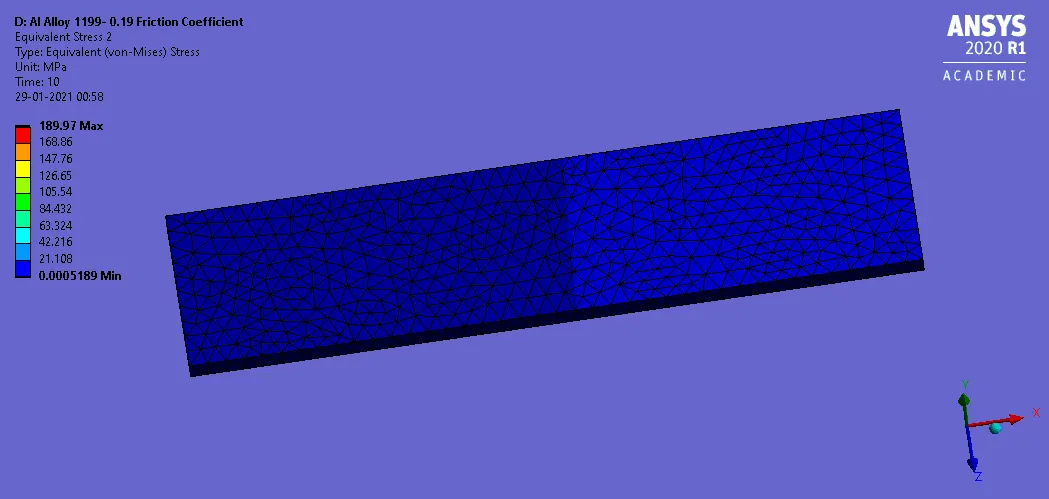
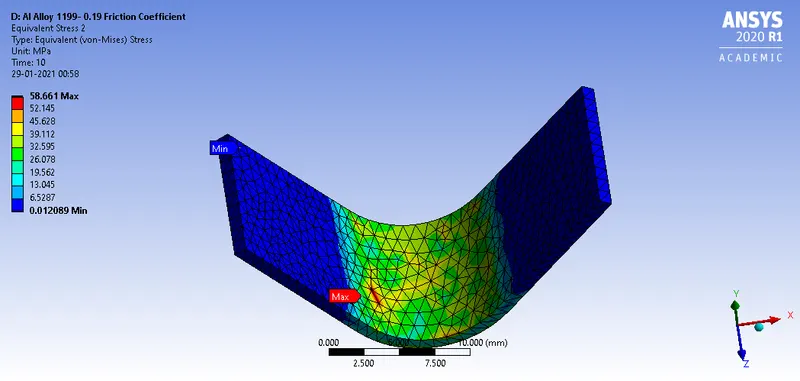
Case 2: With the material as Aluminium Alloy, change the friction coefficient to 0.19 and run the analysis as mentioned in Case 1. Compare the results with that in case 1.
- For case 2 all the setting will remain the same as of the Aluminium Alloy 1199 of case 1 while the material for sheet being Aluminium Alloy 1199 in the contact for both punch to sheet and sheet to die, change the coefficient of friction to 0.19
RESULT:-
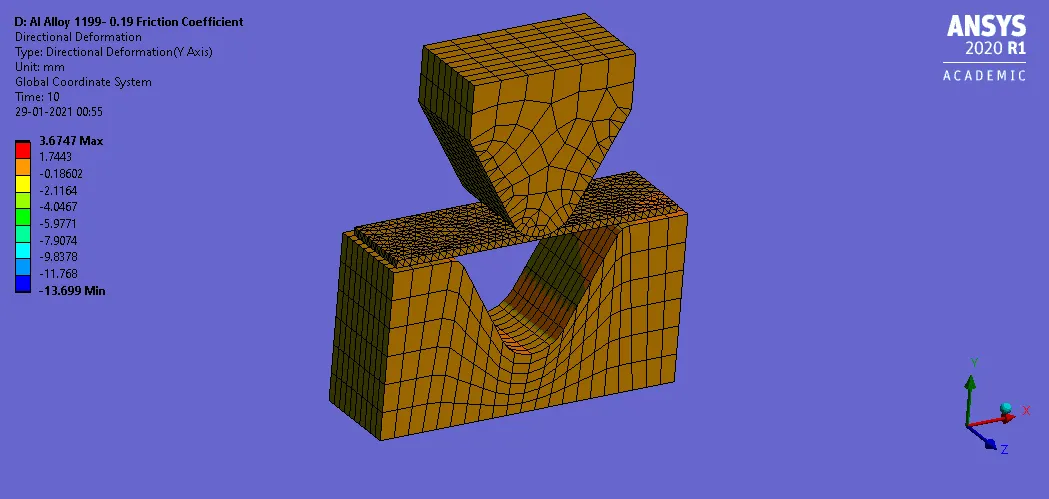
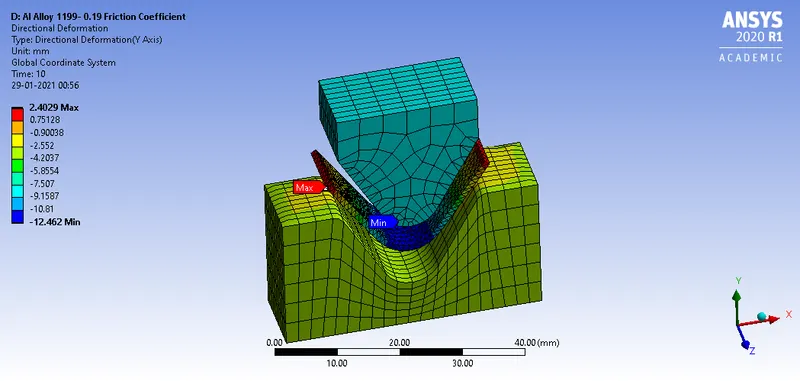
Aluminium Alloy 1199 with Friction Coefficient 0.19
Y- Directional Deformation
Equivalent Elastic Strain
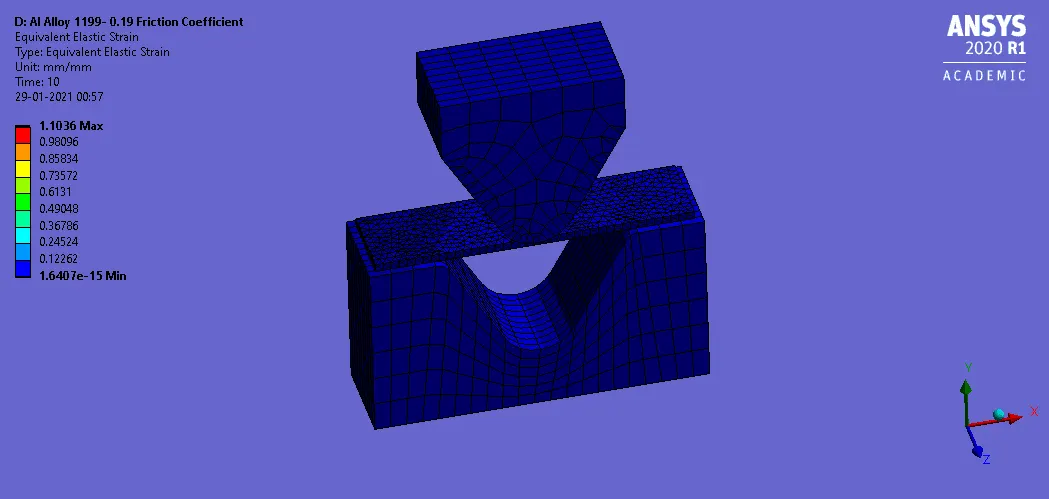
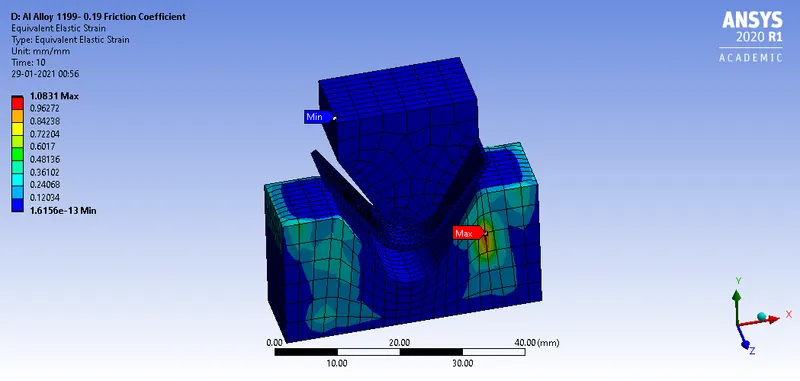
Equivalent Elastic Stress
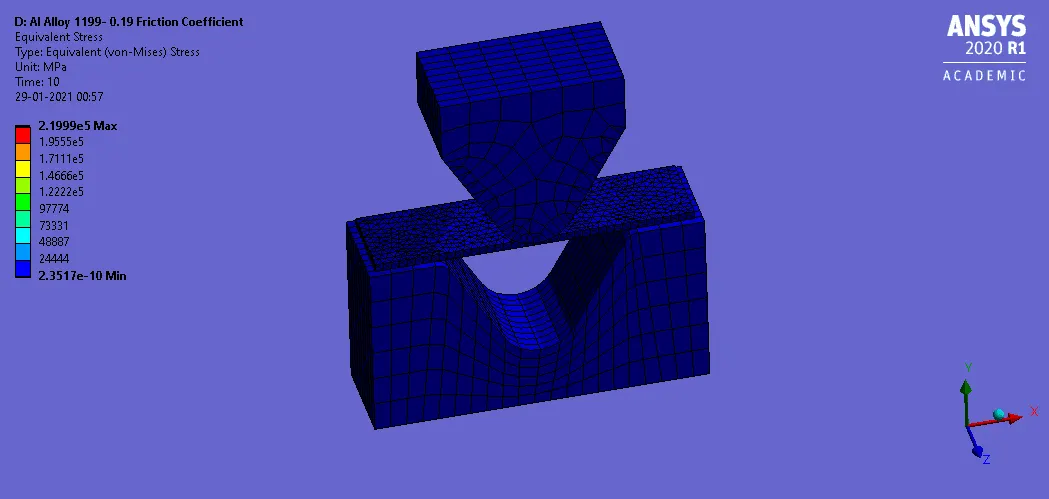
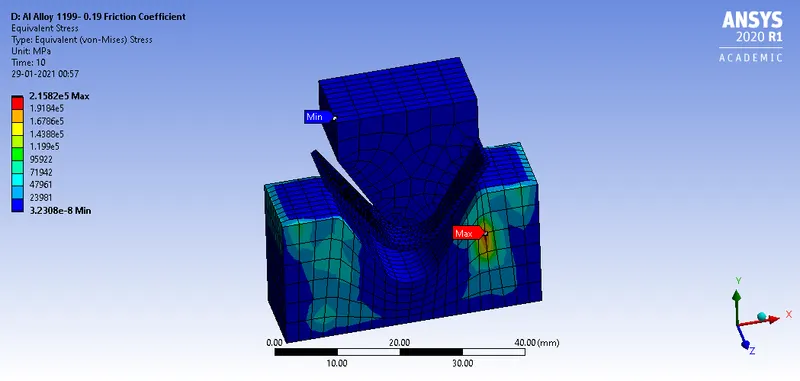
Equivalent Elastic Stress on Plate
| Material Type | Friction Coefficient | Max. Y-Directional Deformation (mm) | Max. Equivalent Strain (mm/mm) | Max. Equivalent Stress (Von-Mises) (MPa) | Max. Equivalent Stress On Plate (MPa) |
| Al Alloy 1199 | 0.1 | 3.682 | 1.3034 | 2.60E+05 | 188.89 |
| Al Alloy 1199 | 0.19 | 3.6747 | 1.1036 | 2.20E+05 | 189.97 |
So it can be observed that the Al alloy 1199 for the friction coefficient 0.19 experience less directional deformation in the y-axis, strain, stress in comparison to the 0.1 friction coefficient.
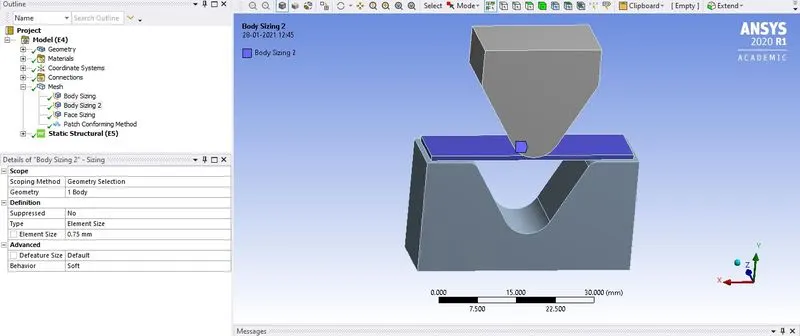
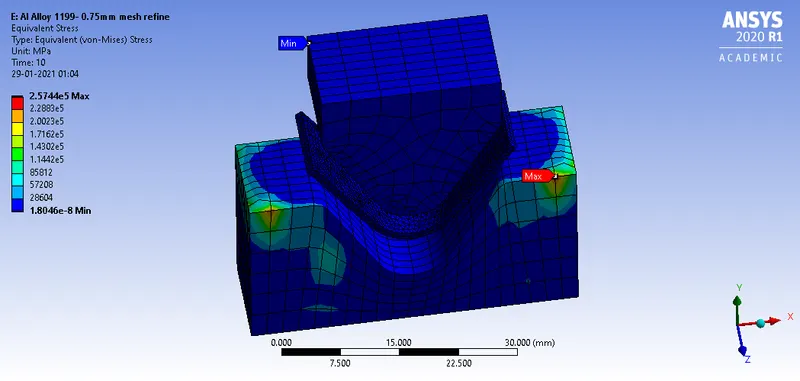
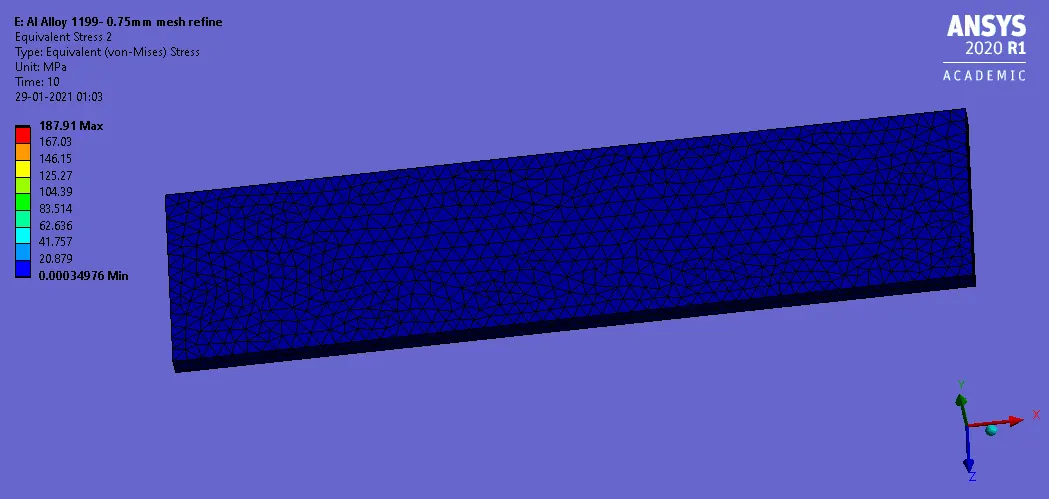
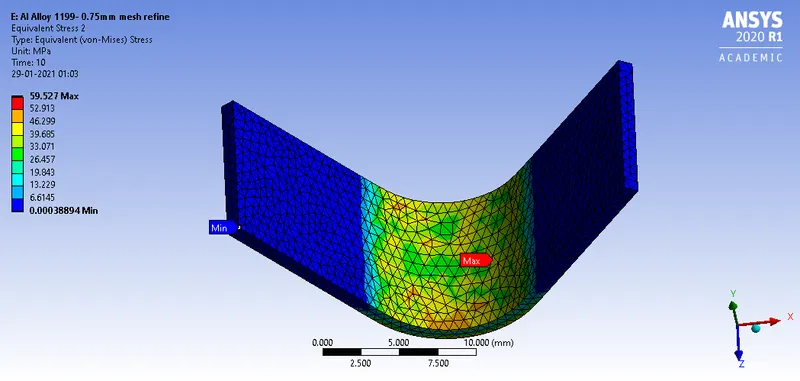
Case 3: Refine the mesh on the plate such that it doesn't cross the academic limit. With Aluminium alloy as material, run the analysis as in Case 1 and compare the results.
- For Case 3 all the setting will remain the same as of the Aluminium Alloy 1199 of case 1 while the material for sheet being Aluminium Alloy 1199 in the mesh the element size of the sheet will be changed to 0.75mm.
RESULT:-
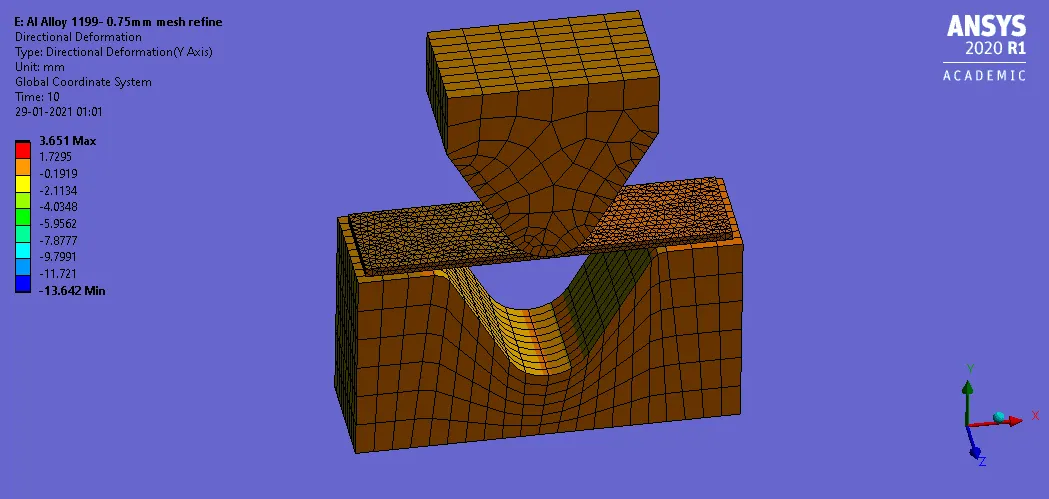
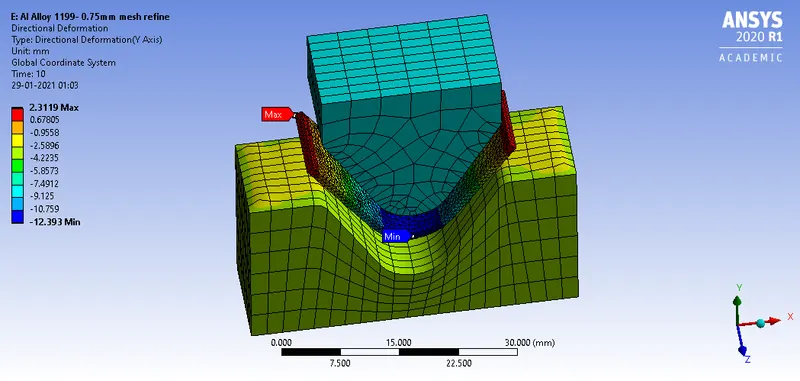
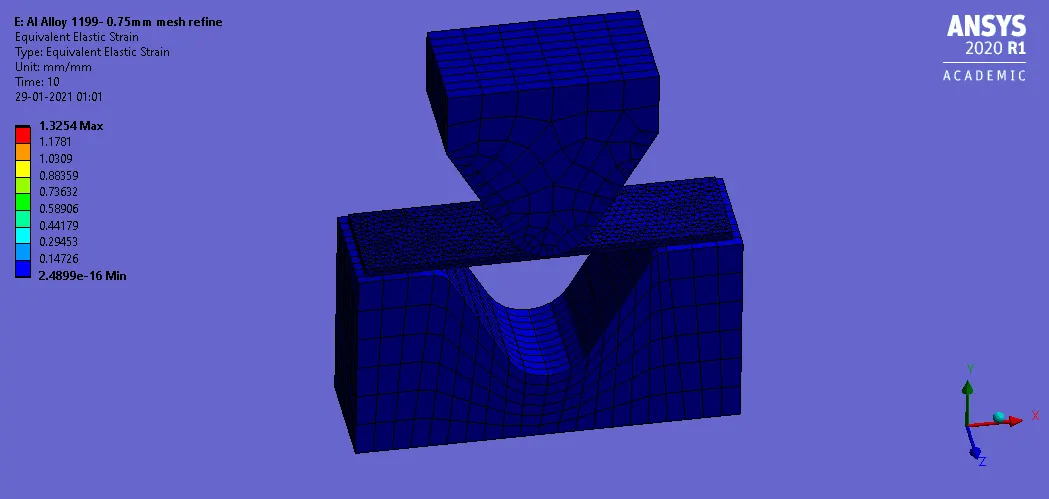
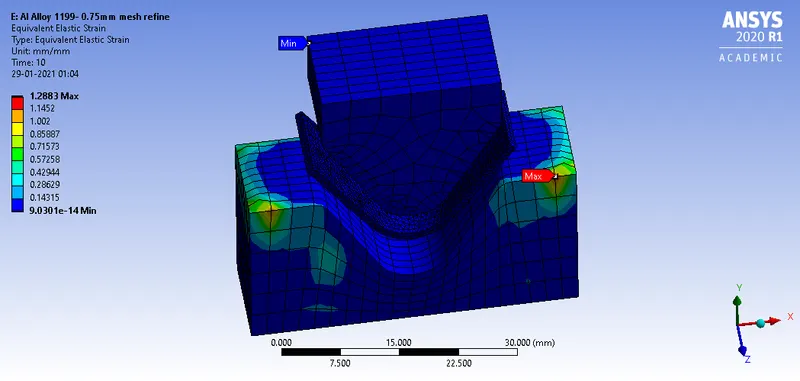
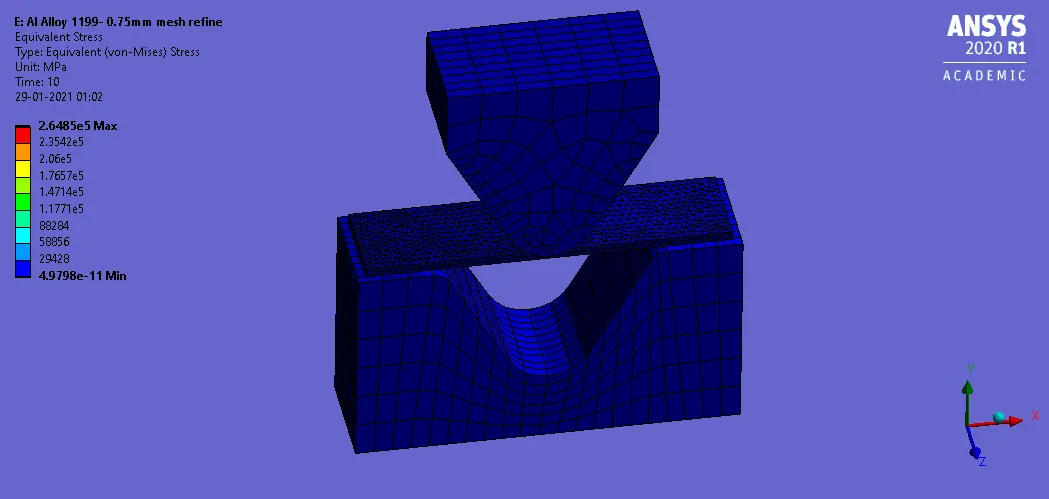
Aluminium Alloy 1199 with Sheet Element Mesh Size 0.75mm
Y- Directional Deformation
Equivalent Elastic Strain
Equivalent Elastic Stress
Equivalent Elastic Stress on Plate
| Material Type | Sheet Mesh Size (mm) | Max. Y-Directional Deformation (mm) | Max. Equivalent Strain (mm/mm) | Max. Equivalent Stress (Von-Mises) (MPa) | Max. Equivalent Stress On Plate (MPa) |
| Al Alloy 1199 | 1 | 3.682 | 1.3034 | 2.60E+05 | 188.89 |
| Al Alloy 1199 | 0.75 | 3.651 | 1.3254 | 2.65E+05 | 187.91 |
So it can be observed by changing the element mesh size from 1mm to 0.75mm for the plate the accuracy of the result increases.
CONCLUSION:-
So by completing the analysis it can be inferred that increasing the mesh size of the plate yields more accurate result while increasing the friction coefficient decreases the result value and from the three material Al alloy 1199 will be the suitable material.
Simulation Files- https://drive.google.com/file/d/19R0UJ0CJOQbKxT8bbLt_ulknOZARkSCq/view?usp=sharing