Week-3 Challenge: ADVISOR Tool
ADVISOR TOOL
QUESTION:
- For the EV_defaults in file, if cargo mass is 500 kg with all other default conditions, can the vehicle travel for 45 KM with FTP drive cycle?
Conclude your observations.
- In the above case, try changing battery capacity & repeat simulation.
- Perform gradeability test with PRIUS.
Compare your results in table & conclude.
Introduction to ADVISOR:
- Advanced Vehicle Simulator (ADVISOR) was first devel[1]oped in November 1994 at the National Renewable Energy Laboratory.
- It was designed as an analysis tool to assist the US Department of Energy (DOE) in developing technolongies for hybrid electric vehicles (HEV) through the Hybrid Electric Vehicle Propulsion System contracts with Ford, General Motors, and DaimlerChrysler.
- Its primary role is to highlight the system-level interactions of hybrid and electric vehicle components and their impacts on the vehicle performance and fuel economy.
- ADVISOR was first released publicly via the Internet (www.nrel.gov/transportation/analysis) in September 1998. The number of public users of the software tool has grown steadily from a small group of about 30 initial partners to a group of over 4500 individuals that have downloaded the software.
- The majority (68%) of ADVISOR users are members of industry while 29% are members of academia with the remaining 3% representing government entities.
- This large user community provides feedback necessary to improve the models and component data to be used within the models. Since first introduced, several updated versions of the software have been periodically distributed via the Internet.
- ADVISOR Version 3.2 is the latest version of the software. This paper will discuss the fundamental approach used to model vehicle systems in ADVISOR.
- A description of ADVISOR’s capabilities and limitations will be presented. ADVISOR has three types of power source models that can be included in a vehicle model.
- These include an internal combustion engine, a fuel cell system, and an energy storage system. The general modelling approach employed for each of these systems will be described briefly.
ADVISOR structure
- ADVISOR was created in the MATLAB/Simulink environment.
MATLAB provides an easy-to-use matrix-based programming environment for performing calculations while Simulink can be used to represent complex systems graphically using block diagrams.
- ADVISOR uses three primary graphical user interface (GUI) screens to guide the user through the simulation process.
- With the GUIs, the user can iteratively evaluate the impacts of vehicle parameters and drive cycle requirements on the vehicle performance, fuel economy, and emissions.
- The GUIs facilitate interaction with the raw input and output data that is present in the MATLAB workspace. The vehicle model is depicted graphically using Simulink block diagrams to define the connections between components.
- The model then reads the input data from the MATLAB workspace during the simulation and outputs the results to the workspace to be viewed in the results window
1) For the EV_defaults in file, if cargo mass is 500 kg with all other default conditions, can the vehicle travel for 45 KM with FTP drive cycle?
Conclude your observations.
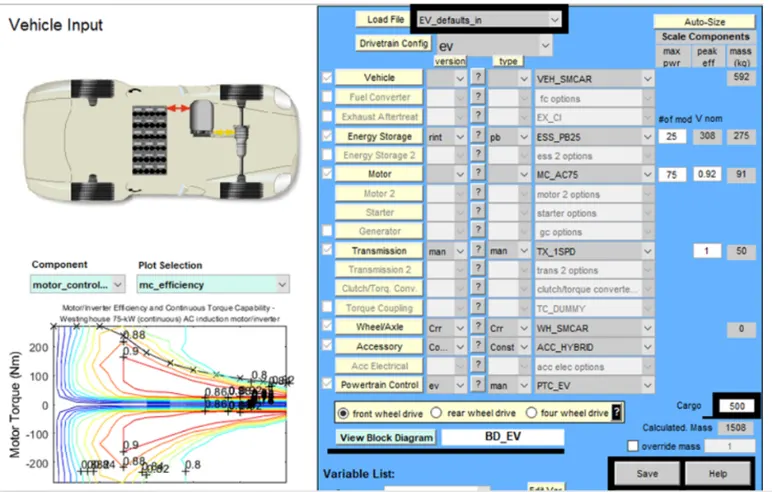
A default vehicle input is opened, in the load, file drop down selects the EV_defaults_in file.
Change the cargo mass to 500 kg and click continue.
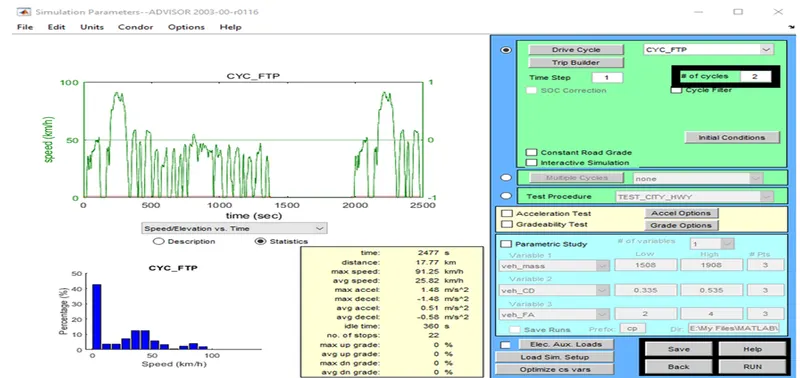
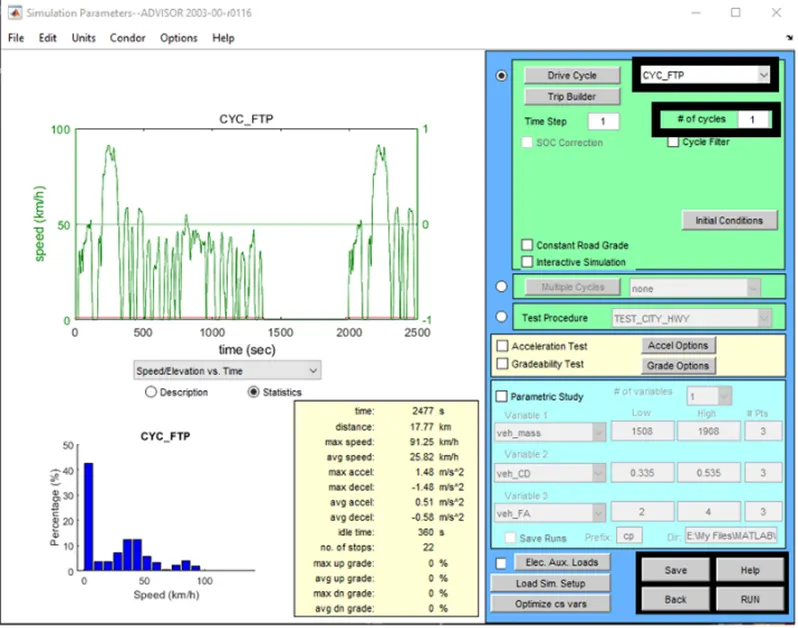
Simulation parameters opens and changes drive cycle .
No. of cycle is 1 and run.
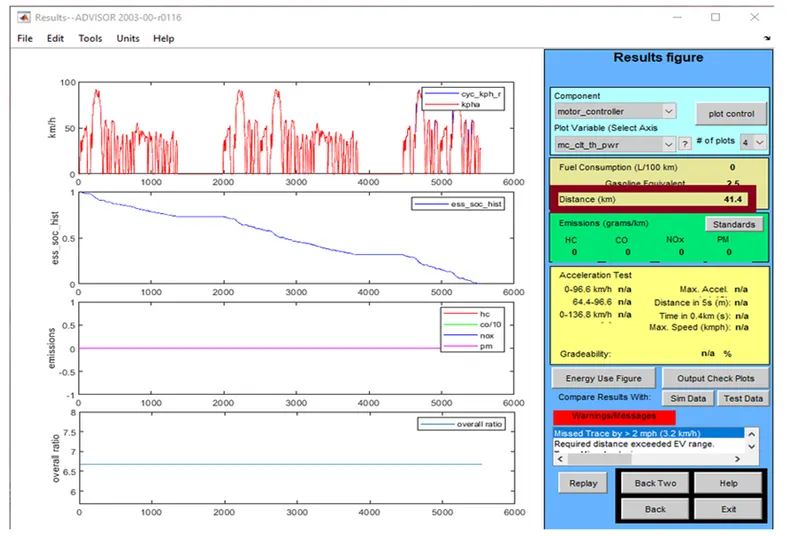
2) In the above case, try changing battery capacity & repeat simulation.
The current battery capacity is kept 25.
We need to increase the battery pack capacity so that vehicle can run more than 45kms.
So for this we will increase the battery capacity from 25 to 45.
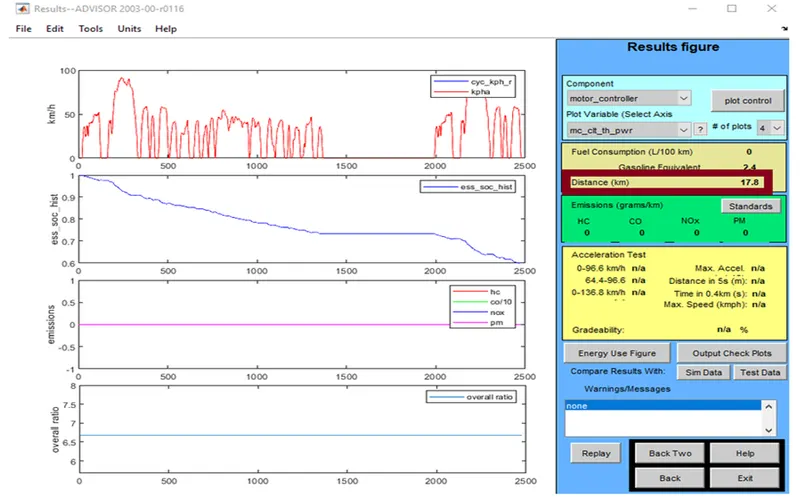
- Perform gradeability test with PRIUS.
Compare your results in table & conclude.
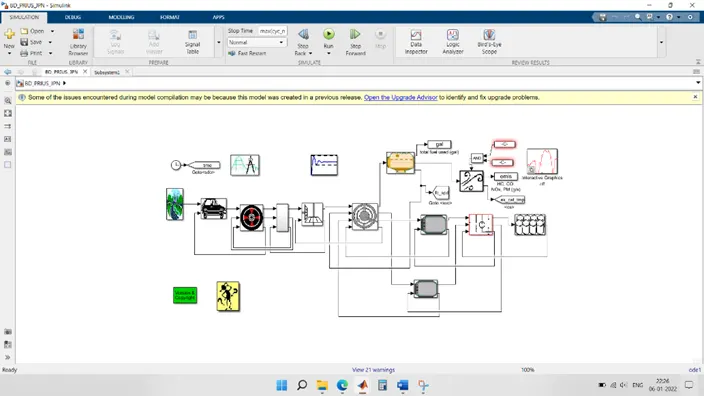
select prius from the load file option to load the prius model.
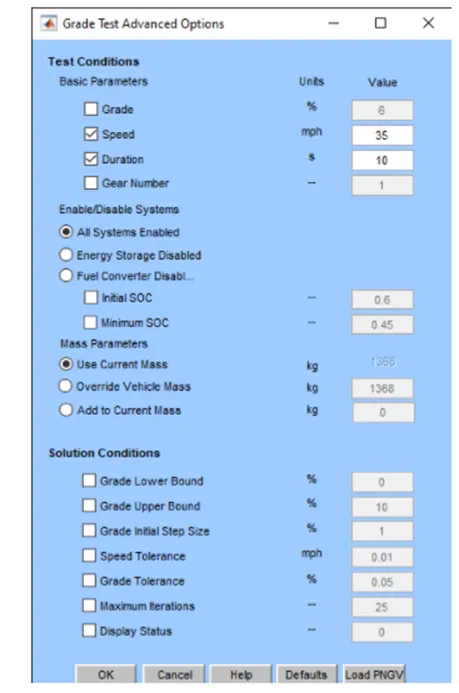
Hit the continue and select the grade options to open grade test options in this we need to change the option which will include both fuel and energy storage system.
Conclusions:
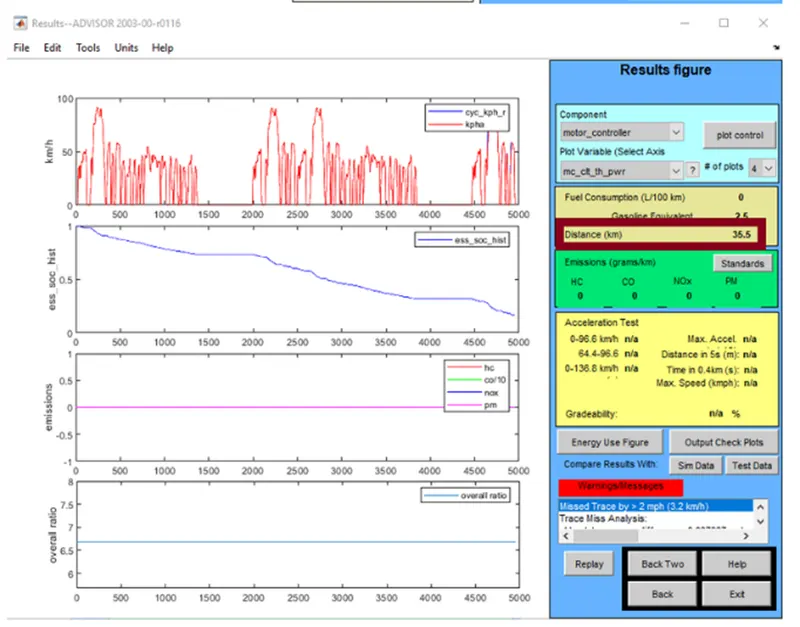
The distance of 45KM cannot be reached by the systems as battery capacity is not enough to cover the distance it can travel to 41 KM by using battery fully.

Increasing battery module from 25 to 28.
For 45KMs, 28 module is necessary