Week 3 - Adiabatic Flame Temperature calculation
AIM: Adiabatic flame temperature calculation by varying the equivalence ratio,heat loss,number of carbon atoms and also with respect to alkane,alkene and alkyne.
OBJECTIVE:
1.By variation of equivalence ratio:
- Assuming that methane is contained in a constant volume chamber. We need to write a program in Python to plot the effect of equivalence ratio on the final adiabatic flame temperature.
- To calculate the results with Cantera for varying equivalence ratios using the equilibrate method. Assume that N2 is present.
2. By variation of heat loss:
- Consider a constant pressure reactor with heat loss. The reactor is initially set at STP conditions.
- The maximum heat loss for the reaction is given below. You will vary the heat loss term by multiplying the “maximum heat loss” with a factor known as H_loss_factor. Example, H_loss_factor = 0.5 would mean a heat loss for that reaction that is equal to 50% of the maximum possible heat loss.
`Q_(rxn,p)=sum_iN_(i,r)*Deltah_(i,r)-sum_iN_(i,p)*Deltah_(i,p)`
where, `h_(i,r)`=enthalpy of reaction
`h_(i,p)=` enthalpy of product
- By varying the H_loss_factor from 0 to 1. Plot variation in Flame temperature w.r.t H_loss_factor
- Combustion stoichiometry for a general hydrocarbon fuel:
`C_xH_y+(x+y/4)(O_2+3.76N_2)=xCO_2+(y/2)H_2O+3.76(x+y/4)N_2`
- If we vary the carbon atom that means the fuel we are considering i.e,hydrocarbon fuel is also varying with the carbon atoms.
- if the carbon atoms in the fuel varies from 1,2,3 etc then the coefficients are also gong to vary in the reaction.
THEORY:
- Generally the heating values of a fuel are used to quantify the maximum amount of heat that can be generated by combustion with air at STP conditions.(298.15k and 101325Pa).
- The amount of heat release from the combustion of the fuel will depend on the phase of water in the products.
- If water is in the gas phase in the products, the value of total heat release is know as lower heatinf value(LHV).
- When water vapour condensed to liquid ,additional energy (equal to latent heat of vapourization) is obtained and the heat release is called higher heating value(HHV).
- Most important feature of a combustion process is the highest temperature of the combustion products.
- So,inorder to achieve the highest temperature of combustion products,there would not be any heat losss to surroundings.
- To calculate the AFT, an adiabatic constant pressure or constant volume analysis is used.
For the first case ,AFT variation with respect to equivalence ratio:
let consider for lean mixture,where there is excess of oxygen as compared to fuel.So, there will be extra oxygen on the product side.
`CH4+x(O_2+3.76N_2)=aCO_2+bH_2O+cN_2+dO_2`
balancing the coefficients we get:
2x=2a+b+2d.............(i) >> 2x=2a+2+2d
2b=4.......................(ii)>> b=2
a=1 .......................(iii)
We need to define stoichometry air-fuel ratio as AFR|s =(no. of moles of fuel/no.of moles of air)=1/2
now, equivalence ratio: (Actual fuel air ratio/stoichiometry fuel air ratio)=(1/x)/(1/2)=(2/x)
`phi=2/x` so, `x=2/phi`
substituting the value of x: 2x=2+2+2d
d=(`2/phi-2`)
similarly we can find the coefficient for rich mixture where CO is present in the product side.
CASE I
Variation of AFT with respect to equivalence ratio
"""
calculation of aft at different equivalence ratio

 phi<1
 CH4 + (2/phi)*(O2 +3.76N2)=CO2 + 2*H2O + (7.52/phi)*N2 + (2/phi - 2)*O2
 phi>=1
 CH4 + (2/phi)*(O2 +3.76N2)= (4/phi-3)*CO2 + 2*H2O + (7.52/phi)*N2 + (4-4/phi)*CO
"""

import matplotlib.pyplot as plt
import numpy as np
import cantera as ct
"""
function to evaluate enthalpy
"""
def h(T,coeff):
	R=8.314  #j/(mol-k)
	a1=coeff[0]
	a2=coeff[1]
	a3=coeff[2]
	a4=coeff[3]
	a5=coeff[4]
	a6=coeff[5]

	return (a1+(a2*T)/2+(a3*pow(T,2))/3+(a4*pow(T,3))/4+(a5*pow(T,4))/5+a6/T)*R*T

CH4_coeff_l= [5.14987613E+00,-1.36709788E-02,4.91800599E-05,-4.84743026E-08,1.66693956E-11,-1.02466476E+04,-4.64130376E+00]
O2_coeff_l= [3.78245636E+00,-2.99673416E-03,9.84730201E-06,-9.68129509E-09,3.24372837E-12,-1.06394356E+03,3.65767573E+00]
O2_coeff_h= [0.02926640E+02, 0.14879768E-02,-0.05684760E-05, 0.10097038E-09,-0.06753351E-13,-0.09227977E+04, 0.05980528E+02]
N2_coeff_l= [0.03298677E+02, 0.14082404E-02,-0.03963222E-04, 0.05641515E-07,-0.02444854E-10,-0.10208999E+04, 0.03950372E+02]
N2_coeff_h= [0.02926640E+02, 0.14879768E-02,-0.05684760E-05, 0.10097038E-09,-0.06753351E-13,-0.09227977E+04, 0.05980528E+02]
H2O_coeff_h= [3.03399249E+00,2.17691804E-03,-1.64072518E-07,-9.70419870E-11,1.68200992E-14,-3.00042971E+04,4.96677010E+00]
CO2_coeff_h= [3.85746029E+00,4.41437026E-03,-2.21481404E-06,5.23490188E-10,-4.72084164E-14,-4.87591660E+04,2.27163806E+00]
CO_coeff_h=[2.71518561E+00, 2.06252743E-03,-9.98825771E-07, 2.30053008E-10,-2.03647716E-14,-1.41518724E+04, 7.81868772E+00]

T_std=298.15
phi=np.linspace(0.1,2,50)
R=8.314

def f(T,phi):
	"""
	function that represents the root finding problem
	"""
	h_CO2_p=h(T,CO2_coeff_h)
	h_N2_p=h(T,N2_coeff_h)
	h_H2O_p=h(T,H2O_coeff_h)
	h_O2_p=h(T,O2_coeff_h)
	h_CO_p=h(T,CO_coeff_h)

	h_CH4_r=h(T_std,CH4_coeff_l)
	h_O2_r=h(T_std,O2_coeff_l)
	h_N2_r=h(T_std,N2_coeff_l)


	if phi>=1:

			H_products=(4/phi-3)*h_CO2_p+2*h_H2O_p+(7.52/phi)*h_N2_p+(4-4/phi)*h_CO_p
			H_reactants=h_CH4_r+(2/phi)*h_O2_r+(7.52/phi)*h_N2_r
			N_products=((4/phi)-3)+2+(7.52/phi)+(4-4/phi)
			N_reactants=1+2/phi+7.52/phi

	elif phi<1:
				H_products=h_CO2_p+2*h_H2O_p+(7.52/phi)*h_N2_p+((2/phi)-2)*h_O2_p
				H_reactants=h_CH4_r+2/phi*h_O2_r+(7.52/phi)*h_N2_r
				N_products=1+2+((2/phi)-2)+7.52/phi
				N_reactants=1+2/phi+7.52/phi
	return (H_reactants-H_products)-R*(N_reactants*T_std-N_products*T)


def fprime(T,phi):
	return(f(T+1e-06,phi)-f(T,phi))/1e-06

"""
writing Newton Raphson code
"""
T_guess=1500
tol=1e-03
alpha=0.2
cx=0
aft=[]
for i in phi:

	while(abs(f(T_guess,i))>tol):
		T_guess=T_guess-alpha*(f(T_guess,i)/fprime(T_guess,i))
		cx=cx+1


	aft.append(T_guess)


print(aft)


"""
writing code using cantera
phi<1
 CH4 + (2/phi)*(O2 +3.76N2)=CO2 + 2*H2O + (7.52/phi)*N2 + (2/phi - 2)*O2
 phi>=1
 CH4 + (2/phi)*(O2 +3.76N2)= (4/phi-3)*CO2 + 2*H2O + (7.52/phi)*N2 + (4-4/phi)*CO
 """

AFT=[]
gas=ct.Solution('gri30.xml')

for i in phi:
	N_total=1+2/i+7.52/i
	N_CH4=1/N_total
	N_O2=(2/i)/N_total
	N_N2=(7.52/i)/N_total


	gas.TPX=298.15,101325,{'CH4':N_CH4,'O2':N_O2,'N2':N_N2}
	gas.equilibrate('UV','auto')
	AFT.append(gas.T)

print(AFT)
plt.plot(phi,aft,'+',color='red',label='python')
plt.plot(phi,AFT,'*',color='blue',label='cantera')
plt.xlabel('equivalence ratio(phi)')
plt.ylabel('adiabatic flame temperature')
plt.legend(["python","cantera"])
plt.grid('on')
plt.show()
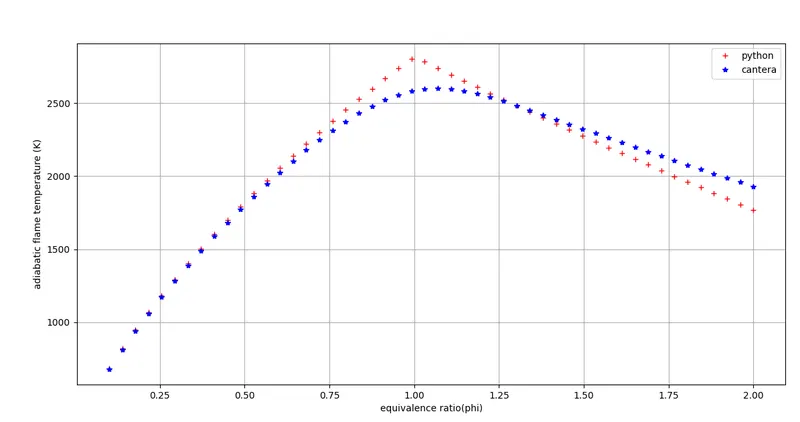
- Here in the above graph,the adiabatic flame temperature in python code gives 2825k and for cantera code it is giving temp. of 2617 K. Here in the cantera the intermediate species are more so, the evaluation of AFT is somewhat practical and lower than python code.
CASE II
Variation of AFT with heat loss factor
"""
calculation of aft variation with heat loss factor

 phi<1
 CH4 + (2/phi)*(O2 +3.76N2)=CO2 + 2*H2O + (7.52/phi)*N2 + (2/phi - 2)*O2
 phi>=1
 CH4 + (2/phi)*(O2 +3.76N2)= (4/phi-3)*CO2 + 2*H2O + (7.52/phi)*N2 + (4-4/phi)*CO
"""

import matplotlib.pyplot as plt
import numpy as np

"""
function to evaluate enthalpy
"""
def h(T,coeff):
	R=8.314  #j/(mol-k)
	a1=coeff[0]
	a2=coeff[1]
	a3=coeff[2]
	a4=coeff[3]
	a5=coeff[4]
	a6=coeff[5]

	return (a1+a2*T/2+a3*pow(T,2)/3+a4*pow(T,3)/4+a5*pow(T,4)/5+a6/T)*R*T

CH4_coeff_l= [5.14987613E+00,-1.36709788E-02,4.91800599E-05,-4.84743026E-08,1.66693956E-11,-1.02466476E+04,-4.64130376E+00]
O2_coeff_l= [3.78245636E+00,-2.99673416E-03,9.84730201E-06,-9.68129509E-09,3.24372837E-12,-1.06394356E+03,3.65767573E+00]
O2_coeff_h= [3.28253784E+00,1.48308754E-03,-7.57966669E-07,2.09470555E-10,-2.16717794E-14,-1.08845772E+03,5.45323129E+00]
N2_coeff_l= [0.25000000E+01,0.00000000E+00,0.00000000E+00,0.00000000E+00,0.00000000E+00,0.56104637E+05,0.41939087E+01]
N2_coeff_h= [0.24159429E+01,0.17489065E-03,-0.11902369E-06,0.30226245E-10,-0.20360982E-14,0.56133773E+05,0.46496096E+01]
H2O_coeff_h= [3.03399249E+00,2.17691804E-03,-1.64072518E-07,-9.70419870E-11,1.68200992E-14,-3.00042971E+04,4.96677010E+00]
CO2_coeff_h= [3.85746029E+00,4.41437026E-03,-2.21481404E-06,5.23490188E-10,-4.72084164E-14,-4.87591660E+04,2.27163806E+00]
CO_coeff_h=[2.71518561E+00, 2.06252743E-03,-9.98825771E-07, 2.30053008E-10,-2.03647716E-14,-1.41518724E+04, 7.81868772E+00]

T_std=298.15
heat_loss_factor=np.linspace(0,1,100)
R=8.314

def f(T,heat_loss_factor):
	"""
	function that represents the root finding problem
	"""
	h_CO2_p=h(T,CO2_coeff_h)
	h_N2_p=h(T,N2_coeff_h)
	h_H2O_p=h(T,H2O_coeff_h)
	h_O2_p=h(T,O2_coeff_h)
	h_CO_p=h(T,CO_coeff_h)

	h_CH4_r=h(T_std,CH4_coeff_l)
	h_O2_r=h(T_std,O2_coeff_l)
	h_N2_r=h(T_std,N2_coeff_l)
	phi=1

	if phi>=1:

			H_products=(4/phi-3)*h_CO2_p+2*h_H2O_p+(7.52/phi)*h_N2_p+(4-4/phi)*h_CO_p
			H_reactants=h_CH4_r+(2/phi)*h_O2_r+(2/phi)*3.76*h_N2_r
			N_products=(4/phi-3)+2+(7.52/phi)+(4-4/phi)
			N_reactants=1+2/phi+7.52/phi

	elif phi<1:
				H_products=h_CO2_p+2*h_H2O_p+(7.52/phi)*h_N2_p+(2/phi-2)*h_O2_p
				H_reactants=h_CH4_r+2/phi*h_O2_r+(7.52/phi)*h_N2_r
				N_products=1+2+(2/phi-2)+7.52/phi
				N_reactants=1+2/phi+7.52/phi


	h_CO2_p_stp=h(T_std,CO2_coeff_h)
	h_N2_p_stp=h(T_std,N2_coeff_h)
	h_H2O_p_stp=h(T_std,H2O_coeff_h)
	h_O2_p_stp=h(T_std,O2_coeff_h)
	h_CO_p_stp=h(T_std,CO_coeff_h)

	H_products_Tstp=(4/phi-3)*h_CO2_p_stp+2*h_H2O_p_stp+(7.52/phi)*h_N2_p_stp+(4-4/phi)*h_CO_p_stp

	LHV=H_reactants-H_products_Tstp
	loss=LHV*heat_loss_factor
	return (H_reactants-H_products-loss)


def fprime(T,phi):
	return(f(T+1e-06,phi)-f(T,phi))/1e-06

"""
writing Newton Raphson code
"""
T_guess=1500
tol=1e-03
alpha=0.2
ct=0
aft=[]
for i in heat_loss_factor:

	while(abs(f(T_guess,i))>tol):
		T_guess=T_guess-alpha*(f(T_guess,i)/fprime(T_guess,i))
		ct=ct+1


	aft.append(T_guess)


plt.plot(heat_loss_factor,aft,'*',color='red')
plt.xlabel('heat loss factor')
plt.ylabel('adiabatic flame temperature (K)')
plt.legend(["python"])
plt.grid('on')
plt.show()
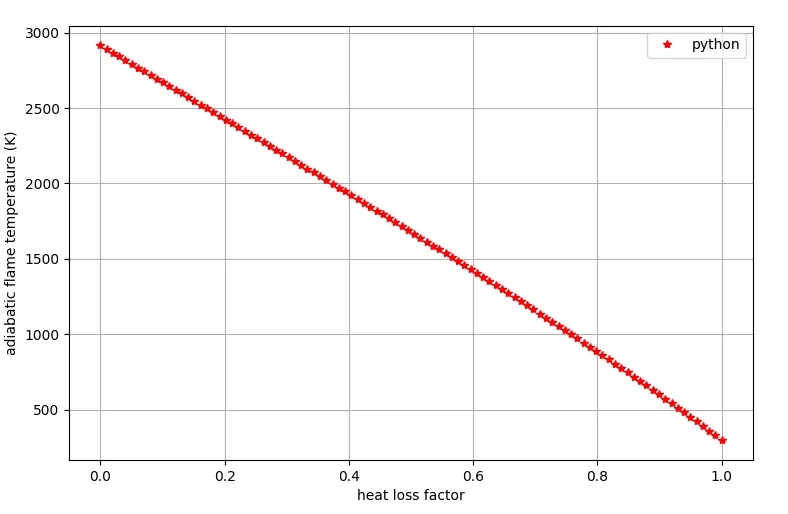
- In this case the reactor is at constant pressure having heat loss and is initially set at STP condition.
- As the heat loss factor increases the flame temperature decreases.
- When there is no heat loss ,then the product temperature increases as the energy released from combustion is used for temperature rise of the product species.
CASE III
Variation of AFT with alkanes,alkenes and alkynes
"""
calculation of adiabatic flame temperature variation with alkane,alkene and alkynes(variation with bond structure)

 Combustion stoichiometry for a general hydrocarbon fuel
 CxHy + (x+y/4)*(O2 +3.76N2)=xCO2 + (y/2)*H2O + (3.76)*(x+y/4)*N2
 Balancing the equation we would get the moles of respective species:
 1. C2H6 + (2+3/2)*O2 + 3.76*(7/2)*N2 = 2*CO2 + 3*H2O + (3.76)*(7/2)*N2
 2. C2H4 + (2+1)*O2 + 3*3.76*N2 = 2*CO2+ 2*H2O + 3.76*3*N2
 3. C2H2 + (2.5)*O2 + 3.76*2.5*N2 = 2*CO2 + H2O + 3.76*2.5*N2

"""

import matplotlib.pyplot as plt
import numpy as np
import cantera as ct
"""
function to evaluate enthalpy
"""
def h(T,coeff):
	R=8.314  #j/(mol-k)
	a1=coeff[0]
	a2=coeff[1]
	a3=coeff[2]
	a4=coeff[3]
	a5=coeff[4]
	a6=coeff[5]

	return (a1+a2*T/2+a3*pow(T,2)/3+a4*pow(T,3)/4+a5*pow(T,4)/5+a6/T)*R*T

C2H6_coeff_l=[4.29142492E+00,-5.50154270E-03, 5.99438288E-05,-7.08466285E-08,2.68685771E-11,-1.15222055E+04, 2.66682316E+00]
C2H4_coeff_l=[3.95920148E+00,-7.57052247E-03,5.70990292E-05,-6.91588753E-08,2.69884373E-11,5.08977593E+03,4.09733096E+00]
C2H2_coeff_l=[8.08681094E-01,2.33615629E-02,-3.55171815E-05,2.80152437E-08,-8.50072974E-12,2.64289807E+04,1.39397051E+01]
O2_coeff_l= [3.78245636E+00,-2.99673416E-03,9.84730201E-06,-9.68129509E-09,3.24372837E-12,-1.06394356E+03,3.65767573E+00]
O2_coeff_h= [3.28253784E+00,1.48308754E-03,-7.57966669E-07,2.09470555E-10,-2.16717794E-14,-1.08845772E+03,5.45323129E+00]
N2_coeff_l= [0.03298677E+02, 0.14082404E-02,-0.03963222E-04,0.05641515E-07,-0.02444854E-10,-0.10208999E+04, 0.03950372E+02]
N2_coeff_h= [0.02926640E+02, 0.14879768E-02,-0.05684760E-05, 0.10097038E-09,-0.06753351E-13,-0.09227977E+04, 0.05980528E+02]
H2O_coeff_h= [3.03399249E+00,2.17691804E-03,-1.64072518E-07,-9.70419870E-11,1.68200992E-14,-3.00042971E+04,4.96677010E+00]
CO2_coeff_h= [3.85746029E+00,4.41437026E-03,-2.21481404E-06,5.23490188E-10,-4.72084164E-14,-4.87591660E+04,2.27163806E+00]
CO_coeff_h=[2.71518561E+00, 2.06252743E-03,-9.98825771E-07, 2.30053008E-10,-2.03647716E-14,-1.41518724E+04, 7.81868772E+00]

T_std=298.15
fuel_type=[1,2,3]
R=8.314

def f(T,fuel_type):
	"""
	function that represents the root finding problem
	"""
	h_CO2_p=h(T,CO2_coeff_h)
	h_N2_p=h(T,N2_coeff_h)
	h_H2O_p=h(T,H2O_coeff_h)
	h_O2_p=h(T,O2_coeff_h)
	h_CO_p=h(T,CO_coeff_h)


	h_O2_r=h(T_std,O2_coeff_l)
	h_N2_r=h(T_std,N2_coeff_l)
	h_C2H6_r=h(T_std,C2H6_coeff_l)
	h_C2H4_r=h(T_std,C2H4_coeff_l)
	h_C2H2_r=h(T_std,C2H2_coeff_l)


	if fuel_type==1:
			x=2
			y=6
			h_fuel=h_C2H6_r


	elif fuel_type==2:
			x=2
			y=4
			h_fuel=h_C2H4_r


	elif fuel_type==3:
			x=2
			y=2
			h_fuel=h_C2H2_r

	H_reactants=h_fuel+(x+y/4)*h_O2_r+(x+y/4)*(3.76)*h_N2_r
	H_products=x*h_CO2_p+y/2*h_H2O_p+3.76*(x+y/4)*h_N2_p

	return (H_products-H_reactants)


def fprime(T,phi):
	return(f(T+1e-06,phi)-f(T,phi))/1e-06

"""
writing Newton Raphson code
"""
T_guess=1500
tol=1e-03
alpha=0.2
cx=0
aft=[]
for i in fuel_type:

	while(abs(f(T_guess,i))>tol):
		T_guess=T_guess-alpha*(f(T_guess,i)/fprime(T_guess,i))
		cx=cx+1


	aft.append(T_guess)


plt.bar(['ethane','ethene','ethyne'],aft,color='red')
plt.ylabel('adiabatic flame temperature (k)')
plt.xlabel('Hydrocarbon fuel')
plt.show() 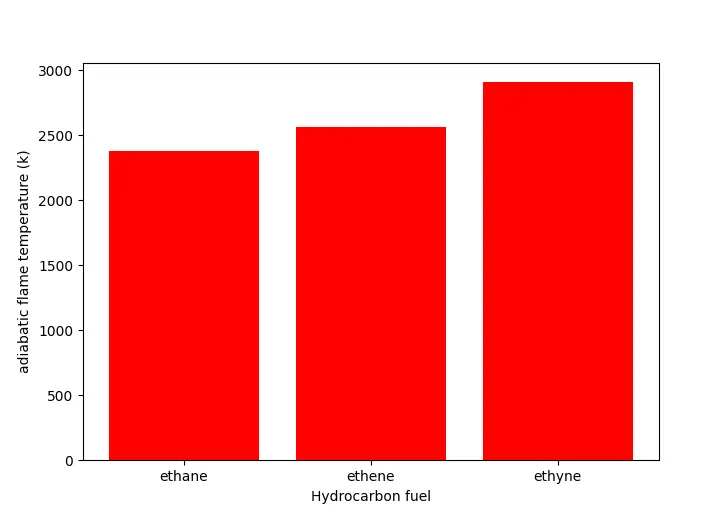
- In this figure shown the AFT variation is done with respect to ethane,ethene and ethyne.
- The maximum temperature attained for ethane,ethene and ethyne are 2382k,2572k and 2919k respectively.
CASE IV
Variation of AFT with respect to number of carbon atoms
"""
calculation of adiabatic flame temperature with number of carbon atoms:

 Combustion stoichiometry for a general hydrocarbon fuel
 CxHy + (x+y/4)*(O2 +3.76N2)=xCO2 + (y/2)*H2O + (3.76)*(x+y/4)*N2


"""

import matplotlib.pyplot as plt
import numpy as np
import cantera as ct
"""
function to evaluate enthalpy
"""
def h(T,coeff):
	R=8.314  #j/(mol-k)
	a1=coeff[0]
	a2=coeff[1]
	a3=coeff[2]
	a4=coeff[3]
	a5=coeff[4]
	a6=coeff[5]

	return (a1+a2*T/2+a3*pow(T,2)/3+a4*pow(T,3)/4+a5*pow(T,4)/5+a6/T)*R*T

CH4_coeff_l=[5.14987613E+00,-1.36709788E-02, 4.91800599E-05,-4.84743026E-08,1.66693956E-11,-1.02466476E+04,-4.64130376E+00]
C2H6_coeff_l=[ 4.29142492E+00,-5.50154270E-03, 5.99438288E-05,-7.08466285E-08,2.68685771E-11,-1.15222055E+04,2.66682316E+00]
C3H8_coeff_l=[ 0.93355381E+00, 0.26424579E-01,0.61059727E-05,-0.21977499E-07,0.95149253E-11,-0.13958520E+05,0.19201691E+02]
O2_coeff_l= [3.78245636E+00,-2.99673416E-03,9.84730201E-06,-9.68129509E-09,3.24372837E-12,-1.06394356E+03,3.65767573E+00]
O2_coeff_h= [3.28253784E+00,1.48308754E-03,-7.57966669E-07,2.09470555E-10,-2.16717794E-14,-1.08845772E+03,5.45323129E+00]
N2_coeff_l= [0.03298677E+02, 0.14082404E-02,-0.03963222E-04, 0.05641515E-07,-0.02444854E-10,-0.10208999E+04, 0.03950372E+02]
N2_coeff_h= [0.02926640E+02, 0.14879768E-02,-0.05684760E-05, 0.10097038E-09,-0.06753351E-13,-0.09227977E+04, 0.05980528E+02]
H2O_coeff_h= [3.03399249E+00,2.17691804E-03,-1.64072518E-07,-9.70419870E-11,1.68200992E-14,-3.00042971E+04,4.96677010E+00]
CO2_coeff_h= [3.85746029E+00,4.41437026E-03,-2.21481404E-06,5.23490188E-10,-4.72084164E-14,-4.87591660E+04,2.27163806E+00]
CO_coeff_h=[2.71518561E+00, 2.06252743E-03,-9.98825771E-07, 2.30053008E-10,-2.03647716E-14,-1.41518724E+04, 7.81868772E+00]

T_std=298.15
fuel_type=[1,2,3]
R=8.314

def f(T,fuel_type):
	"""
	function that represents the root finding problem
	"""
	h_CO2_p=h(T,CO2_coeff_h)
	h_N2_p=h(T,N2_coeff_h)
	h_H2O_p=h(T,H2O_coeff_h)
	h_O2_p=h(T,O2_coeff_h)
	h_CO_p=h(T,CO_coeff_h)


	h_O2_r=h(T_std,O2_coeff_l)
	h_N2_r=h(T_std,N2_coeff_l)
	h_CH4_r=h(T_std,CH4_coeff_l)
	h_C2H6_r=h(T_std,C2H6_coeff_l)
	h_C3H8_r=h(T_std,C3H8_coeff_l)


	if fuel_type==1:
			x=1
			y=4
			h_fuel=h_CH4_r


	elif fuel_type==2:
			x=2
			y=6
			h_fuel=h_C2H6_r


	elif fuel_type==3:
			x=3
			y=8
			h_fuel=h_C3H8_r

	H_reactants=h_fuel+(x+y/4)*h_O2_r+(x+y/4)*(3.76)*h_N2_r
	H_products=x*h_CO2_p+y/2*h_H2O_p+3.76*(x+y/4)*h_N2_p

	return (H_products-H_reactants)


def fprime(T,fuel_type):
	return(f(T+1e-06,fuel_type)-f(T,fuel_type))/1e-06

"""
writing Newton Raphson code
"""
T_guess=1500
tol=1e-03
alpha=0.2
cx=0
aft=[]
for i in fuel_type:

	while(abs(f(T_guess,i))>tol):
		T_guess=T_guess-alpha*(f(T_guess,i)/fprime(T_guess,i))
		cx=cx+1


	aft.append(T_guess)


print(cx)
plt.bar(['methane','ethane','propane'],aft,color='red')
plt.xlabel('adiabatic flame temperature (k)')
plt.ylabel('number of carbon atoms')
plt.show() 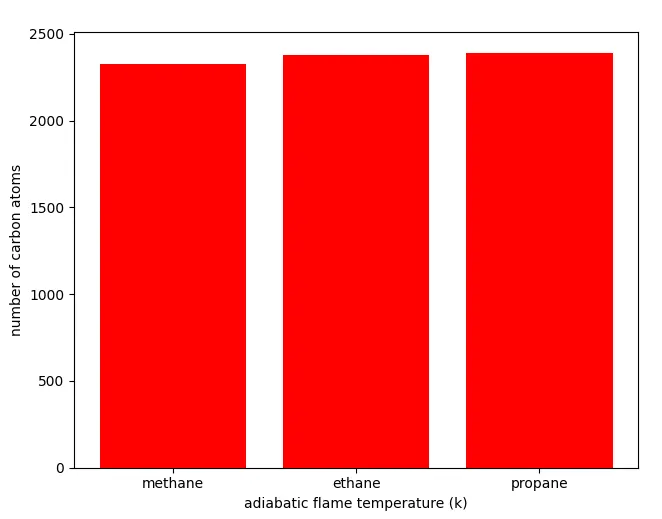
- By varying the number of carbon atoms we are getting not predominant variation of temperature.The max. temperature we are getting as 2320 K, 2387K and 2400K.
Result inference
- Visible deviations arise in stoichometric conditions and become larger in richer mixture.Reason for deviation is the assumption made about product species in rich mixtures.(for variation in AFT with equivalence ratio)
- The software(cantera) takes into account of dissociation of products at high temperature making it more accurate than python code.