Week 2 - Flow over a Cylinder.
AIM
To simulate a fluid flowing over a cylinder and demonstrate the phenomenon of Karman Vortex Street by varying Reynolds number.
INTRODUCTION
Flow past a blunt body, such as a circular cylinder, usually experiences boundary layer separation and very strong flow oscillations in the wake region behind the body. In certain Reynolds number range, a periodic flow motion will develop in the wake as a result of boundary layer vortices being shed alternatively from either side of the cylinder. This regular pattern of vortices in the wake is called a Karman vortex street. It creates an oscillating flow at a discrete frequency that is correlated to the Reynolds number of the flow. The periodic nature of the vortex shedding phenomenon can sometimes lead to unwanted structural vibrations, especially when the shedding frequency matches one of the resonant frequencies of the structure. Study of this phenomenon is very useful for a number of practical applications, such as, development of airfoils, designing of tube bundles in shell and tube heat exchange, etc.
THEORY
The Reynolds number is the ratio of inertial forces to viscous forces within a fluid that is subjected to relative internal movement due to different fluid velocities. A region where these forces change behaviour is known as a boundary layer.
Where,
Re = Reynolds number
ρ = Density of Fluid
V = Velocity of Fluid
Lc = Characteristic length (for cylinder its Diameter)
µ = Dynamic viscosity
Strouhal number (Sr) is a dimensionless number describing oscillating flow mechanisms. For large Sr (order of 1), viscosity dominates fluid flow. For low Sr (order of 10−4 and below), the high-speed, quasi-steady-state portion of the movement dominates the oscillation.
Where,
Sr = Strouhal number
f = Frequency of vortex shedding
U = Velocity of Fluid
Lc = Characteristic length
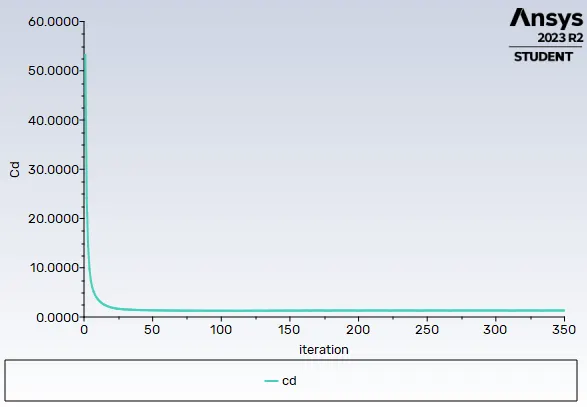
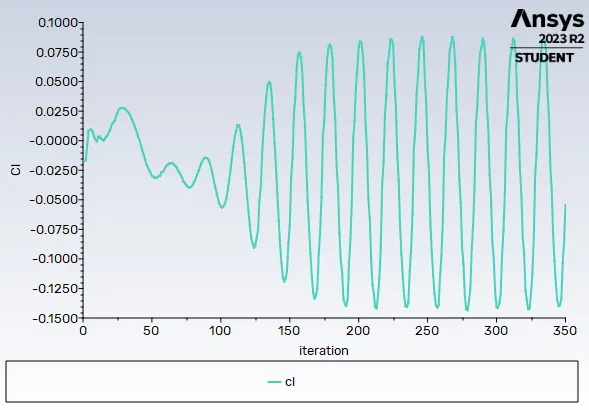
The drag coefficient is equal to the drag force divided by the product of velocity pressure and frontal area. The velocity may be induced upon a stationary body by flowing fluid; it may be a body moving through stationary fluid, or it may be both. Similarly, lift coefficient is also obtained.
Where,
Cd, Fd = Drag coefficient and Drag force respectively
Cl, Fl = Lift coefficient and Lift force respectively
ρ = Density of Fluid
V = Velocity of Fluid
A = Frontal area (Area of solid colliding head-on with fluid)
Geometry
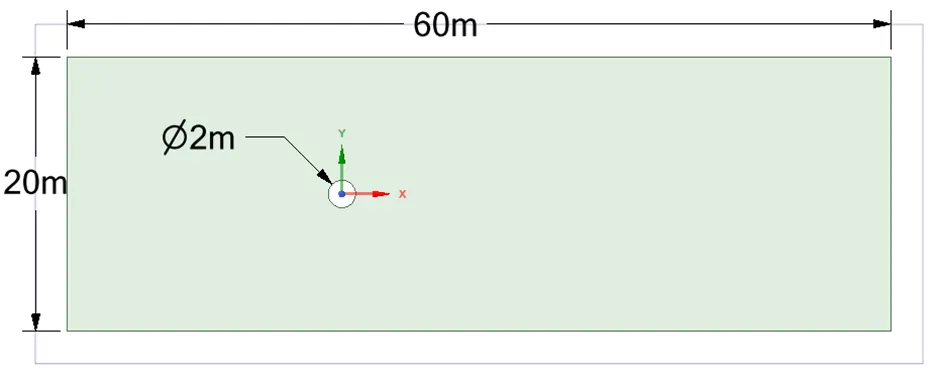
The horizontal distance of cylinder from inlet is 20 m and from outlet its 40 m. Vertically, it is equidistant from top and bottom boundaries. Rest dimensions are explained in provided snapshot.
Mesh
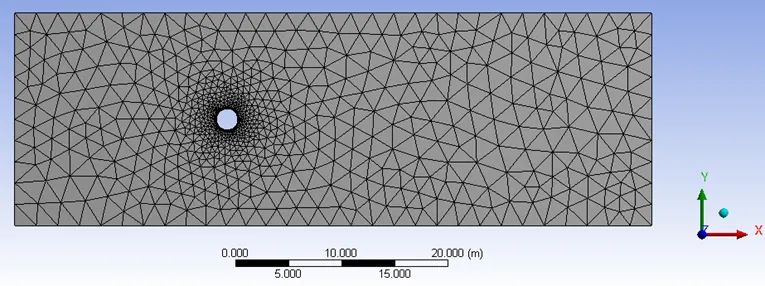
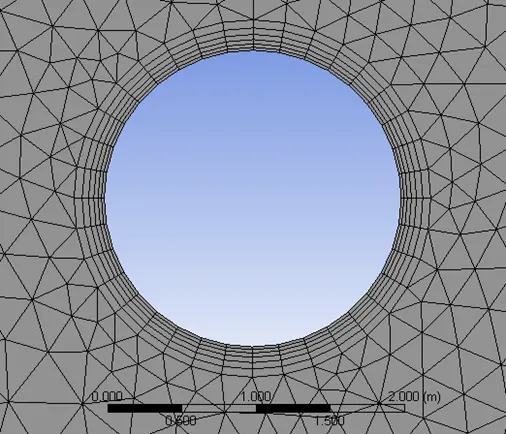
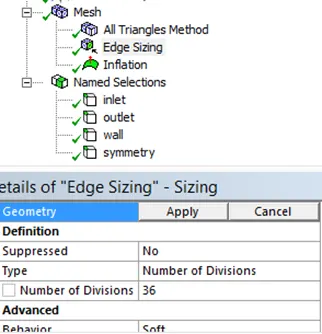
Mesh was generated using All Triangles method. At the cylinder surface 6 layers of inflation were provided. Also, the cylinder edge size was divided into 36 divisions, which can be seen in the snapshot provided.
A mesh with 0.5 m element size was generated and used for all siulations. Number of nodes= 5632. Number of elements= 10692.
Solver
The flow was laminar. Fluid that was used in the flow was created with a constant density of 1 Kg/m^3 and dynamic viscosity of 0.02 Kg/m-s.
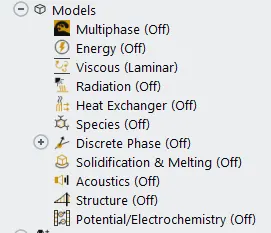
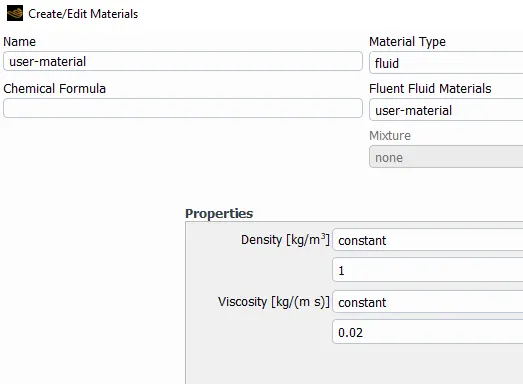
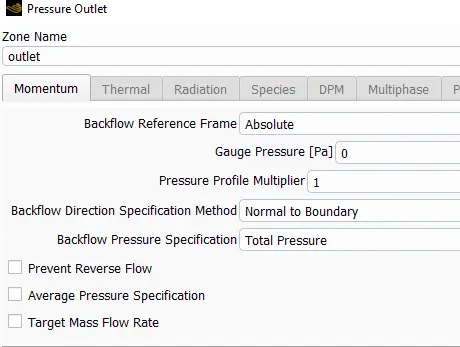
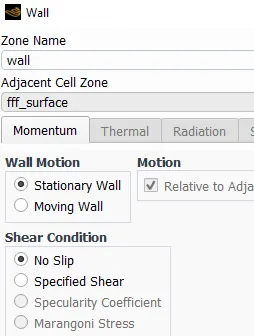
Boundary conditions - Pressure outlet with zero gauge pressure was ensured. No slip condition was ensured for the external wall of stationary cylinder.
Inlet velocity was varied to change the Reynolds number as required. For Re=100, inlet velocity was 1 m/s.
</>
<><>> - >
<>< src alt="">
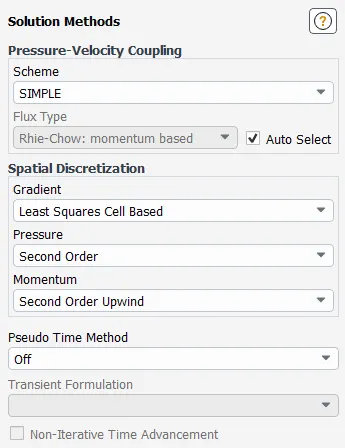
Covergence conditions were unchecked to ensure unhindered running of all iterations.
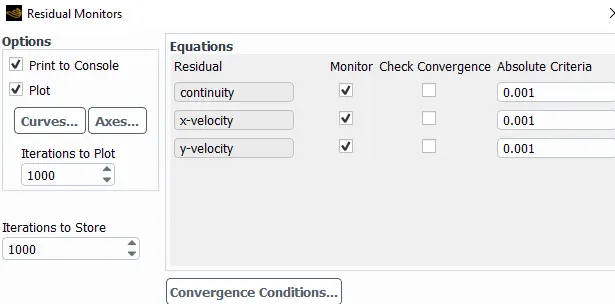
Monitor point velocity, coefficient of drag and lift reports were created to obtain respective datasets. Velocity and pressure contours along with velocity animation were obtained as well in all simluations.
< src>
PART-I
To simulate the flow with the steady and unsteady case and calculate the Strouhal Number for Re= 100.
Solving for Re=100 using steady state solver.
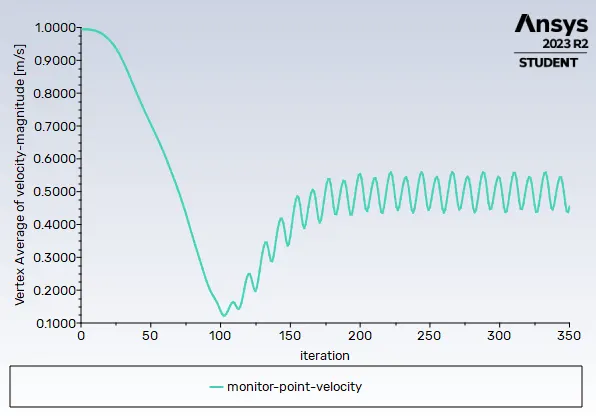
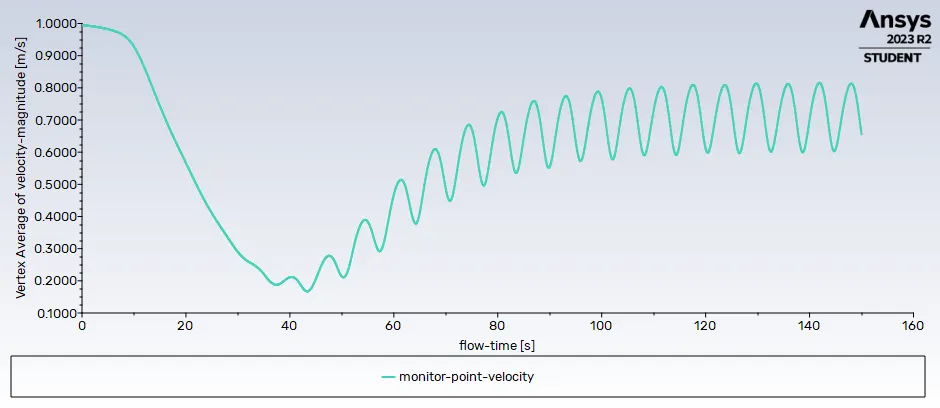
A monitor point for observing velocity changes was created at a distance of 10 m from the center of the cylinder. The stability of below curve denoted by recurring values shows that the solution has converged.
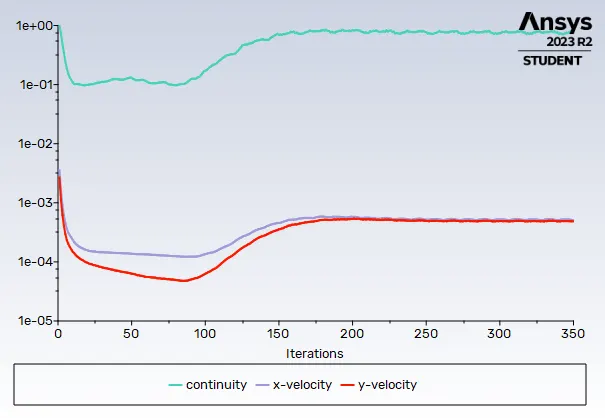
Scaled Residuals
Coefficient of drag
Coefficient of lift
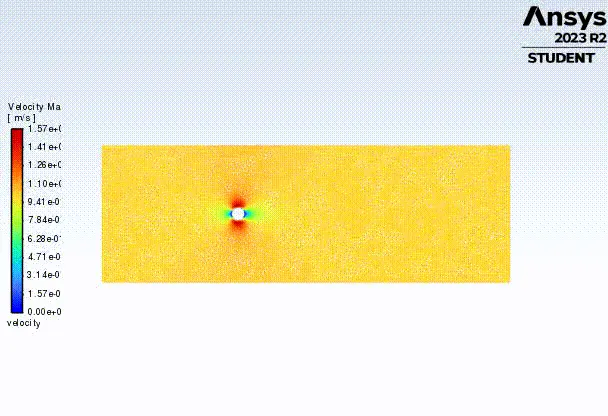
Vortex shedding animation
Solving for Re=100 using transient state solver.
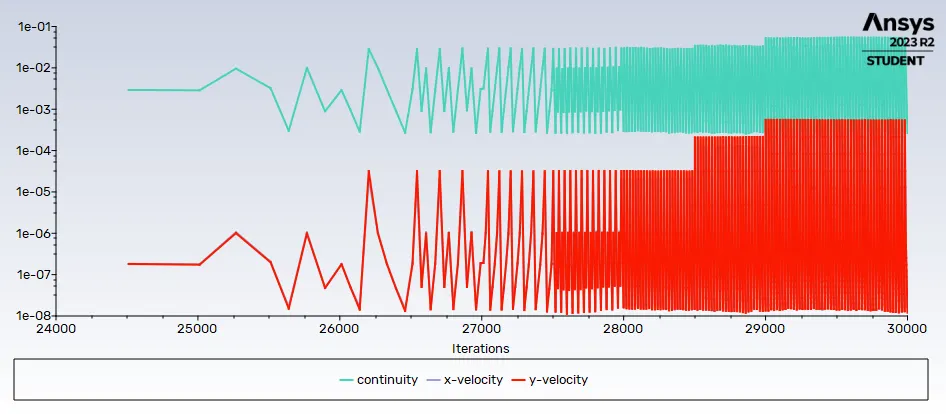
1500 timesteps of 0.1 secs were iterated in the transient solver. A total of 30000 iterations were run.
A monitor point for observing velocity changes was created at a distance of 10 m from the center of the cylinder. The stability of this curve denoted by recurring values shows that the solution has converged.
Scaled residuals
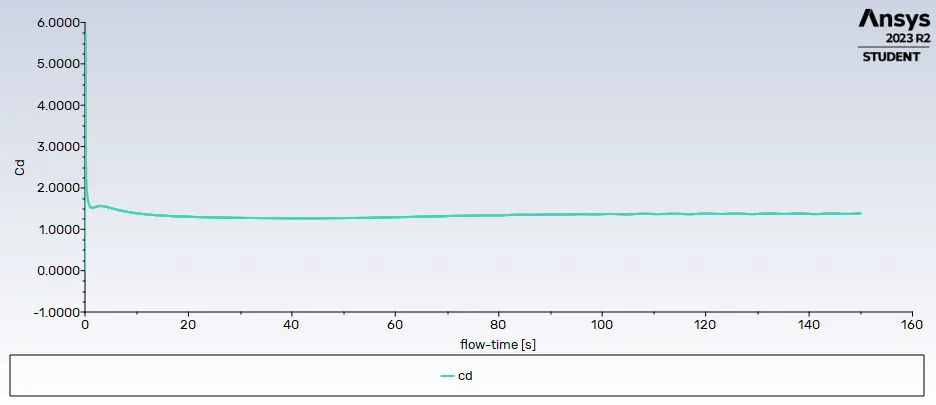
Coefficient of drag
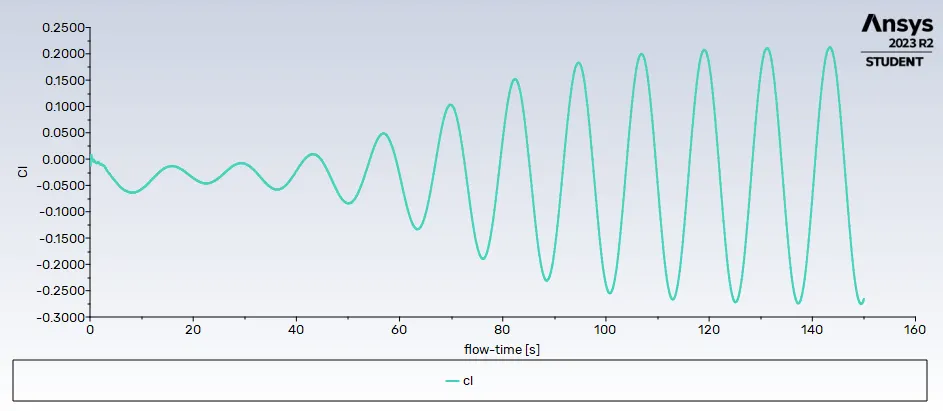
Coefficient of lift
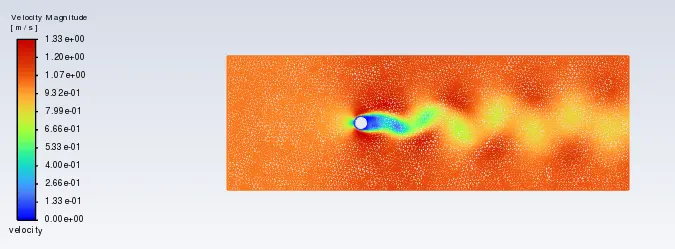
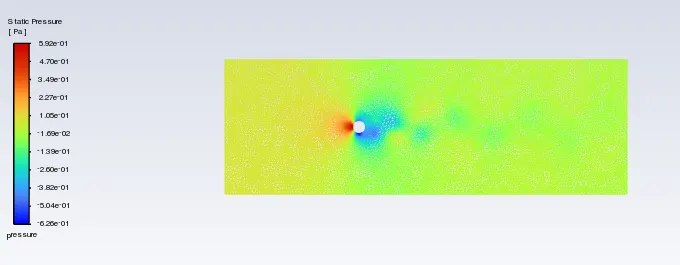
Velocity contour
Pressure contour
Strouhal number plot
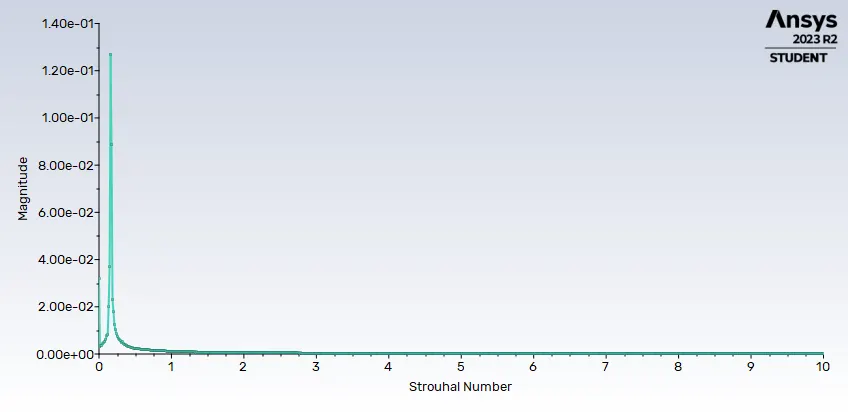
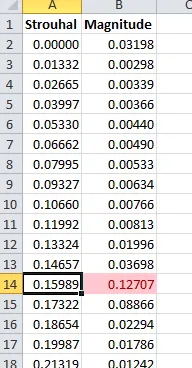
In the results tab, FFT was opened and y-axis was changed to 'Magnitude', x-axis was changed to 'Strouhal', and the lift coefficient rfile was loaded using the input file button. Plotting the result produced the above curve. Then, this FFT file was written into a .xy file using 'Write to file' check button and the contents of that file was copied into excel datasheet and formatted for better usability. A snapshot of the same is provided below and it shows the Strouhal number corresponding to the highest magnitude highlighted using conditional formatting feature of MS Excel. Thus the obtained Strouhal number corresponding to flow over cylinder at Re=100 is 0.15989. This was validated using the work of Rajani et al [1] and an error of 1.8% was observed, which is acceptable.
Strouhal number was only calculated for simulations of transient solver as it provided accurate time dependent simulation result. The vortex shedding animation could not be provided for the transient solver simulation result as the solver kept crashing everytime in the middle of writing the animation video file.
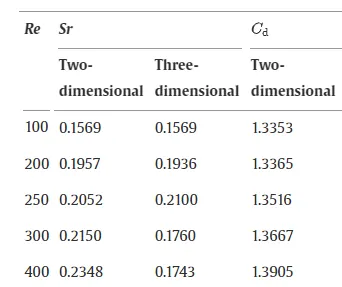
Results obtained by Rajani et al [1]
PART-II
To calculate the coefficient of drag and lift over a cylinder by setting the Reynolds number to 10,100,1000,10000 & 100000 using steady state solver.
Table-1: Reynolds number vs Coefficient of drag and lift
| Velocity (m/s) | Re | Coefficient of Drag | Coefficient of Lift |
| 0.1 | 10 | 3.3122201 | -0.0016580815 |
| 1 | 100 | 1.3225447 | -0.14160076 |
| 10 | 1000 | 0.71278996 | -0.15817649 |
| 100 | 10000 | 0.66982358 | -0.56750459 |
| 1000 | 100000 | 0.6174431 | -0.27252612 |
By validating the above data with the work of Rajani et al [1] an error of 0.95% was observed, which is acceptable.
Scaled residuals
| Re | Scaled residuals after 500 iterations |
| 10 | 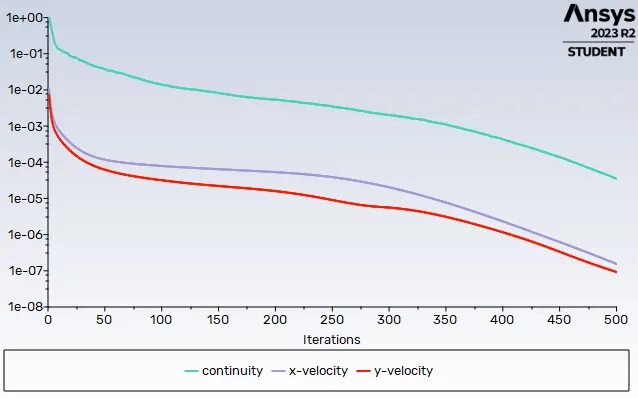 |
| 100 | 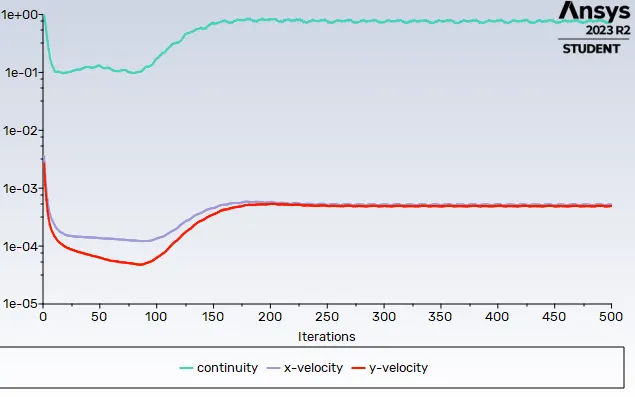 |
| 1000 | 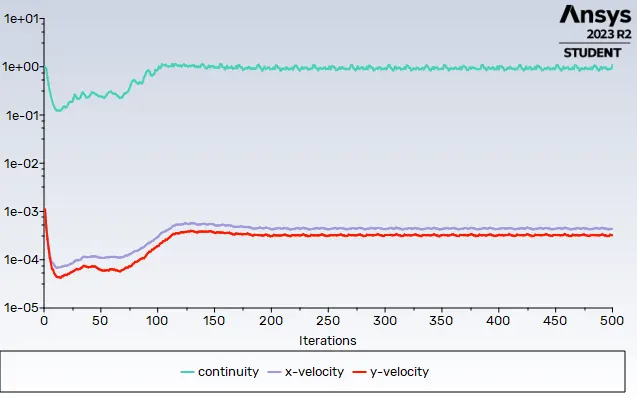 |
| 10000 | 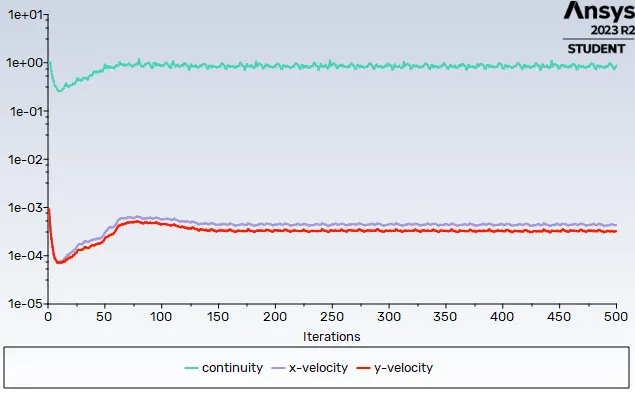 |
| 100000 | 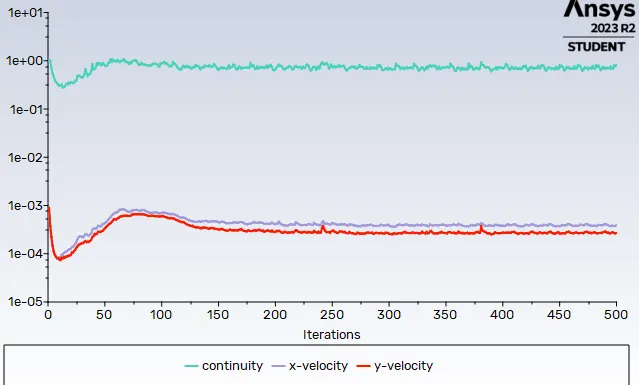 |
Vertex average velocity plot of a point at a distance of 10 m from the center of cylinder
| Re | Vertex average velocity plot after 500 iterations |
| 10 | 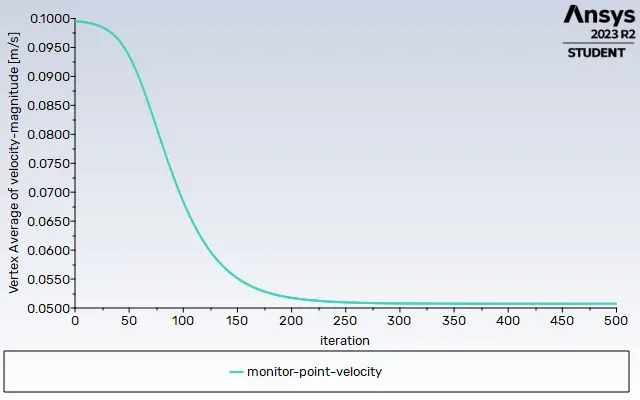 |
| 100 | 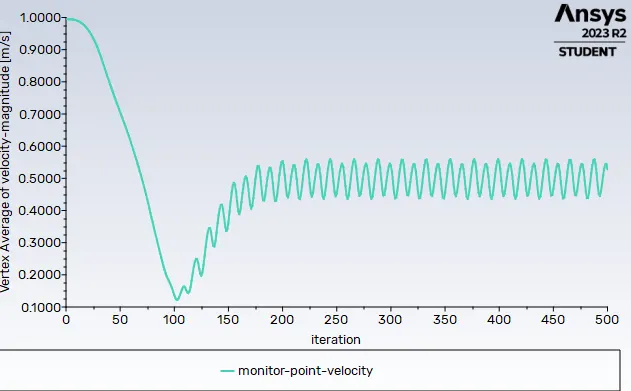 |
| 1000 | 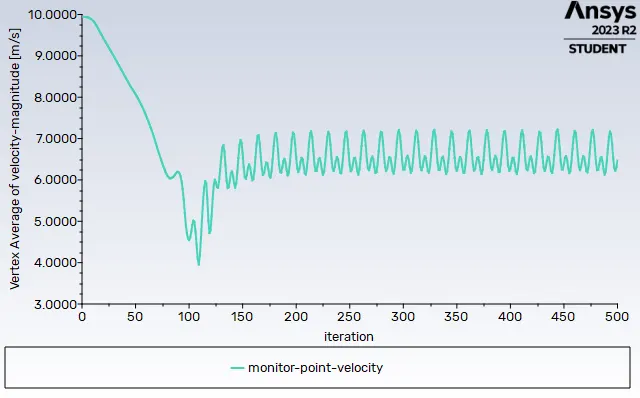 |
| 10000 | 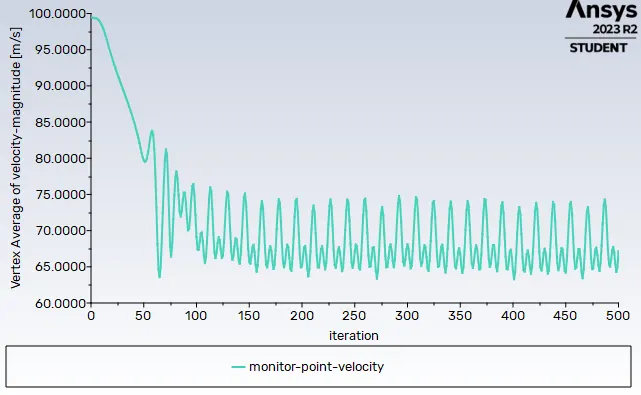 |
| 100000 | 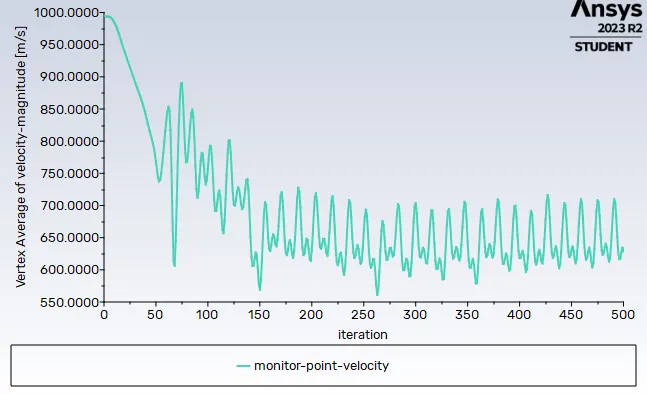 |
Coeffieicent of drag plot
| Re | Coefficient of drag plot after 500 iterations |
| 10 | 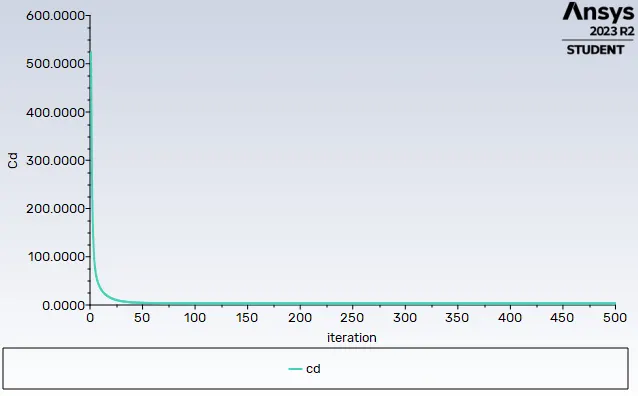 |
| 100 | 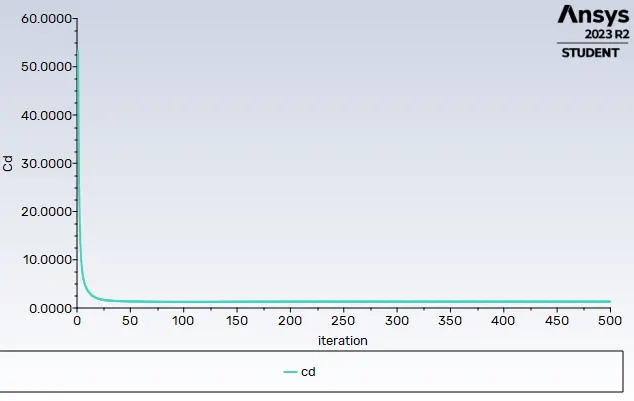 |
| 1000 | 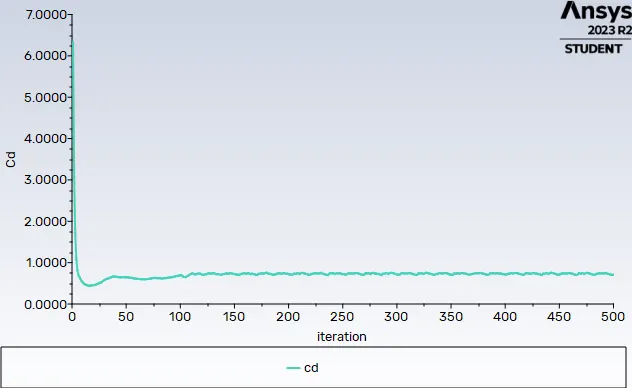 |
| 10000 | 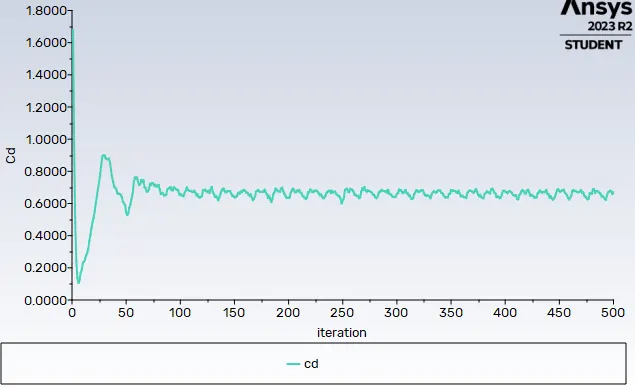 |
| 100000 | 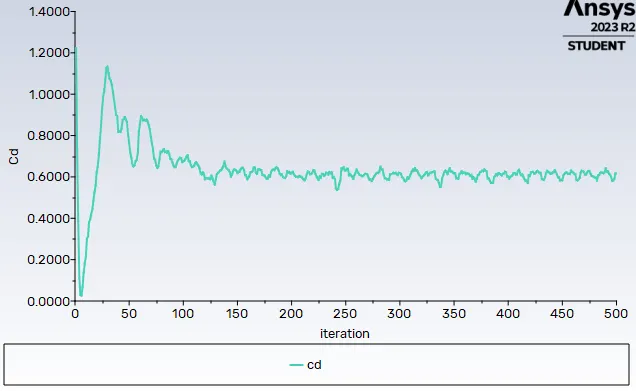 |
Coefficient of lift plot
| Re | Coefficient of lift plot after 500 iterations |
| 10 | 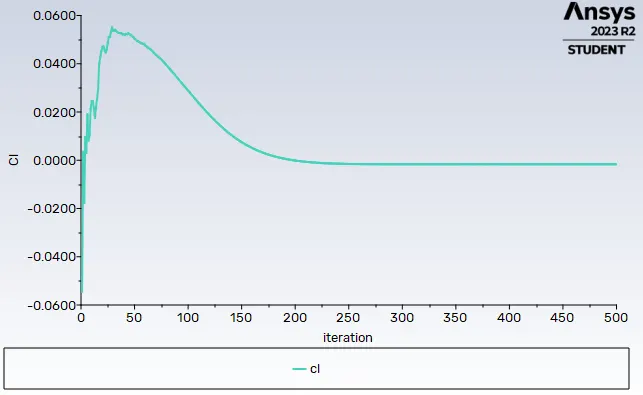 |
| 100 | 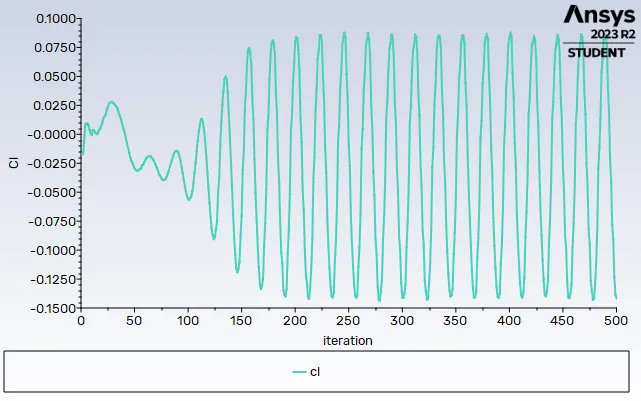 |
| 1000 | 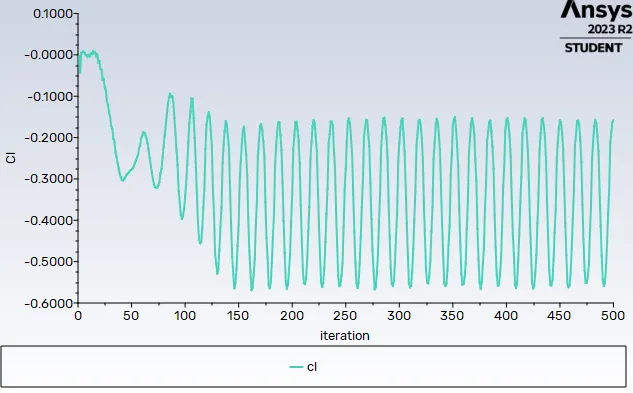 |
| 10000 | 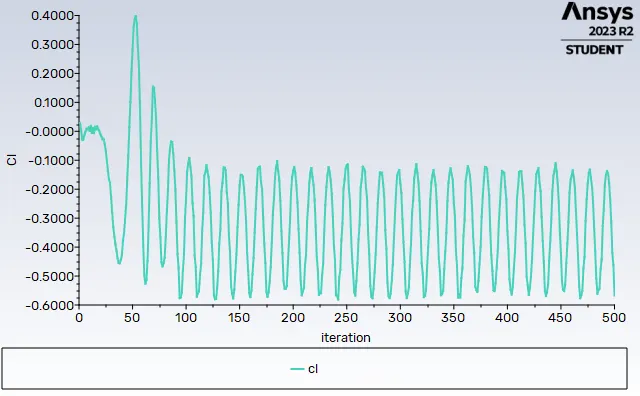 |
| 100000 | 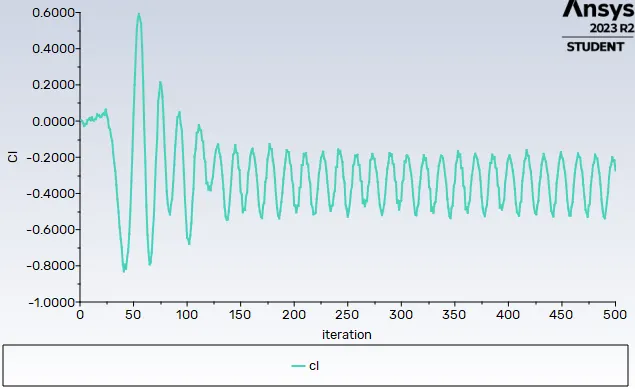 |
Velocity contours
| Re | Velocity contour after 500 iterations |
| 10 | 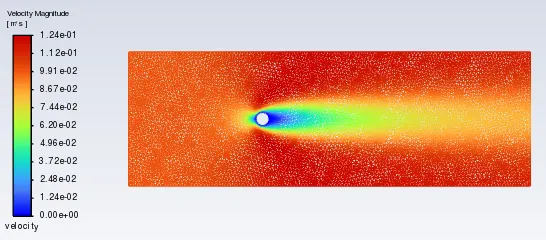 |
| 100 | 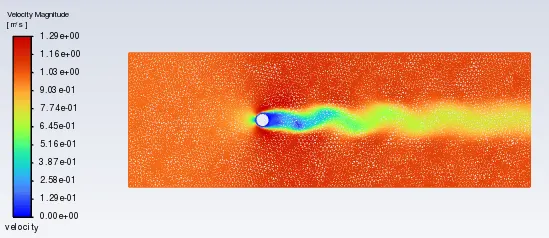 |
| 1000 | 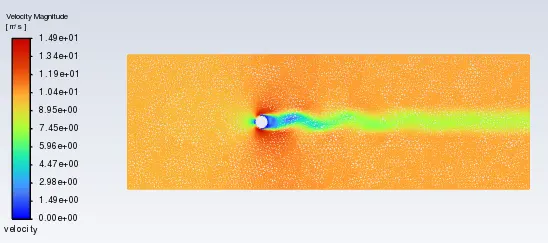 |
| 10000 | 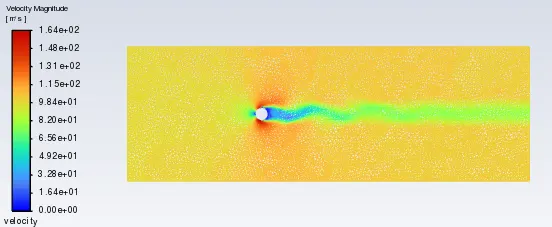 |
| 100000 | 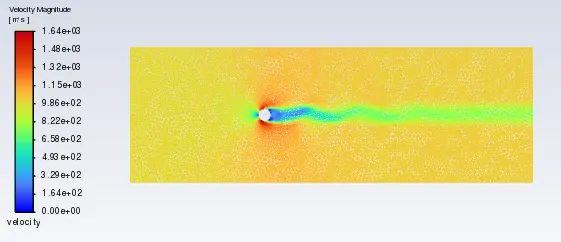 |
Pressure contours
| Re | Pressure contour after 500 iterations |
| 10 | 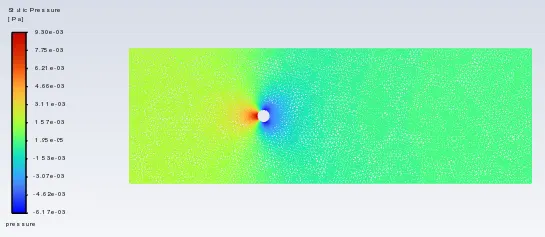 |
| 100 | 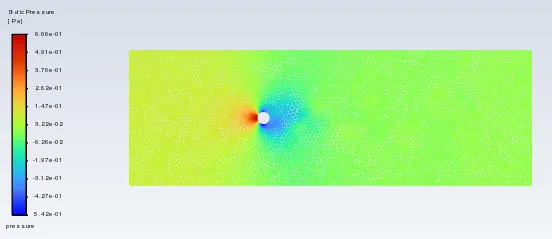 |
| 1000 | 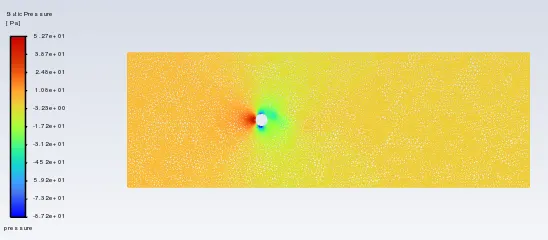 |
| 10000 | 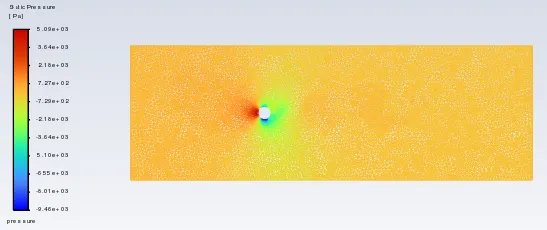 |
| 100000 | 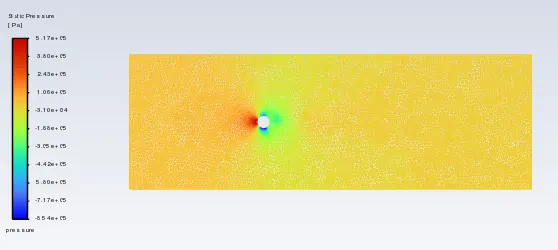 |
Karman vortex street animations
| Re | Vortex shedding animation after 500 iterations |
| 10 | 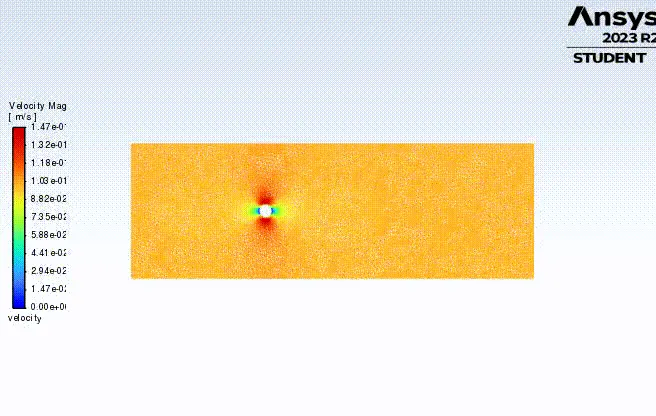 |
| 100 | 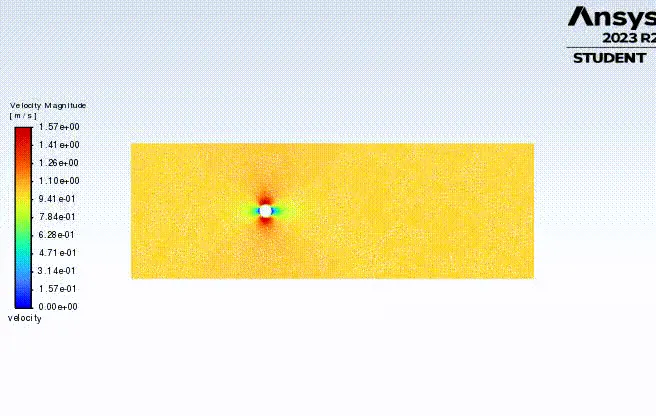 |
| 1000 | 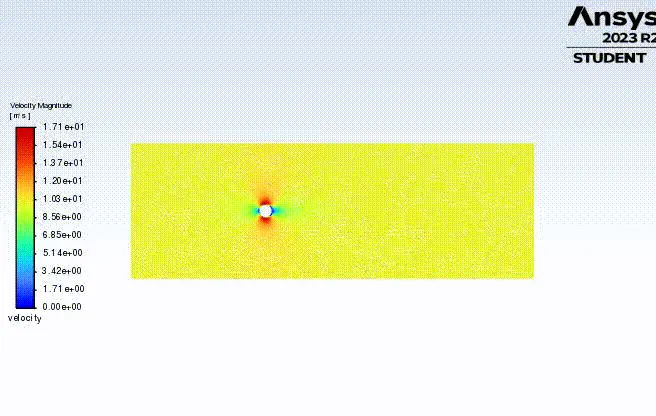 |
| 10000 | 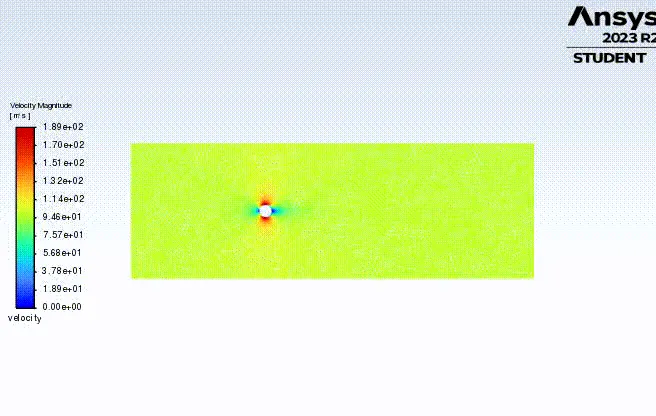 |
| 100000 | 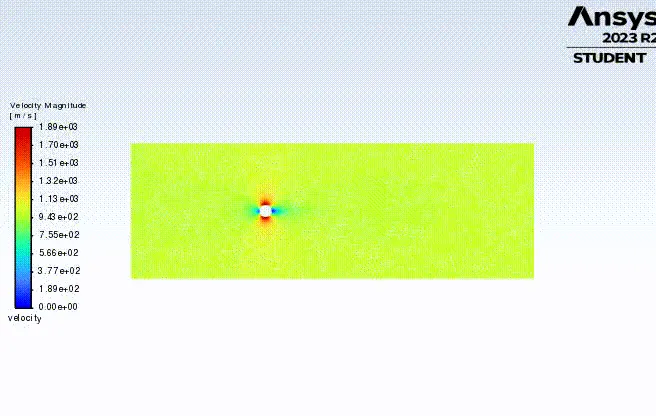 |
Conclusions
- All simulations fairly resemble the phenomenon in accordance with theory.
- Karman Vortex Street was observed in the velcity contours of flow over cylinder at Reynolds number greater than 40.
- In all simulations, converged results were obtained. This can be observed from the plots showing vertex average velocity at monitor point and scaled residuals plot. In the cases where Karman Vortex Street was obtained, convergence can be observed from the stability of coefficient of lift plot as well.
- With the increase in Reynolds number, the coefficient of drag decreased, as evident in Table 1.
- The frequency of vortex shedding increases with increase in Reynolds number.
Reference
[1] Rajani, B. N., Kandasamy, A., & Majumdar, S. (2009). Numerical simulation of laminar flow past a circular cylinder. Applied Mathematical Modelling, 33(3), 1228-1247.