Week 2 - Flow over a Cylinder.
Aim
To simulate the flow over a cylinder to visualise and capture the Von Karman vortex street and estimate the Strouhal number for Reynold's number of 100 using steady state and unsteady simulations. Further, estimate the lift and drag coefficients on the cylinder at Reynold's numbers of 10,100,1000,10000,100000 and validate with literature.
Introduction
Vortex Shedding and the Von Karman Vortex Street
Vortex shedding is a flow phenomenon that typically occurs during flow past bluff bodies. In this flow, vortices are generated behind the body and are detached periodically alternating from side to side.
The Von Karman Vortex street is the pattern of swirling vortices behind the bluff bodies created by the vortex shedding.
Strouhal Number
The Strouhal number is a non-dimensional parameter defined as the ratio of the inertial forces due to the unsteadiness of the flow and is often used to describe oscillating flow patterns.
`St = (fd)/U`
where,
f - frequency of vortex shedding [1/s]
d - characteristic length [m]
U - Free stream Velocity [m/s]
Lift and Drag Coefficient
In order to compare the lift and drag forces acting on various bodies in a fluid flow, a non-dimensionalisation of the forces is required. This is done using the lift and drag coefficients which relate the lift/drag force to the dynamic pressure, frontal area and the velocity of the fluid.
Equations for the lift and drag coefficients are given as:
`Cl = l /(1/2rho V^2 S)`
`Cd = d /(1/2rho V^2 S)`
where,
Cl, Cd - Lift/Drag Coefficients [-]
l/d - Lift/Drag Forces [N]
`rho` - Density of the fluid [`(kg)/m^3`]
V - Free stream velocity of the fluid [m/s]
S - Characteristic Area/ Frontal Area [`m^2`]
In the case of 2D bodies, the section lift/drag coefficient is used which computes lift/drag at a given cross-section of the geometry and the characteristic area is replaced by a characteristic length.
Method
Geometry and Fluid Domain
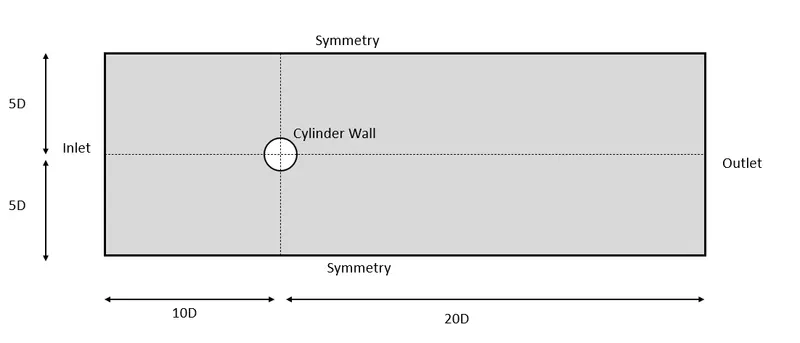
Two-dimensional simulations were preferred for this study as the cylinder is considered to have an infinite span. In the current study, a cylinder of diameter D =2m is considered for the analysis. The fluid domain generated around the cylinder extends to 10D upstream of the cylinder and 20D downstream of the cylinder with the top and bottom sides extending to 5D lengths as seen in the schematic below:
Mesh
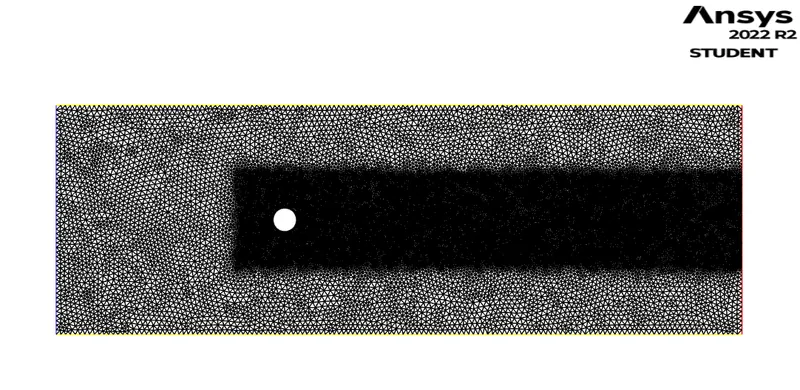
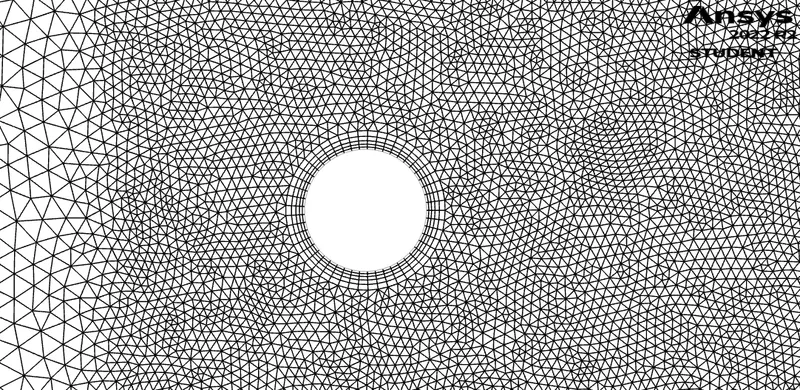
The fluid volume was then meshed using tetrahedral cells with a global element size of 0.25m with 5 prism layers added over the cylinder wall with a transition ratio of 0.6 to allow a gradual transition from prism layers to the bulk mesh. Additionally, a body of influence was imposed on the fluid domain in the region of the expected wake behind the cylinder with element sizing of 0.15m
Solver
For the steady-state simulations, the pressure-based Simple scheme was used and the unsteady simulations used the pressure-based PV coupled scheme to discretize pressure and momentum. Since the Reynold's number of the flow is relatively small, the laminar turbulence model was used. Hybrid initialisation was used to initialise the solution.
A custom fluid was used in the study to simulate accurate Reynold's numbers with properties tabulated below:
| Property | Value |
| Density | 1 [`kgm^-3`] |
| Dynamic Viscosity | 0.02 [`kgm^(-1)s^(-1)`] |
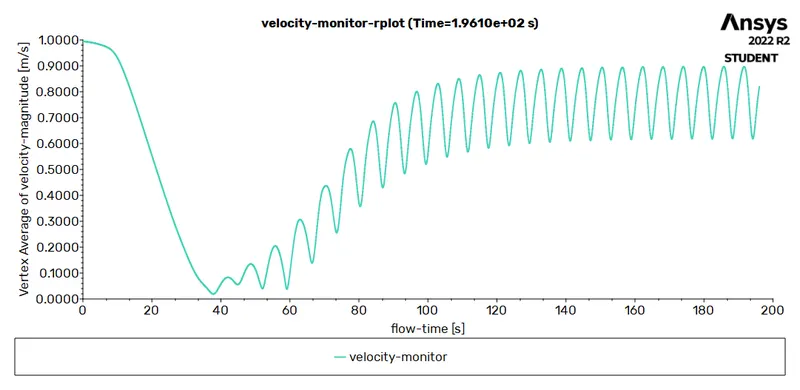
Convergence of the simulations was monitored using the plots of lift, drag and velocity monitor at location 5D downstream of the cylinder. Simulations were deemed converged when consistent periodic oscillations of the parameters were observed. The steady-state simulations typically took under 1000 iterations to achieve convergence. The unsteady simulations took about 200 flow seconds with a time step of 0.1s to achieve convergence with a well-established Von Karman Vortex Street.
The diameter of the cylinder (2m) was considered as the characteristic length required to estimate the coefficients of lift and drag.
Results
Part 1: Simulation of the Von Karman Vortex Street and estimation of Strouhal Number at Re=100
Steady State:
The image below shows the instantaneous velocity field at Reynolds number of 100 performed using steady-state simulations.
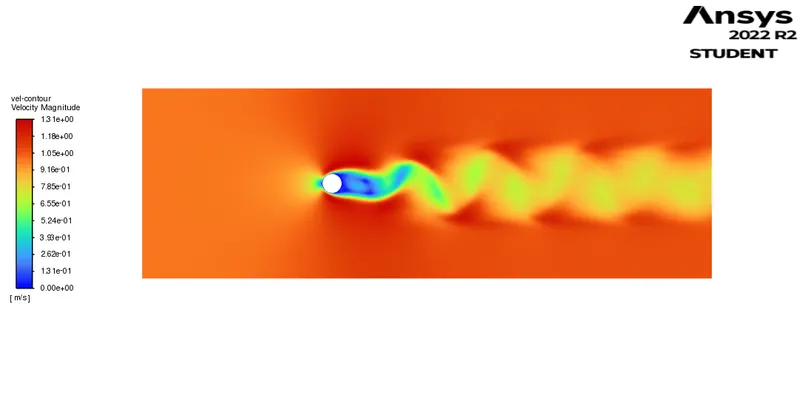
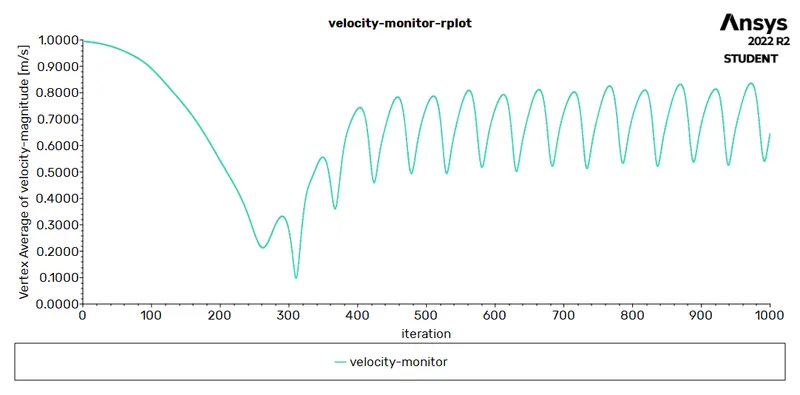
The velocity monitor in the image below reflects the periodic oscillation of velocity seen in the velocity contours above.
Unsteady Simulation:
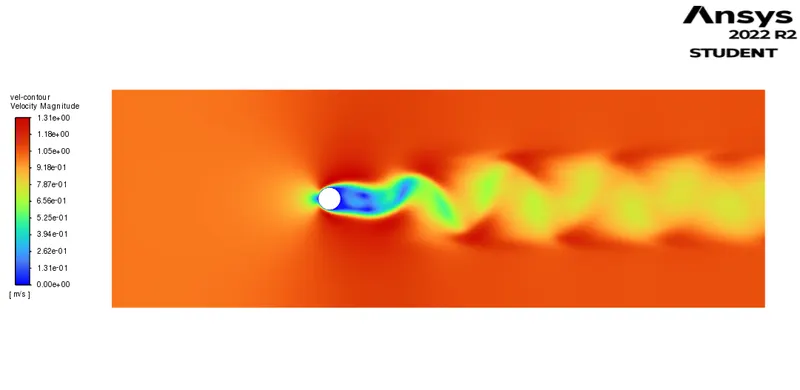
The image below shows the instantaneous velocity field at Reynolds number of 100 performed using unsteady simulations.
The velocity monitor in the image below reflects the periodic oscillation of velocity seen in the velocity contours above.
This periodic oscillation of velocity can be used to obtain the frequency of vortex shedding used to estimate the Strouhal number as:
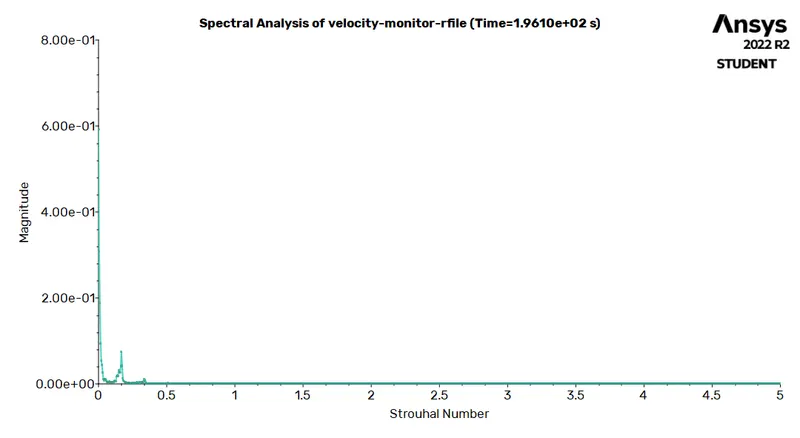
From the graph above, the Strouhal number of the flow is 0.17
Part 2: Estimation of Lift and Drag coefficients at various Reynold's numbers
Re10
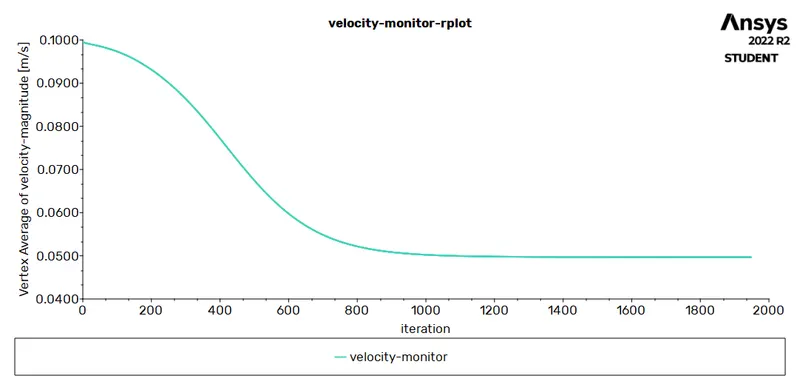
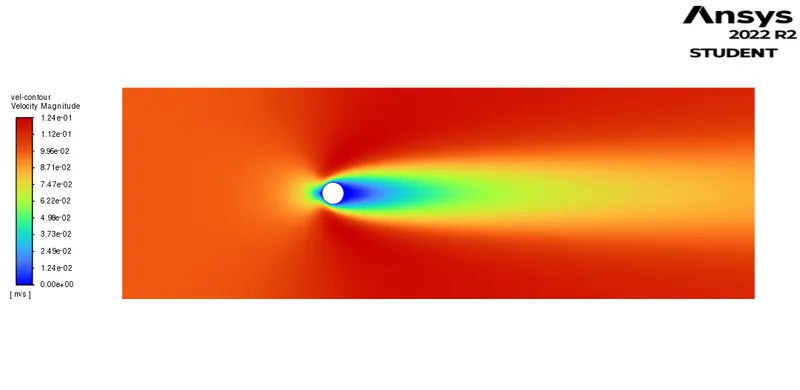
Variations of Lift and drag coefficients with iterations can be seen below. The averaged Cl = 0.049 and averaged Cd = 3.32.
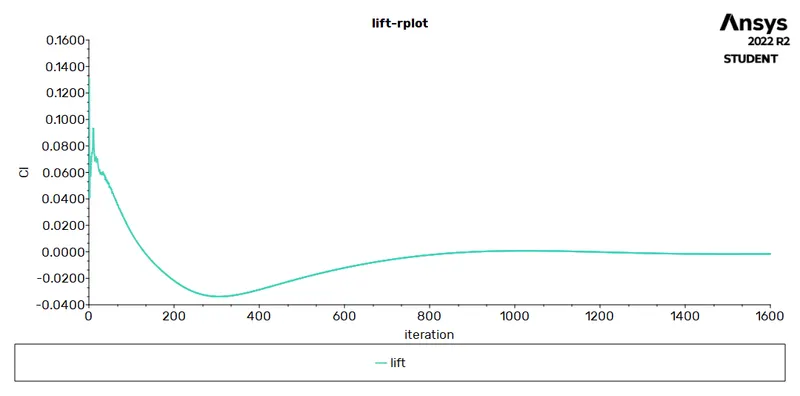
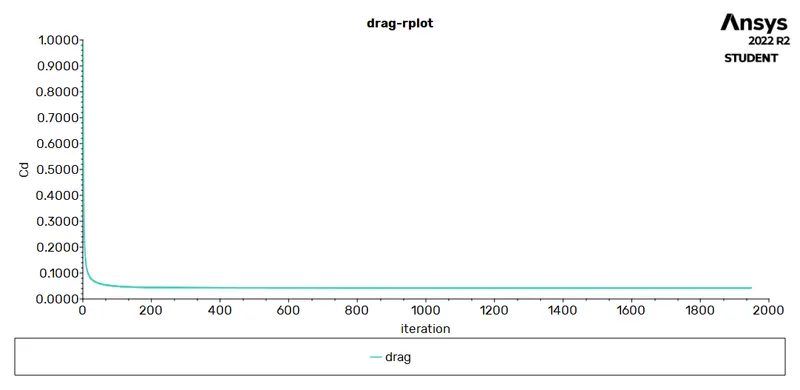
Velocity monitor to ensure convergence along with instantaneous velocity field to visualise the von karman vortex street
Re 100
Variations of Lift and drag coefficients with iterations can be seen below. The averaged Cl = 0 and averaged Cd = 1.36.
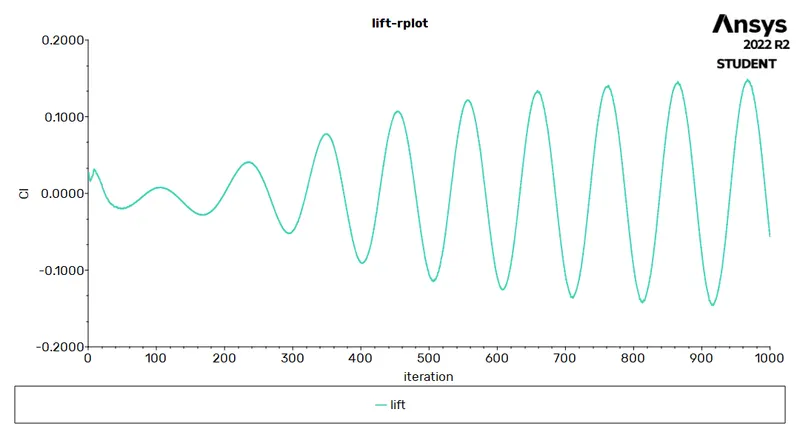
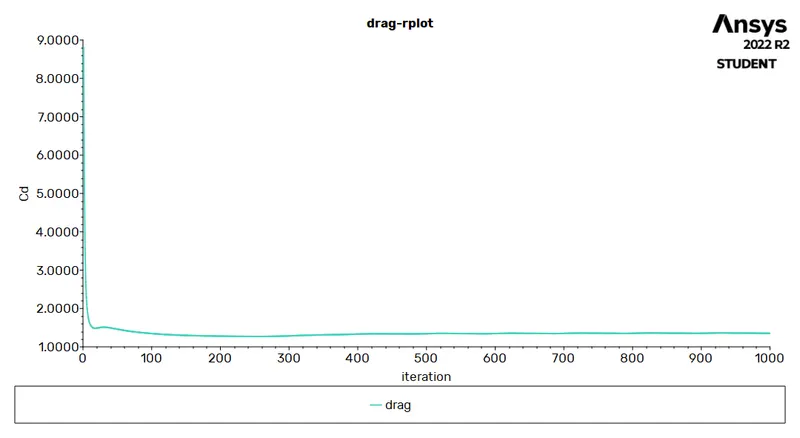
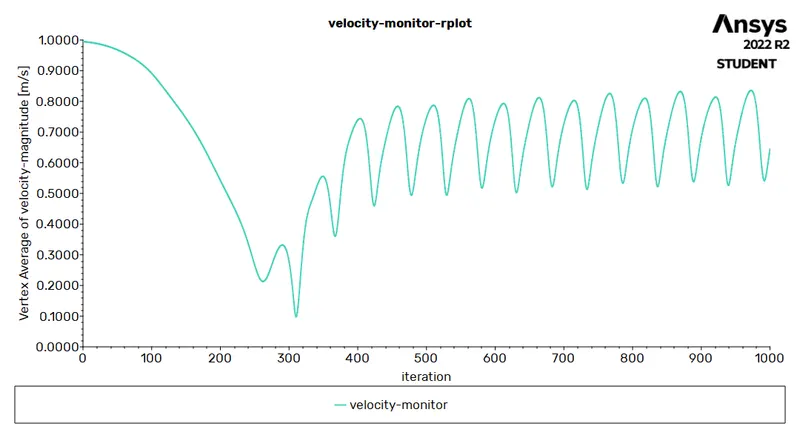
Velocity monitor to ensure convergence along with instantaneous velocity field to visualise the von karman vortex street
Re 1000
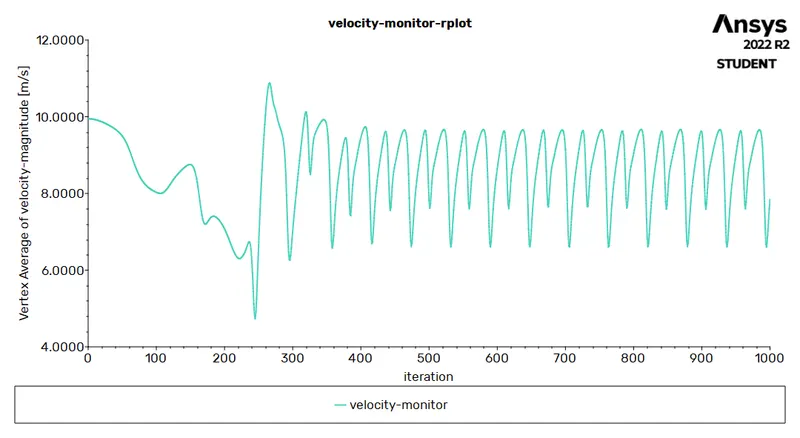
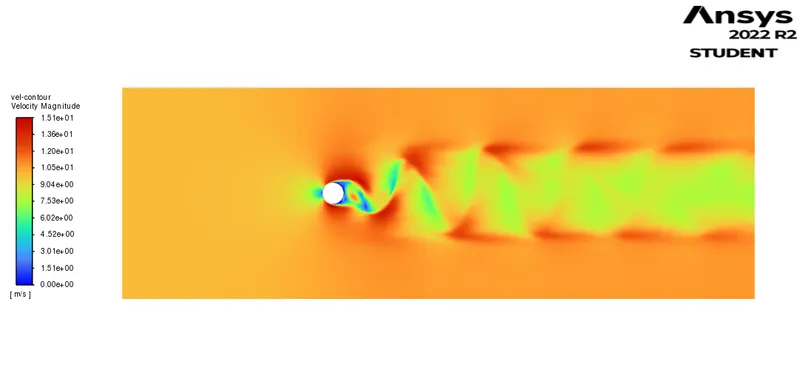
Variations of Lift and drag coefficients with iterations can be seen below. The averaged Cl = 0 and averaged Cd = 1.37.
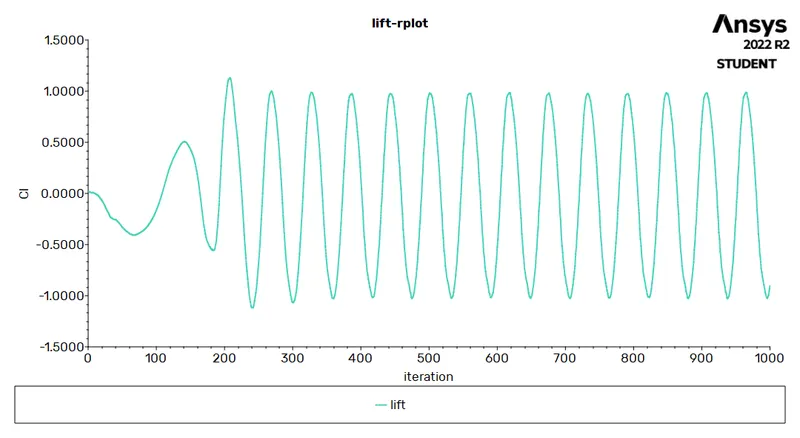
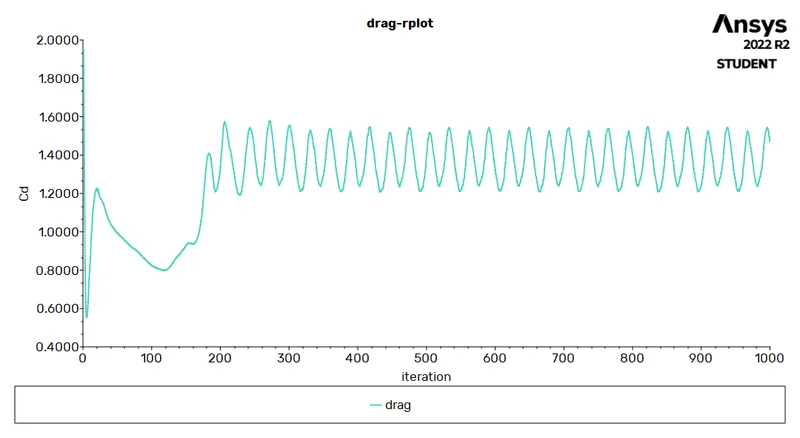
Velocity monitor to ensure convergence along with instantaneous velocity field to visualise the von karman vortex street
Re 10000
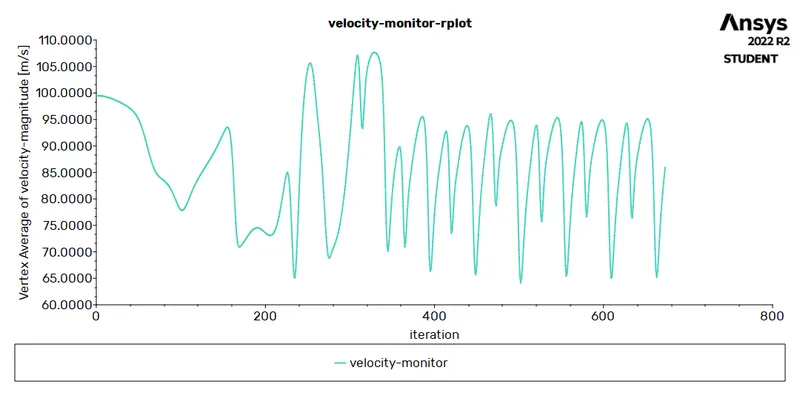
Variations of Lift and drag coefficients with iterations can be seen below. The averaged Cl = 0 and averaged Cd = 1.48.
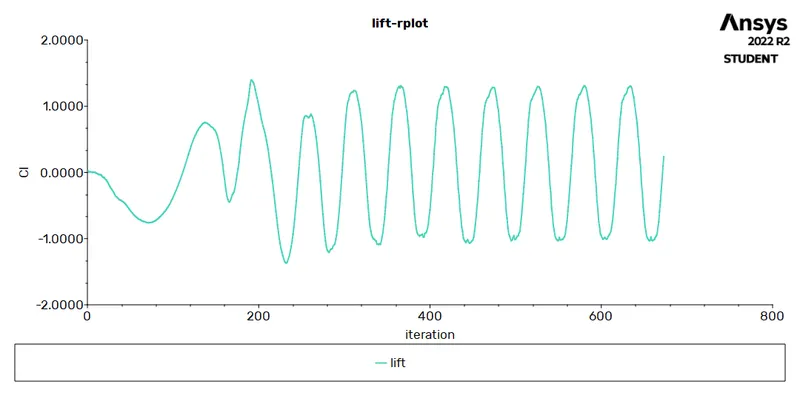
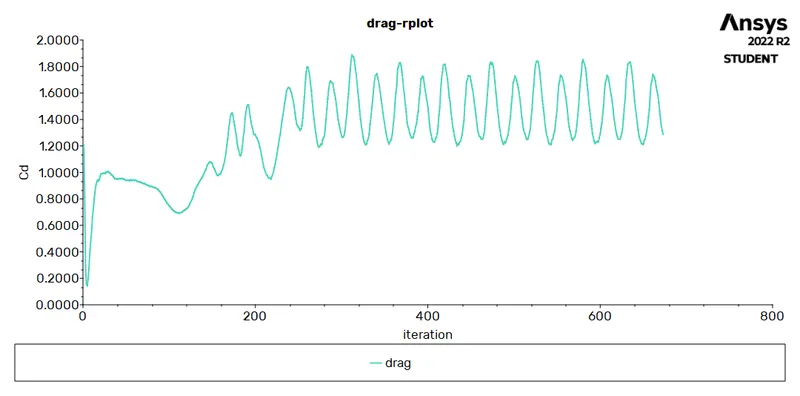
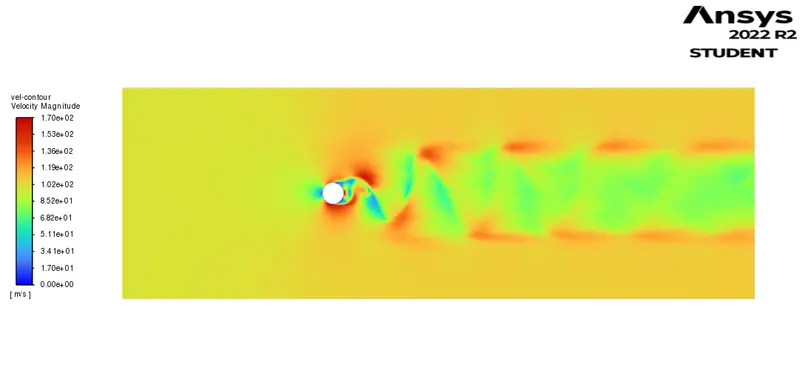
Velocity monitor to ensure convergence along with instantaneous velocity field to visualise the von karman vortex street
Re 100000
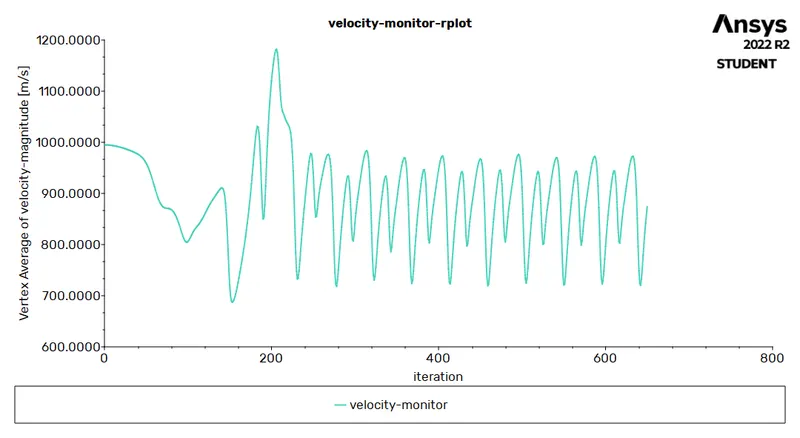
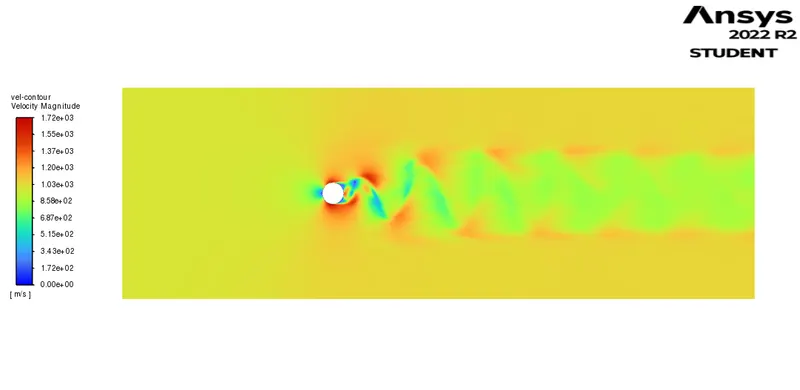
Variations of Lift and drag coefficients with iterations can be seen below. The averaged Cl = 0 and averaged Cd = 1.11.
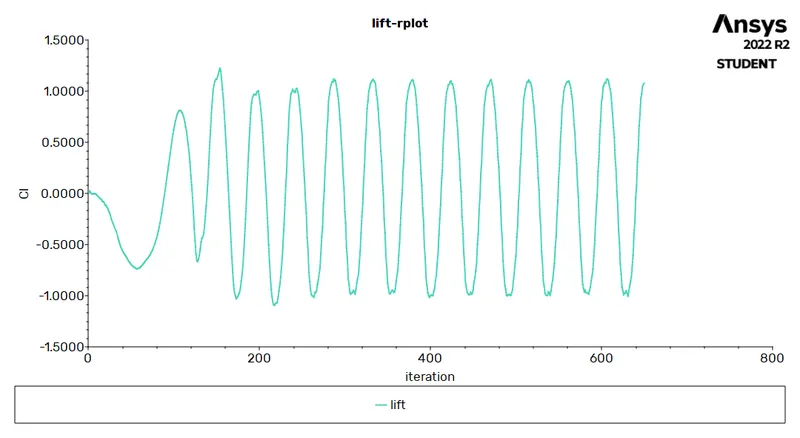
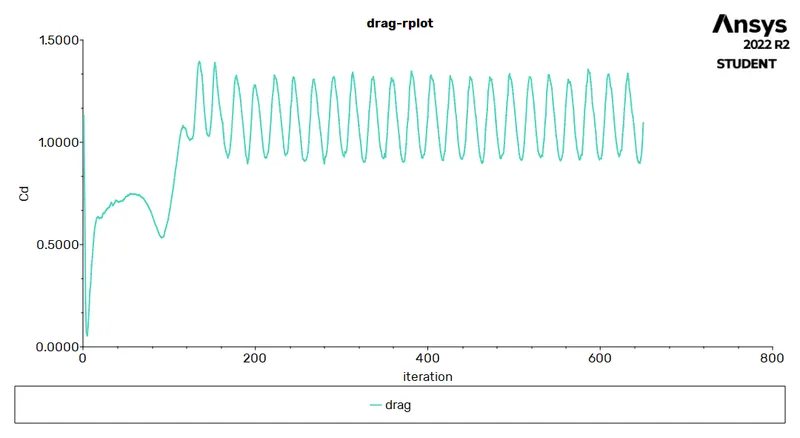
Velocity monitor to ensure convergence along with instantaneous velocity field to visualise the von karman vortex street
Drag Coefficient Validation with the literature [1]
| Reynold's No. | Cd |
| 10 | 3.32 |
| 100 | 1.36 |
| 1000 | 1.37 |
| 10000 | 1.48 |
| 100000 | 1.11 |
From Rajani et al [1] we obtain the mean drag coefficient acting on a circular cylinder at Reynold's number 100 as 1.4. Comparing the result to the current study (`Cd_(Re_(100))` = 1.36), the error percentage is 2.8% and thus sufficiently under the 5% error margin.
Conclusion
Steady and Unsteady simulations were performed to simulate low Reynolds number laminar flow over a circular cylinder. Vortex shedding and the Von Karman vortex street were observed and the Strouhal number was estimated for Reynolds number of 100. Further, the lift and drag coefficients were obtained for the circular cylinder at various flow Reynolds numbers (10,100,1000,10000,100000) and validated with literature.
References
1. B.N. Rajani, A. Kandasamy, Sekhar Majumdar, Numerical simulation of laminar flow past a circular cylinder,
Applied Mathematical Modelling, Volume 33, Issue 3, 2009, Pages 1228-1247, ISSN 0307-904X.