Simulating Von-Karman Vortex-Street
Ever wondered why the coffee falls on the ground or sticks to the cup while you are pouring it from one cup to another. Yes, we have all been there, and there is a name to our little, yet annoying problem. It is called the Coanda effect. It is the reason why an aircraft flies.
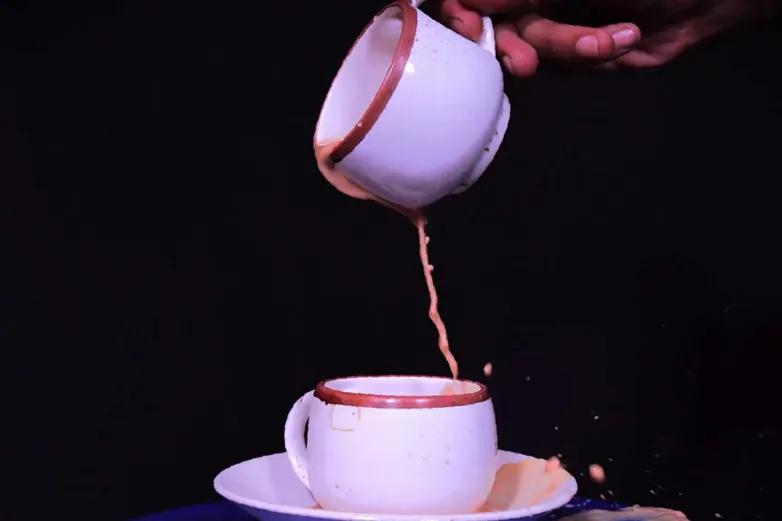
Coanda effect
The Coanda effect is the tendency of a fluid to be attached to a convex surface. Watch the following videos for some insights.
Many prominent scientists claim that the Coanda effect is a major reason why there is an atmosphere on earth or any other planet. This is in direct contradiction with Newton’s laws, which suggest that mass and gravity are the reason for the atmosphere on planets. We might never know which is true. Science is unpredictable, theories have been disproved after centuries of their acceptance.
Giordano Bruno was burnt alive for his views on cosmology. His last words were "Perhaps you who pronounce my sentence are in greater fear than I who receive it."
Watch the following videos for the visualization and explanation of the Coanda effect.
Reynolds number – It is a dimensionless parameter, that helps in predicting the flow behavior. It is defined as the ratio of inertial forces to viscous forces within a fluid which is subjected to relative internal movement due to different fluid velocities.
`Re=(rhovd)/mu`
where,
`rho` is the density of the flow
`v` is the velocity of the flow
and `mu` is the viscosity of the flow.
Strouhal number - It is in simple words, the measure of flow oscillation/ fluctuation.
`St=(omegal)/mu`
where,
`omega` is the frequency of oscillation
and `l` is the characteristic length.
Okay, as the prerequisites have been discussed, let us get back to the project, here we simulate a laminar flow around a cylindrical object.
Software used - Ansys Fluent
Analysis - 2D
Reference values -
density = 1
velocity = 1
But what is so special about this flow?
It is just a normal flow around an object until you reach a specific Reynolds number, i.e., 100. At this Reynolds number, the fluid flow generates oscillating vortices behind the cylinder, and this phenomenon is named the Karman Vortex Street.
The reason for this development is when the flow passes through a circular object, the friction from the flow pulls the molecules right behind the object with it. This creates a low-pressure area behind the object, which eventually makes flow move in that region.
So, does this mean, we have a Karman vortex sheet for all objects? A simple answer is NO. Here is where the Coanda effect comes into the picture since a cylinder is a convex-shaped object. The flow attaches and moves along the surface of the cylinder. The momentum of the flow from both the bottom and top surface of the cylinder helps in the growth of Karman vortex street.
So, flow around a convex surface should form Karman vortex streets, right? The answer is No again. If the inertial forces are not enough, then the vortices will not develop. Reynolds number comes into the picture here, the Reynolds number must be at least 40 for initialization of vortices. A Reynolds number of 100 is decent for visualization of Karman vortex street.
Procedure
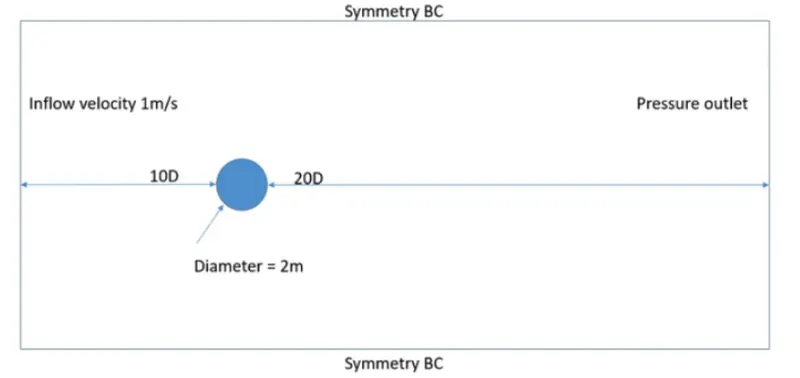
1. Create geometry as shown below using Spaceclaim
2. Meshing
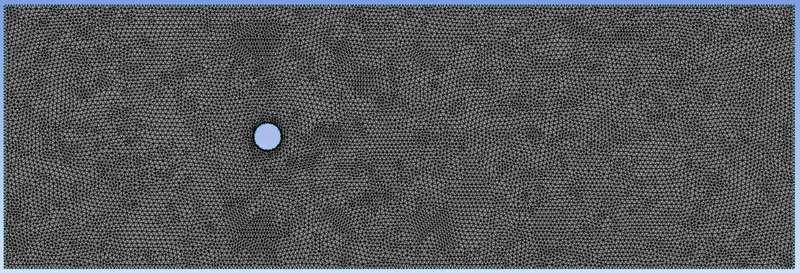
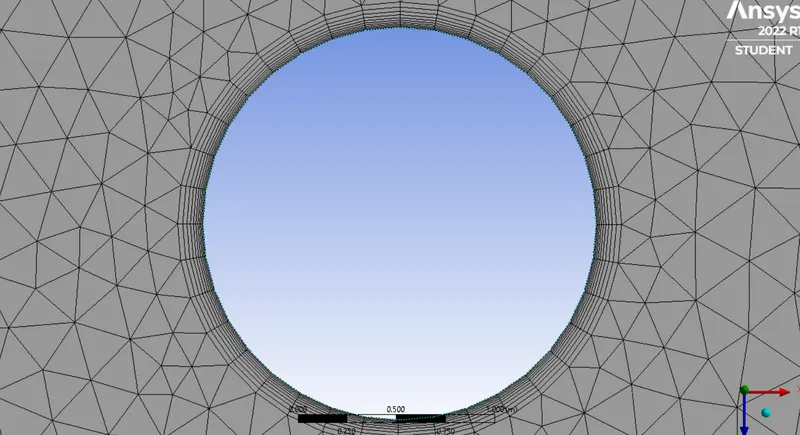
Meshing is an important step for this project. If the mesh is not refined properly, the vortices will not form even if the physics are set up correctly.
Number of nodes used - 14605
Number of elements - 28280
Methods - Triangular elements; Inflation layers; Edge sizing.
3. Setting up physics
Solver - Pressure based
Time - Steady for steady-state
- Transient for Unsteady state
Viscous Model - Laminaar
Material - As per requirement
4. Solution and Results
Plots used - Coefficient of Drag; Coefficient of Lift; Velocity variation at distance 4d from the center of the cylinder
Animation - Velocity animation
Part 1 - Simulation of flow with the steady and unsteady case at Re = 100
1. Steady-state
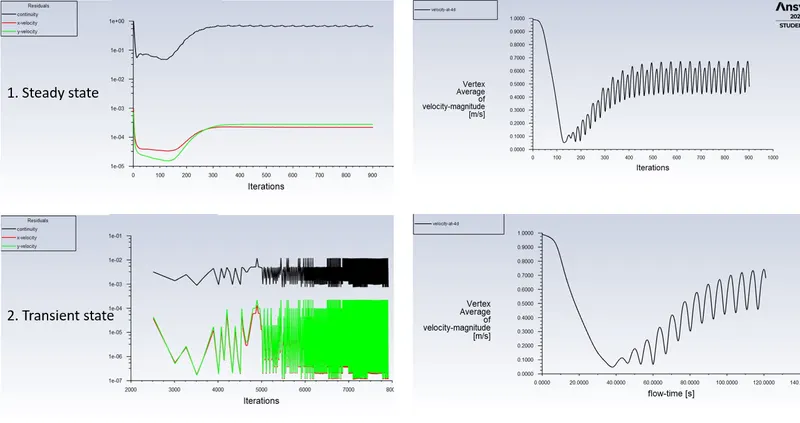
The residuals have become stable after 400 iterations, which means that the solution has converged pretty fast and is stable. The velocity at the point is uniformly oscillating, which again means that the steady-state has been achieved and the Karman vortex street has formed.
2. Unsteady/ Transient state
Time step = 0.1
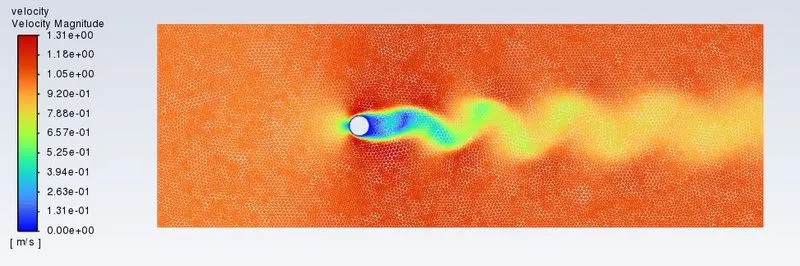
From the graphs, one might think that the solution has not converged yet, but it is necessary to observe that the residuals are varying, but are varying in a specific range. The solution is either converged or is still under convergence in this case.
It is also important to notice the number of iterations in the transient analysis case. Even after 8000 iterations, the solution has not achieved the steady-state condition. The simulation was made to run on 4 core processors and it took almost 30 min to achieve this. This explains why CFD is expensive.
`St=(omegal)/mu`
The frequency of oscillation has been calculated manually from the time period found in the graph.
Time period = 8 sec
omega = 1/8
Characteristic length = diameter = 2
Strohoual number for the velocity at a point which is at a distance of 4d = 0.25.
Strohoual number can also be calculated for lift or drag coefficients.
Part 2 - Effect of Reynolds number
Reynolds number was controlled by changing the viscosity of the flow.
For Reynolds number = 10
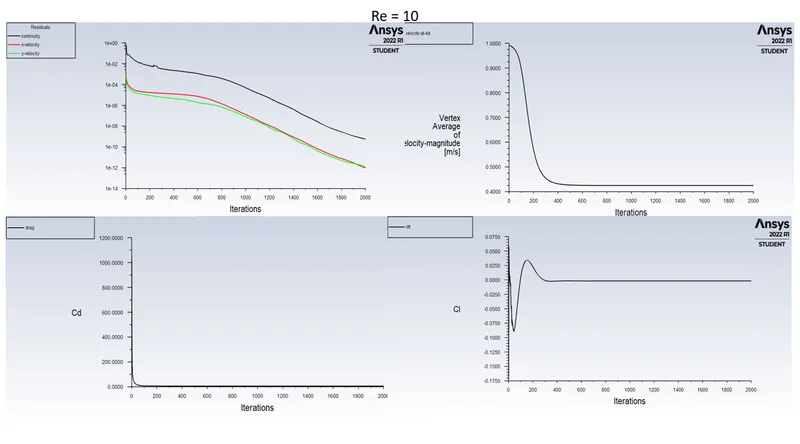
The residuals from the above graphs are still falling, which means that the solution is not yet converged. But, from the velocity, drag coefficient, and lift coefficient plots, it can be said that the flow has converged.
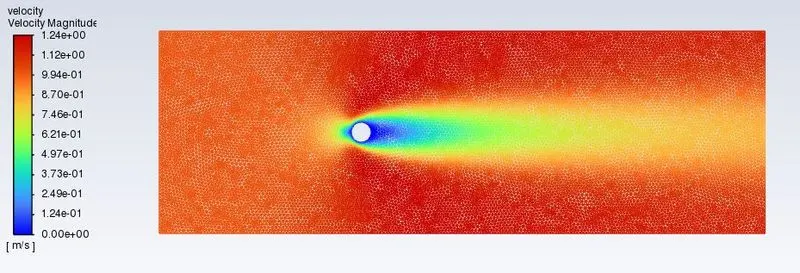
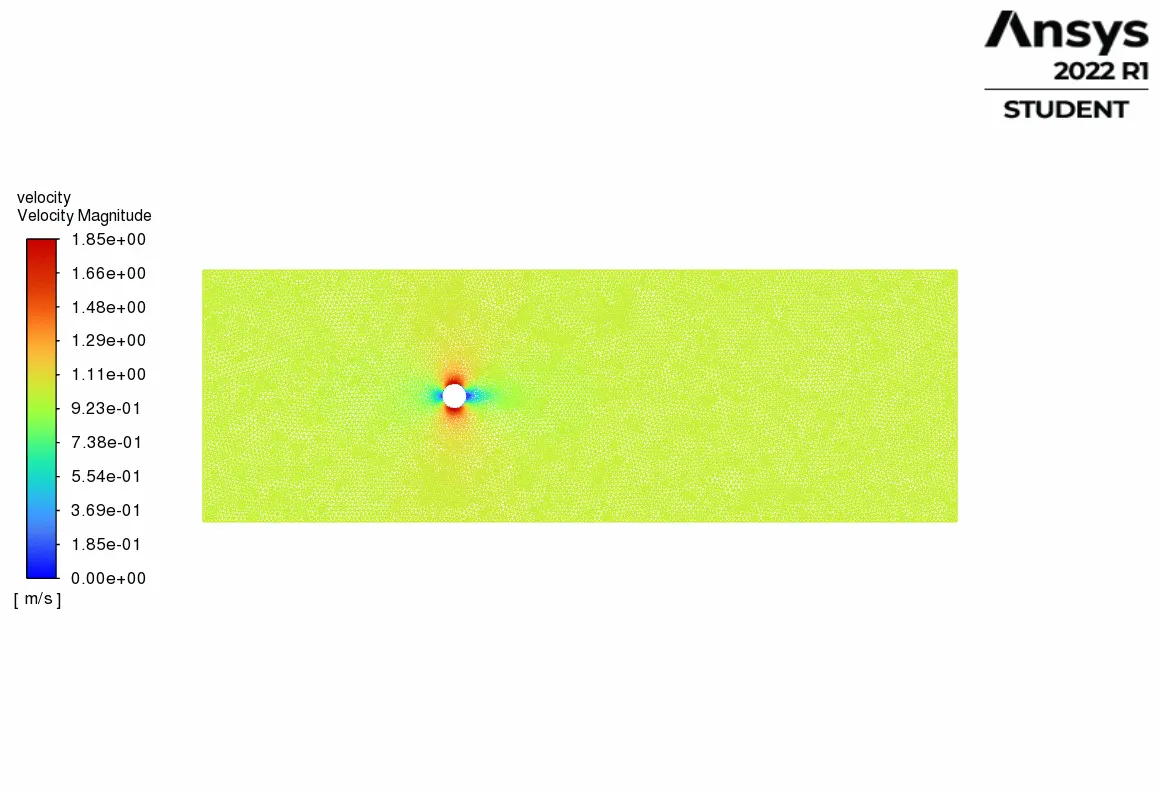
Clearly, the formation of Karman-vortex street cannot be seen. This is because the Reynolds number is too low to even generate counter-rotating vortices. Only after the generation of Counter-rotating vortices, the formation and growth of the Karman-vortex street can be seen. As per literature, this critical Reynolds number is around 49.
Re= 1e2, 1e3, 1e4, 1e5.
Residuals
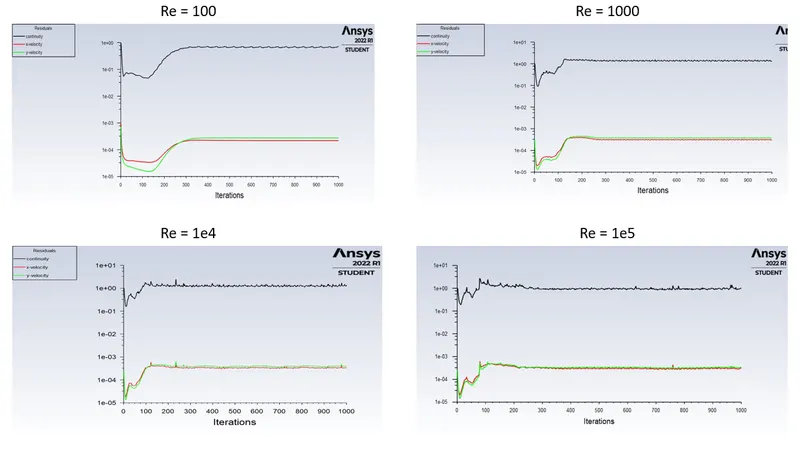
For all the cases of Reynolds number used in this problem other than 10, the solution converges from the residuals point of view in around 300 iterations.
Velocity at a point 4d from the center of the cylinder
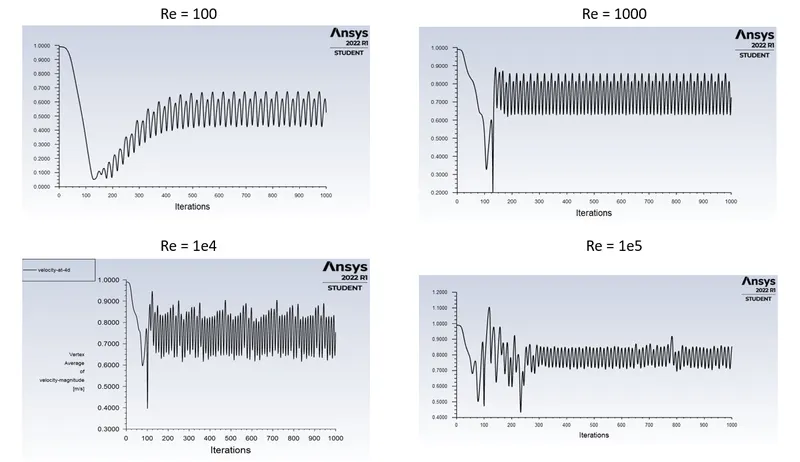
As the Reynolds number of the flow increased, the velocity of the flow also increased at the point of the study. The number of iterations required to achieve the final state decreased with increasing Reynolds number.
Flow simulation for Re=1e2
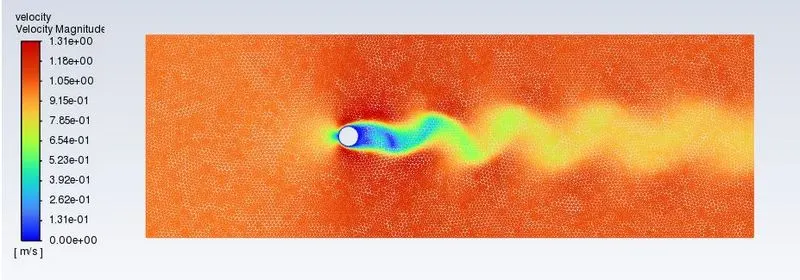
Flow simulation for Re=1e3
In reality, at high Reynolds numbers, the flow becomes 3 Dimensional. The vortices start creating disturbances in a spanwise direction, hence making the situation 3 Dimensional.
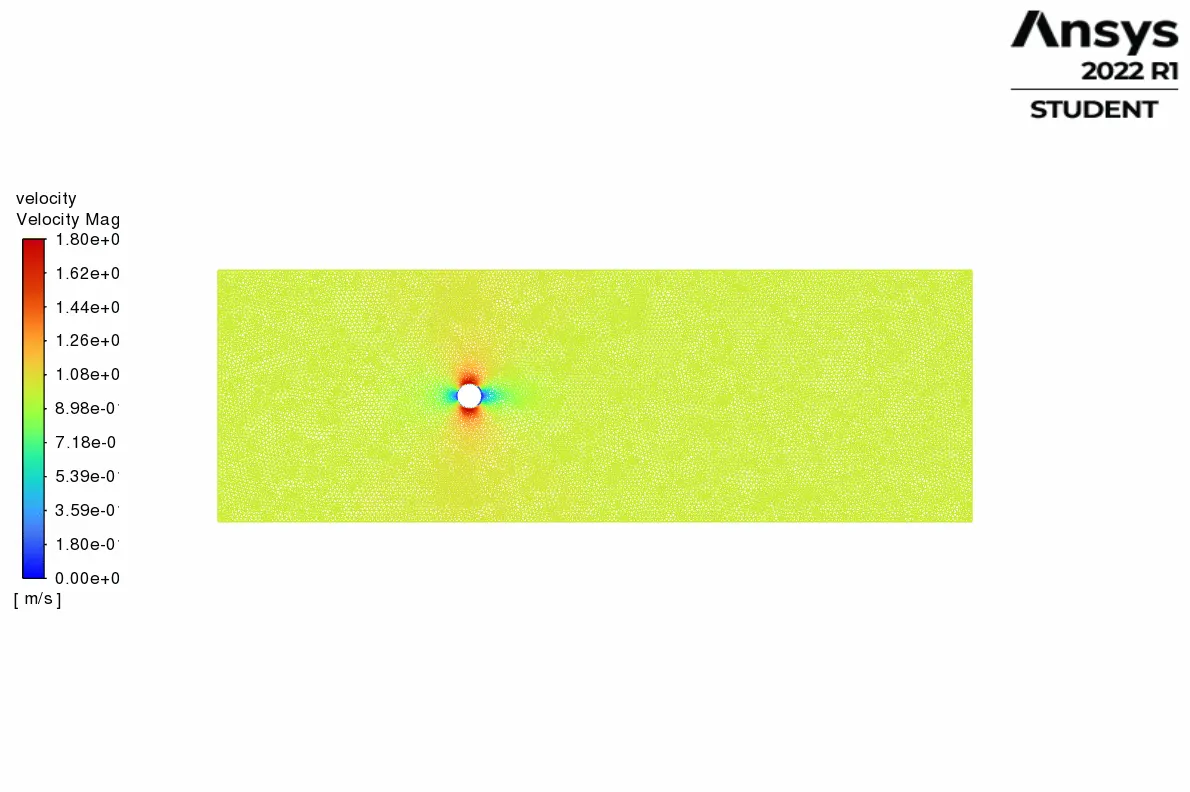
Flow simulation at Re = 1e4
Drag Coefficient
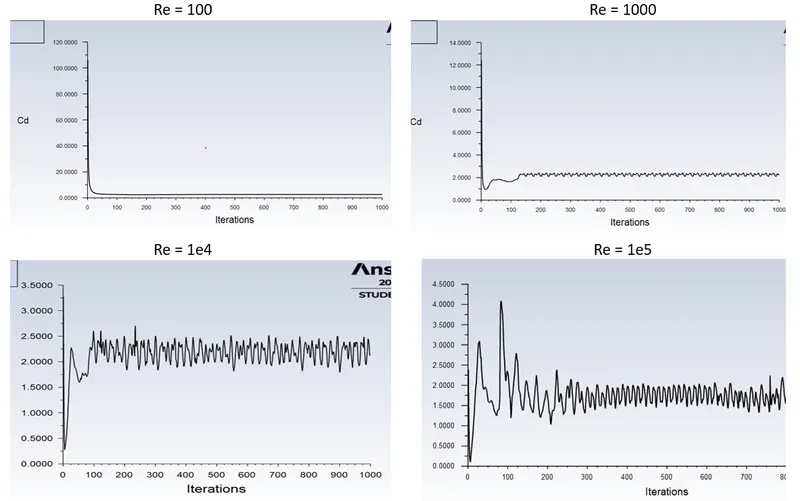
It can be seen that as the Reynolds number increases, the initial drag falls rapidly.
This does not mean that as viscosity decreases, the drag force also decreases. There is no direct relationship between drag and viscosity.
It is a much more complex phenomenon.
At Reynolds number of 100, even though there is a formation of Karman Vortex street, the coefficient of drag does not seem to fluctuate as it does in other cases.
It can also be noticed that as the Reynolds number increases, the fluctuations in the coefficient of drag also increase in amplitude.
Lift Coefficient
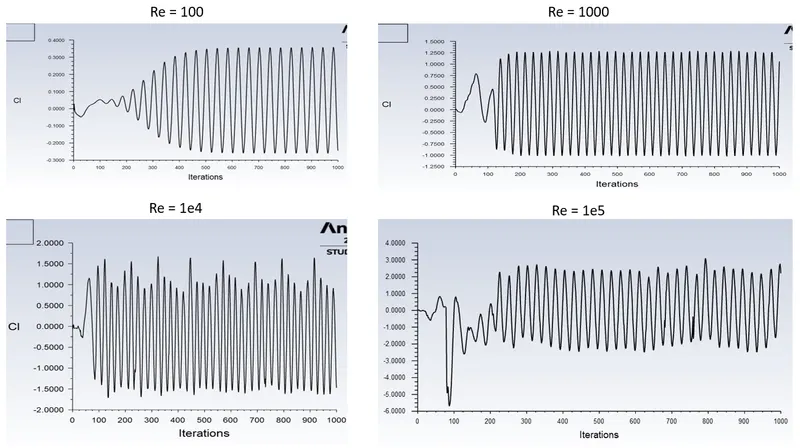
From the fluctuations in graphs, it can be inferred that as the Reynolds number increased, the average coefficient of lift reduces over a period of time.
References