Week - 2 - Explicit and Implicit Analysis
Aim: To Explain the difference between explicit and implicit solver.
Solution:- Finite Element Analysis or FEA is a method of analysing engineering designs by applying simulating forces and other conditions, on the 3D model of object called Finite Element model. The whole 3D model is divided into small elements, which are connected to each other through nodes. The problem needs to be solved at each node, and then approximated between the node.The problem which we are discussing here is Partial diffrential equation, and can be solved using two method called- Implicit method and Explicit method.
Explicit method:- Explicit method calculates the state of system at later time then the state of system at current time. It directly solves the Partial diffrential equation by applying load steps. There is a condition which must be satisfied for getting accurate results using Explicit method. The time step for load increament must be less then the time taken by a sound wave to cross the element length. This condition ensures the accurate and converging results.
Implicit method:- In Implicit method solves the problem using the both states, the current state and the later state of time. The solving process in Implicit method is similar to the Explicit method, but in addition to that, an equillibrium is enforced between the calculated forces and applied forces, by refining the time step at each iteration. This ensures the accurate solution using Implicit method. Due to this enforced equillibrium, the condition of time step being smaller then the time taken to sound wave to cross the element is not necessary. Due to this for small static problems, implicit method suits best.
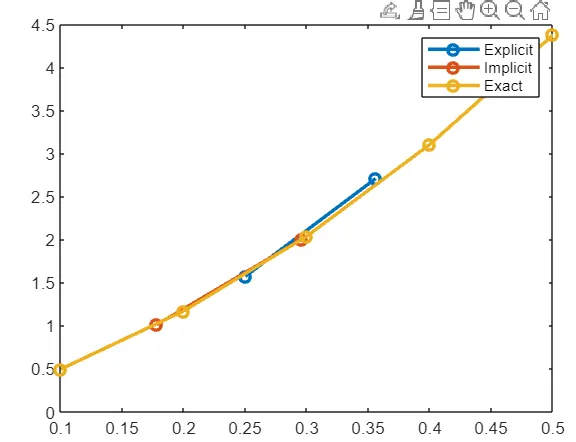
As an example, lets try to solve a problem using explicit and implicit method, and then compare them using graphs.
Eqn. is- F(u) = u3+9u2+4u, and let the total force applied will be 2 N
d F(u)/du = K(u) = 3u2 +18u+4
∆F = K∆u
Using Explicit dynamics-
Step 1:-
u0 = 0.0
K(u0) = 4
∆F1 = 1
∆u1 = 1/4
u1 = u0 + ∆u1
u1 = 0.25
F(u1) = 1.57
Step 2:-
K(u1) = 8.687
∆u2 = 0.115
u2 = 0.365
F(u1) = 2.707
Here, solution is completed. If we compare, total force and calculated force, then the calculated force exeeds the total applied force by 0.707,
Now lets solve the problem using implicit method.
Here the tolerance value is 0.01
For first step the residual is F(u1) - F = 1.57-1 = 0.57
So, correction factor is-
= -k ((u1)(0))-1 (R0)
= -0.57/8.687
= -0.0656
Upadted u1 = 0.184
F(u1)0 = 1.046
Residual = 0.04
Since, its greater then Tolerance, so next iteration is required,
New correction factor is,
= -k ((u1)(1))-1 (R1)
= -0.04/7.413
(u1)1 = 0.178
F(u1)1 = 1.0072
Residual = 0.007
Now, its is smaller then the tolerance, so no further iterations are required.
Now, moving to next step 2:
k(u1) = 7.299
∆u2 = 0.137
u2 = 0.315
F(u2) = 2.184
Residual = 0.184
After first iteration, updated u2 = 0.296
F(u2) = 2.003
Residual = 0.003
Since, its is less then the tolerance limit, so it is the final solution.
Explict Analysis Summary-
| Step (i) | del (F) | ui | F(ext) | f(int) | Residual |
| 1 | 1 | 0.25 | 1 | 1.57 | 0.57 |
| 2 | 1 | 0.365 | 2 | 2.707 | 0.707 |
Implicit Analysis Summary-
| Step (i) | del (F) | ui | F(ext) | f(int) | Residual |
| 1 | 1 | 0.178 | 1 | 1.0072 | 0007 |
| 2 | 1 | 0.296 | 2 | 2.003 | 0.003 |
Here the graphical comparison of both the solutions-