Week 2 - Converging diverging nozzle
OBJECTIVE:
Simulate flow across a Converging-Diverging Nozzle, Plot:
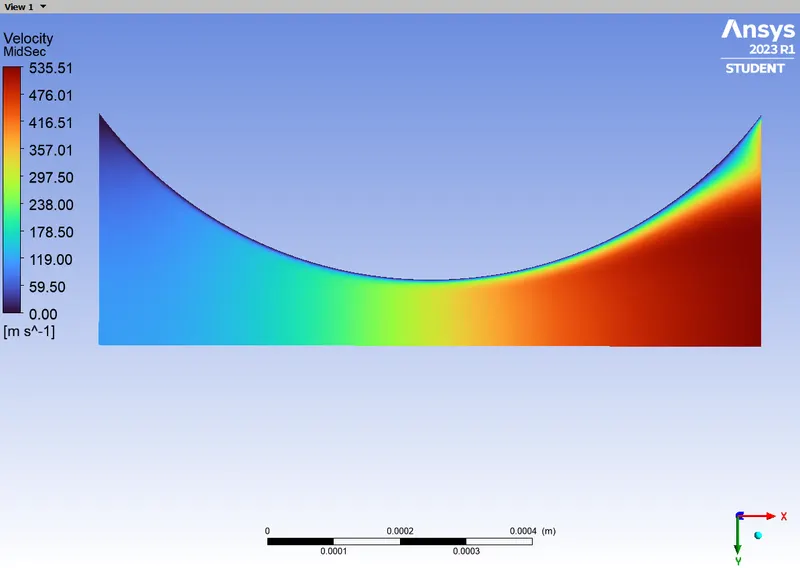
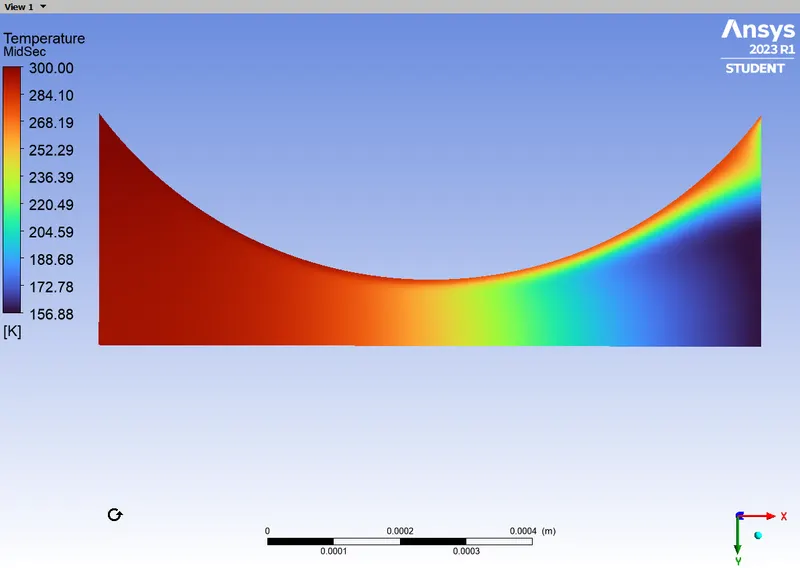
- The pressure, velocity and temperature variations across the domain
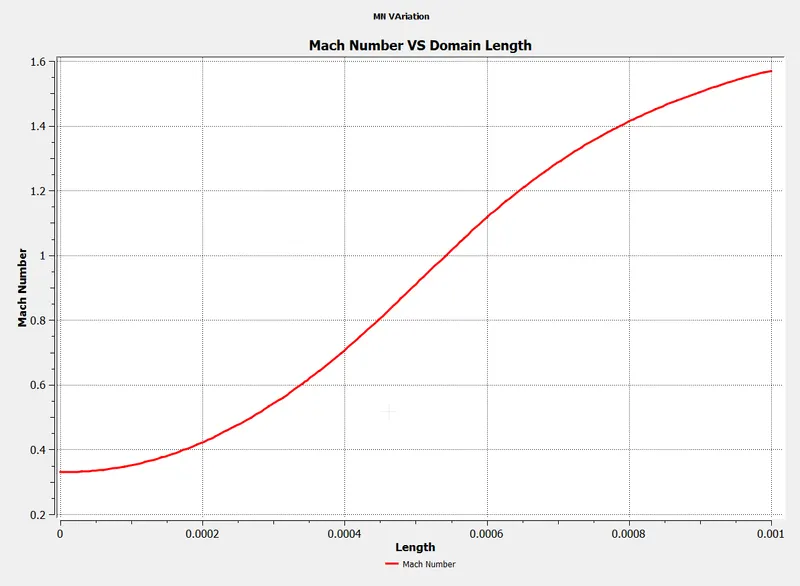
- The interpretation of Mach number across the field and at what distance from the inlet does the flow become supersonic.
THEORY:
A converging-diverging nozzle is an asymmetric hourglass-shaped device used to accelerate compressible fluids to supersonic speeds by converting thermal energy into mechanical energy.
Because the mass flow rate is constant, a subsonic gas flow will speed up if the pipe carrying it gets smaller. The gas flow through a nozzle is isentropic. The gas velocity locally reaches sonic (Mach number = 1.0) levels near the "throat," where the cross-sectional area is at its lowest, and this phenomenon is known as choked flow. When the cross-sectional area of the nozzle rises, the gas starts to expand, and the flow reaches supersonic velocities (Mach number > 1.0).
. As the gas exits the throat, the increased area allows it to undergo a Joule-Thompson expansion, in which the gas expands at supersonic speeds from high to low pressure, pushing the velocity of the mass flow beyond sonic speed.
GEOMETRY:
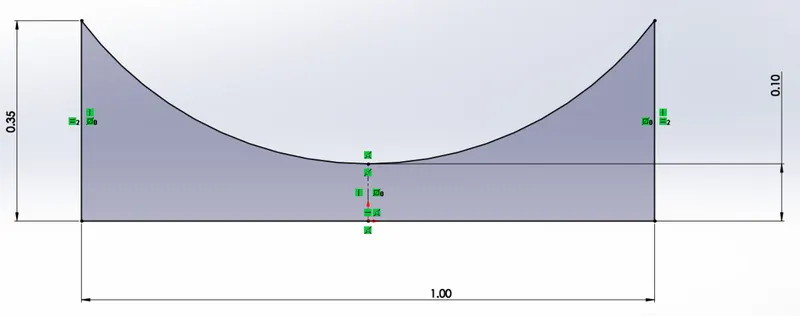
MESHING:
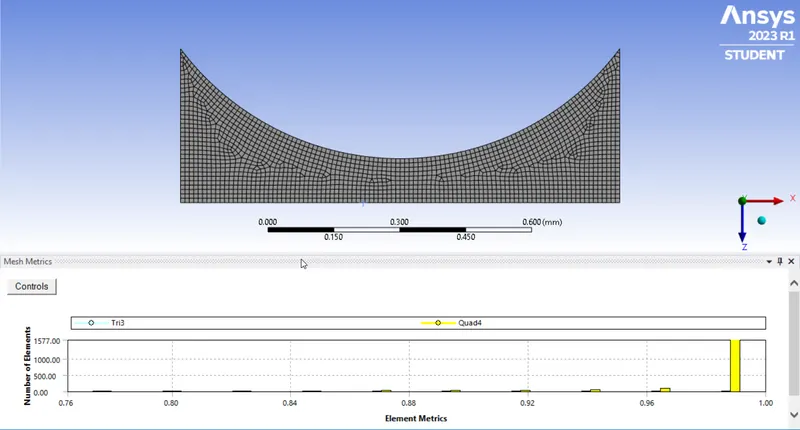
SETUP:
Fluid: Air with ideal gas law
Boundary Conditions:
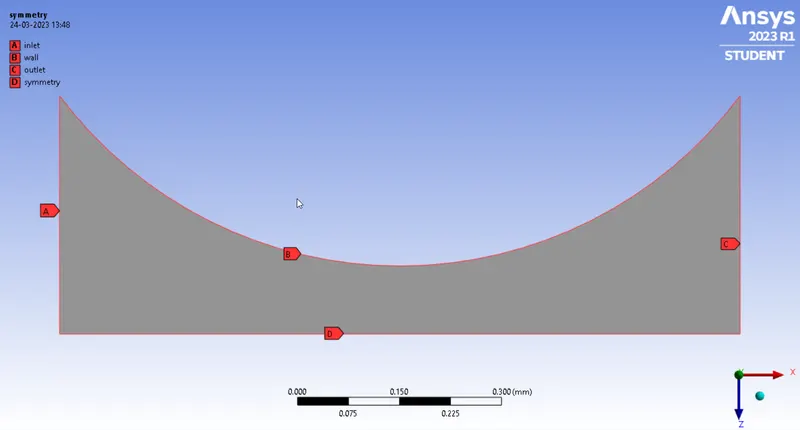
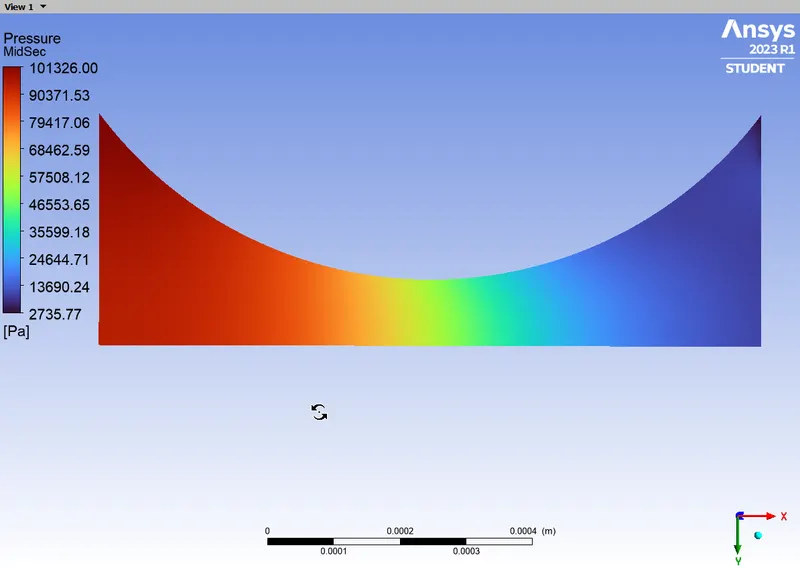
Inlet: pressure inlet @ 101325 Pa
Outlet: pressure outlet @2735.775 Pa
Walls: Wall Boundary Condition
Axis of Nozzle: Symmetry Boundary Condition
Solver: Axisymmetric, Density-Based, Steady-State Solver
Turbulence Model: K-Epsilon Standard with Standard Wall Functions
RESULTS:
Pressure Contour:
Velocity Contour:
Temperature Contour:
Mach Number:
CONCLUSION:
- The flow becomes supersonic (M>1) beyond 0.55 mm from the inlet, i.e. after crossing the throat of the Nozzle, which is in line with the operation of a CD Nozzle.
- The temperature difference can be seen showing how thermal energy is converted to kinetic energy and achieve supersonic velocities.