Week 9 - FVM Literature Review
FINITE VOLUME METHOD:
Finite Volume method is one of the discretization method used in numerical calculus, the others being, finite element method and finite difference method. In this method, the conservation statement or physical law represented by PDE is applied in a form applicable to a space or finite volume. This is done by converting the PDE into integral equations. Let us understand better with an example:
Applying Finite Volume Method on 1-D Heat Conduction Equation:
Consider a discretized mesh as follows: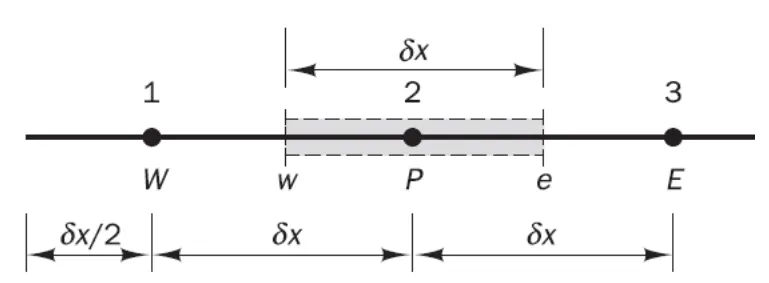
The point P, W and E represent the centres of 3 discrete finite volumes adjacent to each other. The point w and e are the edges shared by `V_p` with `V_w` and `V_e` respectively. The Heat conduction equation can be given as:
`d/(dx)*(k*(dT)/(dx)) + S = 0`
where all the terms have their usual meanings. Integrating this equation over the discretized volume we get:
`int_e^wd/(dx)*(k*(dT)/(dx))dV + int_e^wS*dV = 0`
Further `dV` can be written as `dV = Adx`
therefore, `int_e^wd/(dx)*(kA*(dT)/(dx))dx + bar S*dV = 0`
`implies (kA*(dT)/(dx))_w - (kA*(dT)/(dx))_e + bar S*dV = 0`
which is our discretized equation in finite volume, where `bar S` is the costant rate of heat generation.
NEED OF INTERPOLATION SCHEME AND FLUX LIMITERS:
Interpolation schemes are used in FVM as the flux needs to be computed at the the interfaces of two volumes, in our case at w and e. The FVM method requires values at these points to calculate values at the computational nodes of finite volume. This is where Interpolation Schemes come in handy and help compute these variables at non-computational nodes.
Flux limiter schemes are used to limit the spatial derivatives to realistic values – for scientific and engineering problems this usually means physically realisable and meaningful values. They are used in high resolution schemes for solving problems described by PDEs and only come into operation when sharp wave fronts are present. For smoothly changing waves, the flux limiters do not operate and the spatial derivatives can be represented by higher order approximations without introducing spurious oscillations.
MAJOR DIFFERENCES BETWEEN FDM AND FVM:
The primary difference between FDM and FVM is that FDM is used to discretize partal differential equations whereas FVM discretizes their integral forms.
Another important difference is that conservational laws are followed and valid throughout the finite volume in FVM which is not the case in FDM.
Some other minor differences are that FDM computes on nodes and FVM is spatial. FVM is better suited for irregular and arbitary geometry as well as unaligned and irregular meshes. In case of movig meshes as well, FVM is preferred over FDM.