Week 2 - Converging diverging nozzle
Aim
To simulate the flow through the given Convergent-Divergent nozzle using the prescribed boundary conditions.
Introduction
The convergent-divergent nozzle geometry is often used in applications where subsonic flow is required to be accelerated to supersonic velocities. The principle behind its working is based on the Area-Mach relation shown below.
`(dA)/A = (M^2 - 1)(dU)/U`
where,
A-Cross sectional Area
M-Mach Number
U- Velocity
From the above relation, it can be seen that a reduction in the cross-sectional area will result in an increase in velocity when the Mach number of the flow is subsonic. However, an increase in cross-sectional area is required to increase the velocity when the Mach number is supersonic. At the sonic condition (M=1), no change in cross-sectional area will exist.
Method
Geometry and Mesh
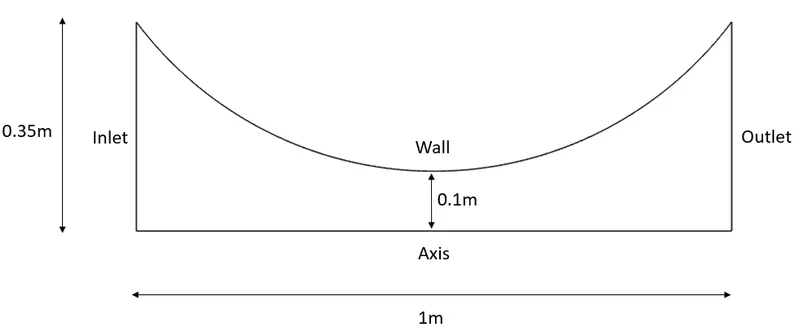
The geometry of the Convergent-Divergent nozzle can be seen in the illustration below. Due to the symmetric nature of the nozzle, 2D axisymmetric simulations were conducted.
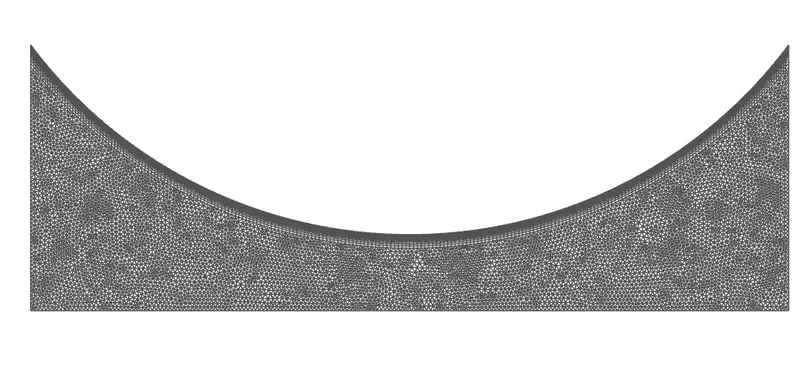
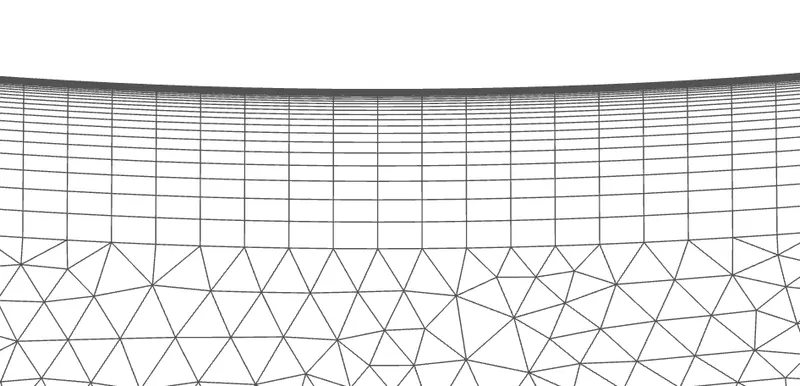
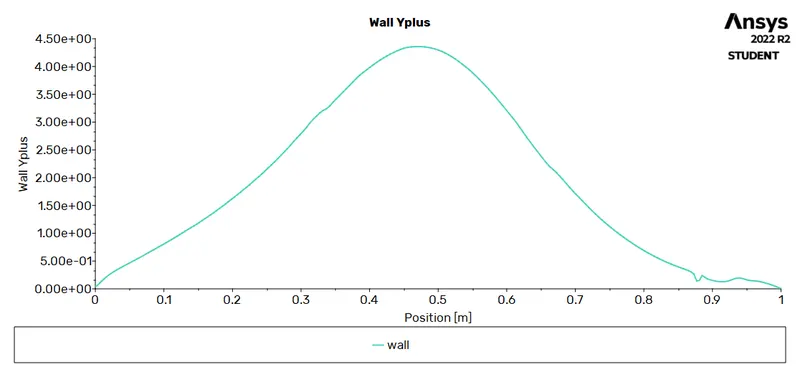
A triangular mesh was created over the surface of the nozzle with 30 inflation layers generated at the wall of the nozzle with a first cell height of 15 micrometers as shown below.
CFD Setup
The flow simulation was conducted on ANSYS Fluent 2022R2. Air was used as the fluid with density estimated using the ideal-gas formulation. The total pressure at the inlet was set to 1atm and the outlet was set to 0.027atm with the total temperature set to 300K. The operating pressure was set to 0Pa for the simulation.
The steady-state pressure-based PV coupled solver was used to discretize the flow parameters. Turbulence in the flow was predicted using the two-equation K-Omega SST model. The second-order scheme was used to estimate the pressure, the second-order upwind scheme was used to estimate momentum, energy, and turbulence parameters. The solution was initialized by a hybrid initialization. The simulation was run with pseudo transient time stepping with an automatic global conservative length scale. Convergence was checked by scaled residuals achieving 1e-4 units. The simulation converged within 150 iterations.
Results
The images below show the pressure, temperature, and velocity distribution across the domain.
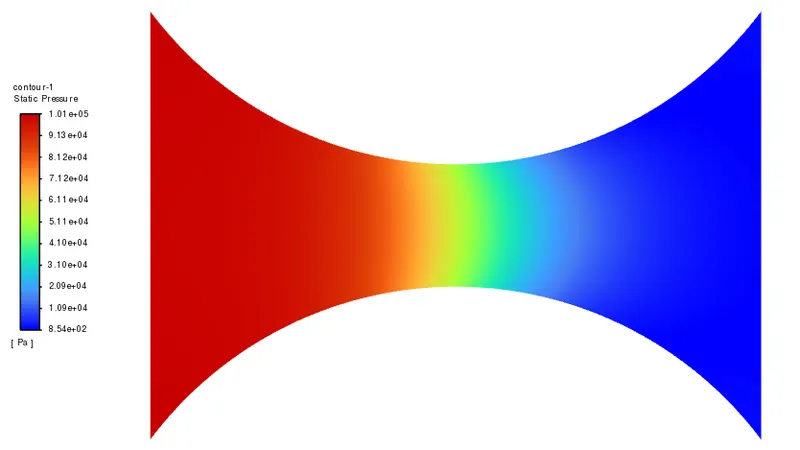
The above static pressure distribution shows a steady decrease in static pressure in the domain from the convergent section to the diverging section.
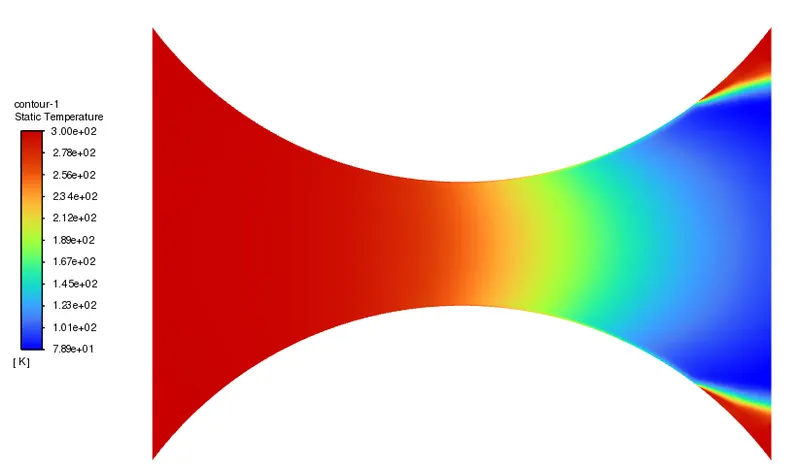
The above static temperature distribution shows a steady decrease in static temperature in the domain as well. However, a sudden rise in temperature could be spotted near the outlet of the nozzle. This could be caused due to an oblique shockwave indicating an overexpanded nozzle.
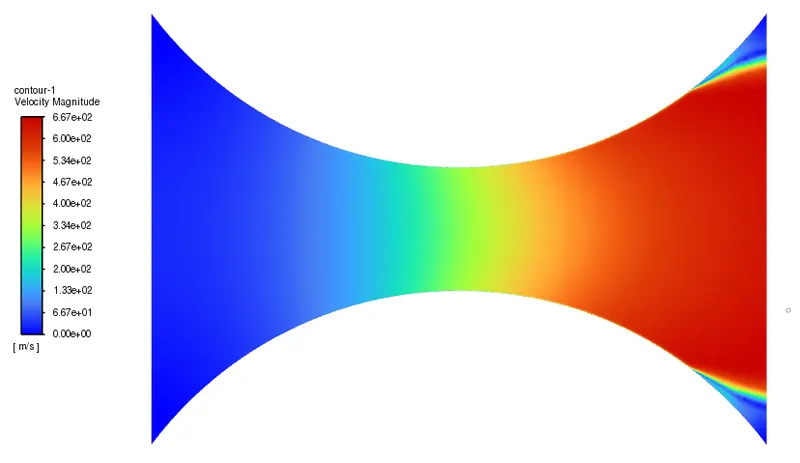
The above velocity distribution shows a steady increase in velocity in the domain. Similar to the temperature distribution, a sudden drop in velocity could be spotted near the outlet of the nozzle evidencing the presence of an oblique shock.
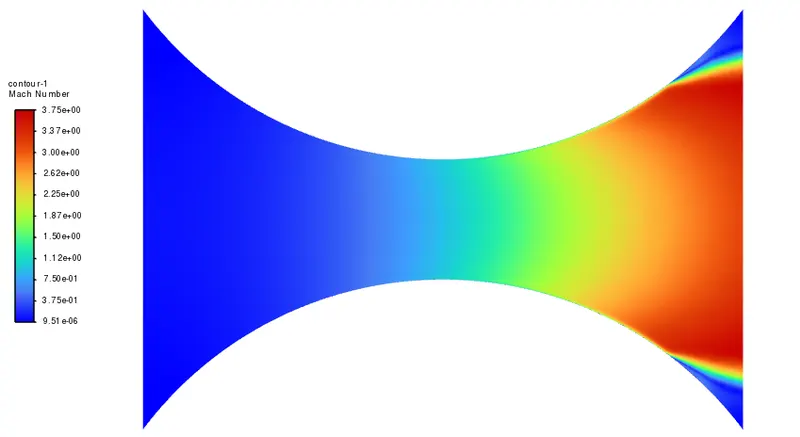
The above Mach number distribution shows a steady increase in Mach number in the domain from subsonic to supersonic. Similar to the velocity and temperature distribution, a sudden drop in Mach number could again be spotted near the outlet of the nozzle affirming the presence of an oblique shock caused due to the overexpanded nature of the nozzle.
The plot below shows the variation in Mach number along the axis of the CD nozzle.
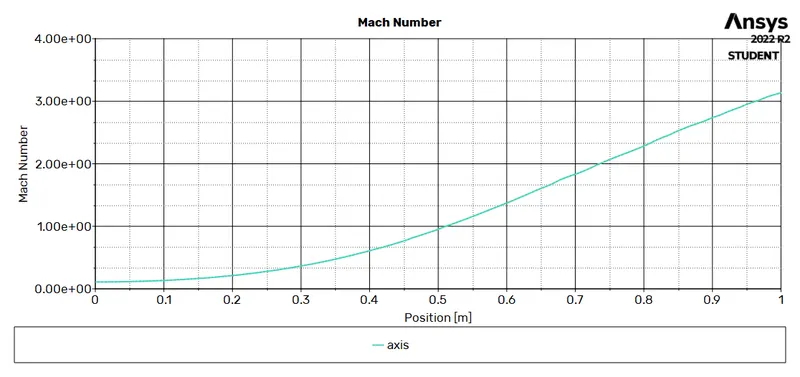
From the above image, sonic speed (M=1) is achieved at x=0.513m and the Mach number is seen to rise beyond that point. Hence it can be deemed that the flow is supersonic from x=0.514m from the inlet.
From the results shown above, a reduction in cross-sectional area in the converging section of the nozzle increases the velocity of the flow as the flow is subsonic in nature. At the throat of the nozzle, sonic condition is achieved where no change in the cross-sectional area of the nozzle is present. Upon increasing the cross-sectional area in the diverging section of the nozzle, an increase in the velocity of the flow is observed as it accelerates to supersonic speeds. These results follow the Area-Mach relation stated above.
Overexpanded nozzle indicates that the flow in the nozzle has expanded far below the ambient pressure at the exit plane creating a suction into the nozzle from the exit. This generates oblique shockwaves at the outlet and causes a loss in the performance of the nozzle.
Conclusion
The flow simulation was conducted over the given Convergent-Divergent Nozzle with the given boundary conditions. Distributions of pressure, temperature, velocity, and Mach number over the domain were illustrated to visualize the flow field. It was observed that supersonic speed was achieved at x=0.514m from the inlet.