Week 2 - Converging diverging nozzle
Title: To perform flow simulation through converging-diverging nozzle.
Aim:
- To plot pressure, velocity and temperature variations across the domain
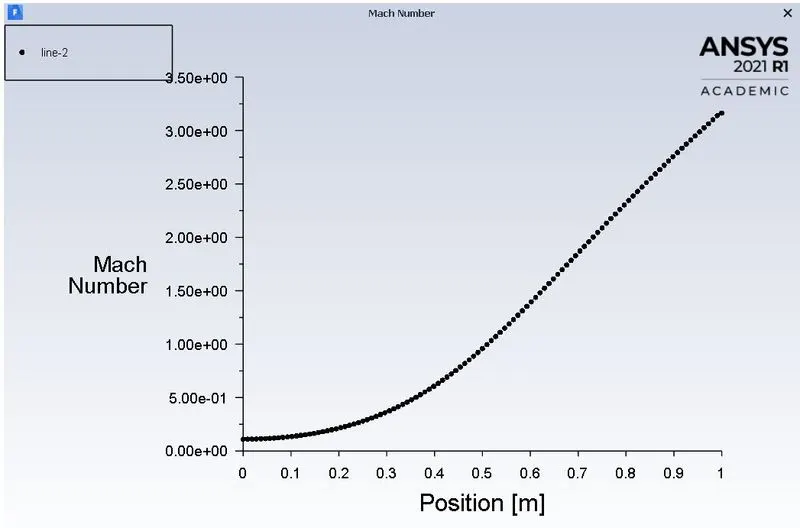
- To plot variation of Mach number across the domain and at what distance from the inlet does the flow become supersonic.
Theory:
A convergent-divergent nozzle is a used to accelerate a compressible fluid to supersonic speeds in the axial (thrust) direction, by converting the thermal energy of the flow into kinetic energy. It is widely used in some types of steam turbine and rocket engine nozzles. It also sees use in supersonic jet engines.
It consist of converging, diverging and throat section as shown below.
In converging section Mach no (M)<1, at throat M=1 and in diverging section M>1.
A convergent nozzle is a nozzle that starts big and gets smaller-a decrease in cross-sectional area. As a fluid enters the smaller cross-section, it has to speed up due to the conservation of mass. To maintain a constant amount of fluid moving through the restricted portion of the nozzle, the fluid must move faster.
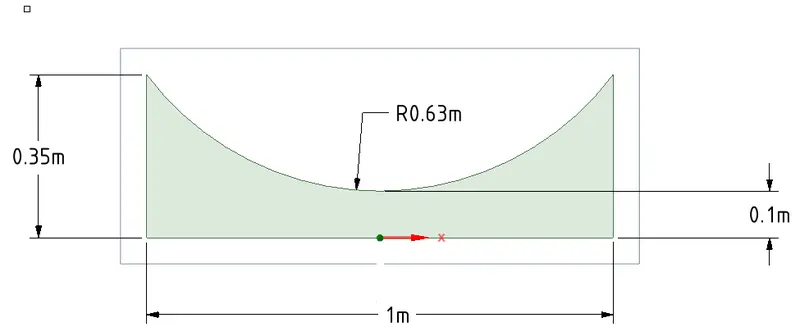
Geometry
Geometry is created using Ansys Spaceclaim.
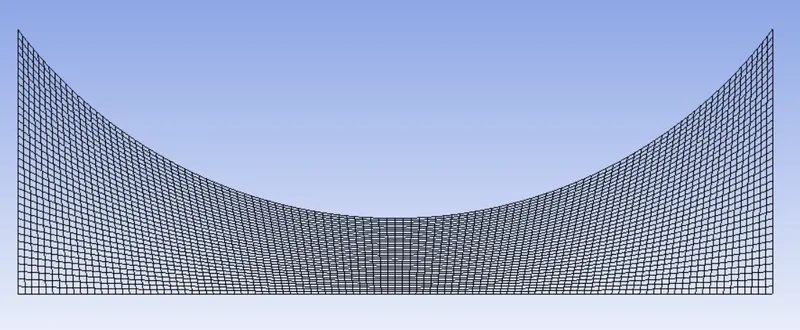
Mesh

Set up:
Solver: Steady state, density base
Energy: On
Turbulance model: Inviscid
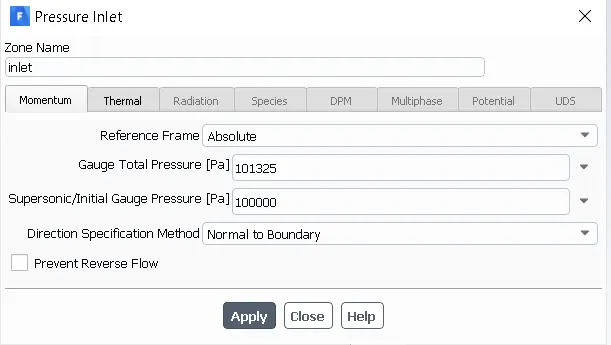
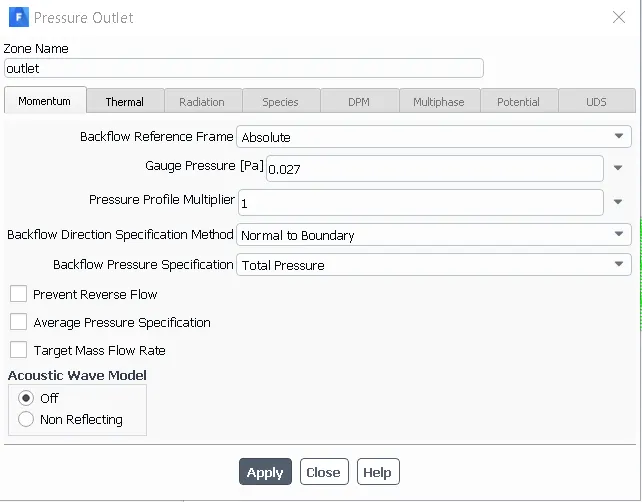
Boundary conditions:
Inlet:
Outlet:
Results:
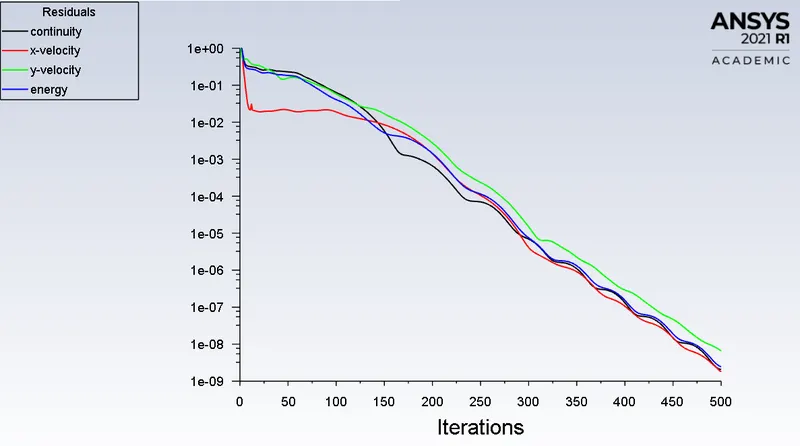
Residual
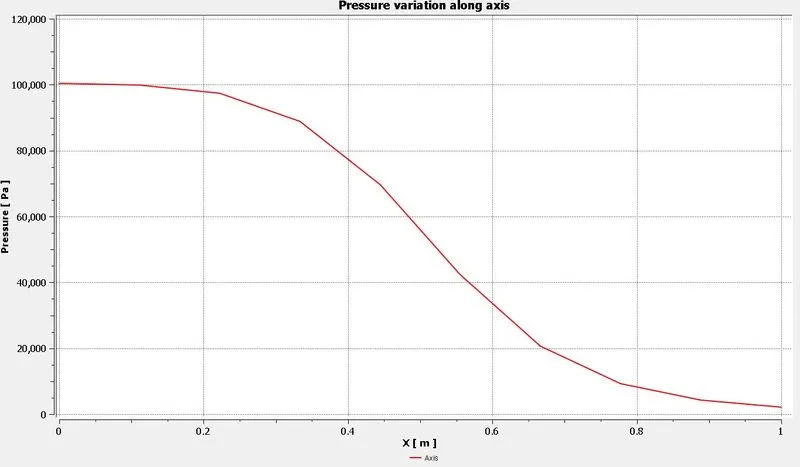
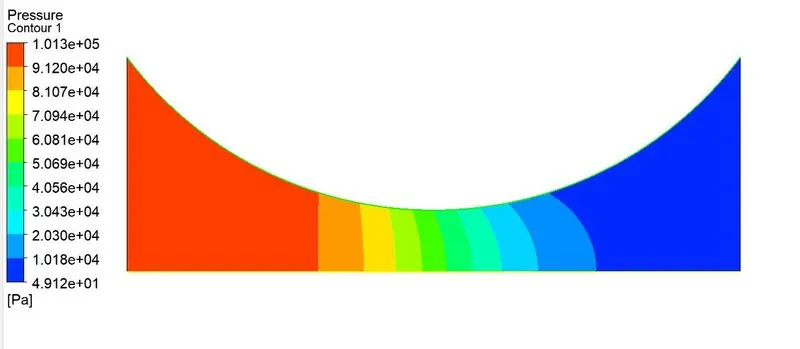
Pressure variation along axis of nozzle
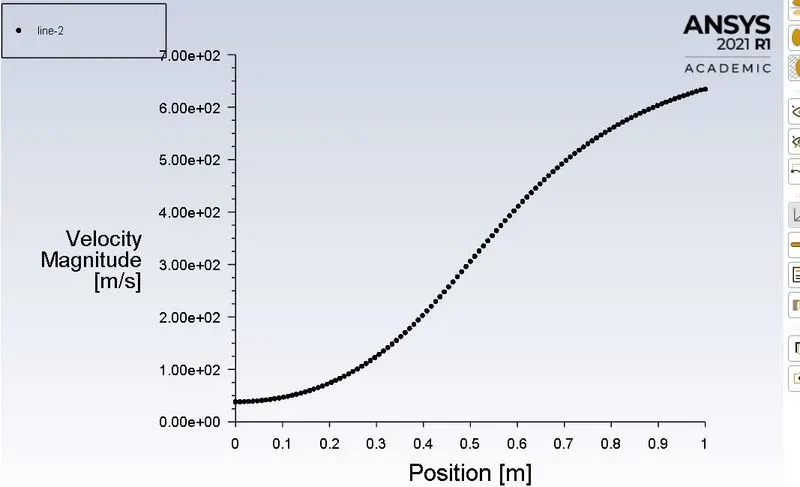
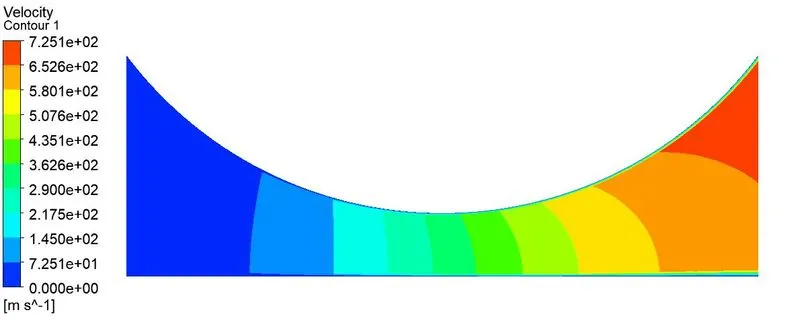
Velocity variation along axis of nozzle
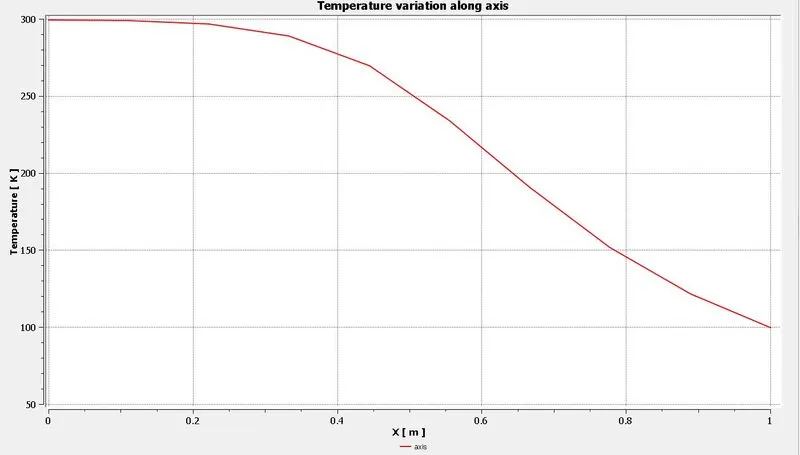
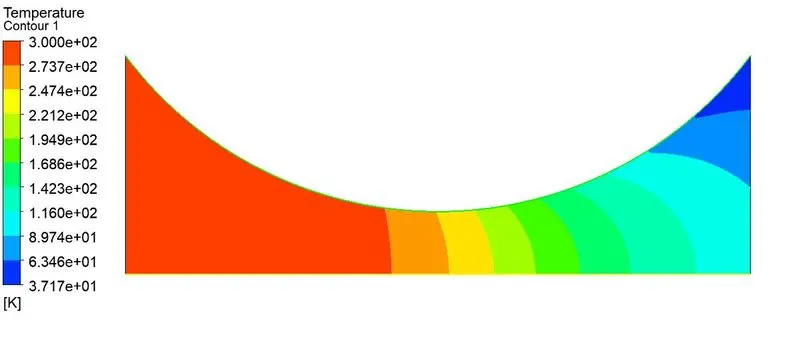
Temperature variation along axis of nozzle
Mach number variation along axis of nozzle
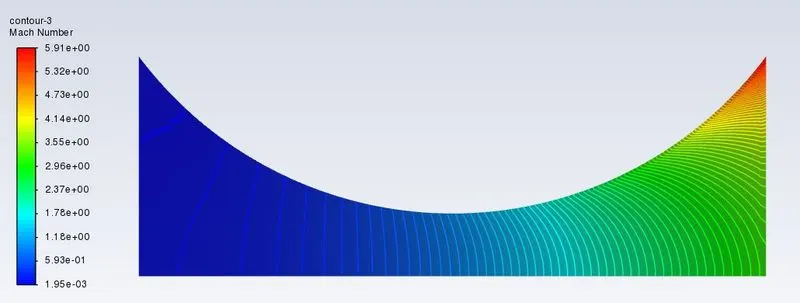
Concluding remarks/ Variation of change in area on mach number on the given geometry
We have the equation, `(1 - M^2) *( dV) / V = - (dA)/ A`
- This equation tells us how the velocity V changes when the area A changes, and the results depend on the Mach number M of the flow.
- If the flow is subsonic then (M < 1), the term multiplying the velocity change (dV/V) is positive i.e. (1 - M^2 > 0). An increase in the area (dA > 0 ) produces a negative increase (decrease) in the velocity (dV < 0).
- For a supersonic flow (M > 1) the term multiplying velocity change (dV/V) is negative i.e. (1 - M^2 < 0). Then an increase in the area (dA > 0) produces an increase in the velocity (dV > 0).
- This effect is exactly the opposite of what happens subsonically.
- To conserve mass in a supersonic (compressible) flow, both the density and the velocity are changing as we change the area.
- For subsonic (incompressible) flows, the density remains fairly constant, so the increase in area produces only a change in velocity. But in supersonic flows, there are two changes; the velocity and the density.
- According to equation,`- (M^2) * (dV) / V = (dr) / r`, or M > 1, the change in density is much greater than the change in velocity. To conserve both mass and momentum in a supersonic flow, the velocity increases and the density decreases as the area is increased.