AIM:
1.To compare four fuel cells and state their applications.
2.To compare various battery on a plot of energy density and power density.
EXPLANATION:
1.
| |
Proton Exchange Membrane Fuel Cell
|
Solid Oxide Fuel Cell
|
Alkaline Fuel Cell
|
Direct Methanol Fuel Cell
|
|
Advantages
|
- Lower corrosion due to solid electrolyte.
- The electrolyte management is relatively easier compared to other types of fuel cells.
- Can be operated at lower temperatures and the cell can quickly support the load.
|
- The cell is a little versatile since it can accept various fuels.
- The cell is very efficient and there is a solid electrolyte present.
- Heat is generated as a by product in the chemical reaction of the cell which makes it a suitable choice for heating systems
|
- The cost of making the cell is relatively lower than the other types of fuel cells.
- It can be operated at low temperatures.
- The cell can quickly start supporting the load.
|
- The fuel used is readily available and of very low cost ie. methanol.
- The fuel cell can be operated at low temperature and pressure.
|
|
Disadvantages
|
- The cost of the catalyst used which is platinum is very expensive.
- The fuel cell is very sensitive to the presence of impurities in the fuel.
|
- Corrosion can occur at higher temperatures which can lead to break down of the cell components.
- It is long time for the cell to start supplying power once switched on and it can be shut down only a limited number of times
|
- The fuel cell is sensitive to the presence of CO2.
- Electrolyte management is a little tricky while the conductivity is also to be kept in mind.
|
- The fuel being a hydrocarbon emits CO2.
- The rate of oxidation of methanol is much lower than that of hydrogen.
- The chemical reactions involved can reduce the cell voltage over time.
|
|
Applications
|
- Car battery packs and automotive applications
|
- Power systems and heating systems
|
- Used in aerospace and aeronautical applications
|
- Small vehicles like forklifts and electronic gadgets like mobile phones, laptops and cameras.
|
2.
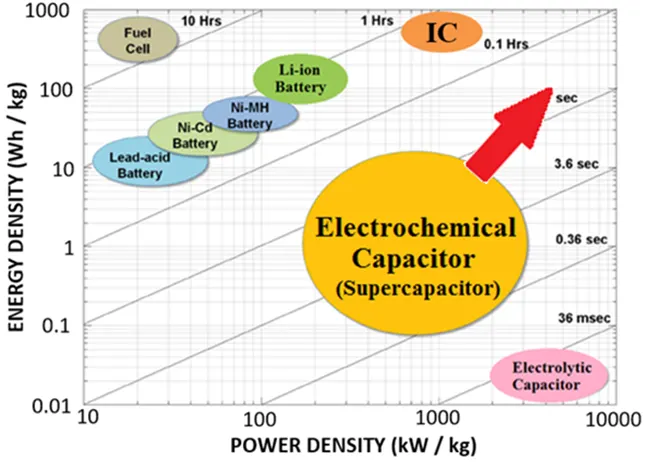
The Ultracapacitor has very high power density but very low energy density as result of which it can give short bursts of energy.
The lead acid battery has low energy density and power density as result of which a lot of them are needed for high energy applications.They are generally used in low voltage applications.
The Nickel Cadmium battery and Nickel Metal Hydride battery have higher power densities in comparison to the lead acid battery.
The lithium ion battery has an energy density ranging from 100-265 Wh/kg along with a high power density making it very suitable for automotive applications.
The fuel cell has very high energy density but low power power density which come with challenges of its own like storage of fuel within the car among others.
RESULT:
1.Various types of fuels are compared and their apllications have been tabulated.
2.Various batteries are arranged accordingly on a power density vs energy density plot.