Week 2 Bevel Gear Challenge
Bevel Gear Challenge:
Aim:
To understand the concept of grid dependency test and perform the test for the bevel gear simulation for the mesh sizes of 6mm,5mm and 4mm.And solve for equivalent stress,Equivalent elastic strain and total deformation.
Objective:
1)Write a few words on what a grid dependency test is and its use.
2)Perform a grid dependency test for the Bevel gear simulation for mesh sizes of 6,5 and 4 mm
3) Solve for Von-Mises stress, Equivalent elastic strain, and Total Deformation using the previously mentioned mesh sizes.
4) Present your findings in an organized manner.
Grid Dependency test:
It is the test where analysis begins with a coarse mesh and it is refined to finer mesh for each even until the results do not change significally and depend of the grid size anymore.As the grid or mesh size approaches zero the approximate solution is almost equal to actual solution.
Purpose:
An independence test was conducted to assess the optimal grid resolution range desired based on previous study to exclude possible biases owning to subjective judgement in the selection of grid conditions.
Procedure:
- Firstly open the ANSYS workbench software.
- Select static structural from analysis system.
- In the engineering data structural steel is selected by default.
- And then import the geometry from the system files.
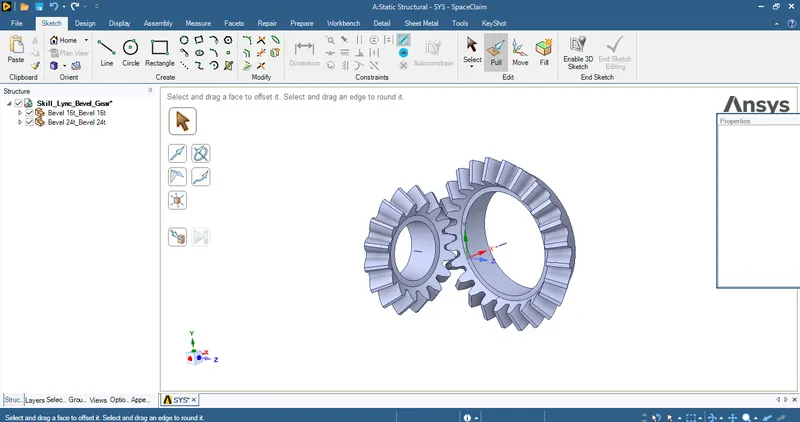
- Then after import it to the spaceclaim tab to remove the excess surface.
- Then cut down the big gear with a radius of 45mm and small gear with a radius of 25mm respectively.
- The extra surfaces are not necessary for the simulation process.
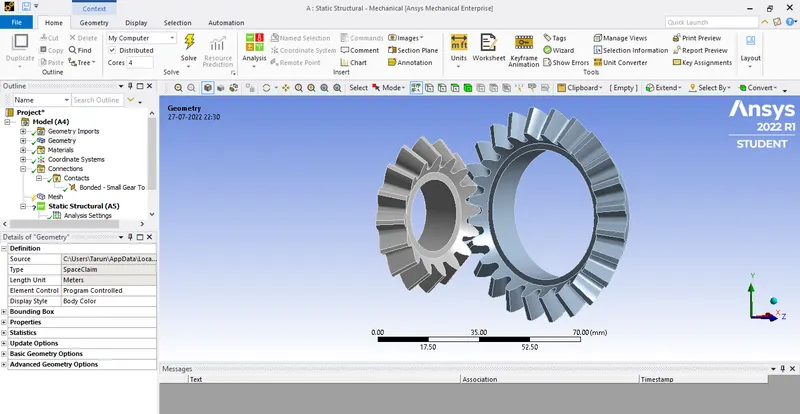
- The imported gear in the mechanical tab is as follows.
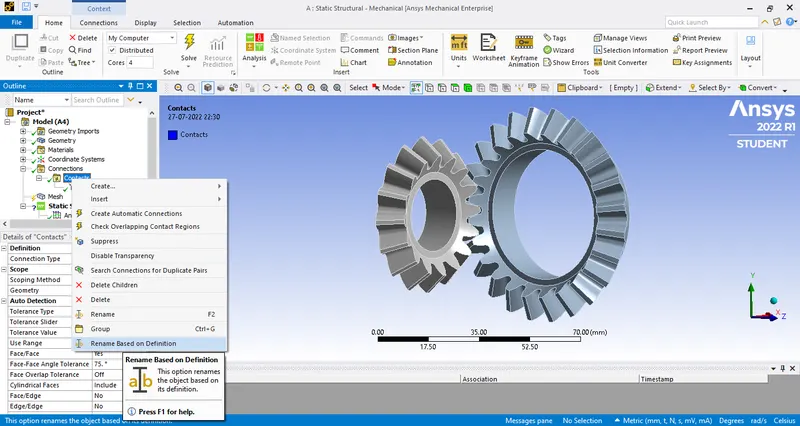
- And in the model tree change the name of the gears as per our convenience.
- And then go to connections slect contacts and right click on the contacts and select 'Rename based on definition'.
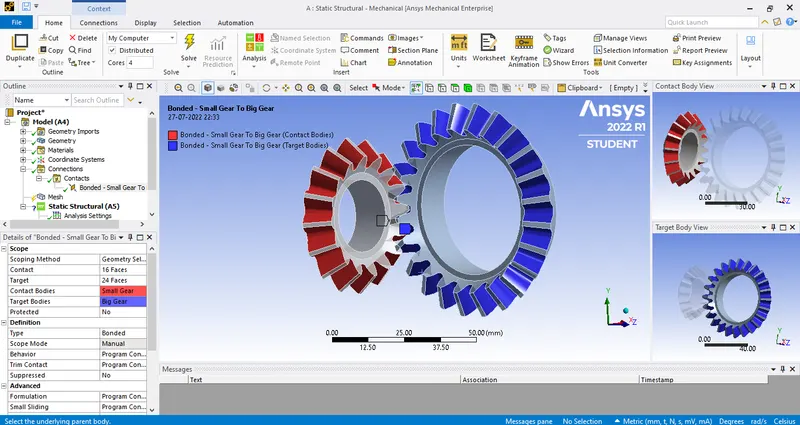
- And in that select the contacts faces and target faces of the gears respectively.
- And then create joint loads for the gears.
For Small Gear:
Connection Type- Body-Ground
Type - Revolute
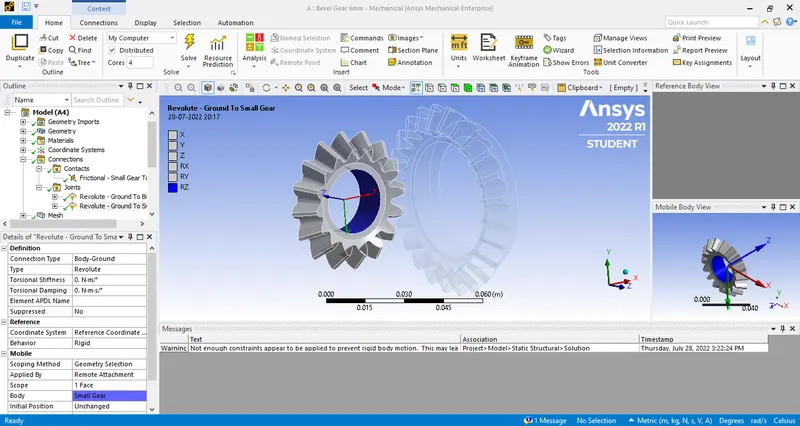
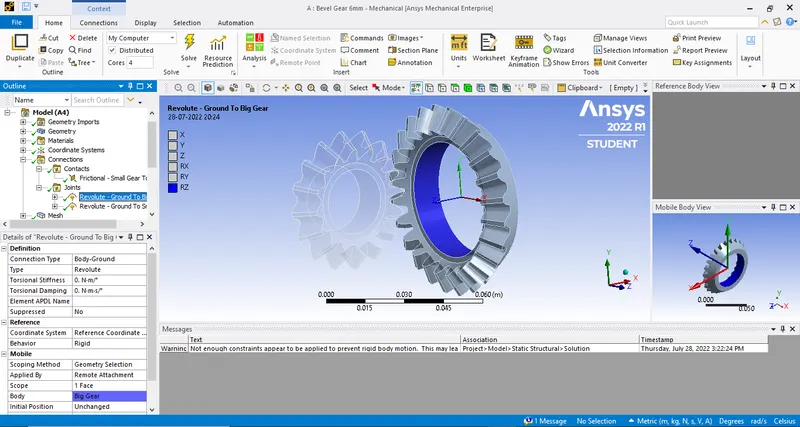
For Big Gear:
Connection Type- Body-Ground
Type - Revolute
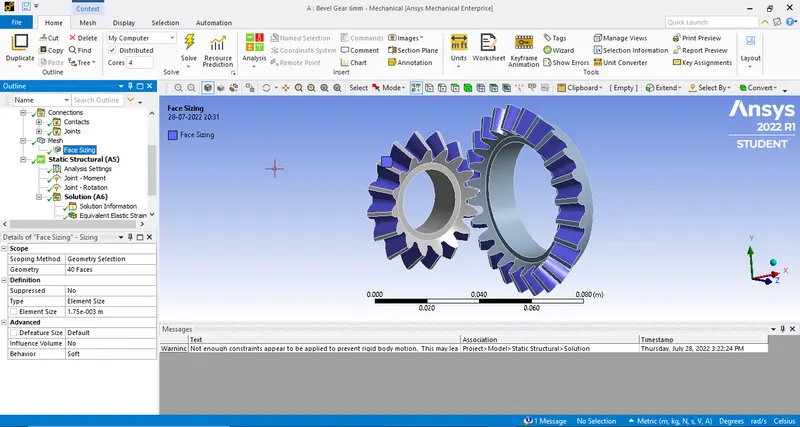
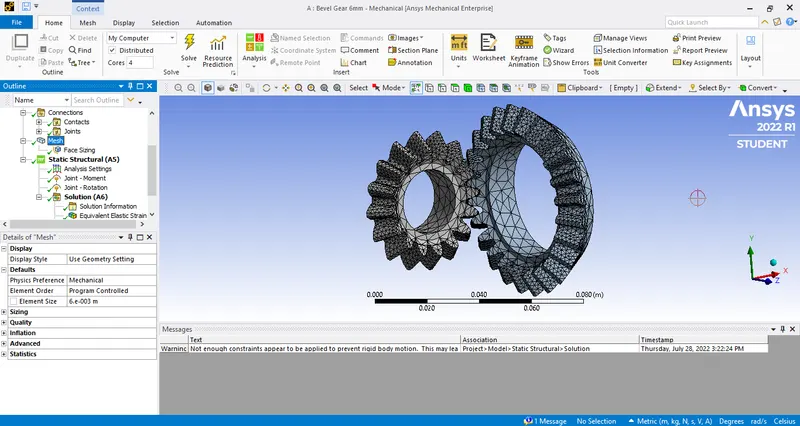
- Then we procedd for meshing as it grid dependency test which evaluates the much that changes the resulting output in the bevel gear simulation.
- The mesh is given as 6mm size.
- The gear faces are selected with the mesh size of 1.75mm.
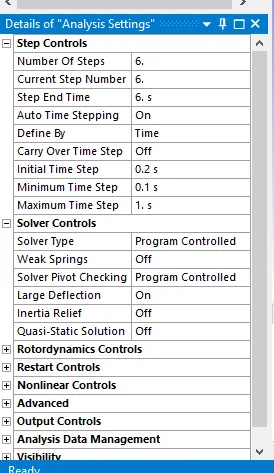
- Then we go for analysis settings where we assign the values
No of steps- 6
Auto time stepping- ON
Define by- Time
Intial Time step-0.2s
Minimum Time step-0.1s
Maximum Time step-1s
- Then create joint loads for rotation and moment.
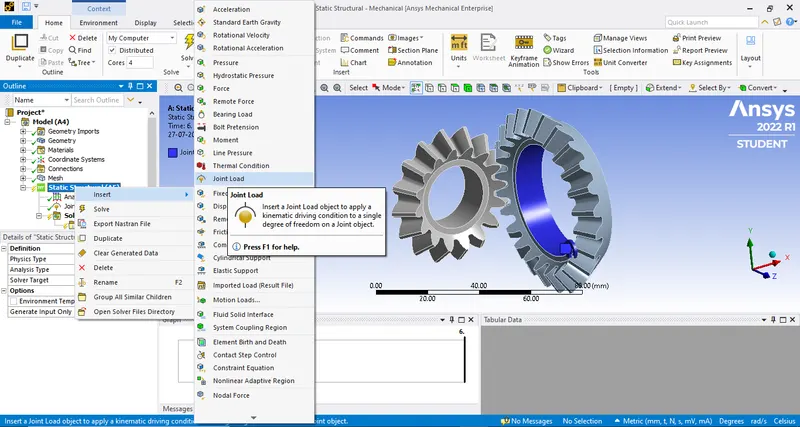
Joint Rotation:
To rotate the small gear with a rotation angle of 20 degrees of each step.
Joint - ground to small gear
Type- Rotation
Magnitude-Tabular data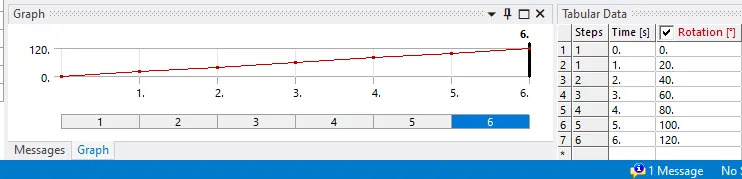
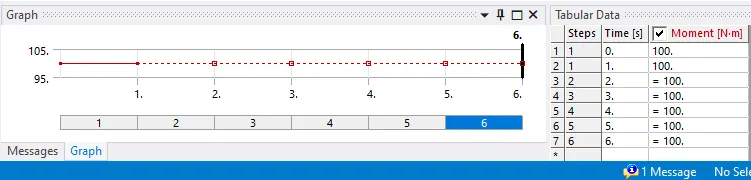
Joint Moment:
To rotate the big gear as to opposite direction of small gear with a moment of 100(N-m).
Joint - ground to small gear
Type- Rotation
Magnitude-Tabular data
- Check whether the co-ordinate system of small gear has changed to change the angle of rotation to the RZ axis.
- And in solution insert Equivalent stress,Equivalent elastic strain and total deformation.
Results:
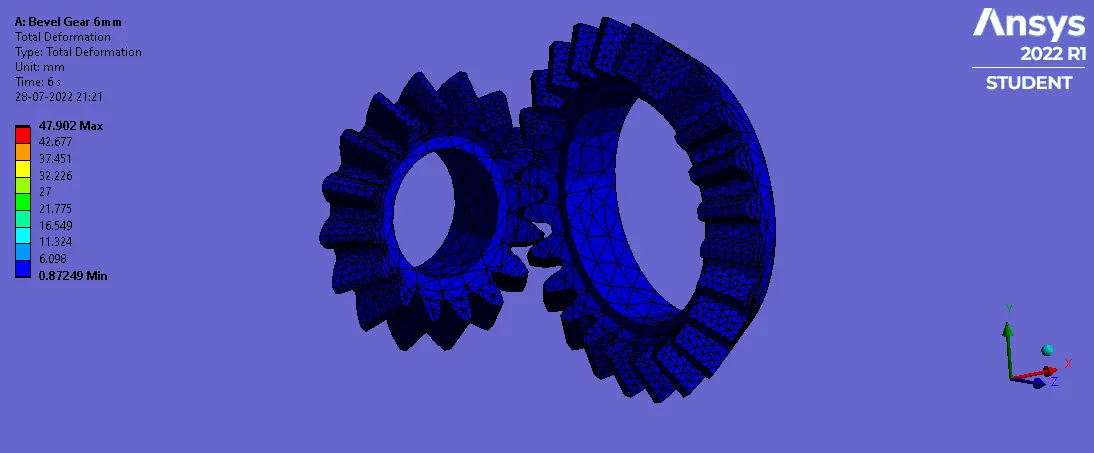
The results obtained for structural steel after solving each node for meshing.
CASE 1:
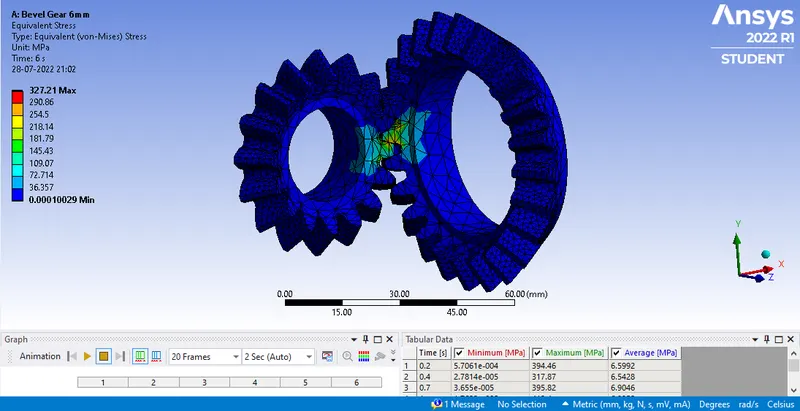
Mesh Size - 6mm
Face sizing- 1.75mm
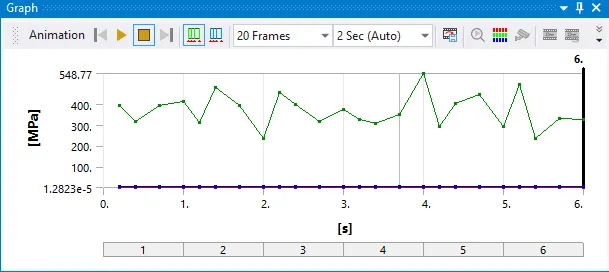
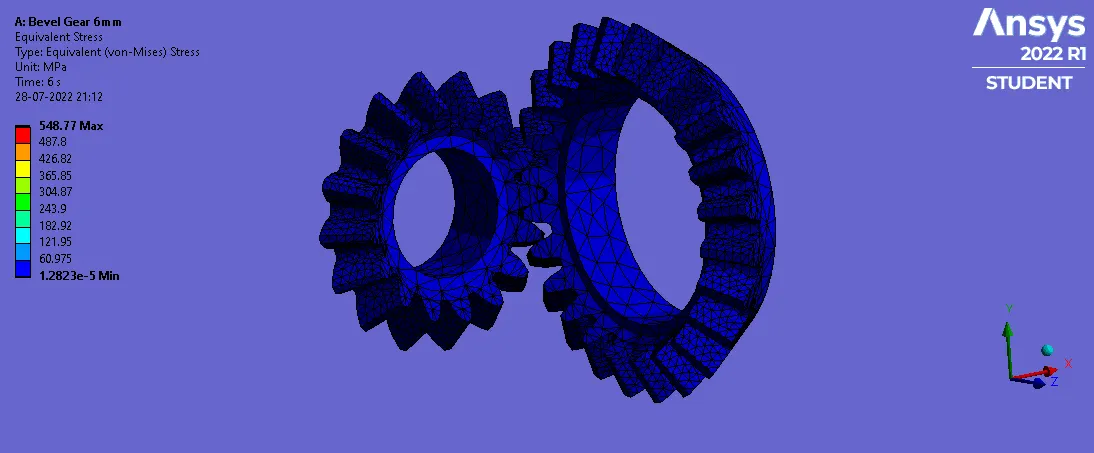
Equivalent stress:
Maximum-327.21 Mpa
Minimum-0.00010029 Mpa
Graph:
GIF:
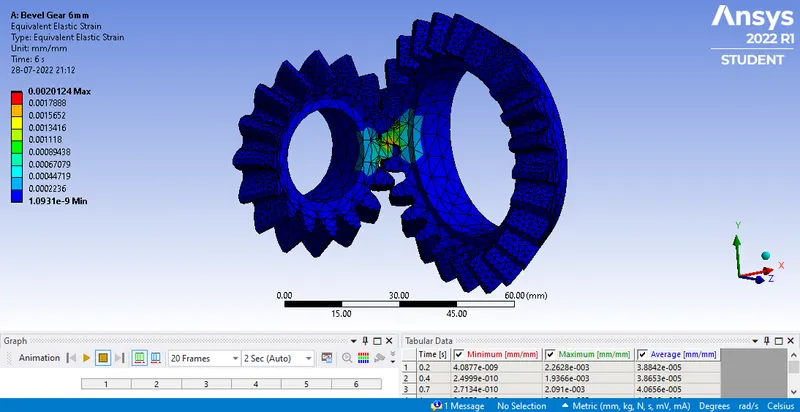
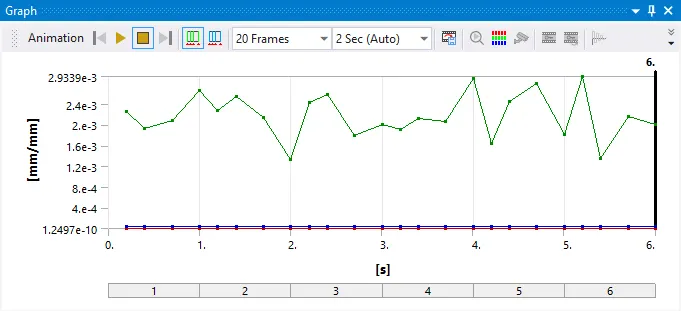
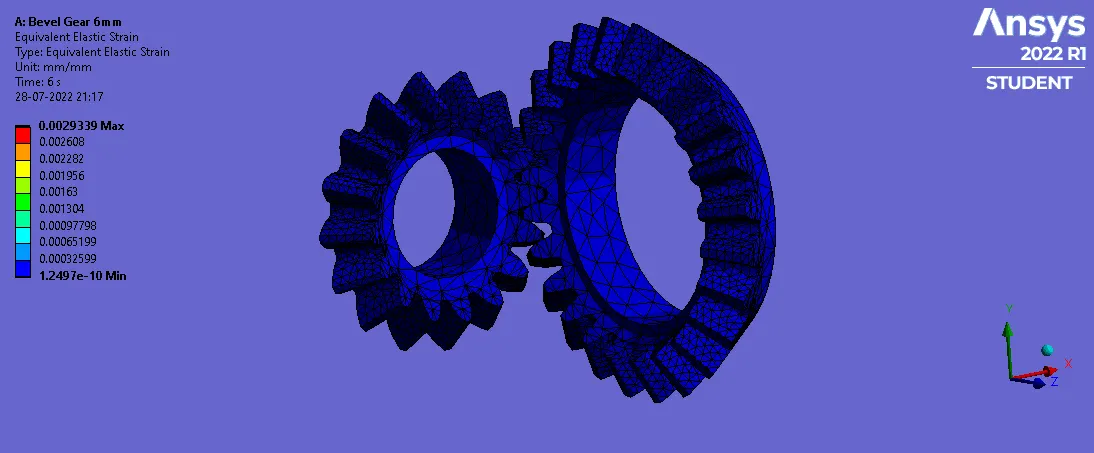
Equivalent Elastic Strain:
Maximum-0.0020124 mm/mm
Minimum-1.0931e-9 mm/mm
Graph:
GIF:
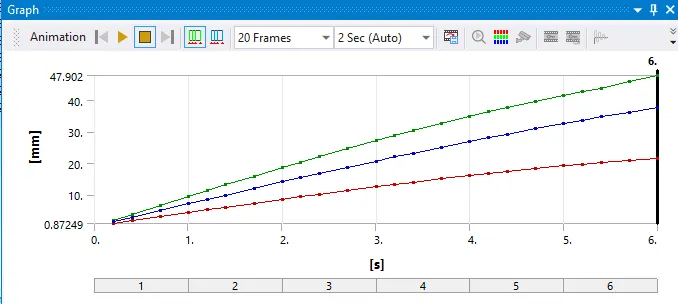
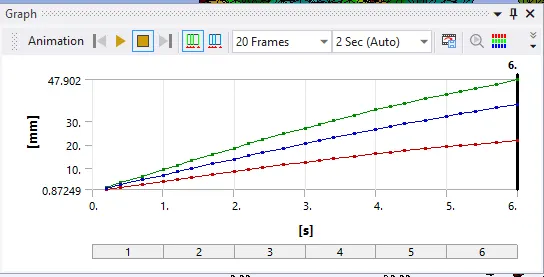
Total Deformation:
Maximum-47.902 mm
Minimum-21.651 mm
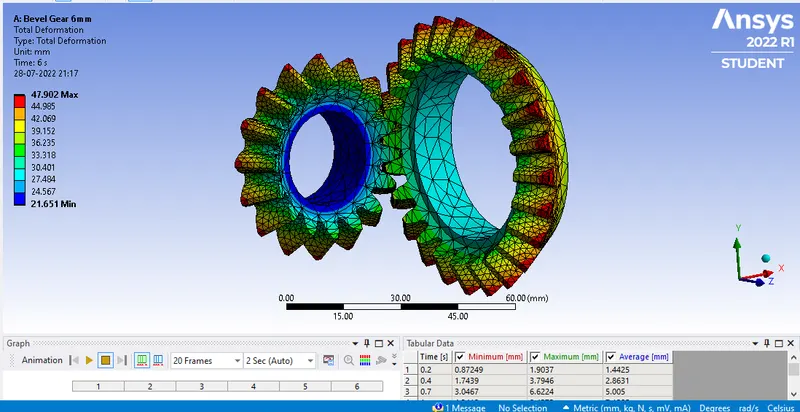
Graph:
GIF:
CASE 2:
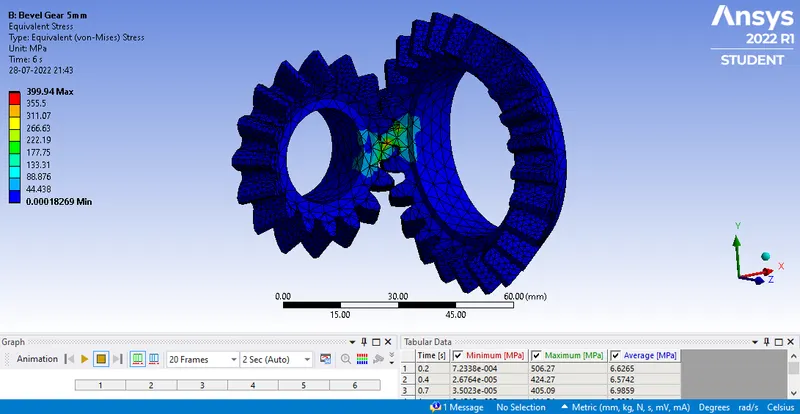
Mesh size-5mm
Face sizing- 1.75mm
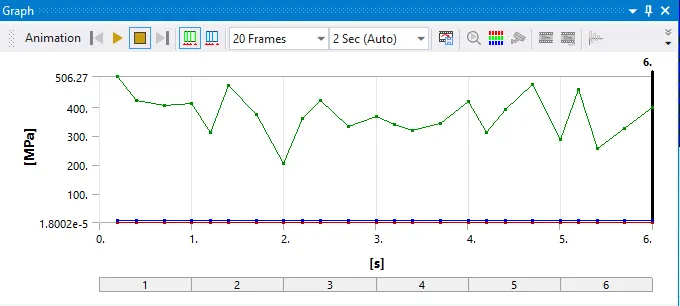
Equivalent stress:
Maximum-399.94 mpa
Minimum-0.00018269 mpa
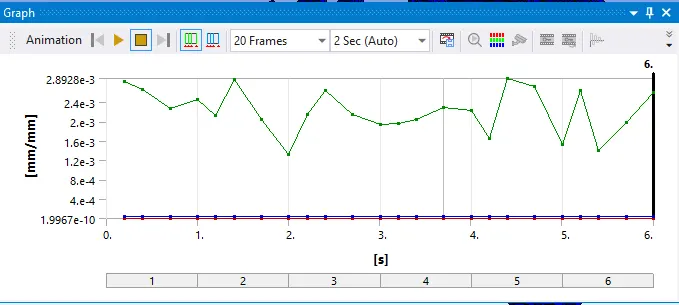
Graph:
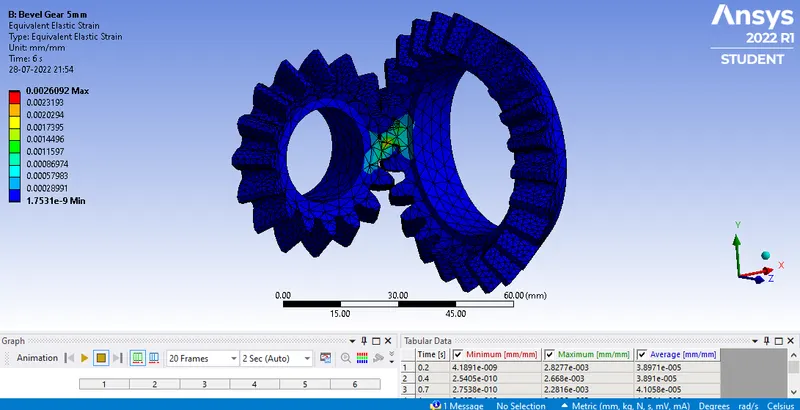
Equivalent elastic strain:
Maximum-0.0026092 mm/mm
Minimum- 1.7531e-9 mm/mm
Graph:
Total Deformation:
Maximum-47.902 mm
Minimum-21.651 mm
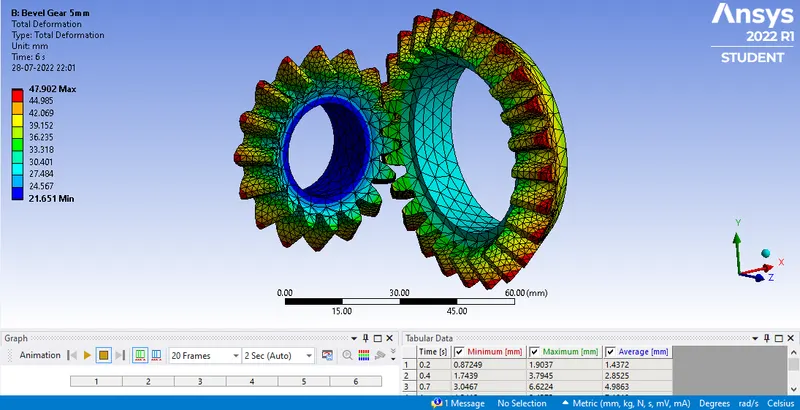
Graph:
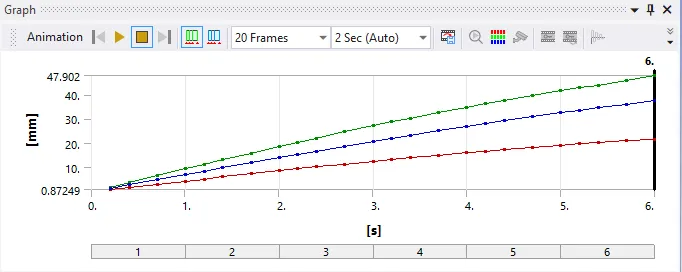
CASE 3:
Mesh Size- 4mm
face sizing- 1.75mm
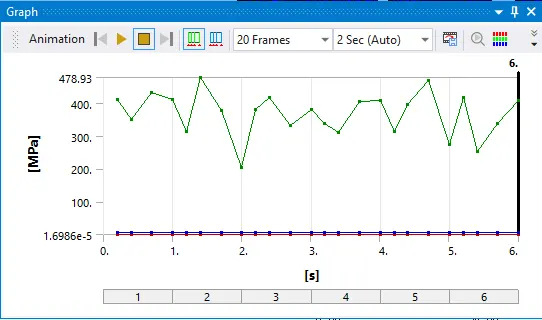
Equivalent stress:
Maximum-407.95 mpa
Minimum-0.00015773 mpa
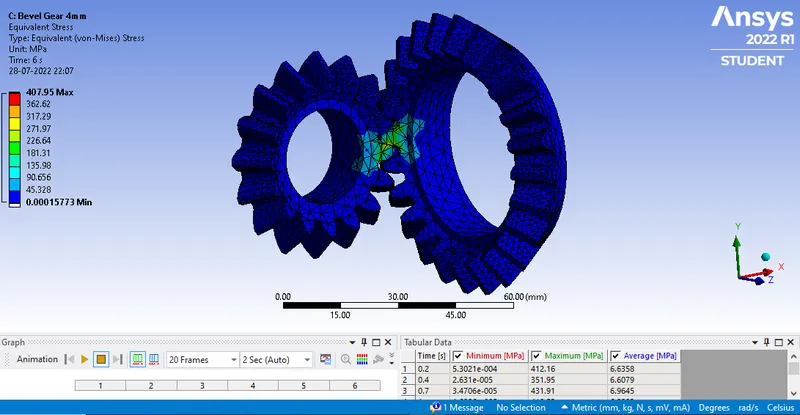
Graph:
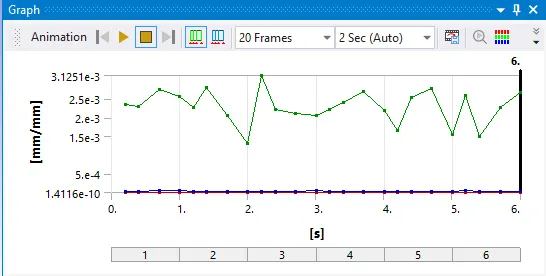
Equivalent Elastic Strain:
Maximum- 0.0026837 mm/mm
Minimum- 1.402e-9 mm/mm
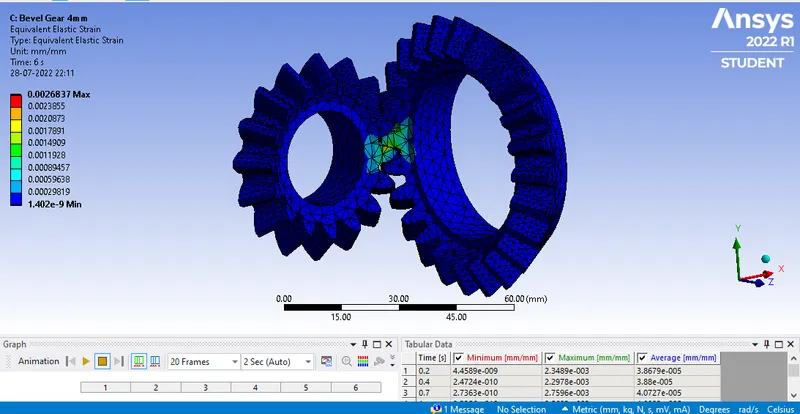
Graph:
Total Deformation:
Maximum- 47.902 mm
Minimum- 21.651 mm
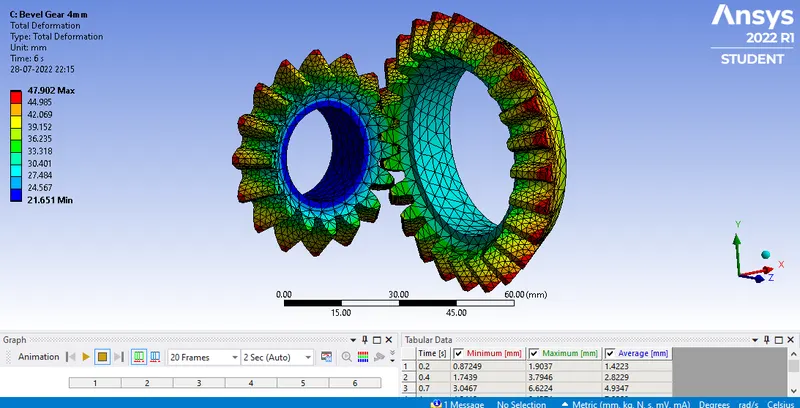
Graph:
Tabular data:
Equivalent Stress(Mpa):
Mesh Sizes Maximum Minimum
6mm 327.21 0.00010029
5mm 399.94 0.00018269
4mm 407.95 0.00015773
Equivalent Elastic strain(mm/mm):
Mesh Sizes Maximum Minimum
6mm 0.0020124 1.0931e-9
5mm 0.0026092 1.7531e-9
4mm 0.0026837 1.402e-9
Total Deformation(mm):
Mesh Sizes Maximum Minimum
6mm 47.902 21.651
5mm 47.902 21.651
4mm 47.902 21.651
Conclusion:
From the above tabular data we can say that equivalent stress is increased when the mesh sizes are changed from 6mm,5mm and 4mm respectively.The change in output value for element size of 5mm and 4mm are very less.Reducing the mesh size will increase time and cost but the value will be almost same.So,finally it is recommded to use 5mm mesh for the bevel gear.