Week 2 : Basic Calibration of Single cylinder SI-Engine
Week 2 : Basic Calibration of Single cylinder SI-Engine
1.Run the case at 1800 rpm and list down important parameters (20 Marks)
- air flow rate
- BMEP
- BSFC
- In-cylinder pressure
2. Increase the power output at 3600 rpm by 10% (30 Marks)
Answer
Introduction
A spark-ignition engine (SI engine) is an internal combustion engine, generally a petrol engine, where the combustion process of the air-fuel mixture is ignited by a spark from a spark plug. This is in contrast to compression-ignition engine, typically diesel engines, where the heat generated from compression together with the injection of fuel is enough to initiate the combustion process, without needing any external spark.
There exist some important parameters which characterize the operation of internal combustion engines and they are important to an engine user for comparing performance of different reciprocating engines. The factors include
Air-flow rate:
It is the amount of air that is entering the engine and it is important because it decides how the fuel combustion takes place. A low air flow produces incomplete combustion leading to CO emissions whereas a higher air flow leads to NOx emissions. Therefore, an air flow close to stoichiometry is desired.
Break Mean Effective Pressure:
It is the ratio of gross work-done per cycle to the volume displaced per cycle. It provides a valuable measure of the engine performance which is independent of the engine displacement.
Brake Specific Fuel Consumption:
It is the amount of fuel consumed per unit power produced in a cycle. Low values of BFSC are desirable
In-cylinder pressure:
It is the maximum pressure that is developed inside the engine during a single cycle. It provides a measure of the work that can be extracted from the engine
Setting up the model
The model is imported from tutorials > modelling applications > engine_performance > 1cylSi-final.gtm
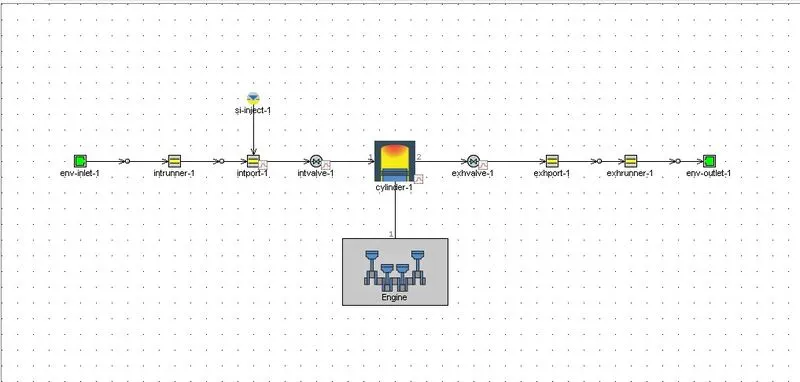
The specifications of the engine used in this model is summarized in the table below
|
Geometric Parameter |
Value |
|
Number of cylinder |
1 |
|
Bore [mm] |
86 |
|
Stroke [mm] |
86.07 |
|
Connecting rod length [mm] |
175 |
|
Compression ratio |
9.5 |
Air Flow Rate
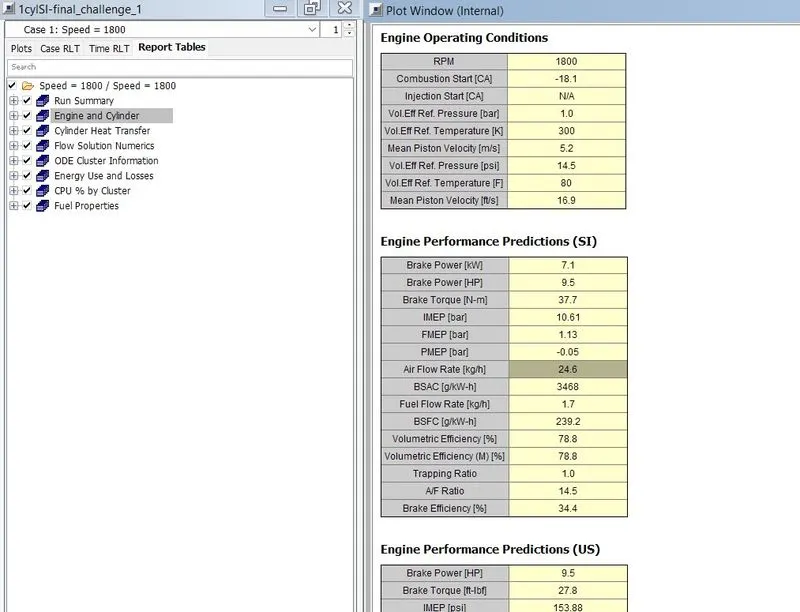
Air flow rate = 24.6 Kg/h
Break Mean Effective Pressure
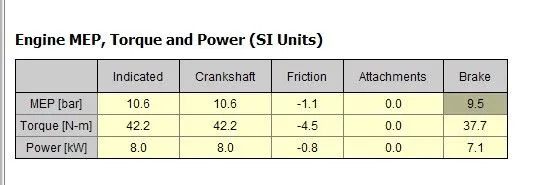
Break mean effective pressure: 9.5 bar
Brake Specific Fuel Consumption
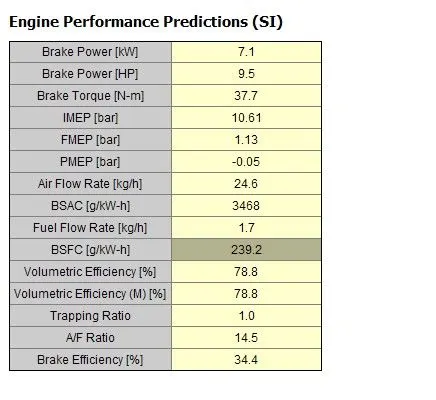
BSFC = 239.2
In Cylinder Pressure
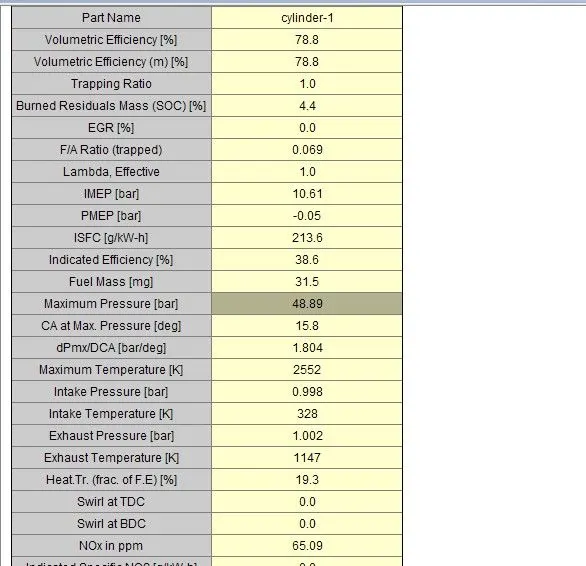
Maximum Pressure = 48.89 bar
RUNNING THE ENGINE AT 3600 RPM:
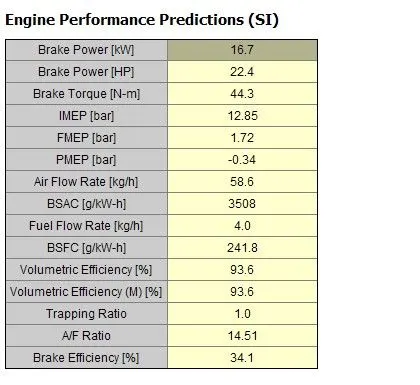
Brake power output: 16.7 KW
INCREASING THE POWER OUTPUT BY 10%:
The output power can be increased by changing the various parameters,
- By increasing the bore
- By increasing the stroke
- By increasing bore, stroke and connecting rod
- By increasing inlet pressure
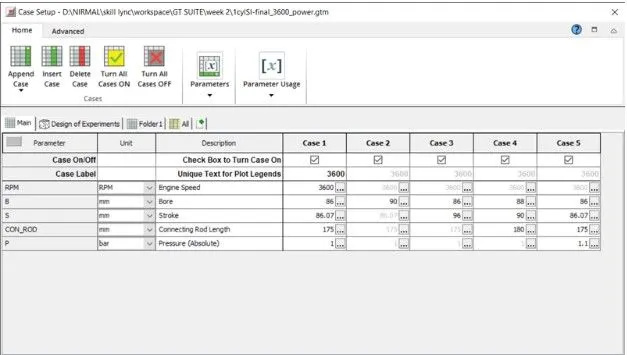
- In case 1, RPM is changed from 1800 to 3600 RPM.
- In case 2, bore is changed from 86 to 90 mm.
- In case 3, stroke is changed from 86 to 96 mm
- In case 4, bore is changed from 86 to 88 mm, stroke is changed from 86 to 90 mm and connecting rod length is changed from 175 to 180mm.
- In case 5, intake pressure is changed from 1 to 1.1 bar.
Results
- In case 1, the brake power obtained is 16.7 KW.
- In case 2, the brake power obtained is 18.4 KW.
- In case 3, the brake power obtained is 18.6 KW.
- In case 4, the brake power obtained is 18.3 KW.
- In case 5, the brake power obtained is 18.9 KW.
Conclusion
- By increasing the cylinder volume by changing the bore and stroke more burning of air and fuel can takes place.
- By increasing the connecting rod length, better torque can be obtained.
- By increasing the intake pressure better combustion can be obtained, But increasing the intake air pressure requires turbocharger or supercharger which increases the cost of an engine.
The above steps increases the power output of the engine by 10%.